
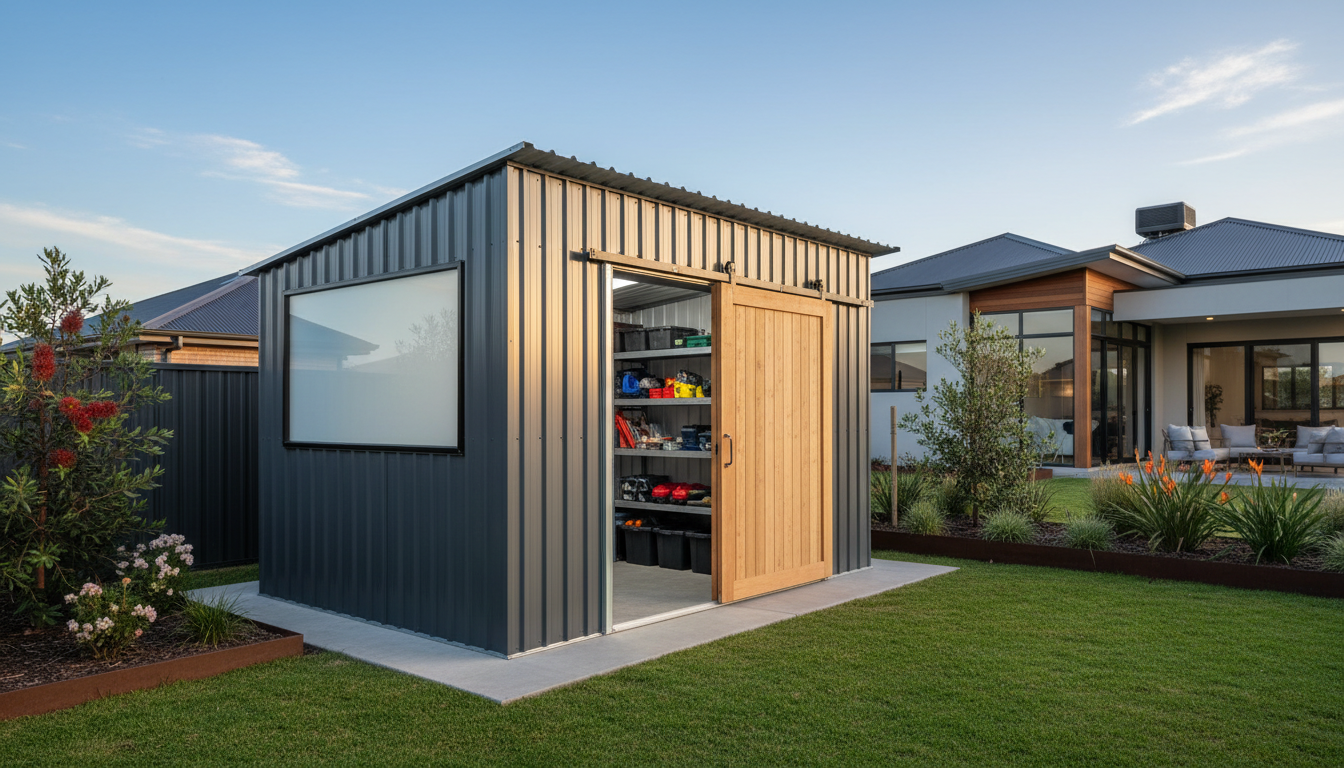
Excerpt: Looking at a 10 sqm shed for your backyard or investment property? This expert Australian guide covers sizes, council approvals, wind ratings, Colorbond vs Zincalume, pricing, insulation and build options—plus a 5‑step buying checklist, case studies, and region‑specific tips for WA, QLD, NSW, VIC and beyond.
Added 2024 WA wind-rating compliance notes and state-based council pointers. Built for Australian homeowners, renovators and property investors who want a premium, compliant, long‑life shed.
What size is a 10 sqm shed—and what actually fits?
- Common footprints: 3.0 × 3.3 m, 2.5 × 4.0 m, 3.2 × 3.2 m (check allowable wall heights and boundary setbacks with your council).
- Use-cases: bikes and surfboards, ride‑on mower, garden gear, small workshop bench, pool pump/chemicals, compact home gym, or lock‑up storage for investment properties.
- Door options: single hinged, double hinged, or compact roller door; add vermin flashing, security mesh, and deadbolts.
What are the best shed materials for Perth’s climate?
In Perth and coastal WA, high UV, sea spray, and summer heat make material choice critical. Most premium backyard sheds use BlueScope steel cladding in either Colorbond or Zincalume on a galvanised cold‑formed frame.
Colorbond vs Zincalume — which is better for WA conditions?
| Feature | Colorbond steel | Zincalume steel |
|---|---|---|
| Finish | Pre‑painted (baked-on) colour range; COLORBOND Ultra for severe coastal | Metallic alloy coating (Al‑Zn); silver appearance |
| Coastal performance | Strong; Ultra recommended for marine zones (check distance from surf) | Good but typically not for very close marine; more maintenance vigilance |
| Heat reflection | High with lighter colours; reduces heat load | Reflective when clean; can dull over time |
| Aesthetics | Matches home Colorbond roofs, gutters, fences | Industrial look; can be painted later |
| Cost | Higher upfront | Lower upfront |
| Warranty | Residential warranties available via supplier (conditions apply) | Residential warranties available via supplier (conditions apply) |
| Best for | Premium finish, coastal and suburban homes | Budget builds, inland/rural where aesthetics less critical |
How much does a 10 sqm shed cost in Australia (2025)?
- DIY light‑gauge kit (basic hardware‑store grade): approx. $1,200–$2,500 supply only.
- Premium engineered kit (Colorbond cladding, heavy‑duty frame): approx. $3,500–$7,000 supply only.
- Installed, with slab and fixings (regional variations apply): approx. $6,000–$12,000+ depending on wind rating, doors, insulation, and site works.
Note: Steel prices remain volatile in 2024–2025 per national market commentary; final quotes may be time‑limited. See industry bodies like the Australian Steel Institute for context Australian Steel Institute.
Do I need council approval for a 10 sqm shed?
It depends on your local planning scheme. Many councils across WA, NSW, VIC and SA offer exemptions for small Class 10a structures under certain thresholds (e.g., floor area, wall height, boundary setbacks). However, exemptions are not universal.
- WA example: Some councils exempt sheds ≤10 m² and below a set height, but you may still need a building permit or siting approval. Always confirm.
- QLD: Small sheds may be accepted development, but cyclonic regions often require full engineering and building approval.
- NSW: Complying Development/Exempt Development may apply for small outbuildings that meet standards.
Bottom line: Ask your council or private certifier. Request site‑specific engineering to AS/NZS 1170.2 (wind actions) and follow the NCC (Class 10a). If in a bushfire‑prone area, check BAL under AS 3959.
How to get council approval for your custom shed in WA
- Obtain a site plan showing boundaries, setbacks, and services.
- Get engineered drawings and computations to AS/NZS 1170.2 (wind), AS/NZS 4600 (cold‑formed steel), AS/NZS 4100 (steel structures).
- Confirm height, area, and drainage compliance; add gutters and adequate downpipes.
- Lodge building permit with the council or engage a private certifier.
- Book inspections (footing/slab if required, final) and keep records for insurance.
What wind rating do I need for a 10 sqm shed?
Wind region and terrain determine your design pressure. Non‑cyclonic (N1–N3) covers much of southern Australia; cyclonic (C1–C4) covers parts of QLD, NT, and northern WA. In WA’s Pilbara and coastal north, Region D may apply. Always get your site wind classification confirmed by an engineer or certifier.
- N ratings = Non‑cyclonic wind classes (N1–N6).
- C ratings = Cyclonic wind classes (C1–C4).
- BAL = Bushfire Attack Level under AS 3959.
Essential references: Bureau of Meteorology for cyclone/climate data, Australian Standards, and your local authority portal. For cyclonic areas, specify wind‑rated sheds for cyclonic areas and look for cyclone‑rated sheds QLD with certified hold‑down systems and thicker purlins/girts.
10 sqm shed types and keyword clusters (choose your use‑case)
Backyard storage and workshop
- Popular in cities: steel sheds Perth, custom carports Melbourne integration, shed builders Adelaide, lock‑up storage Canberra.
- Features: workbench, LED batten lights, anti‑condensation blanket, vermin flashing, whirlybird or ridge vent.
Compact garage and hobby space
- Consider a narrow roller door or sliding barn doors; for larger vehicles, upgrade to a custom‑built double garage in Perth or custom Colorbond garages Perth.
- Urban alternatives: steel garages Brisbane, double garage Sydney for drive‑through blocks.
Rural and coastal properties
- Rural sheds NSW, farm lean‑tos, and farm machinery storage add‑ons; specify COLORBOND Ultra near surf.
- For the tropics: cyclone‑rated sheds QLD with upgraded hold‑downs and cyclonic flashings.
DIY shed kits vs custom‑built: which is right for 10 sqm?
- DIY shed kits: fastest lead times; ideal for level sites and non‑cyclonic ratings. Look for clear manuals, pre‑punched frames, and compliant fasteners.
- Custom‑built: best for sloping sites, high wind/BAL, architectural colours, insulated roof panels, and integrated affordable carports for Australian homes.
Flat (skillion) vs gable roof for small sheds
- Skillion: simpler, cheaper, easier near boundaries; ensure minimum fall for drainage.
- Gable: better airflow, traditional look, easier to add ridge venting and skylight sheets.
Engineering and slab basics for a 10 sqm shed
- Footings/slab: common spec is 100 mm reinforced slab (e.g., SL62 mesh), with thickened edges per engineering. In sand, consider deeper edge beams or piers.
- Frame: galvanised cold‑formed steel, portal frame or stud framing; hot‑dip galvanised base plates in coastal zones.
- Fixings: cyclone washers in C regions, high‑pullout fasteners, chemical anchors to slab as specified.
- Drainage: gutters, adequate downpipes, and dispersal—prevent stormwater nuisance to neighbours.
How to keep a 10 sqm shed cool, dry and secure
- Thermal control: light Colorbond colours, insulated roof panels, or anti‑condensation blanket; cross‑flow vents or whirlybirds.
- Moisture: sarking or condensation control blanket; slab vapour barrier under concrete; seal penetrations.
- Security: reinforced hinges, pad‑bolts, quality roller door lock, anchor points for bikes/mowers, sensor lighting.
Real‑world mini case studies
Perth (non‑cyclonic) — premium Colorbond storage/workshop
- Size: 3.2 × 3.2 m (~10.2 m²), skillion roof, Monument matte cladding.
- Spec: anti‑condensation blanket, vermin flashing, hinged double doors, concrete slab with 100 mm edge thickenings.
- Outcome: compliant with local setbacks; council-approved sheds WA with site‑specific engineering (N2).
Townsville (cyclonic) — wind‑rated pool equipment shed
- Size: 2.5 × 4.0 m (10 m²), gable roof, Zincalume walls, Colorbond roof.
- Spec: C2 engineering, cyclonic fixings, upgraded hold‑downs, sealed penetrations for pool pipework.
- Outcome: Passed building approval; verified tie‑downs and inspection.
5‑step buying guide for custom sheds in Australia
- Clarify use and size: layout what must fit (bench, mower, bikes), choose door type and clearance heights.
- Confirm site constraints: setbacks, easements, BAL, wind region, coastal exposure, overhead wiring.
- Pick materials: Colorbond vs Zincalume; add insulation, ventilation, and vermin protection.
- Engineering and approvals: request site‑specific engineering to AS/NZS 1170.2; confirm council pathway.
- Install and handover: level site, quality slab, compliant fixings, stormwater connected; keep manuals and warranties.
FAQs
Do 10 sqm sheds always avoid council approval?
No. Some councils exempt small sheds by area/height, but many still require permits for structural steel sheds or certain locations. Check locally before you buy.
Can I put a 10 sqm shed on the boundary?
Possibly, but boundary setbacks, fire separation, and height limits apply. Bushfire or acoustic overlays may alter placement. Ask your council or certifier.
Is a 10 sqm shed big enough for a small workshop?
Yes—plan tool storage vertically, add a fold‑down bench, and choose a gable roof for better headroom if you’ll stand at a bench.
What maintenance is needed?
Rinse coastal sheds periodically, clear gutters, check fasteners annually, and touch up scratches per manufacturer guidance.
Local compliance, codes and climate references
- NCC (Class 10a), wind actions AS/NZS 1170.2, steel design AS/NZS 4600/AS 4100, cladding AS 1397/AS 2728, bushfire AS 3959.
- Climate and cyclone awareness: Bureau of Meteorology climate resources.
- Industry guidance: Housing Industry Association, Master Builders Australia, CSIRO, Energy.gov.au.
Market context: See “2025 Australian Steel Market Outlook” and the “2025 HIA Outdoor Structures and Home Improvement Report” for demand, pricing, and homeowner trends (check latest editions from the publishers).
Who should choose a 10 sqm shed—and when to size up
- Choose 10 m² if you need compact, compliant storage with minimal footprint and quick approvals.
- Size up if you want a full workshop, motorbike bay, or futureproofing for yard gear; consider a 12–18 m² footprint or an attached affordable carport.
Sample specification checklist for premium 10 sqm sheds
- Cladding: Colorbond (coastal: COLORBOND Ultra); alternate: Zincalume for inland budgets.
- Frame: galvanised cold‑formed steel; site‑specific engineering with N/C wind rating noted.
- Roof: skillion or gable; sarking or anti‑condensation blanket; consider insulated roof panels.
- Doors: double hinged or compact roller; quality locks; vermin seals.
- Slab/footings: 100 mm slab with edge thickenings; chemical anchors per engineering.
- Drainage: gutters and downpipes compliant with rainfall intensities.
Why this guide beats generic advice
- Region‑specific tips for Perth heat, QLD cyclones, and coastal corrosion.
- Actionable council pathway, standards, and engineering references.
- Competitor gaps covered: council-approved sheds WA, cyclone-rated sheds QLD, custom Colorbond garages Perth.
Get a quote with the right engineering
When requesting quotes, ask for: site wind classification, connection details, footing/slab design, cladding specification (Colorbond grade), condensation management, and warranty terms. That’s how you compare apples with apples.
Related LSI terms used in this guide: steel sheds Perth; custom carports Melbourne; rural sheds NSW; workshop sheds Victoria; garage kits Tasmania; shed installers Gold Coast; steel garages Brisbane; custom Colorbond garages Perth; council‑approved sheds WA; cyclone‑rated sheds QLD; Colorbond vs Zincalume comparison; wind‑rated sheds for cyclonic areas; farm machinery storage; DIY shed kits; affordable carports for Australian homes; insulated panel roof Perth; anti‑condensation blanket; vermin flashing; portal frame; site‑specific engineering.