
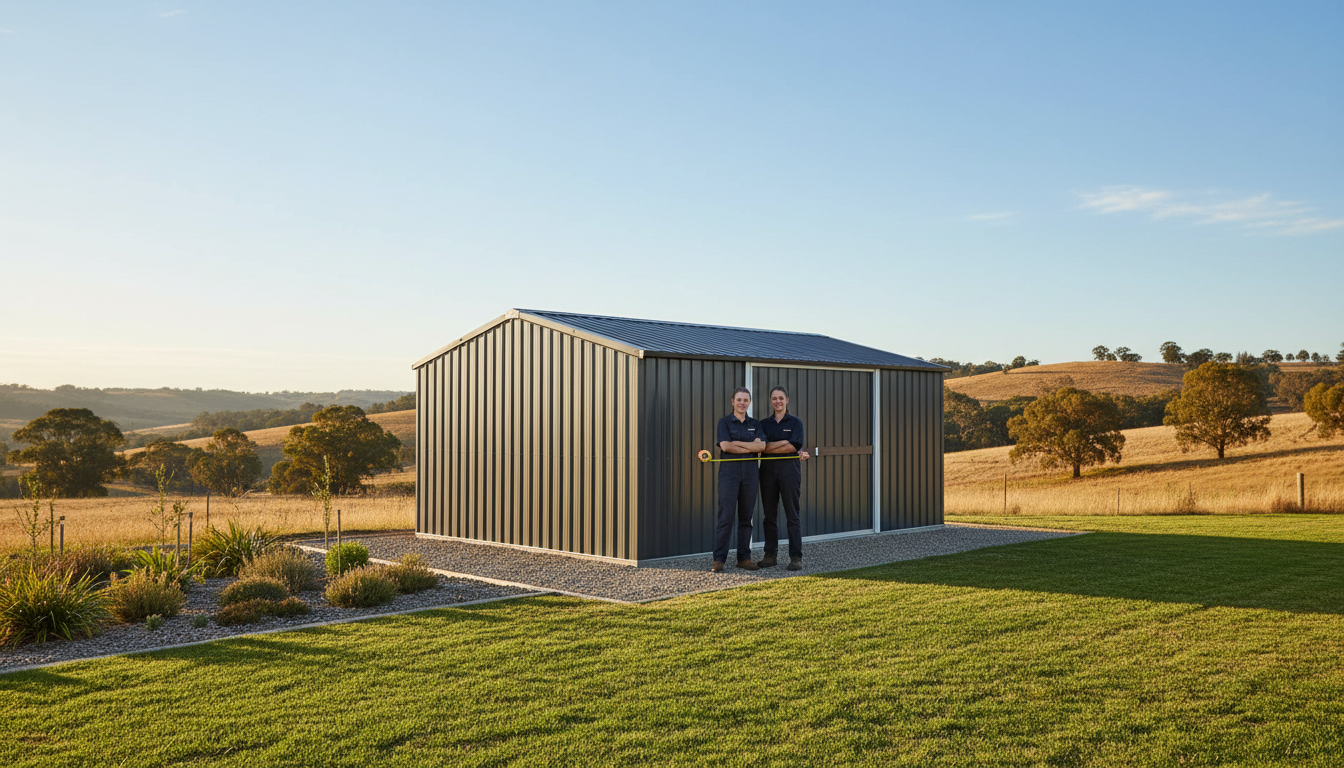
Whether you call it a 10 x 20 storage building, a 10×20 shed, or simply a compact workshop, Australian buyers are usually looking at a 3 m x 6 m Colorbond steel shed that meets local wind ratings, site conditions, and council rules. This guide brings the industry know‑how together—materials, engineering, approvals, pricing, and practical options tailored for steel sheds in Perth, rural sheds in NSW, and cyclone-rated sheds in QLD.
- Ideal uses: workshop, farm machinery storage, garden equipment, motorbike or small boat storage, or a custom-built double garage in Perth (tight sites).
- Spec options: DIY shed kits or turnkey supply-and-install, gable or skillion roof, roller door + PA door, insulation and ventilation, skylights, and gutters to water tanks.
How big is a “10 x 20” shed in Australia?
In US terms, “10 x 20” means feet. In Australia, that’s approximately 3.05 m x 6.10 m. Most local shed builders use metric modules, so you’ll typically see 3.0 m x 6.0 m, 3.2 m x 6.0 m, or 3.0 m x 6.2 m.
- Space planning: One small car plus storage racking, or a generous workshop bench along one wall.
- Common wall heights: 2.4 m – 2.7 m; go 3.0 m+ for 4WDs with roof racks or mezzanine storage.
What are the best shed materials for Perth’s climate?
For Australian backyards and small workshops, the market standard is BlueScope steel. You’ll usually choose between Colorbond and Zincalume cladding on a galvanised steel frame.
Colorbond vs Zincalume — which is better for WA conditions?
Perth’s hot summers and coastal salt exposure favour high-quality coatings. Here’s a practical comparison for 3×6 m sheds near WA’s coast or hot inland suburbs.
| Factor | Colorbond | Zincalume |
|---|---|---|
| Appearance | Large Australian colour palette to match homes and fences | Bright metallic; limited aesthetic matching |
| Heat performance | Thermatech colours reflect more solar heat | Good reflectance when new; can dull over time |
| Corrosion resistance (coastal) | Excellent with correct grade and detailing | Strong, but watch detailing within high-salt zones |
| Warranty | BlueScope product warranties available | BlueScope product warranties available |
| Cost | Typically higher | Typically lower |
| Best for | Backyards, street-visible builds, coastal suburbs | Rural/industrial, budget-driven builds |
Tip: In coastal WA and QLD, specify marine‑grade fasteners, proper flashings, and wash-down access to handle salt spray. See Australian Steel Institute corrosion guidance for detailing advice (Australian Steel Institute).
How much does a 10 x 20 Colorbond shed cost in Australia?
Indicative budget ranges (AUD) for a 3×6 m wind-rated shed, assuming straightforward access and slab:
- DIY shed kits: roughly $2,800 – $5,500 depending on wind region, roof style, and cladding.
- Supply and install (non-cyclonic): typically $6,500 – $11,000 including engineering, fixings, and labour.
- Cyclone-rated sheds (QLD/WA North): allow 15–35% more for extra bracing, heavier frames, and tie-downs.
- Concrete slab (100–120 mm typical residential): often $100 – $160/m² depending on soil class, thickening, mesh, and site prep.
Note: Prices vary by wind region, terrain category, site slope, delivery distance, and options such as insulation, windows, or roller doors. Always obtain site-specific engineering and a formal quote.
How to choose the right 10×20 shed for your site
- Wind region (AS/NZS 1170.2): Regions A–D; cyclonic in many coastal/northern areas of QLD and WA. Added 2024 WA wind-rating compliance notes
- Terrain category: Open paddocks vs suburban blocks affect design pressures and bracing.
- Bushfire (AS 3959): Check your BAL rating for cladding, ember protection, and openings.
- Corrosion environment (AS 4312): Coastal C3–C5/CX zones need correct coatings and details.
- Use-case: Workshop, garden storage, farm machinery storage, or a compact double garage?
- Access and height: Roller door clearance, roof racks, mezzanine options.
- Drainage: Gutters, downpipes to tank, site fall away from slab.
How to get council approval for your custom shed in WA
Step-by-step for council-approved sheds WA
- Pre-check: Confirm planning requirements (setbacks, site coverage, heights) with your local shire.
- Site plan: Show boundaries, services, easements, slab location, drainage, and driveway if relevant.
- Engineering: Obtain site-specific engineering (wind region, terrain, importance level) and footing/slab details signed by a qualified engineer.
- Application: Submit Building Permit (BA1/BA2) with structural drawings, energy notes (if required), and specs.
- Inspections: Arrange footing/slab inspections if your council requires them; keep your Form BA7 on completion.
Timeframe: Straightforward sheds often clear within 2–4 weeks; allow longer in coastal/cyclonic or high-bushfire zones. For general guidance, see HIA permit information (HIA permits overview).
10×20 shed design options and smart upgrades
- Roof profiles: gable roof shed for classic streetscape; skillion roof shed for modern look and fast water run-off; flat roof only where wind loading allows.
- Doors: manual or motorised roller doors; PA door with deadlock; security screens; wind-lock kits in cyclonic areas.
- Insulation: roof blankets or insulated roof panels; add wall batts for comfort and condensation control.
- Ventilation: ridge vents, eaves vents, whirlybirds; louvre windows with flyscreens.
- Electrical: LED high-bays, dedicated circuits for tools, outdoor GPOs; solar-ready conduit.
- Storage: wall battens for shelving, steel racking, mezzanine over roller door line.
- Water management: gutters to tank, leaf-guards, sumps and overflows.
- Finish: Colorbond colours to match home or custom Colorbond garages Perth aesthetics.
Pro Tip: Using insulated roof panels can reduce internal shed temperatures by up to 10°C in summer, especially when paired with cross-ventilation and lighter Colorbond colours. See general energy efficiency advice at Energy.gov.au.
Designing for cyclones and bushfire
cyclone-rated sheds QLD and northern WA
- Engineering: Enhanced frames, extra bracing, heavier purlins/girts, and certified hold‑downs.
- Doors: Wind-locked roller doors; consider smaller door widths or mullions to reduce wind pressure spans.
- Connections: Cyclone washers, screw patterns to engineering, and adequate edge distance.
Track cyclones and seasonal wind patterns via the Bureau of Meteorology (BOM cyclone guidance).
Bushfire-prone sites
- Check BAL and specify ember-sealing of roof/wall junctions, screened vents, and compliant glazing/doors.
- Clear vegetation within asset protection zones and store flammables safely.
See CSIRO bushfire design resources (CSIRO bushfire guidance).
DIY shed kits vs custom-built installation
DIY shed kits
- Pros: Cost-effective, flexible timing, popular for handy homeowners and tradies.
- Cons: Requires tools, lifting gear, and strict adherence to engineering; weather delays.
Custom-built and installed
- Pros: Turnkey; faster build; compliance paperwork handled; warranty under one roof.
- Cons: Higher upfront cost; schedule lead times.
Not sure a full shed is right for you? Consider affordable carports for Australian homes or custom carports Melbourne for vehicle cover on a budget, with the option to enclose later subject to council approval.
Build examples
Example 1 — Custom-built double garage in Perth
- Size: 3.2 m x 6.0 m, 2.7 m wall height
- Spec: Colorbond Monument walls/roof, motorised roller door, insulated roof blanket, ridge vent
- Engineering: Region A, Terrain Cat 2.5, slab 120 mm with thickenings per engineer
Example 2 — Cyclone-rated storage in Townsville, QLD
- Size: 3.0 m x 6.0 m, 3.0 m wall height, skillion roof
- Spec: Zincalume cladding, wind-locked roller door, additional wall bracing and hold-downs
- Engineering: Region C, site-specific tie-down schedule and door wind ratings
Example 3 — Rural sheds NSW (farm machinery bay)
- Size: 3.0 m x 6.0 m enclosed bay added to an existing machinery shed
- Spec: Zincalume walls, Colorbond roof to match homestead, whirlybird + eave vents
- Use: Secure storage for tools, chemicals in lockable cabinet, and ride-on mower
Frequently asked questions
Will a 3×6 m (10×20) shed fit a car?
Yes, for small to mid-size vehicles. Check door width/height and allow clearance for shelving and tool benches.
What slab do I need?
Typical residential slabs are 100–120 mm with mesh and perimeter thickenings. Your engineer will design to soil class and loads (AS 2870/AS 3600 as applicable).
How long does it take?
From order to install: 3–8 weeks depending on engineering, council, and fabricator capacity. DIY kits can dispatch faster.
What about warranty?
Frame and cladding warranties vary by supplier; BlueScope product warranties are available for Colorbond/Zincalume when installed to guidelines. Check terms with your supplier and BlueScope Colorbond warranty.
Do I need insulation and ventilation?
Recommended in hot climates like Perth and regional WA/QLD. Use roof blankets or insulated panels plus vents to control heat and condensation.
Flat, gable, or skillion roof?
Gable for classic look and good ventilation paths; skillion for modern lines and easy rainwater fall; flat only where wind loading and drainage allow, usually on sheltered suburban blocks.
5-Step Buying Guide for Custom Sheds in Australia
- Confirm size and use: 3×6 m layout, door clearances, power needs, and storage plan.
- Check site constraints: wind region, BAL, setbacks, easements, vehicle access for install.
- Choose materials: Colorbond vs Zincalume, roof profile, insulation/ventilation, gutters to tank.
- Lock in engineering and council: site-specific certification and local permit process.
- Compare quotes: DIY shed kits vs turnkey installs; ensure apples-to-apples on wind rating, fasteners, doors, and warranty.
Keyword clusters and related solutions
- Local: steel sheds Perth, rural sheds NSW, custom carports Melbourne, council-approved sheds WA
- Technical: Colorbond vs Zincalume comparison, wind-rated sheds for cyclonic areas, site-specific engineering, insulated roof panels
- Use-cases: farm machinery storage, DIY shed kits, custom Colorbond garages Perth, affordable carports for Australian homes
Standards, climate and industry resources
- Standards to reference: AS/NZS 1170.2 (Wind Actions), AS 3959 (Bushfire), AS 4312 (Corrosivity), AS 2870/AS 3600 (Concrete/Slabs).
- Climate: Check seasonal winds and cyclones via BOM (Bureau of Meteorology).
- Industry: Housing Industry Association (HIA), Master Builders Australia, Australian Steel Institute.
- Further reading: 2025 HIA Outdoor Structures and Home Improvement Report; 2025 Australian Steel Market Outlook (market trends and material availability).