
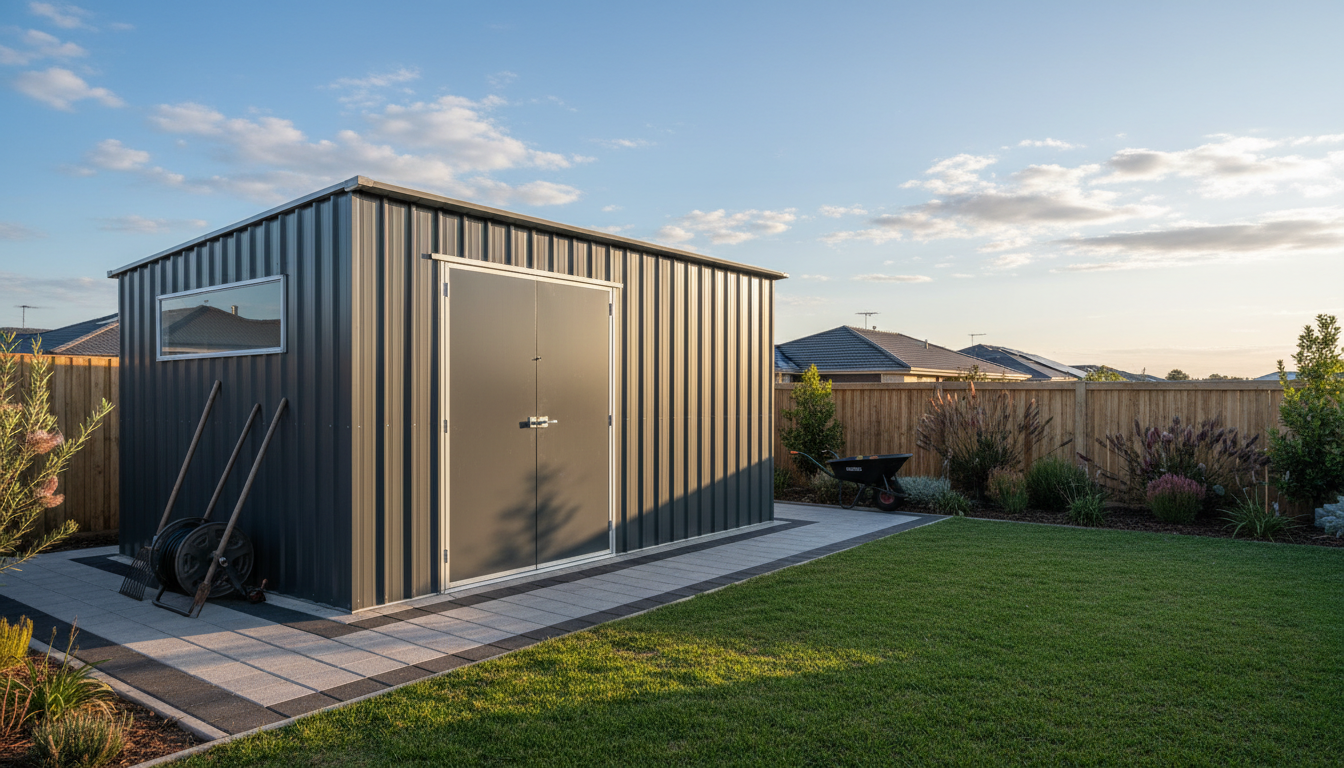
Whether you mean a compact 10×6 ft garden shed or a spacious 6×10 m Colorbond steel shed, this guide helps Australian homeowners, renovators, and investors design, certify, and build the right shed for local conditions. We cover wind ratings, council rules, material choices, costs, and practical layouts that actually work.
What size is a 10×6 shed in Australia?
“10×6 shed” usually refers to 10 ft x 6 ft garden sheds (about 3.0 m x 1.8 m), perfect for garden tools, bikes, and a mower. If you’re planning a workshop or vehicle storage, you likely mean a 6×10 m shed — enough room for a custom-built double garage in Perth, a workshop in Adelaide, or boat storage in coastal NSW.
- 10×6 ft (3.0 x 1.8 m): suits garden tool storage, bikes, DIY shed kits, compact workshop benches.
- 6×10 m: suits double garage, trailer and boat storage, small farm machinery storage, or a hybrid workshop with roller door automation.
What Are the Best Shed Materials for Perth’s Climate?
Western Australia’s UV and coastal salinity demand top-tier coated steel and smart roof build-ups. Here’s how Colorbond and Zincalume compare for WA and broader Australian conditions.
| Feature | Colorbond steel | Zincalume steel |
|---|---|---|
| Coating & finish | Painted, baked-on finish over zinc/aluminium/magnesium base | Unpainted zinc/aluminium/magnesium coating |
| UV resistance (Perth heat) | Excellent with modern paint systems; Colorbond Matt reduces glare | Good, but reflective; can show patina over time |
| Coastal/corrosion performance | Very good; choose Colorbond Ultra for severe marine zones | Good inland; consider extra protection near the coast |
| Colour options | Extensive Colorbond palette | Silver-grey only |
| Typical use | Premium residential sheds, custom Colorbond garages Perth | Budget-friendly farm/rural sheds NSW inland |
| Price | $$ to $$$ | $ to $$ |
Engineering and compliance: wind ratings, codes, and council
Every compliant steel shed in Australia is engineered to AS/NZS wind actions and local terrain. Your 10×6 must be wind-rated for the site, certified by an engineer, and, where required, approved by council/private certifier.
Added 2024 WA wind-rating compliance notes
- Design to AS/NZS 1170.2 wind actions and AS/NZS 4600 (cold-formed steel). Coastal WA north of Kalbarri trends toward higher wind regions; check Region B–D exposure.
- Nominate Terrain Category (TC2, TC2.5, etc.) and shielding per site survey. Cyclonic design uses C classifications (e.g., C2) and enhanced connections.
- Anchorage: engineer-specified M12–M16 anchors with edge distances and embedment; slab thickened edges often required.
How to get council approval for your custom shed in WA
- Obtain site plan, elevations, and engineering certification (Form BA3/BA4 as applicable).
- Confirm setbacks, heights, and open space rules with your local council (R-Codes may apply).
- Provide wind region, terrain category, and N rating (N1–N4) or C rating (C1–C4 for cyclonic).
- Address stormwater management and driveway/slab drainage; add gutters and compliant downpipes to legal point of discharge.
- If in bushfire-prone areas, document BAL (AS 3959) requirements for doors, vents, and ember protection.
For North QLD and parts of coastal WA, specify cyclone-rated sheds QLD with tested door systems, extra hold-downs, and purlin spacing to suit C classifications. In WA, many installers now advertise council-approved sheds WA to streamline permits and engineering.
Design options that make a 10×6 shed work harder
Roof style: flat/skillion vs gable
| Roof type | Pros | Considerations | Best for |
|---|---|---|---|
| Flat / Skillion | Simpler, modern look; easy water fall to one side; pairs with affordable carports for Australian homes | Needs adequate fall; watch gutter capacity in heavy rain | Urban garden sheds, narrow side setbacks |
| Gable | Classic look; better airflow; accommodates insulation easily | Slightly higher cost; more parts | Workshops, 6×10 m garages, rural sheds NSW |
Doors and access
- Roller doors (manual or motorised) for 6×10 m garages; ensure wind-rated curtain and lock options.
- Sliding doors for low-wind inland sites and farm machinery storage.
- Personal access (PA) doors with anti-jemmy frames; consider BAL-rated seals in bushfire zones.
Flooring and slab
- 10×6 ft garden shed: pavers or a 75–100 mm concrete pad is common; use galvanised base rails.
- 6×10 m garage/workshop: 100–120 mm raft slab with SL72–SL82 mesh; thickened edges per engineer; M12–M16 chemset anchors.
Ventilation, insulation, and electrics
- Whirlybirds or ridge vents reduce heat load; fit flyscreens for insects.
- Roof blanket or insulated panels for condensation control; add wall wrap in cooler climates.
- Plan GPOs, lighting, and a sub-board; run conduits before the slab pour.
DIY shed kits vs custom-built
| Option | Pros | Watch-outs | Typical use |
|---|---|---|---|
| DIY shed kits | Lowest cost; fast delivery; weekend build for 10×6 ft | Limited customisation; check local wind compliance | Garden tool storage, bike sheds, shed kits Tasmania |
| Custom-built (engineered) | Optimised for site, wind region, doors, and layout | Higher upfront cost; lead-time for engineering/approvals | 6×10 m workshop, custom Colorbond garages Perth, steel garages Sydney |
Costs in 2025: what to budget
- 10×6 ft steel shed kit: roughly $600–$1,200 supplied; add $300–$1,000 if you’re pouring a small slab.
- 6×10 m engineered Colorbond garage: from $11,000–$18,000 kit only; $22,000–$40,000+ fully installed with slab, doors, and electrical, depending on wind rating and site.