
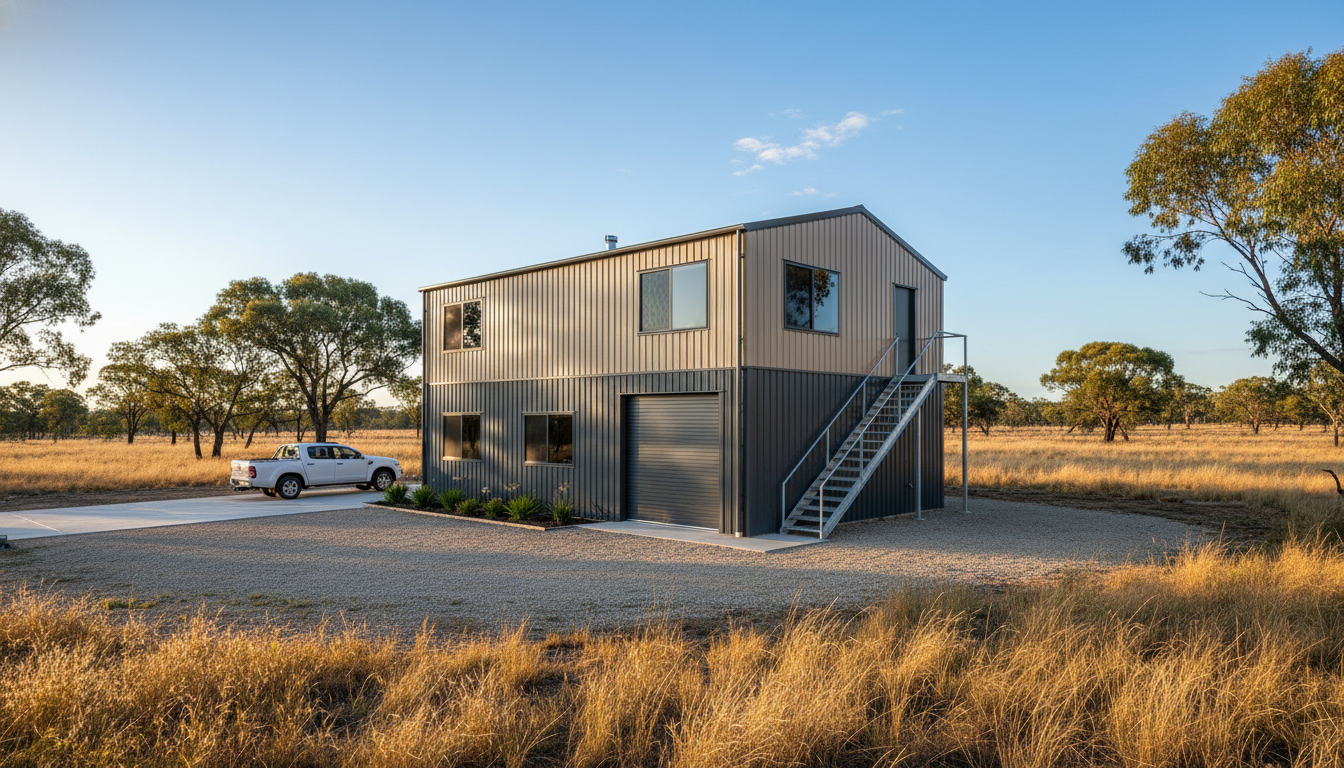
Excerpt: Thinking about a 2 floor shed? This expert Australian guide covers materials (Colorbond vs Zincalume), cyclonic wind ratings, council approvals, costs, and layouts—plus real builds in Perth, Brisbane and regional NSW. Get a practical buying checklist and avoid costly mistakes.
2 floor sheds—also called a 2 story shed, two storey shed or a two floor shed with a mezzanine—are a smart way to double your usable space on the same footprint. Whether you’re after a custom Colorbond steel shed for regional WA, a cyclone-rated shed in QLD, or a workshop with loft storage in NSW, this guide walks you through materials, wind ratings, council approvals, and costs for 2025.
We’ll also show you how these buildings compare with DIY shed kits, what to know about lined sheds and “shed rooms”, and when to choose a custom-built double garage in Perth with an overhead loft.
What is a 2 floor shed—and what’s the difference between a loft and a true two-storey?
A “2 floor shed” in Australia usually means a steel portal-frame shed with either:
- A full second storey engineered for live or storage loads, or
- A mezzanine/loft floor across part of the plan, ideal for light storage or an office.
Most Australian homeowners choose a mezzanine for value: you get upstairs storage or a small office while keeping costs and approval complexity manageable. A full two-storey shed suits commercial use, car collection, or mixed workshop/storage applications where you need more floor area and higher design loads.
What are the best shed materials for Perth’s climate?
Perth’s hot summers and coastal conditions demand durable cladding and roofing. The top options are Colorbond steel and Zincalume, both from BlueScope. Here’s how they compare.
Colorbond vs Zincalume — Which is better for WA conditions?
| Feature | Colorbond steel | Zincalume steel |
|---|---|---|
| Finish | Pre-painted, baked-on colour palette | Metallic alloy coating (no paint) |
| Heat reflection | High, with Thermatech in many colours | Good reflectivity (light silver) |
| Coastal resistance | Excellent with correct grade and detailing | Good, but watch edge/cut corrosion near surf coasts |
| Aesthetics | Modern colours to match roofing/fascia | Industrial look |
| Cost | Slightly higher upfront | Lower upfront |
| Best for | Homes in Perth metro & coastal suburbs | Rural/industrial where budget is key |
Recommendation for Perth: Opt for Colorbond walls and roof, hot-dip galvanised or pre-galv frames, and stainless fixings within 1 km of surf coast. Consider insulated roof panels to reduce heat load.
How do 2 floor sheds meet Australian Standards and wind ratings?
Two-storey and mezzanine sheds must be engineered to Australian Standards, considering wind, snow (alpine), and live loads. For most installs:
- AS/NZS 1170 (structural actions) for wind and live loads
- AS 4100 (steel structures) and/or AS/NZS 4600 (cold-formed steel)
- AS 3600/AS 2870 for slabs/footings (site classification)
- AS 3959 (bushfire) where applicable for setback and detailing
- NCC (BCA) for stairs, handrails, glass, and fire separation near boundaries
Added 2024 WA wind-rating compliance notes WA’s Mid West–Pilbara–Kimberley regions can require Region C or D wind classifications. Perth metro is typically Region A (N1–N4 depending on site exposure). Always obtain a site-specific wind classification and engineer’s certificate.
- Non-cyclonic areas (N1–N6): Standard portal frames with appropriate hold-downs/bracing.
- Cyclonic areas (C1–C4): Heavier connections, closer purlin spacing, increased cladding fasteners, certified roller doors. Consider debris screens for openings.
For North QLD installs, ask for cyclone-rated sheds QLD with engineering to AS/NZS 1170 cyclonic provisions and region-specific detailing.
Which roof style and layout works best for a two-storey shed?
For two floor sheds, roof choice affects headroom over mezzanines and overall aesthetics.
Flat roof vs gable roof for 2 floor sheds
| Aspect | Flat/Skillion | Gable |
|---|---|---|
| Headroom over mezzanine | Good on high side, lower on low side | Excellent central headroom |
| Drainage | Simple with adequate fall/gutters | Balanced drainage, larger gutters |
| Street appeal | Modern/low-profile | Classic, matches many homes |
| Cost | Often slightly cheaper | Slightly higher framing cost |
| Best use | Urban blocks with height limits | Workshops needing central height |
Layout tips:
- Place the mezzanine to avoid clashing with large roller doors.
- Consider an internal stair vs external stair for space and security.
- Allow for pallet access via a swing gate or hoist point if storing heavier items.
- For a “shed room” or office, insulate and line walls (lined sheds) and plan power/data early.
How much do two-storey sheds cost in Australia (2025)?
Costs vary by size, wind rating, finishes and whether you choose a kit or turnkey build.
DIY kit vs custom-built costs
| Option | Typical price (inc. GST) | Pros | Cons |
|---|---|---|---|
| DIY shed kit with partial mezzanine (e.g., 6×6 m) | $18,000–$35,000 + slab | Cheapest, fast supply | Owner project management; council paperwork; limited customisation |
| Custom engineered two-storey shed (6×9–8×12 m) | $45,000–$95,000 + slab | Tailored spans, doors, loads | Higher upfront cost, longer lead time |
| Turnkey supply and install (including approvals) | $70,000–$140,000 + slab/services | Hands-off, council-approved, quality control | Highest upfront cost |
- Concrete slab/footings: typically $120–$180/m² (site-dependent).
- Insulation and lining: $25–$60/m² for roof/walls depending on R-value and finish.
- Roller doors/windows: $1,200–$4,500+ each depending on size, wind rating and automation.
- Cyclonic detailing: add ~10–25% in Region C/D areas.
Sources: 2025 supplier price lists and industry commentary; see the HIA and Master Builders Australia market updates for broader trends.
How to get council approval for a custom two-storey shed
Requirements vary by state and council. Sheds with mezzanines are typically “Class 10a” non-habitable structures unless converted to a habitable room (more controls apply). Always obtain site plans, engineered drawings, and a wind classification report.
How to get council approval for your custom shed in WA
- Check planning: Setbacks, height limits, and lot coverage (local scheme).
- Engineering: Site-specific wind rating and structural certification (AS/NZS 1170, AS 4100/4600).
- Building permit: Apply with plans, energy/insulation notes if required for lined areas.
- Install: Use licensed installers; book mandatory inspections.
- Final sign-off: Obtain occupancy/permit completion as required.
Ask for council-approved sheds WA packages that include drawings and certification to speed approvals.
NSW and VIC snapshot
- NSW: Complying Development (CDC) possible for many sheds; mezzanines may trigger DA. Check bushfire (BAL) overlays via NSW Planning Portal.
- VIC: Building permit required in most cases; planning permit if overlays apply. Stairs/handrails must comply with NCC Volume Two.
QLD snapshot (cyclonic areas)
- Seek region-specific engineering and certified doors/windows. Use “cyclone-rated sheds QLD” suppliers experienced in Region C/D.
- Check corrosion categories in coastal towns; upgrade fasteners accordingly.
What can you do with a two-storey shed or loft?
Popular layouts and keyword clusters include:
- Workshop + loft: A ground-floor workshop shed (e.g., 7×10 m) with upstairs parts storage or an office.
- Two story storage shed: For e-commerce stock, tools and seasonal gear.
- Garage with loft: Store vehicles below, camping gear above; ask for custom Colorbond garages Perth if you’re in WA.
- Farm machinery storage with mezzanine for spares and PPE.
- Lined sheds for a “shed room” or studio—insulate, add sarking, plasterboard or ply lining.
Related solutions if you’re comparing options:
- Steel sheds Perth • rural sheds NSW • workshop sheds Brisbane • shed builders Adelaide
- Custom carports Melbourne • affordable carports for Australian homes
- DIY shed kits vs turnkey installs
Real Australian build examples
Perth (non-cyclonic): 7×10 m gable, 30 m² mezzanine
- Spec: Colorbond Monument walls/roof, insulated roof panels, 3.6 m eaves.
- Use: Double garage plus loft storage. Internal stair.
- Notes: N3 wind rating; whirlybirds and ridge vent keep temps down.
Townsville (Region C): 8×12 m skillion, 40 m² mezzanine
- Spec: Zincalume walls, Colorbond roof, cyclonic-rated roller doors.
- Use: Trade workshop with upstairs office.
- Notes: Extra wall bracing, closer purlin spacing, upgraded fasteners; +18% cost vs non-cyclonic.
Regional NSW (coastal): 6×9 m gable, 24 m² mezzanine
- Spec: Colorbond Surfmist roof/walls, sarking, wall batts to office zone.
- Use: Garden + camping storage; “shed room” for hobbies.
- Notes: Stainless roof screws within 400 m of surf; BAL–12.5 detailing.
5-step buying guide for custom sheds in Australia
- Define the brief: Size, door clearances, mezzanine load (storage vs office), services (power, water, data).
- Pick materials: Do a Colorbond vs Zincalume comparison; choose insulation and ventilation to suit climate.
- Check compliance: Wind classification, setbacks, bushfire overlays, boundary fire rules, stair compliance.
- Compare suppliers: Ask for engineered drawings, cyclone options (if relevant), and lead times. Verify warranties.
- Plan the build: Slab design, drainage, termite protection, and safe stair/handrail details.
Frequently asked questions about 2 floor sheds
Do I always need council approval for a two-storey shed?
Usually yes. Even small mezzanines change building classification or loads. Many suppliers offer council-approved sheds WA or permit-ready packs for other states.
Can a two-storey shed be habitable?
Only if designed as a habitable class (insulation, energy, light/ventilation, waterproofing, fire, and egress rules). Most “shed rooms” are non-habitable unless fully upgraded to NCC requirements and approved.
What live load should a mezzanine be designed for?
Common storage loads are 1.5–2.5 kPa; offices around 2.5–3.0 kPa. Confirm with your engineer and intended use.
What stair rules apply?
Follow NCC for rise/going, handrails and balustrades. In many cases, a compliant internal stair is required if the mezzanine is regularly accessed.
How do I reduce summer heat inside the shed?
Use light Colorbond colours, insulated roof/walls, sarking, roof vents, and shade to western walls. Consider whirlybirds or powered ventilation per Energy.gov.au advice.
Is Zincalume okay near the coast?
Yes, but use correct corrosion category detailing and upgraded fixings. For surf coasts, Colorbond with proper grade and stainless screws often performs better.
What lead times should I expect in 2025?
Typically 4–10 weeks for kits, 8–16+ weeks for custom/turnkey builds. Check steel supply trends via the Australian Steel Institute’s updates.
Technical references and further reading
- Bureau of Meteorology climate data for wind and temperature considerations.
- Australian Steel Institute for steel design resources and market outlooks.
- Energy.gov.au on insulation for comfort and energy performance.
- CSIRO research on materials and corrosion in Australian climates.
Industry context: “2025 Australian Steel Market Outlook” and “2025 HIA Outdoor Structures and Home Improvement Report” indicate steady demand for premium Colorbond sheds and wind-rated sheds for cyclonic areas.
Ready to design your two-storey shed?
Whether you’re after steel sheds Perth, rural sheds NSW, or cyclone-ready in QLD, we can help with design, engineering, and council paperwork. Ask for a quote on two story shed designs, storage buildings with loft, or custom Colorbond garages Perth.