
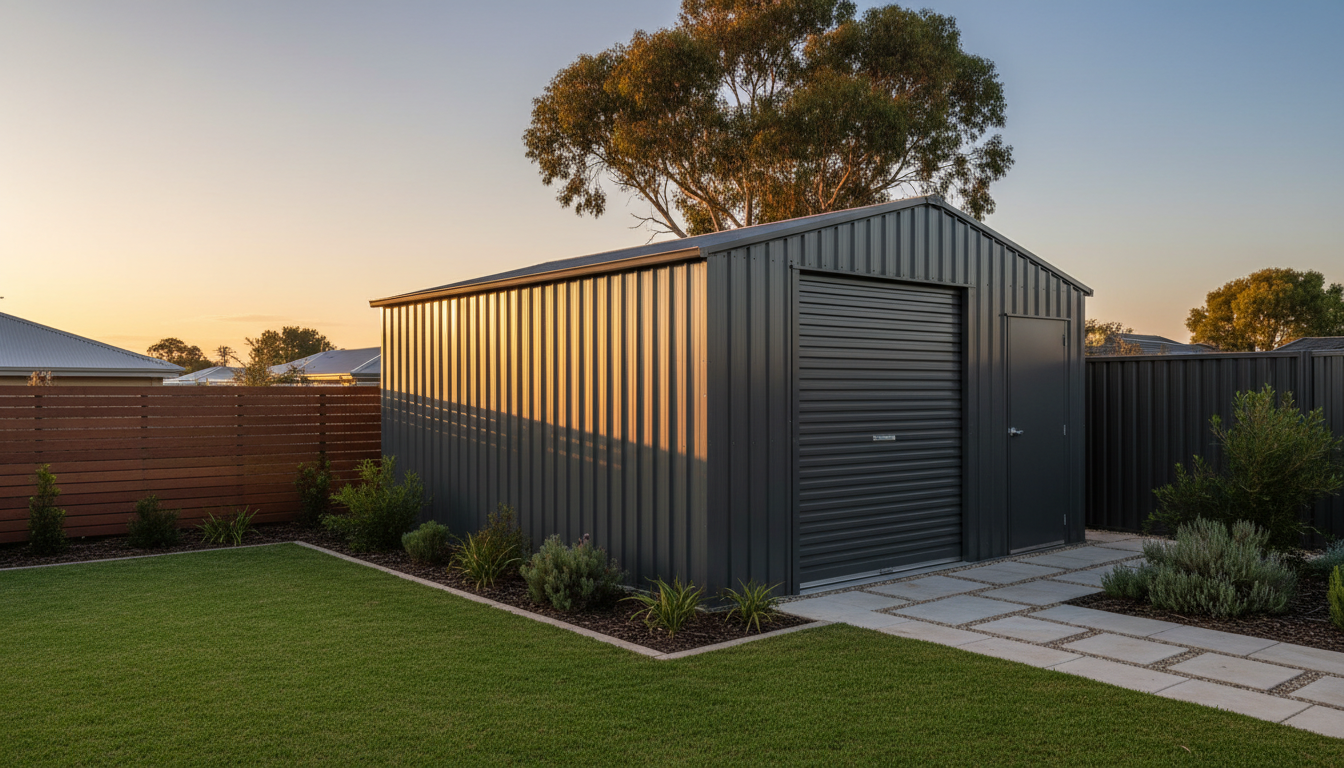
If you’re short on space but big on gear, a 4 x 3 storage shed (4m x 3m; ~12m²) hits the sweet spot. It’s large enough for garden tools, bikes, a mower, or a compact workshop—yet slim enough to fit most suburban backyards from Perth to Melbourne. Below, we break down materials, wind ratings, council approvals, and costs for Australian conditions, whether you want a DIY shed kit or a custom Colorbond steel shed.
What size is a 4 x 3 storage shed and who is it for?
A 4×3 shed is typically 4000mm wide x 3000mm deep with wall heights from 2100–2400mm and a gable or skillion roof up to ~3000–3600mm at the peak (site and council dependent). It’s a popular garden shed 4m x 3m footprint for:
- Backyard workshop or hobby bench with shelving
- Lawnmower and garden tool storage with a side access door
- Bikes, boards, camping gear, and seasonal storage
- Pool pump and pool chemical station (with compliance ventilation)
- Small business parts storage or e‑commerce stock overflow
Size upgrades
Or upsize to a 10 sqm shed for more versatility.
Usage keywords in context: 4mx3m garden shed, 4m x 3m shed, 4×3 shed, steel sheds Perth, rural sheds NSW, custom Colorbond garages Perth.
What are the best shed materials for Perth’s climate?
For WA’s heat and coastal air, pre‑painted Colorbond steel cladding on a galvanised steel frame is the proven choice. Zincalume is an excellent base‑metal option with a metallic finish, often chosen where budget or an industrial look is preferred.
Colorbond vs Zincalume — Which is better for WA conditions?
| Criteria | Colorbond Steel | Zincalume Steel |
|---|---|---|
| Finish & Heat Reflectivity | Pre‑painted, high solar reflectance options reduce heat load; ideal for Perth summers. | Metallic sheen; reflective but can run hotter internally without insulation. |
| Corrosion Resistance | Excellent in most environments; choose appropriate warranty grade for coastal sites. | Strong base protection; coastal performance depends on distance from breaking surf. |
| Colour Range | Wide Colorbond palette to match home/landscape. | Limited metallic silver/grey appearance. |
| Cost | Typically higher upfront; better long‑term aesthetics and heat control. | Generally more affordable; popular for sheds on farms/behind the house. |
| Best For WA | Urban/coastal sites, design‑conscious installs, heat reduction. | Budget rural setups away from surf, utility‑first projects. |
Learn more about climate and corrosion from the CSIRO and heat management options at Energy.gov.au.
Design Options
If your backyard is narrow, Long Thin Garden Sheds work perfectly.
How should you choose roof style and ventilation for a 4×3 shed?
- Skillion (mono‑pitch): Modern look, fast to install, ideal against a fence with fall to one side.
- Gable: Classic profile, good natural airflow, suits higher storage and a central workbench.
- Flat roof: Low visual impact; ensure compliant fall and guttering for heavy rain events.
Ventilation essentials: add soffit vents plus a ridge vent or “whirlybird”, and specify breathable insulation to cut heat and condensation. In tropical or humid zones, cross‑flow ventilation and anti‑condensation blankets are a must.
Are 4×3 sheds compliant with Australian Standards and wind ratings?
Your 4 x 3 storage shed must be engineered to AS/NZS 1170.2 (wind actions) with tie‑down to suit wind region (A, B, C, or D) and terrain category. Many suburban Perth sites are non‑cyclonic (Region A); coastal, escarpment, or cyclone‑prone areas require higher design actions. In North QLD, cyclone‑rated sheds (QLD) demand upgrades like heavier base rails, additional top hats, bracing, and more anchors. The frame should comply with AS/NZS 4600 (cold‑formed steel). Fasteners should be corrosion‑resistant (Class 4 where exposed) per AS 3566.
Added 2024 WA wind-rating compliance notes Ensure your engineering certificate references NCC 2022 and AS/NZS 1170.2:2021 with site-specific wind region, terrain category, shielding, topographic multiplier, and importance level (IL1 or IL2). Verify hold‑down details for your slab or footings.
Check wind region and local severe weather data via the Bureau of Meteorology. For steel design guidance, see the Australian Steel Institute and the NCC (ABCB).
How to get council approval for your custom shed in WA
Most 4m x 3m sheds exceed “minor structure” exemptions. In WA, a building permit is typically required for a Class 10a shed.
- Pre‑check planning rules: setbacks, height, and site coverage (R‑Codes and your local planning scheme).
- Gather documents: site plan, elevations, fixing details, engineering certificate, and specification.
- Confirm wind region and BAL (if in a bushfire area). BAL measures can affect materials and openings.
- Lodge building permit: aim for council-approved sheds WA with a licensed builder or owner‑builder approval.
- Book inspections: slab/footings (if required) and final sign‑off.
Timeframes vary by council; allow 2–6 weeks. For other states, the process is similar—some councils offer fast‑track for standard Class 10a structures.
How much does a 4 x 3 storage shed cost in Australia (2025)?
Indicative pricing varies by spec, site, and wind rating:
- DIY shed kits (budget Zincalume, thin cladding): approx. $1,500–$3,000
- Premium DIY kits (Colorbond, heavier cladding, better hardware): $2,800–$5,500
- Custom-built and installed (engineered, slab, gutters, premium hardware): $5,500–$9,500+
Site works and extras:
- Concrete slab 100–120mm with mesh: typically $130–$180/m² depending on site access
- Footings/piers (where no slab): priced per pier depth and soil conditions
- Insulation, skylights, windows, roller door, and power: optional upgrades
Recent Australian industry commentary (HIA; Australian Steel Institute) indicates steady demand for outdoor structures in 2024–2025. Always request a fixed‑scope, itemised quote.
Should you buy a DIY 4×3 shed kit or go custom-built?
- DIY shed kits: fast delivery, cheaper, great for flat blocks. Choose kits with stamped engineering for your wind region.
- Custom-built: tailored openings, better security, and faster approvals with complete documentation—ideal for sloping sites, coastal zones, or cyclonic areas.
Tip for investors: Custom options like a roller door, lighting, and shelving can lift rental appeal while keeping total cost below a full garage upgrade. For driveway cover, look at affordable carports for Australian homes or custom carports Melbourne to complement the shed.
What does a specification look like for a quality 4×3 shed?
- Cladding: Colorbond or Zincalume, 0.35–0.42 TCT walls, 0.42–0.48 TCT roof (project dependent)
- Frame: galvanised cold‑formed steel, engineered to AS/NZS 4600
- Fasteners: Class 4 external screws, sealed washers, compatible metals to avoid galvanic corrosion
- Doors: single PA door with tri‑lock; optional 2100mm roller door for mower/bikes
- Gutters/DPs: sized for local 1% AEP rainfall; leafguard if trees nearby
- Anchors: mechanical or chemical anchors to engineered slab; cyclone kits for Regions C/D
- Finish: silicone‑sealed laps, scribed flashings, anticapillary detailing
Real build examples for a 4 x 3 storage shed
- Perth (non‑cyclonic): 4m x 3m Colorbond, skillion roof falling to rear, wall 2.4m, ridge vent + insulation blanket. Used for backyard workshop. Completed with council approval in 4 weeks.
- Townsville (cyclonic): 4×3 with Region C engineering, heavier rafters, extra bracing, high‑capacity anchors, and cyclone washers. Roller door plus PA door for safe egress.
- Regional coastal NSW: 4mx3m garden shed in Colorbond Ultra near marine exposure, Class 4 fasteners, sealed laps to mitigate salt spray effects—rural sheds NSW compliant.
5-Step Buying Guide for Custom Sheds in Australia
- Measure and map: Confirm a true 4m x 3m clear area, heights, services, and setbacks. Avoid easements.
- Pick materials: Colorbond for premium finish and heat control; Zincalume for budget utility. Add insulation in hot zones.
- Engineer for wind: Declare address for AS/NZS 1170.2 design (A–D). Specify wind-rated sheds for cyclonic areas if in QLD/NT/WA north.
- Plan approvals: Aim for council-approved sheds WA or your state equivalent. Prepare plans, engineering, and site drawings.
- Choose delivery path: DIY shed kits for simple sites; custom build for sloping or coastal blocks or when you want integrated power and security.
FAQs: 4 x 3 storage sheds in Australia
Is a slab required? Not always. You can use engineered piers/footings, but a 100–120mm reinforced slab provides the best tie‑down, pest control, and clean interior.
What slab thickness and reinforcement? Commonly 100–120mm with SL72/SL82 mesh over compacted base; confirm with your engineer and soil conditions.
Can I build on the boundary? Sometimes, with council permission and fire/resilience provisions. Check planning rules and NCC separation requirements.
Do I need insulation? For Perth heat or tropical humidity, yes—roof blanket or insulated panels with ventilation to cut heat and condensation.
How long does delivery/installation take? Kits can arrive in 1–3 weeks; installs often complete in a day or two once the slab cures. Allow 2–6 weeks for approvals.
What warranty should I look for? Up to 20+ years on steel cladding (site dependent) plus workmanship warranties from the installer. Coastal proximity may alter coverage.
Can I convert it to a garage? A 4×3 is small for vehicle storage, but you can add a roller door for mower/ATV access. For vehicles, consider a custom-built double garage in Perth or an add‑on carport.
Local variations and add‑ons to consider
- WA: High sun load—opt for light Colorbond colours, insulation, and ridge vents. Many clients also add custom carports or patios.
- QLD/NT: Cyclone tie‑down and bracing are mandatory—choose cyclone-rated sheds QLD specifications.
- SA/VIC/TAS: Frost/condensation control—use anti‑condensation blankets and good airflow.
- NSW coast: Corrosion control—Colorbond Ultra, Class 4 fasteners, and diligent sealing.
Choosing complementary structures
A 4×3 shed pairs well with:
- Affordable carports for Australian homes
- Custom carports Melbourne for driveways
- Patio covers and awnings to create all‑weather work zones
Getting a compliant, great‑looking 4 x 3 storage shed
For a hassle‑free result, ask for: engineered drawings to AS/NZS 1170.2, frame and cladding specs to AS/NZS 4600 and AS 1397, Class 4 fasteners, site‑specific hold‑down details, and a clear inclusions list. Request proof of insurance and builder licence. For national guidance, see HIA and speak to your local council. The combination of compliant design, Colorbond quality, and good ventilation will deliver a long‑lasting 4m x 3m shed.
Related keyword clusters covered: steel sheds Perth; custom Colorbond garages Perth; custom carports Melbourne; rural sheds NSW; council-approved sheds WA; cyclone-rated sheds QLD; Colorbond vs Zincalume comparison; wind-rated sheds for cyclonic areas; DIY shed kits; farm machinery storage; backyard workshop; affordable carports for Australian homes; gable roof; skillion roof.