
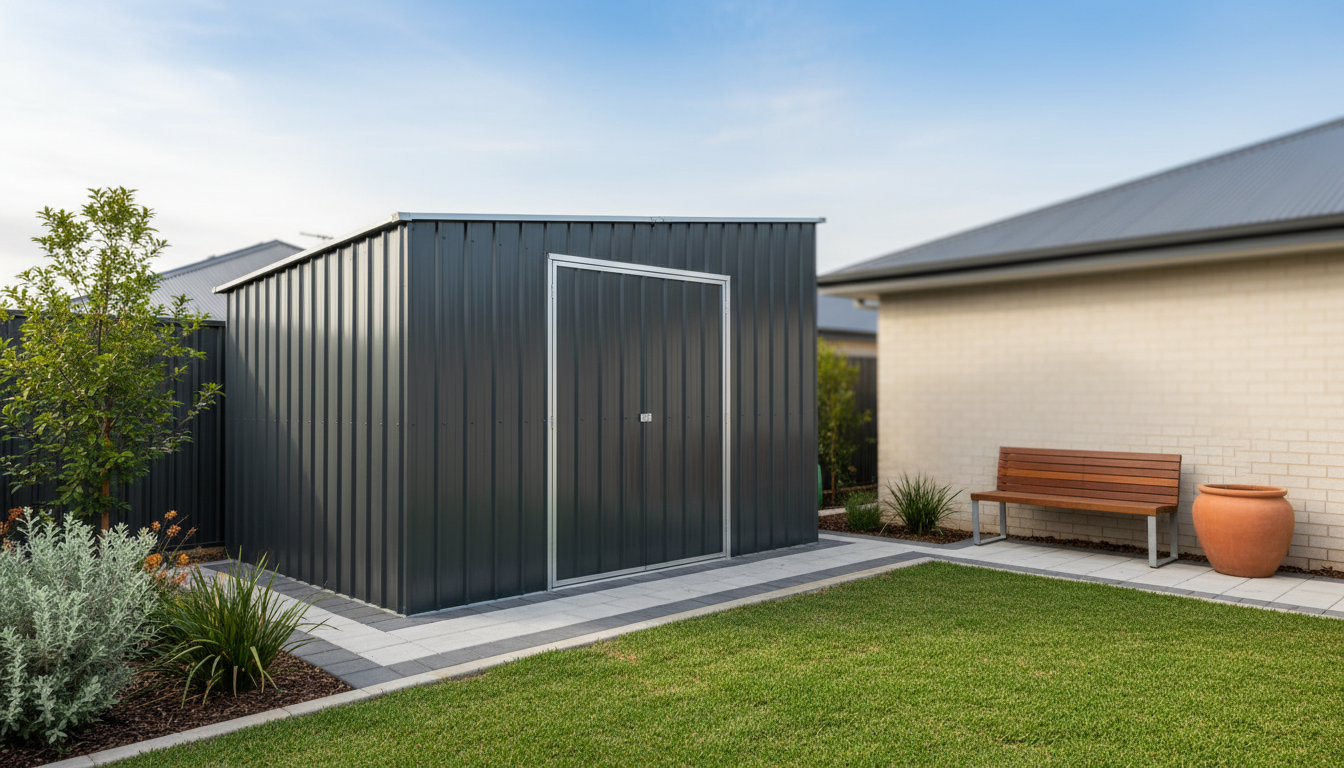
What size is a 4 x 3 storage shed—and is it right for your block?
A 4m x 3m shed delivers a versatile 12 m² footprint—ideal for garden tools, bikes, pool equipment, or a compact workshop. For most Australian suburban blocks it neatly fits behind the home without dominating the yard.
- Typical slab: 4,100 x 3,100 mm to allow cladding overhang and weather drip lines.
- Internal clearance: Aim for 2.1–2.4 m wall height to store tall items and add overhead shelving.
- Drive-through not needed? Choose a single roller door (2.1 m high), or a pair of double doors plus a PA door for easy access.
What are the best shed materials for Perth’s climate?
Australia’s harsh UV, sea spray, and heat make cladding choice critical. Here’s how Colorbond compares with Zincalume—especially in WA’s coastal and high-UV conditions.
| Feature | Colorbond steel | Zincalume steel |
|---|---|---|
| Coating | Painted, baked-on finish in popular colours (e.g., Monument, Surfmist) | Metallic aluminium-zinc coating (silvery finish) |
| Corrosion resistance | Excellent, especially in inland/suburban WA; coastal warranties vary by distance to surf | Very good; can show white rust if poorly ventilated in humid/coastal zones |
| Heat reflectivity | Cooler colours and Thermatech options reflect heat | Naturally reflective initially; dulls over time |
| Aesthetics | Premium look; matches house roof/fence colours | Classic shed look; budget-friendly |
| Best for | Premium residential, custom Colorbond garages Perth, coastal-aware builds | Budget projects, rural/internal regions |
Verdict for WA: Choose Colorbond for most Perth metro and coastal suburbs. In harsh marine zones, confirm the warranty conditions, consider upgraded coatings, or add extra ventilation to control condensation.
How do 4×3 sheds meet Australian Standards and wind ratings?
A compliant 4mx3m garden shed should be engineered to the NCC and key Australian Standards, with a wind classification suited to your site exposure.
- Standards: NCC Vol. 2 (Housing Provisions), AS/NZS 1170.2 (Wind Actions), AS 4100 (Steel Structures), AS/NZS 4600 (Cold-formed steel), AS/NZS 2312 (Corrosion protection).
- Regions: A (most of southern/eastern inland), B (coastal), C and D (cyclonic, large parts of QLD/NT/WA North).
- Terrain categories: TC2 suburban, TC2.5 open, TC3 exposed coastal/open country.
Added 2024 WA wind-rating compliance notes: Many Perth suburbs fall into Region A or B with TC2–TC2.5. Hills and coastal headlands can see higher local speeds—ask for a site-specific engineering certificate (RPEQ/WA CPEng equivalent) and tie-down details for your slab or piers.
- QLD North and WA North: Specify cyclone-rated sheds (Region C/D) with upgraded purlins, hold-downs, door wind-locks, and reinforced roller doors. Use cyclone-rated sheds QLD as your quote term.
- BAL zones (bushfire): In BAL-12.5 to BAL-40 areas, consider ember sealing, metal flyscreens and non-combustible eaves. Check AS 3959 guidance via local authority.
Do I need council approval for a 4×3 shed in Australia?
Rules vary. Some councils exempt small sheds under certain heights (e.g., under 10–20 m² and under 2.4 m high), but others need a building permit or planning approval, especially in overlays, strata, or flood/cyclone areas. Always confirm locally.
How to get council approval for your custom shed in WA
- Check your LGA’s requirements (R-Codes, setbacks, lot coverage, height).
- Get engineering (wind classification, footing/slab details, tie-down schedule).
- Prepare plans (site plan, elevations, stormwater management).
- Lodge a Building Permit (BA2/BA3) if required; some minor works use a Building Approval Certificate.
- Arrange final inspection if mandated by your LGA. Ask for “council-approved sheds WA” from your supplier.
Quick notes for QLD cyclone regions
- Region C/D must be cyclone-rated with certified doors and wind locks.
- Footing upgrades and slab thickening at edges are common.
- Some councils ask for Form 15/16 certificates from a registered engineer.
4×3 shed design options and upgrades (what the pros recommend)
- Roof styles: Gable (classic look, good airflow), Skillion/Monopitch (modern, easy water run-off), Flat with fall (budget, lower profile).
- Doors: 2.1 m roller door, hinged double doors, PA door with deadbolt. In cyclonic areas, specify wind-rated roller doors.
- Cladding: Colorbond or Zincalume in contemporary profiles; match fences/roof for kerb appeal.
- Ventilation: Vented ridge, louvres, whirlybirds to reduce condensation and heat build-up.
- Insulation: Roof blanket, sarking, or insulated panels to manage summer heat and winter condensation.
- Gutters & downpipes: Direct to stormwater or a rainwater tank; essential in high-rainfall areas.
- Flooring: 100–120 mm concrete slab with mesh; for heavy loads add thickened edge beams and anchor bolts per engineering.
- Coastal/corrosion: For C3–C4 environments, upgrade fasteners to class 4, add wash-down access and generous eaves.
DIY shed kit vs custom-built (installed)
Both options work for a 4×3 shed—your time, tools and wind region decide.
| Factor | DIY Shed Kits | Custom-Built/Installed |
|---|---|---|
| Price | Lower upfront; you do the labour | Higher; includes labour and project management |
| Speed | Depends on your availability | Faster; pro crew assembles in 1–2 days |
| Compliance | You must follow plans and tie-downs exactly | Builder handles engineering compliance and certs |
| Best for | Simple Region A/B suburban sites | Coastal/cyclonic, BAL zones, complex blocks |
Flat vs gable roof for a 4×3 shed
| Roof Type | Pros | Considerations |
|---|---|---|
| Gable | Classic look; better natural ventilation; easy to add ridge vents | Slightly taller ridge height; may affect council height limits |
| Skillion/Monopitch | Modern aesthetic; simple to shed water; easy solar panel orientation | Watch wind uplift on high pitches; specify correct purlin spacing |
Costs in 2025: What to budget for a 4×3 shed
Indicative pricing only; always get a site-specific quote with engineering.
- DIY 4×3 Colorbond kit: $1,900–$3,800 depending on wind rating, doors, insulation.
- Installed (metro, non-cyclonic): $4,500–$7,500 including slab, fixings, labour.
- Cyclone-rated (Region C/D): +20–40% for structural upgrades and certified doors.
- Upgrades: Insulation $400–$1,000; extra ventilation $200–$600; gutters/tank connection $300–$1,200.