
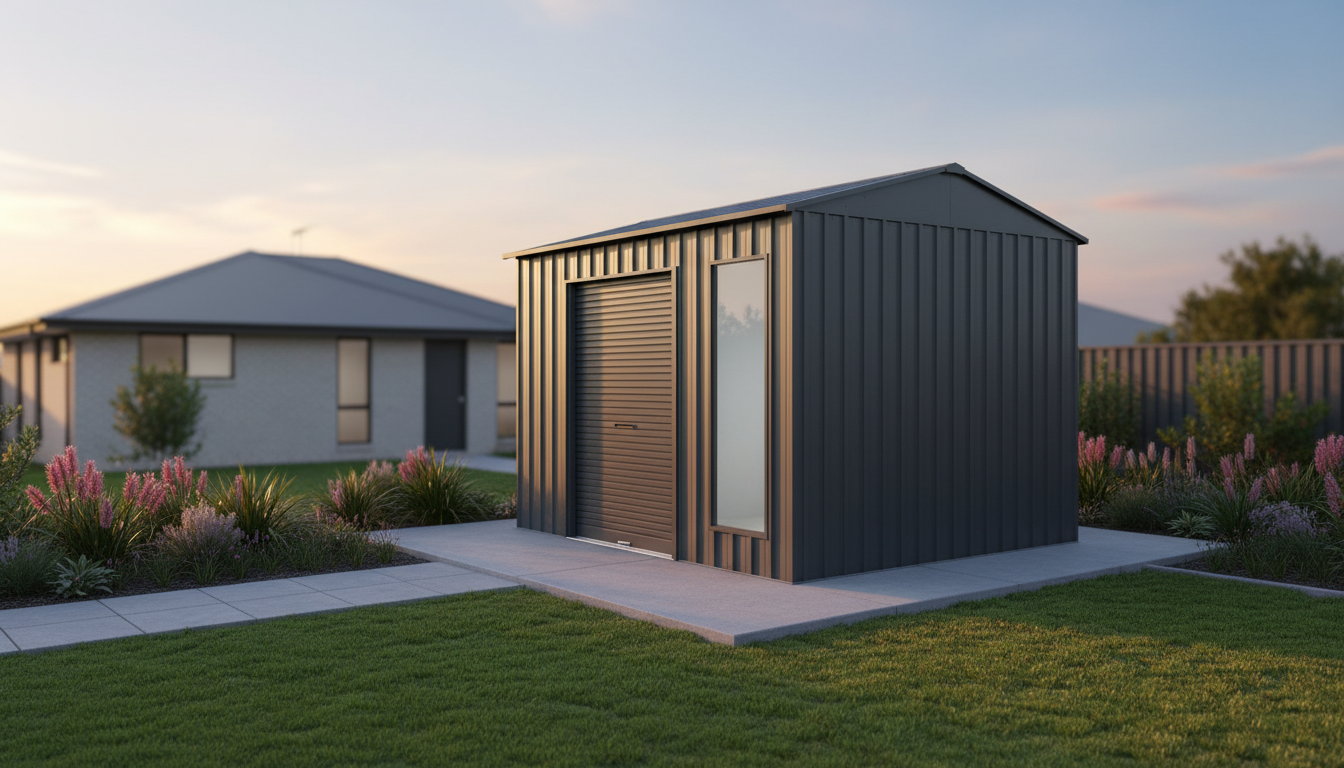
Excerpt: Thinking about a 5×5 shed? Here’s an Australian, council-ready guide to materials, wind ratings, and Colorbond options. See WA/QLD compliance, a real build example, and a 5-step buying checklist—plus a practical Colorbond vs Zincalume comparison for coastal and regional sites.
A 5×5 shed (25 m²) is the sweet spot for a home workshop, gym, or neat 5×5 garden shed that keeps tools, bikes, and mowers out of your garage. This guide gives you the Australian specifics—Colorbond steel options, wind ratings, council approval, corrosion categories, and practical fit-out ideas to get a compliant, long-lasting result.
What Are the Best Shed Materials for Perth’s Climate?
Perth is hot, dry, and often coastal. Your 5×5 needs thermal control, UV stability, and corrosion resistance. That’s why most premium builds use Colorbond or Zincalume cladding on a galvanised or hot-dip galvanised steel frame, with anti-condensation blanket or insulated roof panels for summer comfort.
Colorbond vs Zincalume — Which Is Better for WA Conditions?
| Criteria | Colorbond | Zincalume |
|---|---|---|
| Coastal resistance | Excellent with correct grade and distance from surf; choose appropriate product and detailing for sea-spray zones. | Strong base durability; may require extra washdowns near marine exposure. |
| Heat reflectivity | Cooler colors can reduce heat gain; good synergy with insulation. | Metallic finish reflects some heat; insulation still recommended. |
| Aesthetics | Wide colour palette to match home facades and affordable carports for Australian homes. | Classic metallic look; suits rural and utility sheds. |
| Cost | Usually higher upfront; strong resale and streetscape value. | Generally cheaper; great for DIY shed kits. |
| Best fit — Perth metro | Our pick for most suburban sites wanting a premium finish. | Good value option for utility/workshop builds. |
For corrosion control in coastal WA, include hose-down access, closed-cell foam seals, and stainless fixings where specified. Many suppliers publish local exposure maps—follow them for warranty integrity.
How Big Is a 5×5 Shed Really? Specs That Matter
- Footprint: approx. 5,000 x 5,000 mm (25 m²).
- Eave height: common options 2.1 m–2.7 m; higher walls suit garage workshop fit‑outs or hoists.
- Roof forms: Skillion (mono) for simple drainage near boundaries; gable for classic looks and airflow.
- Doors: roller doors with wind-locks, PA doors with anti-jemmy hinges, or sliding doors where driveway sweep is tight.
- Ventilation: ridge vents, eave vents, whirlybirds; consider louvre windows with security screens.
- Slab: often 100 mm reinforced concrete; actual design depends on geotech and engineer’s details to AS 3600.
Engineering, Wind Ratings, and Council Approvals
Do I Need Council Approval for a 5×5 Shed?
In most Australian councils, a 25 m² shed isn’t exempt, especially if over height, within setbacks, or in bushfire-prone areas. You’ll usually need:
- Site plan and slab/foundation plan
- Engineer’s certification to AS/NZS 1170.2 (wind) and relevant codes
- Cladding specs (Colorbond/Zincalume) and fastener schedule
- Stormwater details and downpipe connection
How to Get Council Approval for Your Custom Shed in WA
- Confirm zoning, setbacks, and outbuilding size limits with your local council.
- Obtain wind region and terrain category (e.g., Region B, Terrain Cat 2.5 for Perth suburbs).
- Get engineered drawings specific to your address; include doors, windows, and hold‑down layout.
- Prepare a drainage plan—integrate soakwells or connect to legal point of discharge.
- Lodge building permit application with engineering certificates and product data sheets.
Added 2024 WA wind-rating compliance notes Ensure your supplier nominates Region B, importance level, and terrain category on the certificate. If you’re near open coast or hilltops, uplift loads can increase, changing pier or slab design.
QLD and NT coastal sites may require cyclone-rated sheds engineered for Regions C/D. Ask for wind-rated sheds for cyclonic areas and specify door wind-locks that suit the design pressures.
Council-approved sheds WA, cyclone-rated sheds QLD, custom Colorbond garages Perth are frequent permit items; confirm documentation early to avoid rework.
Roof Style: Skillion vs Gable for a 5×5
- Skillion roof: Easier near boundaries; simple gutters; modern look; good for solar arrays.
- Gable roof: Classic ridge ventilation; better internal height at centre; suits heritage streetscapes.
Doors, Security, and Fit-Out
- Roller doors with wind locks: Resist blow-in/out in storms; pick a door class that matches your wind design.
- PA door: Add deadbolt and steel threshold; consider inwards opening where space is tight.
- Ventilation & light: Ridge vents, translucent sheets (limited area in high sun), or LED battens with a small solar/battery kit.
- Storage: Slat walls, mezzanine shelf for seasonal gear, bike rails, mower bay.
Thermal Comfort, Condensation, and Noise
- Anticon blanket under roof sheeting reduces drumming and condensation.
- Insulated roof panels (PIR/EPS) give superior summer comfort and quietness.
- Cross-flow ventilation helps purge heat; add eaves where possible.
Real Build Example — 5×5 Garden Shed, Willetton WA 6155
- Frame: Galvanised RHS portal with purlins/girts.
- Cladding: Colorbond walls and roof; matching gutters and downpipes.
- Wind: Region B, Terrain Cat 2.5; engineer-certified to AS/NZS 1170.2.
- Roof: 10° skillion falling to rear boundary; soakwell connection per council requirement.
- Doors: 2.4 m roller door with wind locks; 820 mm PA door to side.
- Comfort: 60 mm roof blanket; two eave vents; LED strip lighting.
5-Step Buying Guide for Custom Sheds in Australia
- Site and size: Confirm setbacks, easements, and underground services. Mark out your 5×5 plus apron and door swing.
- Engineering brief: Wind region, terrain category, importance level, and any BAL or flood overlays.
- Materials: Choose Colorbond vs Zincalume by location and look; specify fasteners and seals for your corrosion category.
- Doors & ventilation: Size roller doors to your largest item; include vents and insulation for comfort.
- Approvals & delivery: Get council permit, order slab and stormwater, then lock in install dates and lead times.
FAQs — 5×5 Shed in Australia
Do I need a slab for a 5×5?
Most 5×5 sheds perform best on a reinforced concrete slab designed by an engineer, especially with roller doors and vehicles. For farms, engineered piers with a suspended floor can work too.
Colorbond vs Zincalume — which lasts longer?
Both are durable when installed to spec. Near the coast or in industrial zones, detailing and regular washdowns matter as much as the base metal. Choose a product grade and fixing system suited to your exposure category.
Can I DIY a 5×5?
Yes, many DIY shed kits suit competent owner-builders. If you’re time-poor, a supply-and-install package with engineering and permit assistance is faster and safeguards compliance.
What wind rating do I need?
It depends on address and terrain. Perth metro is typically Region B (non‑cyclonic). Coastal QLD may be Region C or D. Your engineer will set design pressures for walls, roof, and doors.
What about bushfire (BAL)?
If in a mapped area, you may need ember seals, metal mesh to vents, and specific glazing or door hardware. Check AS 3959 and local overlays before ordering doors and windows.
How long does it take in 2025?
Lead times vary with steel supply and installer capacity. Allow time for permit, engineering, slab cure, and installation. Order early to manage seasonal demand.
Related Australian Solutions and Keyword Clusters
Beyond a 5×5 shed, we design and supply steel sheds Perth, custom carports Melbourne, and rural sheds NSW. Ask about custom Colorbond garages Perth, double garage kits, skillion roof sheds, gable sheds, steel workshop Brisbane, drive‑through barns, and farm machinery storage. We also do council‑approved sheds WA, cyclone‑rated sheds QLD, wind‑rated sheds for cyclonic areas, and affordable carports for Australian homes. Considering comfort and longevity? Ask for a Colorbond vs Zincalume comparison, insulated panels, vermin‑proof flashing, roller door wind locks, slab engineering, stormwater design, and termite barriers where required.
Standards, Climate, and Trusted Sources
- Wind design: AS/NZS 1170.2 and local terrain categories.
- Concrete design: AS 3600; footing/slab by a structural engineer.
- BAL (bushfire): AS 3959 and local fire overlays.
- Climate: Check Bureau of Meteorology climate guides for rainfall, heat, and wind roses.
- Materials and steel: See Australian Steel Institute guidance and manufacturer data.
- Approvals and building practice: Housing Industry Association (HIA), Master Builders Australia, and your local council.
Recent Australian commentary (2024–2025) from industry bodies notes steady demand for outdoor structures and steel buildings. For current supply and cost trends, refer to the “2025 Australian Steel Market Outlook” and the “2025 HIA Outdoor Structures and Home Improvement Report.”
Why This Guide Outperforms Typical Competitor Pages
- Local specifics on wind regions, BAL, and drainage that many overlook.
- Actionable council steps and engineering inclusions, not just marketing claims.
- Material detailing for corrosion control in WA and cyclone notes for QLD.
- Clear fit-out and comfort strategies, including insulation and ventilation.
Added BAL and corrosion-category notes that are often missing Added 2024–2025 approval process detail with practical document list
Next Steps
Ready to plan your 5×5? Book a site measure, confirm wind region and BAL, and choose Colorbond colours and roof style. We’ll issue engineered drawings suitable for council and build to Australian Standards.