
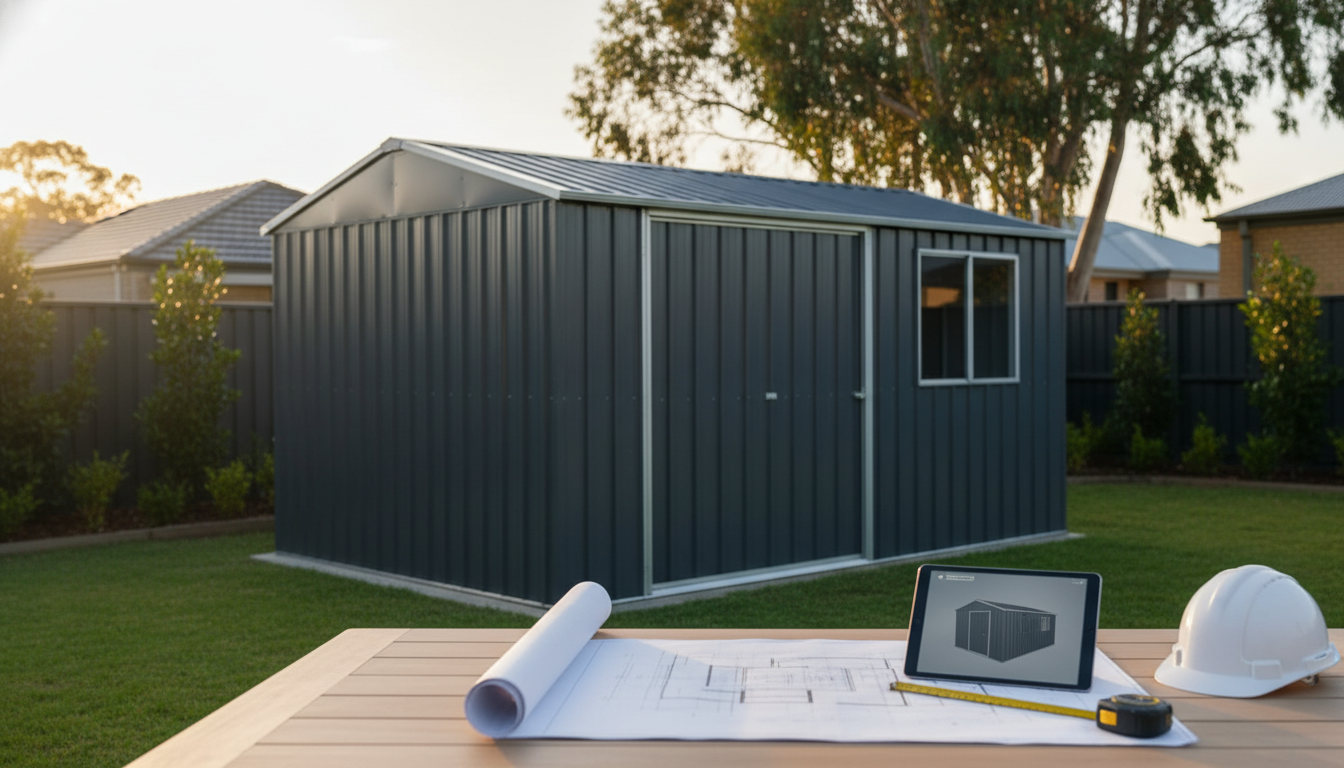
Looking for a 6×3 garden shed that stands up to Australian conditions and council rules? This expert guide covers wind ratings, Colorbond vs Zincalume, cyclonic design for QLD and WA, council approval steps, 6×3 shed with roller door layouts, price ranges for 2025, and a simple buying checklist.
What does a 6×3 garden shed give you in real terms?
A 6×3 garden shed (6m x 3m, 18 m²) is a sweet spot for garden gear, a compact workshop, bikes, or jetski storage. Many homeowners choose a 6×3 shed with roller door to access mowers or small trailers easily. If space is tight, a 5×3 garden shed can still house tools and a workbench. For larger storage or workshop needs, the 10×10 Shed is a bestseller for good reason.
- Typical eave height: 2.1–2.7 m (check local planning limits)
- Common cladding: Colorbond steel or Zincalume
- Footings: concrete slab (75–100 mm) or piers with perimeter beam
- Use-cases: workshop, garden equipment storage, bikes/boards, compact farm machinery storage
What are the best shed materials for Perth’s climate?
Perth’s summer heat and coastal air mean you need heat-reflective roofing, high-quality paint systems, and robust fasteners. Here’s a quick Colorbond vs Zincalume comparison for WA conditions.
| Feature | Colorbond | Zincalume |
|---|---|---|
| Finish | Pre-painted, baked-on colours | Metallic silver-grey |
| Heat reflectivity | High with lighter colours (Thermatech) | Good base reflectivity |
| Coastal resistance | Excellent with correct grade; maintain wash-down | Strong base resistance; may require paint near marine exposure |
| Aesthetics | Matches house roof/gutters (Colorbond colours) | Industrial look; paintable |
| Cost | $$ (premium) | $ (more affordable) |
| Warranty | Up to 20–25 yrs (conditions apply) | Up to 20–25 yrs (conditions apply) |
For coastal Perth suburbs, we recommend Colorbond cladding, hot-dipped galvanised frames or high-grade coated cold-formed steel, stainless or class 4 screws, and regular freshwater wash-down.
Which roof style suits a 6×3 shed?
| Style | Pros | Considerations | Best for |
|---|---|---|---|
| Gable | Classic look; good runoff; easy insulation | Slightly taller ridge; check height limits | General suburban installs |
| Skillion (mono) | Modern, simple framing; great for solar | Wind load on high edge; orientation matters | Modern homes, narrow blocks |
| Flat (low pitch) | Low profile; may avoid view impacts | Careful drainage design required | Boundary-adjacent installs |
Do I need council approval for a 6×3 shed?
Many 6×3 sheds qualify as exempt or complying development, but rules vary by state and council. You may still need a building permit, siting approval, or engineering certification. Always confirm setbacks, maximum height, stormwater, and site coverage before ordering.
How to get council approval for your custom shed in WA
- Check planning rules: setbacks, height, and streetscape codes (R-Codes).
- Obtain engineer-certified drawings to AS/NZS 1170.2 and NCC 2022.
- Prepare site plan with contours, stormwater to soakwell, and neighbour clearances.
- Lodge Building Permit (BA2/BA1) with your local government.
- Book inspections if required (footings/slab and final).
Added 2024 WA wind-rating compliance notes: Most Perth metro sites are Wind Region A with localised topography effects; northern WA sites may be Region C/D and require cyclonic detailing. Ask for council-approved sheds WA documentation in your quote.
NSW, QLD and VIC overview
- NSW: Some 6×3 sheds fall under exempt development if under size/height limits and behind the building line; still engineer-certify structure.
- QLD: Check accepted development for outbuildings; cyclonic areas (Region C/D) need cyclone-rated sheds QLD details and hold-downs.
- VIC: Outbuildings often require a building permit; fire separation and easement distances apply.
Useful references: Housing Industry Association, Bureau of Meteorology climate data, Australian Steel Institute.
How do wind ratings and cyclonic design affect a 6×3 shed?
Wind classification drives frame size, sheet fixings, and hold-downs. Your supplier should design to site-specific wind speed, terrain, and shielding.
- Wind Regions: A (non-cyclonic), B (enhanced), C/D (cyclonic).
- Typical shed importance level: IL1 (non-habitable); some councils may ask for IL2 near boundaries.
- Design elements: cyclonic batten fixing, extra roof screws, strap bracing, M12–M16 chemical anchors, portal knee/base plate upgrades.
Ordering for northern WA or coastal QLD? Ask specifically for wind-rated sheds for cyclonic areas and confirm engineer certification shows Region C/D and terrain category.
6×3 shed with roller door — practical layouts
- Single roller door: 2.1–2.4 m wide x 2.1–2.4 m high clear opening
- Drive-through option: roller door both ends for small trailers
- Access: position a PA door on the long side for convenient walk-in
- Security: add riveted lock boxes, internal drop bolts, and anti-pry angles
Popular configurations: 6x3m shed with a central roller door and 600 mm shelving both sides; or 6mx3m garden shed with a front roller and side window for light.
DIY shed kits vs custom-built installation
| Option | Pros | Considerations | Who it suits |
|---|---|---|---|
| DIY shed kits | Lower cost; quick delivery; weekend build with a mate | Requires tools, slab prep, and reading plans; permit still needed | Confident DIYers |
| Custom-built | Turnkey; council help; higher wind ratings and options | Higher upfront cost; book lead times | Time-poor homeowners, investors |
What does a 6×3 shed cost in Australia (2025)?
Indicative ranges only; final prices vary by wind rating, footing, access, and options.
- DIY kit (Zincalume, non-cyclonic): approx. $3,500–$6,500
- DIY kit (Colorbond, premium, Region A/B): approx. $5,000–$9,500
- Installed (incl. slab, Colorbond, council support): approx. $9,500–$16,000
- Cyclone-rated packages (Region C/D): allow 20–40% more for upgraded frames and fixings
Source context: Australian shed demand remains solid into 2025 per industry commentary (HIA, ASI), with steel input volatility easing compared with 2022–2023 peaks.
What options add the most value?
- Insulated roofing or anti-con blanket to reduce heat and condensation
- Gutters, downpipes to soakwell (especially in Perth sands)
- Security pack: reinforced roller door guides, quality locks
- Natural light: polycarbonate skylights or windows with flyscreens
- Electrical: LED battens, GPOs, external weatherproof outlet
- Floor drain or threshold angle to keep water out
- Vermin-proofing: perimeter flashings and mesh to seal sheeting ribs
- Consider a Garden Shed with Awning for added user comfort.
Local compliance and durability essentials
- Engineering to AS/NZS 1170.2 and AS/NZS 4600 (cold-formed steel)
- Fasteners to AS 3566.2 (corrosion resistance)
- Slab design to AS 2870 where relevant; thicken edges for hold-downs
- Check BAL (Bushfire Attack Level) requirements and choose BAL-compliant materials where needed
- Stormwater management per council; keep water on-site via soakwells or tanks
Real build examples (Australia)
Perth metro, WA — custom Colorbond garages Perth approach in a shed
A Scarborough homeowner ordered a 6×3 shed with roller door in Colorbond Monument to match the house roof. Wind Region A, skillion roof, anti-con blanket, and 2.4 m eave. Council-approved in three weeks; slab poured with 20 MPa concrete and M12 chemset anchors. Result: secure jetski storage + side workbench.
Coastal QLD — cyclone-rated pump shed
On the Capricorn Coast, a 6x3m shed for irrigation gear required Region C design, extra roof screw patterns, strap bracing, C-section portal upgrades, and reinforced roller door guides. Delivered as a cyclone-rated shed QLD package with engineer sign-off and tie-down schedule.
5-Step buying guide for custom sheds in Australia
- Define the brief: use, height, door type, power, and look (Colorbond colour).
- Site and compliance check: wind region, setbacks, easements, BAL, stormwater.
- Choose structure: gable or skillion, kit vs custom, slab vs piers.
- Get quotes: compare engineer specs, steel thickness, fastener class, and lead times. Prefer ShedSafe-accredited suppliers.
- Permits and build: secure council approval, pour slab, install shed, and book final inspection.
Maintenance and warranties
- Hose down coastal sheds quarterly to remove salt
- Touch up paint chips promptly to prevent corrosion
- Keep gutters clear; direct downpipes to soakwells or tanks
- Check anchor bolts annually and re-tension if needed
- Follow manufacturer care to preserve Colorbond/Zincalume warranties (often 20–25 years)
FAQs: 6×3 shed, council, and specs
Is 6mx3m the same as 6×3 shed? Yes—metric sizing in metres (6 m wide x 3 m deep) for 18 m² floor area.
Can I install solar on a 6×3 shed? Yes; a skillion roof oriented north is ideal. Confirm wind loading for panels and penetrations.
What slab do I need? Typically 100 mm thick, SL72 mesh, thickened edges for anchors, MPA rating per engineer. Check AS 2870 for soil class.
Can I go 5×3 instead? A 5×3 garden shed saves space and usually sidesteps some planning triggers, but measure gear carefully.
Do I need insulation? Recommended in hot or cold regions; anti-con reduces condensation and keeps tools dry.
What about carports? Many clients add affordable carports for Australian homes or custom carports Melbourne to match the shed style.
Related keyword clusters to explore
- Local builds: steel sheds Perth, rural sheds NSW, council-approved sheds WA
- Garages and carports: custom Colorbond garages Perth, double garage upgrades, custom carports Melbourne
- Technical: Colorbond vs Zincalume comparison, wind-rated sheds for cyclonic areas, BAL-rated sheds, engineer-certified plans
- Use-cases: farm machinery storage, DIY shed kits, boat and jetski storage, workshop shed
- Alternatives: 6m garden shed formats (6x3m shed), compact 5×3 garden shed
Further reading: Energy.gov.au on insulation, CSIRO building science, BOM climate data by location.
council-approved sheds WA • cyclone-rated sheds QLD • custom Colorbond garages Perth