
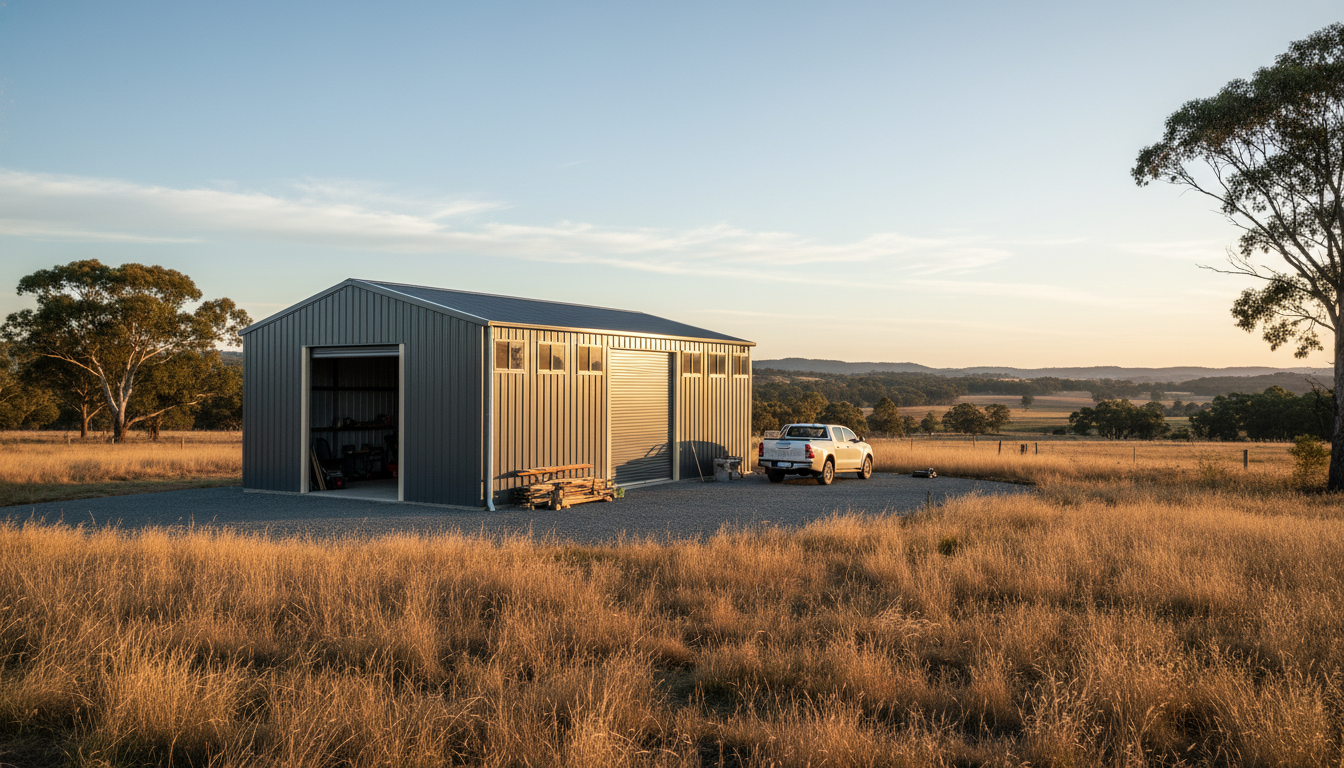
Build a 6×9 Storage Shed That’s Council‑Compliant and Built to Last
If you’re planning a 6×9 storage shed (also written as 6m x 9m), this guide covers everything a time‑poor owner or tradie needs: compliant engineering, Colorbond vs Zincalume, wind ratings for cyclonic areas, council approval, slab design, and whether a DIY shed kit or custom build is the smarter move.
How Big Is a 6×9 Storage Shed—and What Can It Fit?
A 6×9 storage shed offers 54 m² of floor area with flexible wall heights from 2.4 m to 3.6 m. It’s a sweet spot for suburban blocks and rural sheds in NSW or VIC, with enough span for:
- Two small cars or one custom-built double garage bay with a workshop
- Farm machinery storage (mower, quad, implements) and parts racking
- Trade workshop with mezzanine storage and roller door access
- Boat or caravan storage (check door height and clearances)
Common configurations include a gable roof with twin roller doors, or a skillion roof 6m frontage with a single 3.0 m roller door plus a personal access door and windows for crossflow ventilation.
What Are the Best Shed Materials for Perth’s Climate?
Perth heat and UV punish cheap cladding. For steel sheds Perth homeowners usually choose Colorbond due to colour stability and reduced maintenance, while Zincalume is popular inland as a cost‑effective option. In coastal or industrial zones, upgrade to Colorbond Ultra or additional protective coatings to handle salt spray.
Colorbond vs Zincalume — Which Is Better for WA Conditions?
| Feature | Colorbond | Zincalume |
|---|---|---|
| Finish | Pre‑painted in Australian colours (e.g., Monument, Surfmist) | Silver metallic (no paint) |
| Heat performance | Choice of lighter colours for better solar reflectance | High reflectance initially; can dull over time |
| Coastal suitability | Choose Colorbond Ultra for marine influence | Use with caution near surf coasts; maintain wash‑down |
| Cost | Slightly higher upfront | Lower upfront |
| Aesthetics | Architectural look; easy match with custom carports Melbourne or patios | Utilitarian look |
How Much Does a 6×9 Shed Cost in Australia (2025)?
Actual pricing varies with wind region, engineering, wall height, doors, and finish. Recent market commentary (see the 2025 Australian Steel Market Outlook and HIA Outdoor Structures report) indicates steady demand and lead times, with steel input costs stabilising after 2023 peaks.
- 6×9 shed kit (Region A/B, 2.7 m eave, one roller door, PA door, Colorbond walls/roof): typically $9,500–$15,000 supplied only.
- Custom 6m x 9m shed (engineered, Region B/C, 3.0 m eave, two 3.0 m roller doors, windows, insulation, gutters/downpipes): $16,000–$28,000 supplied and installed, excluding slab.
- Concrete slab (100–120 mm thick with thickenings, typical suburban soil): $4,000–$8,000 depending on site access and soil conditions.
For a significantly larger alternative, view the 10×20 Shed.
Allow for electrical fit‑out, council fees, and stormwater connections. For cyclone-rated sheds QLD or WA north, the heavier frame, hold‑downs and doors increase cost but are essential for compliance.
Which Roof Style and Layout Works Best for a 6×9?
- Gable roof: Classic look, good drainage and headroom. Ideal when matching custom Colorbond garages Perth or existing roof pitches.
- Skillion roof: Modern profile, efficient install, easy to solar‑panel. Great near boundaries to shed water to one side.
- Roof pitch: 2.5°–10° common for skillion; 10°–22.5° for gable. Higher pitch improves heat exhaust and suits ceiling fans or whirlybirds.
- Openings: Choose wind-rated roller doors, 2.4–3.0 m height. Add a PA door (hinged) for safety and convenience.
- Ventilation: Ridge vents, louvre windows, and whirlybirds reduce condensation—especially in cool southern climates.
Do I Need Council Approval for a 6×9 Shed?
Most Australian councils require approvals for a 6×9 storage shed due to size, height, and setbacks. Your certifier or council will assess against NCC (Building Code of Australia), local planning overlays, and bushfire or flood controls.
How to Get Council Approval for Your Custom Shed in WA
For council-approved sheds WA wide, you’ll typically lodge a Building Permit (BA1/BA2) with site plan, engineering, and specifications that meet NCC 2022 and AS/NZS standards. Many shires also want stormwater and soakwell details. Added 2024 WA wind-rating compliance notes: WA coastal suburbs can trigger higher design wind speeds—ensure your engineering certificate nominates Region B or C, terrain category, topographic multipliers and serviceability limits per AS/NZS 1170.2.
Queensland Cyclonic Notes
In QLD’s Regions C and D, cyclone-rated sheds QLD require specific detailing—cyclonic roller doors, additional tie‑downs, sheeting fastener patterns, and heavier portal frames. Certification must reference AS/NZS 1170.2 and be signed by an RPEQ engineer.
NSW and VIC Planning Basics
- NSW: Rural sheds NSW may qualify for exempt or complying development if they meet setback, height, and floor‑area thresholds—check the NSW Planning Portal.
- VIC: Most 6×9 sheds need a building permit. Bushfire overlays trigger BAL requirements under AS 3959 for cladding, ember seals, and spark arrestors.
What Wind Rating and Footing Design Should I Specify?
- Wind actions: Design to AS/NZS 1170.2 with correct region (A–D), terrain category, shielding, and topographic multipliers.
- Structure: Portal frame in galvanised RHS/UB with purlins and girts to AS/NZS 4600 (cold‑formed steel) or AS 4100 (steel structures).
- Hold‑downs: Cyclonic regions use additional anchors; non‑cyclonic still need compliant cast‑in bolts or M12/M16 chemset anchors with edge cover.
- Footings: Typical 100–120 mm slab with thickened edge beams; piers may be used on reactive sites. Always obtain a soil test where required.
- Roofing/cladding: Fix to AS 1562.1 and manufacturer specs; use compliant screw patterns for wind uplift, especially near edges and corners.
Look for ShedSafe accredited suppliers to ensure the engineering matches your site, not a generic postcode average.
6×9 Shed Kit vs Custom-Built: Which Suits You?
6×9 shed kit:
- Best for: Experienced DIYers, flat sites, non‑cyclonic regions.
- Pros: Lower cost, fast delivery, weekend‑friendly. Many DIY shed kits include pre‑cut purlins, girts and labelled portal frames.
- Watch‑outs: You handle compliance, slab, and erection risks. Insurance may require proof of licensed electrical and structural sign‑off.
Alternatively, a 12×6 Shed could suit massive storage needs.
Custom-built 6m x 9m shed:
- Best for: Sloping or tight sites, higher wind regions, premium finish.
- Pros: Turnkey approvals, engineered for site, better fit‑out options (insulation, ventilation, vermin flashing, lined walls).
- Watch‑outs: Higher upfront cost. Lead times can extend in peak seasons.
Use Cases and Fit‑Out Ideas for a 6×9
- Trade workshop: Add a 10 A/15 A GPO layout, LED high bays, benching, and a 2.4 m mezzanine.
- Garden + hobby: Racks, pegboards, and sealed floors; include a PA door and insect‑screened louvres.
- Vehicle/boat bay: 3.0 m wind-rated roller door, bollards, oil‑resistant sealer, and a floor waste (where permitted).
- Farm machinery storage: Extra clearance (3.6 m eave), wider bay spacing, and sliding doors for durability.
- Home value add: Pair with affordable carports for Australian homes or a matching patio for a cohesive streetscape.
Thermal, Moisture and Durability Choices
- Insulation: Anticon blanket under roof sheets; consider R1.3–R2.5 wall batts behind internal linings.
- Condensation control: Vapour permeable sarking, ridge vent, and crossflow wall vents—vital in cool climates.
- Coastal corrosion: Select Colorbond Ultra or marine‑grade fasteners within 1 km of surf coasts; hose down salt where practical.
- Bushfire: BAL‑rated sheds may require ember‑proof mesh, sealed gaps, and non‑combustible cladding to AS 3959.
Real‑World Build Examples
Case Study 1 — Bayswater, Perth WA (Heat & Street Appeal)
- Spec: 6×9, 3.0 m eave, skillion roof 5°, Colorbond Monument walls/roof, 2 x 3.0 m roller doors, PA door, two louvre windows.
- Why: Workshop plus small car storage; matched a custom Colorbond garage and fence.
- Upgrades: R1.3 anticon blanket, whirlybird, solar‑ready roof, 100 mm slab with edge thickening, soakwell drainage.
- Outcome: 6‑week lead time, 3‑day install; internal temps reduced noticeably in summer afternoons.
Case Study 2 — Bundaberg QLD (Cyclonic Considerations)
- Spec: 6×9, 3.6 m eave, gable 15°, Zincalume roof with Colorbond walls, cyclonic roller door kit, extra roof fasteners per edge zones.
- Engineering: Region C design to AS/NZS 1170.2; upgraded hold‑downs and door wind locks.
- Outcome: Council signed off quickly with RPEQ certificate; higher upfront cost but insurer accepted cyclone-rated design without exclusions.
5‑Step Buying Guide for Custom Sheds in Australia
- Site + size: Measure setbacks, easements, access, and overhead services; pick your 6×9 orientation and door positions.
- Wind + environment: Confirm wind region (A–D), terrain, and bushfire or flood overlays; choose Colorbond vs Zincalume accordingly.
- Engineering + approvals: Use ShedSafe suppliers; demand site‑specific AS/NZS 1170.2 calculations and NCC‑compliant drawings.
- Fit‑out + future proofing: Add insulation, conduit for power and data, mezzanine allowances, and a solar‑ready roof.
- Contracts + warranty: Check inclusions, slab specs, lead times, licencing, and warranty terms for cladding, frame, and doors.
Frequently Asked Questions
Is a 6×9 shed big enough for two cars?
Yes for small to mid‑size cars with careful door placement. Consider two 2.7–3.0 m roller doors and 6.0–6.5 m internal depth for comfortable access.
Do I need a concrete slab?
For most council‑approved builds, yes. A 100–120 mm slab with edge beams is common. Rural sites sometimes use piers and strip footings—engineer to soil conditions.
What wall height should I choose?
2.7 m suits most uses; 3.0–3.6 m if you need a hoist, caravan clearance, or mezzanine storage.
Can I DIY a 6×9 shed kit?
Many owners do, particularly in non‑cyclonic regions with good access and lifting gear. Always follow engineering drawings and safety practices; electrical work must be licensed.
What colours are available?
Colorbond has a wide palette (e.g., Surfmist, Shale Grey, Monument, Dune). Zincalume is the bare metallic finish; some owners paint interiors for brightness.
How long does it take?
Typical timeline: 2–4 weeks for approvals, 2–6 weeks manufacturing, 2–4 days on‑site erection for standard 6×9 sheds, weather permitting.
Specifications Checklist for a 6×9 Shed
- Frame: Galvanised portal frame to AS/NZS 4600 or AS 4100, hot‑dip or pre‑galv as specified.
- Cladding: Colorbond (or Colorbond Ultra coastal) or Zincalume; roofing profile to manufacturer’s span tables.
- Wind design: AS/NZS 1170.2 site‑specific region, terrain, shielding, and topographic multipliers.
- Fasteners: Cyclone or non‑cyclone patterns; compatible coatings to prevent bimetallic corrosion.
- Doors: Wind‑rated roller doors; add wind locks for Regions C/D.
- Drainage: Gutters/downpipes sized to AS/NZS 3500.3; stormwater or soakwells as required.
- Thermal: Anticon blanket or insulated panels; vapour‑permeable sarking for condensation control.
- Vermin + sealing: Vermin flashing at slab edge; seal penetrations.
- BAL and coastal notes: Detail per AS 3959; use marine‑grade fixings near surf.
Local Insights by Region
- Perth (hot, dry, coastal): Prioritise heat reflectance and corrosion resistance; Colorbond Ultra and light roof colours help.
- Brisbane/QLD coast (humid, storm‑prone): Cyclone detailing, extra ventilation, and mould‑resistant linings.
- Southern states (cooler nights): Condensation control with sarking, ridge venting, and insulation is crucial.
- Rural sites: Consider dust control, bigger eaves, and robust sliding doors for machinery access.
Keyword Clusters You Might Be Searching
6×9 storage shed, 6×9 shed kit, 6m x 9m shed, steel sheds Perth, custom Colorbond garages Perth, council-approved sheds WA, cyclone-rated sheds QLD, rural sheds NSW, DIY shed kits, wind-rated sheds for cyclonic areas, Colorbond vs Zincalume comparison, farm machinery storage, affordable carports for Australian homes, custom carports Melbourne, gable vs skillion shed roof, mezzanine storage, roller doors for sheds, insulated shed roofs, portal frame sheds, coastal corrosion protection.
Trusted Standards, Sources and Further Reading
- Bureau of Meteorology climate maps for wind and cyclone context.
- Australian Standards including AS/NZS 1170.2 (wind actions), AS/NZS 4600, AS 4100, AS 1562.1, AS 3959.
- Housing Industry Association (HIA) Outdoor Structures and Home Improvement updates.
- Master Builders Australia for building compliance guidance.
- Australian Steel Institute for steel design resources.
- Energy.gov.au on insulation and passive cooling measures.
- CSIRO research on condensation management in buildings.
Ready to price your 6×9? Decide whether a 6×9 shed kit suits your skills or opt for a turnkey, engineered build tailored to your wind region and council rules. With the right materials and compliance, your new Colorbond steel shed will look sharp and last decades.