
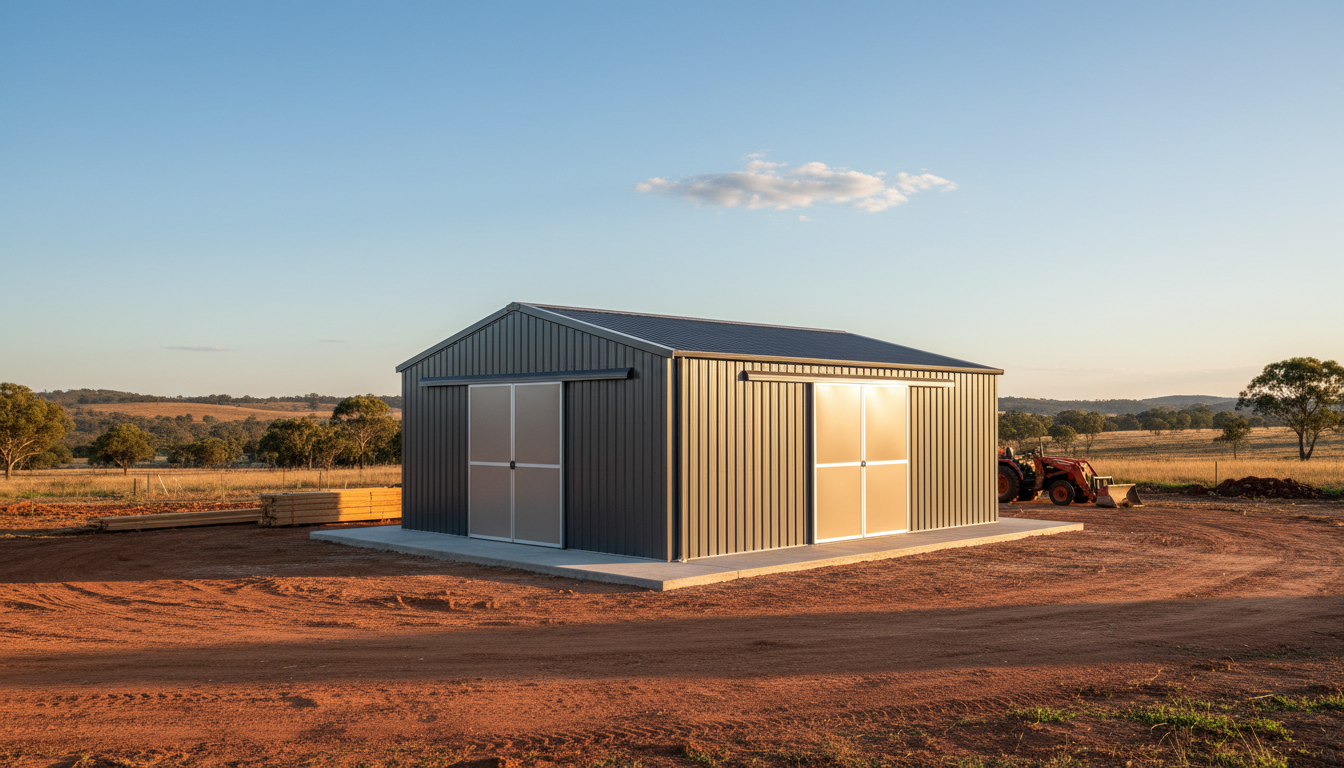
The 9×12 storage shed (9m x 12m) is a sweet spot for Australian backyards, smallholdings, and tradie setups—big enough for a workshop plus vehicle storage, compact enough to fit most suburban blocks. Below is a complete, no-nonsense guide tailored to Australian conditions, codes, and budgets.
What size is a 9×12 storage shed in Australia?
In Australia, a “9×12 storage shed” generally means 9 metres by 12 metres—108 square metres (roughly a double-plus garage with a workspace). You’ll also see “12×9 shed” used interchangeably.
- Floor area: 108 m²
- Common wall heights: 2.4 m, 2.7 m, 3.0 m (rural or machinery storage often 3.6 m+)
- Typical door options: 1–2 roller doors (3.0 m wide), one PA door, optional glass sliding door, windows with security grills
Comparable and common shed sizes in Australia (for planning and quoting):
- 12m x 6m shed price (72 m²)
- 10m x 6m shed prices (60 m²)
- 10m x 10m shed price (100 m²)
- 12m x 8m shed price (96 m²)
- 12m x 9m shed price (108 m²)
- 20 sqm shed (ideal for small storage or garden gear)
- Big sheds Australia / big shed kits (150–400+ m² for farms and workshops)
These align with standard shed sizes Australia homeowners and rural buyers request, but every site and use-case is different. Ask for engineered drawings that match your exact wind region and terrain category.
How much does a 9×12 storage shed cost in 2025?
Prices vary by engineering, wall height, wind rating, and spec level (Colorbond vs Zincalume, insulation, doors). Based on 2025 steel market conditions and current install rates, typical ranges are:
- Kit only (engineered, wind-rated): $18,000–$35,000
- Supply and install (no slab): $28,000–$55,000
- Turnkey (slab, install, typical council approvals): $45,000–$85,000+
Price drivers:
- Wind region (N2/N3 vs cyclone-rated sheds QLD like C2/C3)
- Wall height and bay spacing (tighter bays and taller walls need heavier steel)
- Doors and glazing (extra-wide roller doors, auto openers, security)
- Insulation and sarking (thermal and condensation control)
- Coastal exposure and paint system upgrades
- Site works: slab thickness, excavation, access for trucks/cranage
Quick ballpark comparisons (kit-only where noted):
- 12m x 6m shed price: $10,000–$22,000 (kit)
- 10m x 6m shed prices: $9,000–$20,000 (kit)
- 10m x 10m shed price: $16,000–$32,000 (kit)
- 12m x 8m shed price: $14,000–$28,000 (kit)
- 12×6 shed price: $10,000–$22,000 (kit)
- Industrial sheds prices (heavy portal frames, high wind ratings): from $550–$1,100+/m² installed depending on spec and region
If you need even more room, view the 10×20 Shed for high-capacity storage.
Reference context: 2025 Australian Steel Market Outlook and the 2025 HIA Outdoor Structures and Home Improvement Report indicate steel price volatility and higher labour costs compared to 2022–23, which can move quotes by 8–15% year-on-year.
What are the best shed materials for Perth’s climate?
For hot, dry summers, UV exposure, and seabreezes, Colorbond steel cladding over a galvanised frame is the go-to. Zincalume is popular for budget builds and rural sheds NSW and SA, but many homeowners in WA choose Colorbond for colour selection and corrosion resistance.
| Criteria | Colorbond | Zincalume |
|---|---|---|
| Initial cost | Higher | Lower |
| UV resistance (Perth heat) | Excellent | Very good |
| Coastal performance | Strong (check distance-to-sea specs) | Good (may need extra wash-down/maintenance) |
| Colour range | Wide Colorbond palette | Metallic finish only |
| Aesthetics for residential | Premium look | Industrial/rural look |
| Availability | Excellent | Excellent |
For another popular size, see 6×6 Shed Price in Australia 2025.
Which roof and frame options suit Australian conditions?
- Roof profiles: Trimdek, Corrugated, or Monoclad; BMT 0.42–0.48 mm for cladding; heavier options in high wind regions.
- Frames: Cold-formed galvanised C-sections and RHS, or heavy portal frames for wide bays and high doors.
- Roof styles:
- Gable roof: classic look, great for rain shedding and ceiling storage
- Skillion roof: modern, simpler construction, ideal for solar fall
- Flat roof: least common at this span due to drainage and structural limits
Are 9×12 sheds council-approved and wind-rated?
Yes—when supplied with certified engineering to the NCC (BCA) and relevant AS/NZS standards. Council-approved sheds WA, NSW, VIC, SA, and QLD will require site plans, footing/slab details, and wind-region-specific engineering.
Added 2024 WA wind-rating compliance notes Most of Perth and the South-West are N2/N3, while parts of the North-West are cyclonic (C regions). Your shed must meet AS/NZS 1170.2 for wind actions, plus AS/NZS 4600 (cold-formed steel), AS 4100 (steel structures), AS 1397 (steel sheet), and AS 1562 (roof and wall cladding). In QLD, cyclone-rated sheds QLD (C2/C3) need upgraded hold-downs, purlin spacing, and door bracing.
How to get council approval for your custom shed in WA
- Check planning rules: setbacks, height, boundary walls, and open space ratios.
- Commission site plan and engineered drawings (wind region, terrain, importance level).
- Lodge building permit (BA) with council or a private certifier, including energy and bushfire notes if relevant.
- Organise inspections: slab/footings, frame, and final sign-off.
- Keep all certificates and warranties for insurance and resale.
How should you plan the 9×12 layout and access?
- Door positions: consider driveway alignment and turning circles for utes, trailers, or farm machinery storage.
- Bay spacing: 3.0–4.0 m bays are common; match door width to the bay.
- Clearances: 3.0 m roller doors suit most 4WDs with roof racks; caravans/boats may need 3.6–4.2 m.
- Workflow: separate a clean vehicle bay from a dusty workshop or timber rack.
- Future-proofing: conduit for power/EV, extra noggins for shelving, solar-ready roof pitch on a skillion.
Should you buy a DIY kit or get a custom-built 9×12 shed?
DIY shed kits are cost-effective if you’re experienced and have mates and machinery for safe erection. Custom-built sheds suit time-poor owners and complex sites, including sloping blocks and boundary builds.
- DIY shed kits:
- Pros: cheaper, faster delivery, flexible scheduling
- Cons: lifting gear, risk of mistakes, council paperwork and inspections on you
- Custom-built:
- Pros: turnkey, engineered, council-approved, warranty-friendly
- Cons: higher upfront cost, lead times
We also design custom Colorbond garages Perth owners pair with affordable carports for Australian homes, plus custom carports Melbourne for front setbacks that limit enclosed space.
What foundations and slabs do 9×12 sheds need?
- Slab: commonly 100–125 mm thick, SL72–SL82 mesh, N12 bars at edges; increase thickness under heavy hoists.
- Footings/anchors: M12–M16 chemical anchors or cast-in bolts to engineer’s detail; cyclone tie-down upgrades in C regions.
- Set levels for stormwater fall; include spoon drains or ag lines as needed.
- Termite treatment and vapour barrier per NCC where applicable.
How does a 9×12 shed perform in heat, storms, and coastal areas?
- Heat (Perth, inland SA/NSW): roof insulation (R2.2+), foil sarking, ventilated ridge caps, whirlybirds or powered vents.
- Storms (QLD/NT): upgraded purlins, door bracing, and fixings to AS/NZS 1170.2, C-category engineering.
- Coastal: Colorbond Ultra or additional protective systems; regular wash-down; heavier fasteners.
What about electrical, plumbing, and insulation?
- Electrical: sub-board, LED high-bays, dedicated 15A/20A GPOs, EV-ready conduit, security lights/CCTV.
- Plumbing: floor waste for wet areas, external tap and sink for workshops; check trade waste rules.
- Insulation: R1.3–R2.5 roof/walls for comfort; acoustic batts if using power tools regularly.
Real Australian build examples
- Perth suburban workshop: 9×12 Colorbond Monument gable, 3.0 m wall height, two 3.0 m auto roller doors, R2.2 roof blanket, SL82 120 mm slab. Outcome: cooler workspace, compliant with N3 wind rating; build time 3 weeks plus slab cure.
- North QLD acreage: 9×12 skillion, 3.6 m wall height, cyclone-rated C2 design with reinforced door mullions and upgraded roof fixings. Outcome: machinery storage with high door clearance; satisfied council requirements in first pass.
What sizes compare to a 9×12 shed?
Standard storage shed sizes in Australia often include 6×6 (double garage), 7×9, 9×9, 9×12, 12×12, and bigger rural spans. If you’re browsing typical shed sizes and standard shed dimensions, check internal clear widths and actual door openings, not just external frame sizes. Storage shed dimensions listed by some suppliers exclude eaves—always confirm.
5-Step Buying Guide for Custom Sheds in Australia
- Define use and loads: vehicles, machinery, mezzanine, hoists, racking.
- Pick materials: Colorbond vs Zincalume; insulation level; door and window count.
- Engineer to site: wind rating, terrain, corrosion exposure, bushfire overlay if relevant.
- Permit path: council-approved sheds WA/VIC/NSW/QLD with full drawings and certificates.
- Build logistics: slab date, lead times, access for trucks/cranage, safety and insurance.
FAQs
Is a 9×12 shed too big for a suburban block? Often fine if setbacks and coverage rules are met. Check local planning—rear and side setbacks matter.
How long does approval take? 2–6 weeks typical depending on council workload and completeness of documents.
Can I add a mezzanine? Yes—engineer the frame and slab for point loads; add stairs to code.
What’s the best door size? 3.0 m wide roller doors suit most vehicles. Go 3.6–4.2 m high for vans, caravans, or boats.
Can a shed become a habitable space? Only if upgraded to meet NCC energy, fire, ventilation, and egress standards—usually a separate approval.
What maintenance is needed? Annual wash-down, check fixings and seals, lubricate roller doors, clear gutters. Coastal sites may need more frequent rinse-offs.
Standards, climate data, and further reading
- HIA guidance on residential building and permits
- Master Builders Australia industry resources
- Australian Steel Institute design notes
- Bureau of Meteorology climate and wind info
- CSIRO research on building performance
- Energy.gov.au tips for insulation and efficiency
Whether you need steel sheds Perth, rural sheds NSW, or custom Colorbond garages Perth, we’ll engineer a wind-rated, council-ready solution that suits your budget and site—DIY shed kits or fully custom-built.