

Understanding the 2 x 2 Garden Shed Dimensions and Layout
Precise measurements and footprint of 2m x 2m sheds
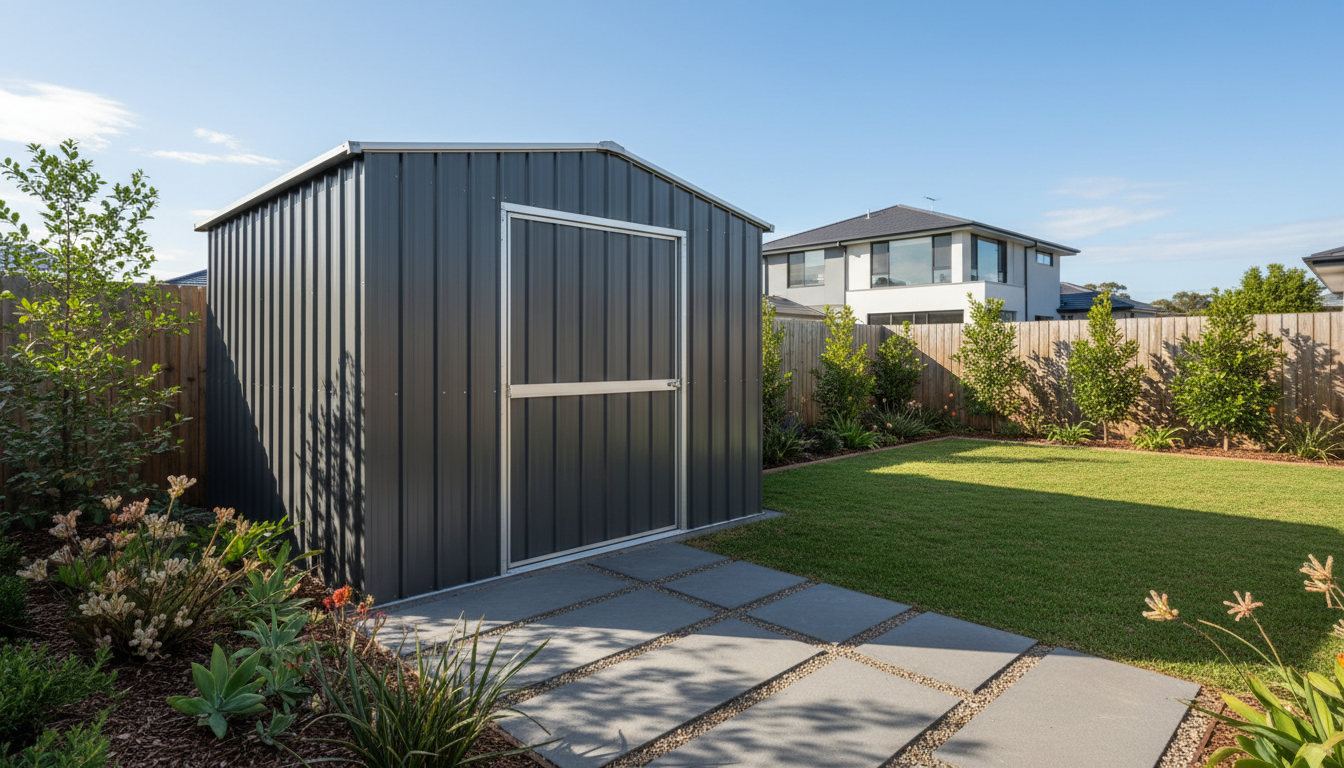
The external footprint of a standard 2m x 2m shed is about 4.00 m². Internal usable floor space is reduced by wall thickness and framing—typical usable internal dimensions are approximately 1,880 mm x 1,880 mm (1.88 m x 1.88 m). “Footprint” here means external ground area occupied.
Typical external heights vary by roof style (flat: ~2.10 m, skillion: ~2.3 m front to ~2.0 m rear, gable: up to ~2.4 m ridge). When planning, allow a minimum aisle/clearance of 600 mm for a single-person passage and 800–900 mm for comfortable access to shelving and a door swing.
Dimension diagram (plan view)
Example layout (not to scale): internal usable 1,880 mm x 1,880 mm; shelving depth options: 300 mm modular shelving (deep enough for pots/boxes), potting bench 600 mm along one side with 600–900 mm clearance for working. Leave a minimum 600 mm clear zone in front of the door for everyday access.

What fits inside: practical examples
- One wall: modular shelving (300 mm deep) 1.8 m long — stores pots, sprays, fertiliser
- Opposite wall: vertical tool rack (pegboard 900 mm x 1,800 mm) and a magnetic tool strip
- Corner: fold-down bench 600 mm deep by 900 mm wide for potting or small projects
- Bike storage: two vertical hangers with 200 mm clearance for tyres and handlebars
Consider modular shelving products (e.g., 300 mm deep galvanised steel shelving or 3-tier powder-coated units) that bolt to wall studs. Allow 10–20 mm clearance between shelving and cladding to prevent condensation contact.
Why Choose Colorbond Steel for Your 2×2 Shed?
Material benefits: durability, corrosion resistance, and longevity
Colorbond steel is a pre-painted, high-tensile steel product manufactured by BlueScope. According to BlueScope’s Colorbond technical datasheet (2024), typical lifecycle expectancy in Australian conditions exceeds 30 years with normal maintenance (BlueScope, 2024). Colorbond combines a zinc-aluminium corrosion-resistant coating (ZINCALUME® basis) with a polymer paint finish for extended durability.
Zincalume (aluminium–zinc alloy coating, commonly AZ150 ~150 g/m² nominal coating mass) provides sacrificial corrosion protection; Colorbond adds a paint system over that coating. For a technical read, see BlueScope’s datasheet: https://www.bluescope.com.au/products/colourbond/ (BlueScope Colorbond technical information, 2024).
Zincalume vs Colorbond — quick difference
Zincalume is unpainted aluminium-zinc-coated steel (excellent corrosion control). Colorbond is Zincalume-based steel that’s pre-painted with a protective topcoat—giving both corrosion protection and UV-resistant colour. For durability and warranty coverage on finished products, most suppliers recommend Colorbond for exposed small sheds.
For deeper comparison, see our internal piece on Colorbond vs Zincalume steel sheds.
Corrosion resistance vs timber/plastic
- Colorbond: high corrosion resistance with pre-painted finish; low ongoing maintenance.
- Timber: susceptible to rot, termites and requires regular painting/treatment.
- Plastic: lightweight and rust-proof but degrades under UV and is often structurally weaker.
When quantified over a 10–30 year horizon, Colorbond typically shows lower lifecycle cost and fewer unscheduled repairs than timber or plastic alternatives (BlueScope lifecycle commentary, 2024).
Thermal properties, UV resistance and SRI
Solar Reflectance Index (SRI — measure of how much solar energy a surface reflects) influences internal temperatures. Light colours reflect more solar energy; dark colours absorb more. Approximate SRI examples (BlueScope colour data, 2024): Classic Cream (high SRI ~65), Shale Grey (medium SRI ~45), Woodland Grey (lower SRI ~28). Choosing a higher SRI colour reduces internal heat buildup in summer.

Recycled content and sustainability
Steel is highly recyclable; Colorbond products often contain recycled content (BlueScope reports vary by product and year—see datasheet). The Australian Green Building Council highlights steel’s high recyclability as a sustainability advantage. For projects favouring low embodied carbon, ask suppliers for recycled-content certificates and lifecycle assessment data (https://new.gbca.org.au/).
Installation Considerations and Local Compliance for Australian Homeowners
Overview of building and council approval processes for 2m x 2m sheds
Many Australian LGAs treat small outbuildings differently; sheds under 10 m² are commonly exempt from full building approval but must comply with local planning and setback rules. Always confirm with your council. See the Australian Building Codes Board guidance for outbuildings: https://www.abcb.gov.au/ (ABCB outbuildings guidance).
Refer to our Garden shed installation and approvals guide for step-by-step application workflows and documentation checklists.
State-by-state quick guide (typical examples — check your LGA)
- NSW: Many councils exempt sheds under 10 m² and under 2.4 m in height; typical minimum side boundary setback examples 900 mm. Confirm via your council portal (e.g., Service NSW LGA pages).
- VIC: Exemptions often apply for <10 m²; typical setbacks 1.0–1.5 m from side boundaries in some municipalities—check local planning overlays.
- QLD: Queensland councils often allow <10 m² exempt sheds but require compliance with boundary and flood overlays—setbacks commonly 900 mm–1.5 m.
- WA: Some LGAs apply a 1.0–1.5 m setback from side boundaries and may require a site plan for exemption.
- SA: Similar exemption patterns for small sheds, but heritage overlays or bushfire zones may alter requirements.
These are typical examples, not rules. Confirm with your local council — rules vary by LGA and planning overlays.
Site-prep checklist and technical tolerances
Site-prep checklist for small Colorbond sheds:
- Confirm permit/exemption with LGA and record reference number.
- Clear and level site; compact subgrade and provide drainage away from shed perimeter.
- Foundation options: concrete slab (recommended), compacted gravel pad with edging, or raised timber bearers.
- Concrete slab specs for lightweight sheds: 75–100 mm thickness, with mesh or steel reinforcement where required.
- Level tolerance: ≤ ±10 mm per metre is a common installer requirement for precise assembly and weather sealing.
- Access plan: confirm delivery path and crane or manual access for panels.
Wind ratings, cyclone zones and applicable standards
Design and fixings must respect AS/NZS 1170.2 (wind actions). See Standards Australia/SAI Global for the full standard (AS/NZS 1170.2-2021). For cyclone-prone areas, choose models specifically rated for your wind speed region and use high-tensile anchors and reinforced frames. Consult a structural engineer where site exposure is elevated.
Common pitfalls and approvals tips from installers
Frequent mistakes include underestimating setback triggers, not verifying easements or service locations, and poor drainage leading to corrosion at the base. Engage an installer familiar with your council — it avoids rework and approval delays. For more on council steps, see Council approvals for Colorbond sheds.
Practical Applications and Storage Solutions for 2m x 2m Sheds
Potting shed conversion — mini case example
Before: cluttered deck space and overloaded balcony pot storage. After: 2m x 2m Colorbond potting shed with 600 mm potting bench, overhead LED strip light, two 300 mm deep shelving runs and vertical pegboard for tools. Outcome: reclaimed 6 m² of deck area and consolidated storage.
Tool & bike multi-use conversion — mini case example
Design: vertical bike hangers on back wall, fold-down bench, lockable tool cabinet and ceiling-mounted bike helmet hooks. Storage list: two adult bikes (vertical hangers), power tool cases on lower shelves, ladder hooks. Result: a secure, organised multi-use shed accessible daily.
Product recommendations for vertical storage
- Pegboard: 900 mm x 1,800 mm galvanised or powder-coated pegboard panels.
- Magnetic strips: 300 mm stainless-mount magnetic tool strips for spanners and screwdrivers.
- Fold-down bench: 600 mm deep hinged bench, locks to wall when stowed.
- Stackable bins: clear plastic storage bins 400 x 300 mm for seed trays and fertiliser packets.
For lifestyle builds and hobby layouts, see our Man Cave Shed guide for creative interior options.
Design Variations: Roof Styles, Doors, and Colour Options
Roof style recommendations by climate
- Flat roof: best for tight height constraints; ensure minimum fall for drainage (50–100 mm over span).
- Skillion: single slope helps rapid runoff—good for high rainfall areas.
- Gable: more headroom and ventilation potential; suited where extra internal volume is desired.
SRI explained and colour selection
Solar Reflectance Index (SRI) measures a material’s ability to reflect solar heat—higher SRI means cooler surfaces. Example SRI approximations from BlueScope 2024 colour data: Classic Cream (~65), Shale Grey (~45), Woodland Grey (~28). Lighter colours help reduce internal temperatures and can reduce the need for extra ventilation or insulation.
Browse popular shades in our Shed Colours Australia 2025 resource for matched palettes and SRI details.
Door types and placement guidance
Hinged doors: simple, secure, but need swing clearance (allow 900 mm min). Sliding doors: save external clearance but require wider wall opening. For narrow side yards, sliding doors are often preferable. If adding windows or vents, confirm with your supplier that modifications do not void warranty and check planning conditions.
Comparing 2 x 2 Colorbond Sheds with Other Storage Options
Lifecycle cost comparison (10-year example)
Example 10-year total cost per unit (illustrative):
- Plastic shed: initial $800 + two replacements/repairs = ~$2,400
- Timber shed: initial $2,500 + painting/pest treatment ($300/year) = ~$5,500
- Colorbond shed: initial $3,700 (materials + slab + install) + minimal maintenance = ~$4,000–4,500
Over 10 years Colorbond often costs similar or less than timber once maintenance and partial replacements are included.
Permit differences by material
Material can affect perceived permanence: timber or masonry builds sometimes trigger greater planning scrutiny; lightweight Colorbond sheds under 10 m² commonly meet exemption thresholds, but always verify with council. See our Timber Frame Garden Shed vs Colorbond comparison for regulatory nuances.
Case studies: Melbourne & Brisbane installations
Melbourne (Fitzroy) — Potting shed (March 2023)
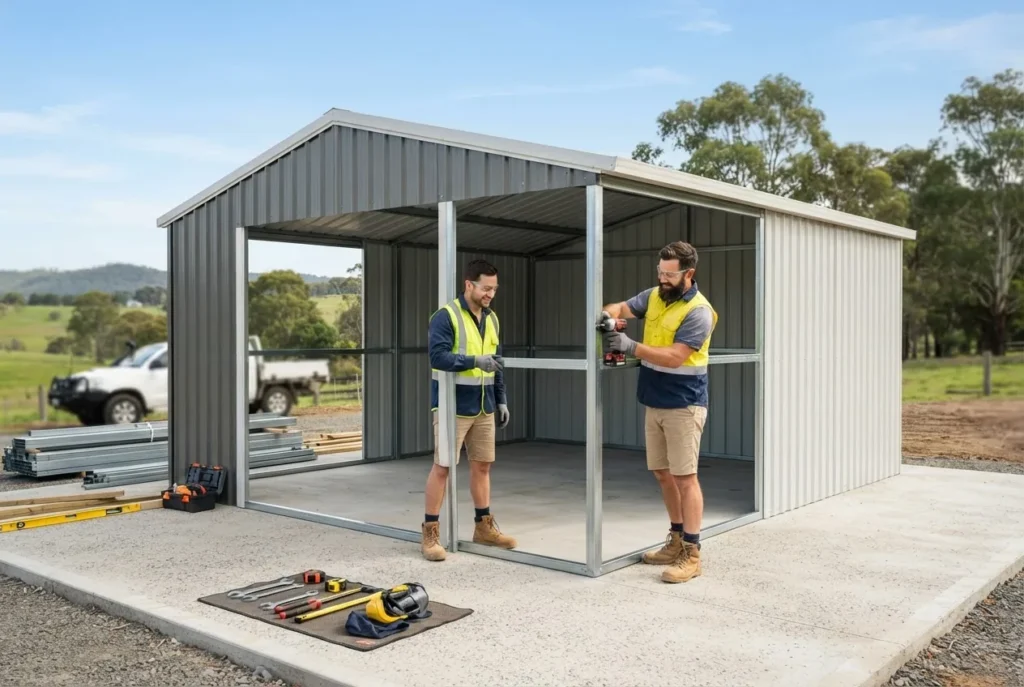
Project: 2m x 2m Colorbond potting shed installed in Fitzroy, Melbourne. Installer: GreenBuild (anonymised local installer). Site constraints: narrow 1.1 m side passage with staggered retaining wall. Foundation: 90 mm concrete slab with D22 mesh reinforcement and edge beams. Colour: Woodland Grey, skillion roof.
Costs (itemised): materials & panels $1,300; framing & fasteners $400; slab $750; delivery $150; install labour $900; permit/inspection $150 = Total $3,650.
Measured outcomes: reclaimed 6 m² of deck space; owners report zero maintenance issues at 24-month check. Installer quote: “Access planning saves time—ensure a 1.0 m clear width for panel staging,” said the lead installer.
Lessons learned:
- Plan delivery method early for narrow access sites.
- Use a reinforced slab to avoid future subsidence on sloping urban blocks.
- Choose a lighter SRI colour for sheds used as potting spaces if plants are sensitive to heat.

Brisbane — Tool & bike shed (October 2022)
Project: 2m x 2m Colorbond tool and bike shed installed in inner-Brisbane. Installer: Coastal Shed Works (anonymised). Site: backyard corner with concrete pad previously used for AC unit. Foundation: compacted gravel pad with concrete edge and chemical termite barrier. Colour: Classic Cream, gable roof for ventilation.
Costs (itemised): materials $1,200; framing $350; gravel pad & edging $400; delivery $120; install $850; extras (vent & shelving) $300 = Total $3,220.
Measured outcomes: tidy bike storage, reduced garage clutter, improved tool security. Installer tip: “Pre-mark service lines and confirm no buried services in the chosen location,” noted the installer.
Lessons learned:
- Verify subterranean services before excavation.
- Installised vents and passive airflow helps avoid condensation.
- Use lockable hardware rated for outdoor use to prevent corrosion of moving parts in coastal humidity.

For larger storage solutions see our guidance on Large Colorbond steel sheds.
Cost and Pricing Analysis for Premium 2m x 2m Colorbond Sheds
Itemised example for a premium 2m x 2m Colorbond shed
Sample premium build (metro):
- Colorbond panels & flashings: $1,200 (0.35 mm BMT typical; 0.42 mm BMT available at premium)
- Structural framing & fixings: $400
- Concrete slab (90 mm): $700
- Delivery & handling: $200
- Installation labour (2 installers, one day): $900
- Permits, inspections, certificates: $150
- Extras (shelving, vents, window): $150–350
Estimated total: $3,700 (fits the AUD 3,500–5,500 premium range). Choosing thicker material (0.42 mm BMT) adds cost but increases longevity and dent resistance; expect a 10–20% price uplift.
Regional labour multipliers and hidden costs
Regional uplift: metro areas typically base price; remote/outer-regional areas can add +10–25% for travel, delivery and logistics. Permit or engineering requirements (e.g., for exposed or cyclone-zone sites) can add $300–1,200 depending on certifier fees.
Value-for-money assessment
Consider lifecycle costs, warranties and local climate. A higher initial investment in Colorbond often reduces total ownership cost due to lower maintenance, longer warranty terms, and greater resale value compared with plastic or untreated timber sheds.
Maintenance and Longevity: Keeping Your Colorbond Shed in Top Shape
Routine maintenance tasks and recommended frequency
Standard care:
- Remove surface dirt and pollutants: wash with soapy water annually (coastal: every 6 months).
- Inspect fastenings, sealants and guttering seasonally and after storms.
- Touch up scratches immediately with manufacturer-approved touch-up paint to prevent bare-metal exposure.
- Lubricate hinges and locks annually with corrosion-resistant lubricant.
BlueScope recommends cleaning schedules and approved touch-up products — see BlueScope guidance for specific paint and primer product codes.
Coastal maintenance regimen
In coastal exposures (<2 km from high tide), wash salt deposits off at least twice yearly and apply protective wax coatings as a supplementary measure. Check base flashings for trapped salt and ensure drainage is clear to prevent pooling.
Warranty checklist and what can void coverage
Typical premium supplier warranties: 10–20 years for materials; workmanship warranties vary. Common warranty exclusions: unauthorised modifications, use of incorrect paints or abrasives, lack of regular maintenance, and installation not following manufacturer instructions. Always register your product and retain purchase documentation.
Check supplier warranty terms directly — many premium suppliers provide online registration forms and warranty PDF downloads.
Troubleshooting common issues
- Rust spots: clean, sand to bright metal, prime and touch up with approved paint.
- Dents: cosmetic; avoid placing heavy or point-load impacts on panels.
- Leaks: check roof laps, flashings and gutter alignment; reapply approved sealant where needed.
For technical maintenance resources refer to BlueScope technical advice pages (link in Sources).
Frequently Asked Questions and Expert Tips for Prospective Buyers
Expert tips (summary):
- Prepare the site and confirm access before ordering panels to avoid delivery delays.
- Choose a lighter SRI colour where heat is a concern; add vents or passive airflow to reduce condensation.
- Engage a local installer early for permit advice and wind-rating confirmation.
Decision checklist — ready to proceed?
- Confirm LGA permit/exemption and any setback or overlay restrictions.
- Choose foundation type (slab recommended for longevity).
- Get 2–3 quotes including slab, delivery and install; verify warranty and SRI for chosen colour.
Sources & further reading
- BlueScope Colorbond technical datasheet (2024): https://www.bluescope.com.au/products/colourbond/
- AS/NZS 1170.2 — Wind actions (Standards Australia reference): https://www.standards.org.au/
- Australian Building Codes Board — outbuildings guidance: https://www.abcb.gov.au/
- CSIRO research on building materials and thermal performance: https://www.csiro.au/
- Australian Green Building Council — steel recyclability: https://new.gbca.org.au/
Ready to enhance your garden space? Explore our supplier listings and local installers to get started on your 2m x 2m Colorbond garden sheds project today. For a deeper buying walk-through see the Premium Colorbond garden shed buying guide.
Frequently Asked Questions
What is the exact size and footprint of a 2 x 2 garden shed?
A standard 2 x 2 garden shed measures 2.00 m x 2.00 m externally (about 4.00 m²). Internal usable floor area is typically ~1,880 mm x 1,880 mm after wall thickness. Always check the manufacturer’s net internal dimensions before ordering and confirm site access and setbacks with your council.
Why is Colorbond steel the preferred material for Australian garden sheds?
Colorbond combines a zinc–aluminium coated steel base with a pre-painted weather-resistant finish, offering strong corrosion resistance, UV stability and long service life (BlueScope reports >30 years typical). Its durability and recyclability also reduce lifetime costs compared with timber and plastic alternatives.
Do I need a building permit for a 2m x 2m Colorbond shed in Australia?
Many councils exempt sheds under 10 m² and below specified heights, but rules vary by LGA, overlays and heritage zones. Always confirm with your local council or certifier before installation—obtain written confirmation or reference numbers where possible to avoid compliance issues.
How can I maximize storage space inside a compact 2 x 2 shed?
Prioritise vertical storage: install 300 mm-deep shelving, pegboards, magnetic tool strips and a 600 mm fold-down bench. Use clear stackable bins and label storage. Maintain a 600–900 mm aisle for access and use ceiling-mounted hooks for infrequent items to preserve floor space.
What roof styles are best suited for a 2m x 2m shed?
Skillion roofs are well-suited for heavy rain areas due to rapid runoff; gable roofs add ventilation and headroom; flat roofs fit tight height-restricted sites. Choose based on local climate, desired internal volume and planning height limits—confirm with your installer for wind and drainage details.
How much does a premium 2 x 2 Colorbond shed typically cost in Australia?
Premium 2m x 2m Colorbond sheds typically range AUD 3,500–5,500 including standard installation and a basic concrete slab. Price varies by material gauge, extras (windows, shelving), site access and regional labour multipliers. Get multiple quotes and itemised cost breakdowns before committing.
What are the maintenance requirements to keep a Colorbond shed in good condition?
Routine care includes annual soapy-water cleaning (coastal: twice-yearly), seasonal gutter checks, immediate touch-up of scratched areas using manufacturer-approved paint, and annual hinge lubrication. Follow supplier guidance and warranty maintenance requirements to ensure coverage remains valid.
Can I customize my 2 x 2 shed with windows or ventilation without losing warranty coverage?
Many suppliers allow windows and vents if installed per manufacturer instructions. Unauthorised modifications or incorrect paints can void warranties. Confirm modification acceptance with your supplier and retain written confirmation to preserve warranty coverage. Confirm with your local council for planning impacts.