
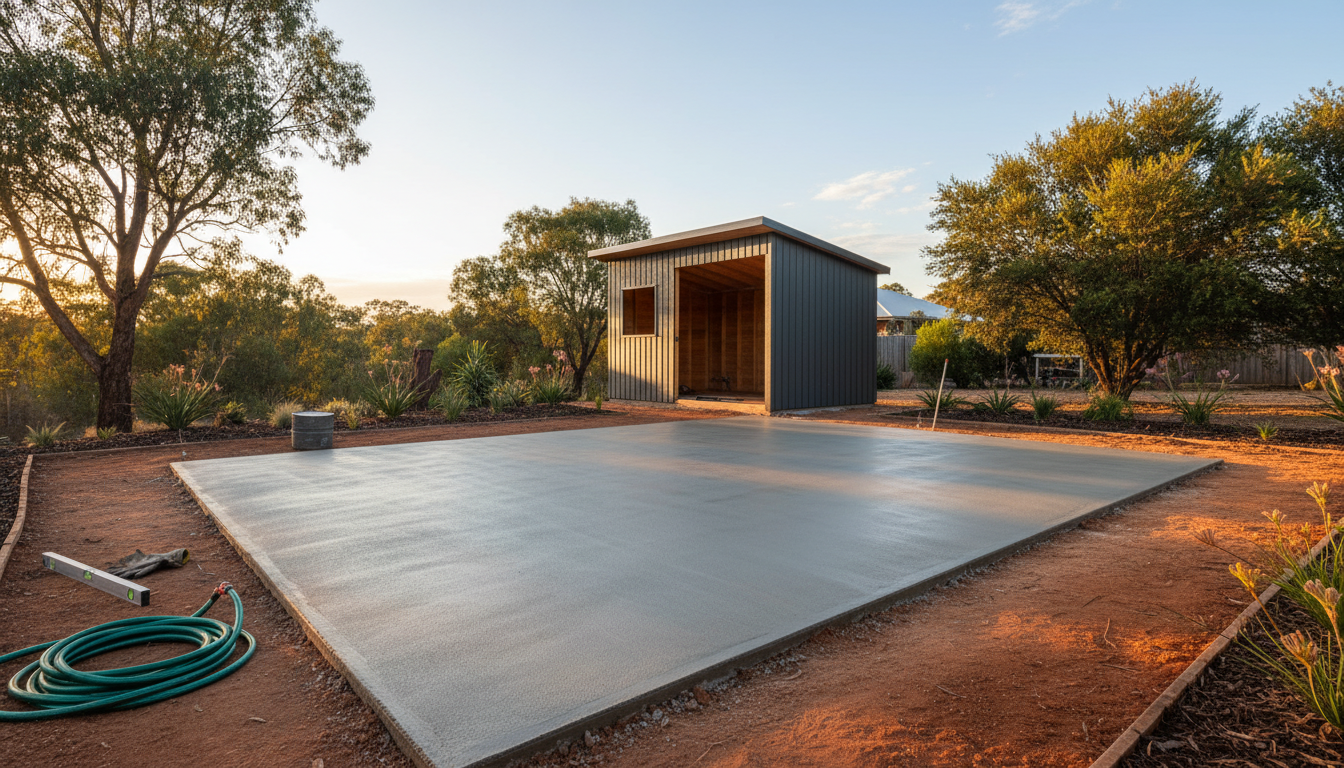

Concrete floors for garden sheds are the backbone of a durable, weather-resistant, and structurally sound outdoor structure. In Australia’s diverse climates and soil conditions, choosing and constructing the right concrete base is vital. This comprehensive guide dives deep into the specifications, cost considerations, and council approval requirements specific to the Australian context, ensuring your garden shed stands firm for decades.
Why a Concrete Floor is Essential for Your Garden Shed in Australia
A solid concrete floor provides a durable shed foundation that resists warping, rot, and pest infestation common in timber or gravel bases. Australian weather extremes, from tropical humidity to arid heat, impact the performance of shed flooring significantly.
Benefits of a Concrete Base Over Other Foundations
- Longevity: Concrete bases last longer than timber or compacted gravel, resisting decay and pest damage.
- Stability: Provides a flat, level surface crucial for door function, storage safety, and overall shed integrity.
- Moisture Resistance: Correctly installed vapor barriers under concrete inhibit rising damp, essential in humid coastal or high-rainfall zones.
- Load Capacity: Concrete supports heavier garden tools or machinery storage without settling.
Impact of Australian Climate and Soil Types on Concrete Floors
The Australian continent presents a spectrum of soil types—expansive clays, sandy loams, and rocky terrains—that affect how soil moves with moisture changes. In wet seasons, some soils swell; during dry spells, they shrink, causing soil stability issues detrimental to poorly designed bases. According to CSIRO soil research, choosing the right slab thickness and suitable reinforcement dramatically mitigates these risks. Additionally, harsh UV exposure and temperature fluctuations accelerate deterioration in substandard bases, proving concrete the best long-term solution.
Longevity and Structural Integrity Considerations
As per Master Builders Australia, a correctly designed concrete floor matched to local soil conditions and climate can last 30+ years with minimal maintenance. This durability is essential for protecting your investment in garden sheds and maintaining their functionality.
Choosing the right foundation, such as a concrete floor, is vital for ensuring the longevity of barn sheds and structural design options in Australia and appropriate sizing like 10×10 Colorbond garden sheds in Australia.
With this foundational knowledge, let’s explore how to design a garden shed concrete floor to Australian standards.
Concrete Floor Specifications for Garden Sheds: Australian Standards and Best Practices
Optimal Thickness and Dimensions for Shed Concrete Floors
According to AS 2870 Residential Slabs and Footings, residential garden sheds typically require a minimum concrete slab thickness between 75mm and 100mm, depending on soil classification and shed size. For standard garden sheds sized around 3 × 3 meters, a 100mm thick slab reinforced with steel mesh is the recommended baseline to handle typical loads.
Smaller bases in expansion-classified soils may require thicker slabs or edge beams to control differential movement as seen in 10 x 20 Colorbond steel sheds concrete base requirements.
Concrete Mix Ratio and Material Selection (cement, aggregates, additives)
- Mix Ratio: Standard concrete for garden shed bases uses a mix of 1 part cement : 2 parts sand : 3 parts aggregate (commonly 10mm crushed rock) with a water-cement ratio around 0.45 to 0.5 to maximize durability.
- Additives: Plasticisers enhance workability without extra water; fly ash improves durability and reduces permeability.
- Aggregate Size: Typically 10mm or smaller aggregate prevents segregation and ensures a smooth finish.
Referencing Housing Industry Association (HIA), choosing quality certified aggregates and Portland cement (Type GP) complies with Australian mix standards.
Reinforcement Options: Wire Mesh vs. Rebar in Garden Shed Bases
| Reinforcement Type | Suitability | Advantages | Considerations |
|---|---|---|---|
| Wire Mesh | Ideal for small to medium sheds (up to 24m²) | Easy installation, cost-effective, good crack control | Limited load bearing compared to rebar; less effective in highly expansive soils |
| Rebar (Steel Bars) | Recommended for larger sheds or unstable soils | Superior tensile strength, controls subsidence, long-term stability | Higher cost, requires precise placement, skilled installation |
Mesh reinforcement is common in Australian garden sheds but consult a structural engineer if your site soil is rated as “Class E” or higher (highly reactive clay).
Moisture and Vapor Barriers Requirements
Installing a polyethylene vapor barrier (minimum 0.2mm thickness) directly under the concrete slab prevents rising moisture that can damage stored items and degrade the slab internally. Australian building codes require moisture barriers under slabs in contact with soil, especially in coastal regions or flood-prone areas.
Drainage Solutions Integrated with Concrete Floors
- Slope: The concrete floor should have a minimum fall of 1:100 (1%) to direct water away.
- Drainage Channels: For larger or sealed sheds, consider integrated peripheral drainage channels or soakage pits to prevent water pooling.
- Edge Restraints: Properly formed edges prevent soil washout and slab undercutting.
Good drainage complements moisture resistance and prolongs slab lifespan.
Next, we analyse the detailed cost components involved in constructing these concrete bases in Australia.
Detailed Cost Breakdown for Concrete Floors for Garden Sheds in Australia
Material Costs: Cement, Sand, Aggregate, Reinforcements
As of 2024, Australian prices average:
| Material | Average Cost (AUD) | Unit | Notes |
|---|---|---|---|
| Portland Cement (Type GP) | $13 – $18 | per 20kg bag | Prices vary by region, bulk discounts may apply |
| Sand (Washed Concrete Sand) | $35 – $55 | per tonne | Local quarry prices vary |
| Aggregate (10mm Crushed Rock) | $45 – $65 | per tonne | Essential for structural mix |
| Steel Reinforcement Mesh | $15 – $25 | per m² | Depends on gauge and mesh size |
| Rebar | $2.00 – $4.50 | per meter | Varies by diameter and supplier |
Labour Costs: DIY vs. Professional Concrete Contractors
- DIY: Saving on labour but requires equipment rental (concrete mixer ~ $80/day, trowels, floats), and physical effort. Suitable for smaller base areas up to 12m².
- Professional Contractors: Labour costs range between $50 – $80 per hour; most trades charge a minimum $1,000 for small pours. Professionals offer better finishing quality and ensure compliance with standards.
Excavation and Site Preparation Expenses
Site clearing, leveling, and excavation costs depend heavily on site accessibility, soil hardness, and vegetation removal:
- Small accessible yards: $200 – $500
- Sites with difficult terrain or retaining walls: $800 – $2,000
Regional Price Variations Across Australian States and Territories
| Region | Average Total Material & Labour Cost (per m² concrete slab) | Notes |
|---|---|---|
| New South Wales (Sydney Metro) | $120 – $160 | Higher labour rates, restricted work hours |
| Victoria (Melbourne) | $110 – $150 | Moderate demand, competitive materials pricing |
| Queensland (Brisbane) | $100 – $140 | Less labour constraints, seasonally variable prices |
| Western Australia (Perth) | $130 – $170 | Material transport impacts pricing |
Budgeting Tips and Hidden Costs to Watch For
- Confirm council fees early—permit costs can add $300 – $1,200 depending on the local authority.
- Account for waste removal and site cleanup—often overlooked.
- Seasonal delays during wet seasons can increase labour time and costs.
- Testing and certification fees for soil classification or concrete strength (roughly $400 – $700).
Understanding these cost layers will help you plan realistically and avoid budget overruns, including cost considerations for 10×6 garden sheds and cost analysis for 6mx3m garden sheds. Now let’s navigate through the complex Australian council approval landscape.
Navigating Australian Council Approval for Concrete Floors in Garden Shed Construction
Overview of Relevant Building Codes and Local Council Regulations (AS 2870, others)
Local councils often require building permits even for concrete bases prior to shed installation to ensure environmental and structural safety standards are met.
To understand the full breadth of council approvals for garden sheds in Australia beyond concrete foundations, and details on the council approval process for 12×8 sheds in Australia, see our comprehensive guide on barn sheds and their regulatory requirements.
Step-by-Step Guide to Securing Permits for Concrete Bases
- Check Local Council Requirements: Visit the local government website or building department for garden shed permits specific to your lot.
- Submit Detailed Plans: Include slab specifications, site plans showing setbacks, drainage details, and soil test reports.
- Apply for a Building Permit: Most councils require an application fee and accompanied documentation per AS 2870 compliance.
- Wait for Approval: This can take 2-6 weeks; some councils offer fast-track for minor works.
- Schedule Inspections: Initial and post-pour inspections by council building officers may be required.
Documentation and Site Inspection Requirements
Common documents councils request include:
- Engineering certification or structural drawings
- Soil classification results
- Concrete mix and reinforcement specifications
- Site plan with drainage and access indicated
Site inspections verify compliance with approvals, correct slab thickness, reinforcement placement, and formwork integrity before pouring.
Common Pitfalls in Council Approval and How to Avoid Them
- Incomplete or inaccurate soil classification leading to permit delays.
- Planning application missing mandatory signatures from certified engineers.
- Overlooking drainage or stormwater management controls in plans.
- Commencing construction without approved permits risking fines.
State and Territory Specific Variations in Approval Processes
| State/Territory | Permitting Authority | Typical Permit Timeframe | Notes |
|---|---|---|---|
| New South Wales | Local Council + NSW Fair Trading | 3–5 weeks | Strict enforcement of environmental controls |
| Victoria | Council + Victorian Building Authority | 4–6 weeks | Mandatory compliance certificates required |
| Queensland | Queensland Building and Construction Commission | 2–4 weeks | Fast-tracking possible for standard shed bases |
| Western Australia | Local Council + WA Building Commission | 4–8 weeks | Detailed soil testing often mandated |
Arming yourself with this knowledge ensures a smooth council approval journey.
Step-by-Step Installation of a Concrete Base for Garden Sheds in Australia
Preparing the Site: Excavation, Leveling, and Formwork
- Mark Out: Outline dimensions accurately using string lines and spray paint.
- Excavate: Remove topsoil and organic matter to a depth of 150-200mm to allow for gravel base and concrete thickness.
- Compact Soil: Use mechanical plate compactors to prepare a firm base, reducing future soil movement.
- Install Formwork: Use timber boards set squarely and level, braced securely to withstand concrete pressure.
- Place Gravel Sub Base: Lay 50mm crushed rock and compact to improve drainage and subgrade stability.
Laying the Cement Base: Pouring, Spreading, and Reinforcing
- Install Vapor Barrier: Lay polyethylene sheeting with overlaps, extending to form edges.
- Place Reinforcement: Position wire mesh or rebar according to design, supported on “chairs” to be mid-slab.
- Mix Concrete: On-site or pre-mixed; ensure consistency and no segregation.
- Pour Concrete: Pour in sections, shovelling to eliminate voids.
- Spread & Level: Use screeds (straight edges) to level; maintain the specified slope for drainage.
Finishing Techniques: Screeding, Trowelling, and Curing Times
- Screeding: Use a straight timber or aluminium screed for initial leveling immediately after pouring.
- Trowelling: Apply steel trowels or power floats after bleed water evaporates to create a smooth, dense surface.
- Curing: Protect slab with plastic sheeting or curing compounds; curing time generally 7 days minimum to achieve design strength.
Post-installation Care and Maintenance Recommendations
- Avoid heavy loads for at least 7 days post-pour.
- Seal slab surface with penetrating concrete sealers annually to improve water resistance.
- Inspect for minor cracks and seal early to prevent water ingress.
Tools and Equipment Needed for a Successful Concrete Floor Installation
- Concrete mixer or ready-mix delivery
- Plate compactor
- Spirit levels and straight edges
- Trowels and floats (manual or power)
- Protective equipment – gloves, boots, safety glasses
- Shovels, wheelbarrows
- Forms and bracing materials
For medium-sized or complex projects, hiring professional concreters optimizes results and regulatory compliance. See also our guide on concrete floor installation for 6×4 garden sheds.
Expert Tips and Troubleshooting for Concrete Floors in Australian Garden Sheds
How to Manage Soil Movement and Subsidence Risks
- Perform a professional soil test to classify as per AS 2870 before slab design.
- In highly reactive clay areas, consider adding reinforced edge beams.
- Maintain consistent moisture levels during and after construction to reduce swelling/shrinkage.
Preventing Cracks and Structural Failures
- Include control joints at intervals to manage natural cracking.
- Avoid rapid drying—curing compounds and shading reduce shrinkage cracks.
- Use proper reinforcement placement to improve tensile strength.
Selecting Reliable Contractors and Concrete Services in Australia
Choose contractors registered with organisations like Housing Industry Association or Master Builders. Request references, confirm insurance, and verify prior experience with shed concrete bases.
Dealing with Moisture and Drainage Problems Post Installation
- Inspect perimeter drainage regularly and clear gutters or channels.
- Apply sealers if excessive moisture observed on slab surface.
- Improve site grading around the shed if water pools near the base.
Long-Term Maintenance for Concrete Shed Bases
- Annual monitoring of slab condition, especially in freeze-thaw zones.
- Resealing surfaces every 2-3 years depending on exposure.
- Repair minor cracks with concrete filler to prevent expansion.
Smaller sheds such as 2 x 2 garden sheds often face unique challenges; careful concrete floor installation mitigates common issues. For premier sizing advice, see also premier concrete floor requirements for 5×5 Colorbond sheds.
Supplementary Resources and Tools: Checklists, Tables, and Diagrams for Planning Your Concrete Floor
Concrete Floor Specification Checklist for Australian Garden Sheds
- Confirm soil class per AS 2870
- Determine slab thickness (minimum 75-100mm)
- Select appropriate reinforcement (mesh or rebar)
- Include moisture vapor barrier
- Design slab slope and drainage features
- Budget for excavation, materials, and labour
- Prepare council permit application documents
Cost Estimation Tables by Region and Material
| Material/Service | Sydney (AUD) | Melbourne (AUD) | Brisbane (AUD) | Perth (AUD) |
|---|---|---|---|---|
| Concrete Materials (per m³) | $260 | $240 | $230 | $280 |
| Labour (per hour) | $75 | $70 | $65 | $80 |
| Excavation (per m³) | $50 | $45 | $40 | $55 |
Sample Council Permit Application Templates
Downloadable permit application templates and checklist forms are available on most local council planning portals. These include:
- Site plan and soil classification summaries
- Structural design and concrete mix certification
- Drainage and erosion control plans
Diagrams Illustrating Reinforcement and Drainage Solutions
Simple annotated diagrams showing:
- Correct placement of wire mesh/rebar within the slab
- Cross-section of slab layering with vapor barrier and gravel base
- Typical slab drainage slope and edge detailing
With planning and reliable information, your concrete base will provide a solid foundation for years.
Conclusion
Building a concrete floor for garden shed in Australia demands attention to soil conditions, construction specifications, cost factors, and compliance with local council regulations. Following Australian standards such as AS 2870, preparing for the council approval process, and understanding regional material costs reduces risks of structural failure and fines. This definitive guide empowers you to make informed decisions—whether DIY or hiring professionals—to ensure your garden shed stands strong through Aussie seasons. Start planning your project with the checklists and tools provided, and consult local authorities early to smooth your approval path.
Ready to lay the foundation for your perfect garden shed? Dive deeper into barn sheds and structural design options in Australia for expert insights.
Frequently Asked Questions
What is the difference between using wire mesh and rebar reinforcement for a garden shed concrete base?
Wire mesh suits small to medium sheds and controls cracking cost-effectively, while rebar offers superior strength and stability for larger sheds or reactive soils. Rebar is more expensive and complex to install but better prevents subsidence in harsh soil conditions.
How does soil type affect the design of a concrete floor for garden sheds in Australia?
Soil types like expansive clays cause swelling and shrinking that stress concrete slabs. Proper design, such as thicker slabs, edge beams, and reinforcement, mitigates soil movement, ensuring long-term structural integrity and reducing cracking risks.
Why is a vapor barrier necessary under a concrete floor for a garden shed?
A vapor barrier prevents rising moisture from the ground into the concrete slab, protecting stored items from dampness and preventing internal slab degradation, especially important in humid or high-rainfall areas across Australia.
When should you consult a structural engineer for your concrete garden shed floor project?
Consult an engineer when building on highly reactive soils (Class E or higher), for large sheds, or if unsure about reinforcement and slab thickness to comply with AS 2870 standards and ensure a durable foundation.
Can a DIY homeowner install a concrete floor for a garden shed, or is professional help recommended?
DIY installation is feasible for small bases under 12m² with proper tools and knowledge. For larger slabs, complex soil conditions, or compliance with local codes, hiring professionals ensures quality, safety, and regulatory compliance.
Is there a standard concrete mix ratio recommended for garden shed floors in Australia?
The typical mix ratio is 1 part cement, 2 parts sand, and 3 parts aggregate with a water-cement ratio of 0.45 to 0.5. This balance maximizes strength and durability for shed foundations.
Which Australian states have the fastest approval times for concrete base permits for garden sheds?
Queensland offers the fastest permit approvals, typically within 2–4 weeks, often including fast-tracking options for simple garden shed bases, compared to longer times in other states.
How do drainage features improve the longevity of a concrete base for a garden shed?
Proper drainage slopes and channels prevent water pooling around the slab, reducing moisture-related damage and soil erosion, thereby extending the concrete base’s lifespan and maintaining structural stability.