

Effective shed ventilation is crucial for maintaining the structural integrity and usability of Colorbond garden sheds and workshops across Australia’s diverse climates. Condensation and heat can wreck Colorbond sheds; the wrong ventilation accelerates corrosion and ruins stored tools. This guide shows climate-tested vent options, installation steps and compliance advice tailored to Australian sheds.
Why Proper Shed Ventilation is Essential for Colorbond Garden Sheds and Workshops
Impact of Australian Climate Zones on Shed Ventilation Needs
Australia’s climate varies from humid coastlines to arid inland and tropical regions. The Bureau of Meteorology (BOM) maps these zones and highlights differences in humidity, wind and rainfall patterns that directly affect shed ventilation needs (BOM climate zones). Coastal sheds need corrosion-resilient ventilation to combat salt-laden air; inland sheds prioritise heat mitigation and dust exclusion; tropical sheds require rainproof, breathable vents and active moisture control to prevent mould.
Moisture, Heat, and Air Quality Challenges in Colorbond Sheds
Colorbond steel offers long life but is vulnerable where condensation and trapped humidity persist. Poor ventilation increases overnight condensation, encouraging corrosion and mould. Heat build-up in summer worsens material fatigue and damages stored tools. Adequate airflow preserves air quality, reduces thermal stress and extends the shed’s service life.
Benefits of Effective Ventilation: Longevity, Comfort, and Protection of Stored Items
- Reduces condensation and corrosion risk, protecting Colorbond finishes;
- Lowers peak internal temperatures for user comfort and tool longevity;
- Prevents mould growth and maintains healthier air quality;
- Helps manage pests by using screened intake/exhaust points;
- Supports insulated sheds by balancing vapour control and airflow.
For sizing-by-shed examples see our guidance for typical layouts: 10×10 Colorbond garden shed specifications and ventilation needs.
Understanding Different Types of Shed Vents Suitable for Colorbond Steel Sheds
Ridge Vents – Design and Effectiveness for Roof Ventilation
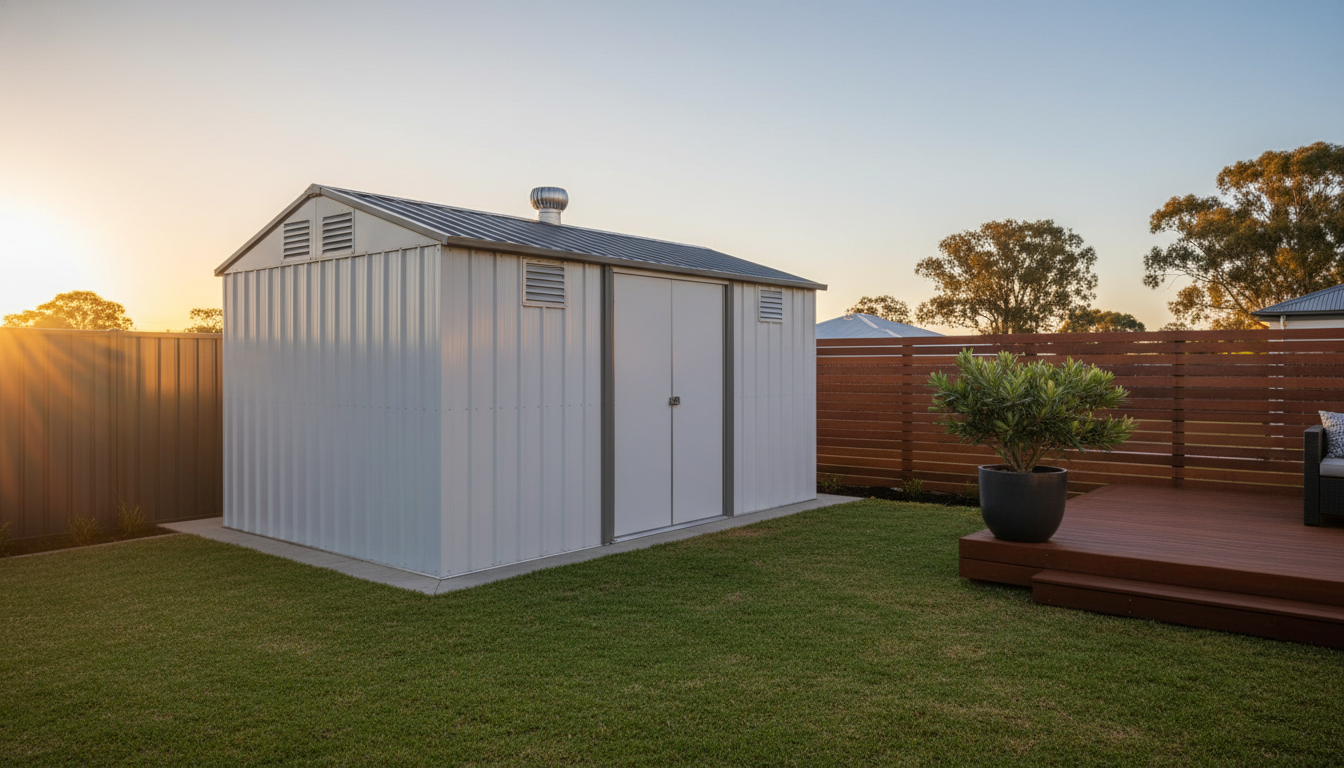
Ridge vents run along the roof peak and use natural convection to exhaust hot air. They are passive, low-noise and low-maintenance but must be paired with intake vents (soffit/eave) for a continuous airflow path. On still, humid nights (common in tropical zones) ridge vents alone may be less effective unless combined with powered extraction. Look for continuous ridge vents with integral insect mesh and downward baffles to limit rain ingress.
Soffit Vents and Eave Vents – Promoting Airflow from Below
Soffit and eave vents supply cool intake air at low levels; combined with ridge vents they create an efficient chimney effect. Ensure vents clear insulation and internal linings to maintain net free area. Use corrosion-resistant trims and stainless or powder-coated mesh screens sized to keep out pests while minimising pressure drop. For insulated sheds, position soffit intakes so they do not compress or bridge insulation.
Gable Vents and Wall Vents – Enhancing Cross Ventilation in Workshops
Gable and wall vents promote cross ventilation and are effective for workshops that need dust and fume control. Place opposing vents to establish directional airflow; gable vents are useful where eaves are minimal. For fume-prone activities, wall vents can be positioned low for intake and high for exhaust or used in combination with mechanical extraction for active removal of contaminants.
Turbine Vents and Powered Ventilation Options for Australian Conditions
Turbine vents (wind-driven) provide mechanical extraction without mains power, working best in consistently windy areas. Solar-powered powered vents offer controlled extraction without wiring and are ideal where mains access is limited. For large workshops or spaces with fumes, electrically powered fans (with timers, thermostats or humidity sensors) deliver predictable air changes but require wiring and maintenance. Consider noise, maintenance and power availability when selecting powered systems.
Vent Types: Sizing Rule-of-Thumb and Product Features to Look For
Rule-of-thumb: target a combined net free vent area of roughly 1/150 to 1/300 of the roof area for passive systems (workshops with fumes need higher rates or mechanical extraction). Look for vents with built-in insect mesh, downward baffles, powder-coated or stainless materials for coastal use, and integrated flashings for watertight roof penetrations.
Selection summary: choose ridge + soffit for passive, cross-ventilation designs; add turbines or solar fans where natural airflow or wind is inconsistent; specify 316 stainless fixings and corrosion-resistant vent bodies for coastal sites.
Australian Building Code and Standards Compliance for Shed Ventilation
Overview of Relevant Sections in Building Code of Australia (BCA)
Ventilation and moisture control requirements are covered by the National Construction Code (NCC), commonly referred to as the Building Code of Australia (BCA). The Australian Building Codes Board (ABCB) provides guidance on natural versus mechanical ventilation, condensation minimisation and durability for metal-clad buildings (Building Code of Australia (BCA) ventilation requirements). NCC guidance addresses minimum airflow strategies, when mechanical extraction is required, and durability provisions to manage corrosion and moisture. For small non-habitable storage buildings, compliance focuses on moisture control and water-tightness, while workshops used as workplaces may attract higher ventilation and health-and-safety standards.
Summary (NCC/BCA expectations): The NCC distinguishes natural ventilation (passive vents sized to provide adequate air changes) from mechanical systems (fans with rated capacities). It also requires that penetrations are sealed to maintain weatherproofing and that materials and fixings are durable for the intended environment. For certainty, consult the NCC volumes and your local building authority for clause references relevant to your state and shed use.
Local Council Regulations and Approval Processes for Ventilation Installations
Many councils require permits for structural modifications that affect waterproofing, wind rating or fire safety. Provide drawings showing cut locations, flashings and materials, and reference NCC/BCA guidance when submitting. Some councils mandate pest-screen specifications or installer accreditation—check your local council building pages and state government guidance when planning work.
BCA/Council Permit Checklist
- Confirm if roof/wall cutting affects wind rating or structural bracing;
- Check if a development or building permit is required for modifications;
- Provide drawings showing vent locations, sizes and flashings;
- Specify waterproofing and sealant methods (product and curing times);
- Note fixings and material grades for coastal exposure (e.g., 316 stainless);
- Include pest-screen specification (mesh size and corrosion resistance);
- List installer accreditation or licence details if required;
- Arrange council inspection slots and retain installation records;
- Confirm warranty compliance with shed manufacturer when modifying profiles.
Safety and Structural Installation Guidance
Use correct metal-cutting techniques to avoid damaging protective coatings, apply roof-grade sealants and ensure penetrations are flashings-compliant. Avoid overdrilling or cutting through structural ribs and follow the shed manufacturer’s instructions to preserve warranty and structural integrity.
Designing Climate-Responsive Ventilation Systems for Different Australian Zones
Ventilation Strategies for Coastal Humid Environments
Coastal sites require corrosion-resistant vent bodies and fixings (316 stainless or marine-grade aluminium), frequent inspection (every 6 months) and sealed flashings to exclude salt spray. Use powered extraction to move humid air out rapidly, combine ridge vents with solar-powered fans and include fine stainless mesh to keep salt and insects at bay. Repaint touch-ups and anti-corrosion treatments should occur annually or after major storms.
Best Practices for Dry Inland and Arid Regions
In arid zones, maximise cross-flow ventilation with large soffit/eave intakes and high exhaust points. Use dust-resistant louvres and flaps with replaceable filters or shutters. Integrate reflective insulation or foil liners to reduce radiant heat; inspect for dust buildup seasonally and clean screens frequently to retain airflow performance.
Tropical and Subtropical Ventilation Considerations
Tropical regions need rain-guarded intakes, protected turbine bases and powered extraction to address high humidity. Fit breathable vent types with downward baffles, sealed flashings and humidity sensors that ramp up extraction during monsoonal periods. Check drainage and insect screens after heavy rains and schedule maintenance quarterly during wet seasons.
Ventilation and Thermal Insulation Integration
Vent placement must complement insulation and vapour barriers. Keep intake vents clear of insulation, provide ventilation paths above ceiling/roof linings, and avoid compressing insulation at eaves. Use a vapour-permeable underlay where needed and ensure vents do not create thermal bridging; correct balancing prevents condensation on cooler surfaces.
Dust and Pest Management through Ventilation Design
Employ fine mesh (mesh size <2mm for insects, finer for mosquitoes), motorised louvres that close in storms, and position intakes away from prevailing dust sources. Replace screens as part of routine maintenance and use sacrificial paint touch-ups for coastal exposures.
Step-By-Step Guide to Installing Shed Air Vents in Colorbond Garden Sheds
Tools, Hardware and Material Specifications
- Cutting tools: fine-tooth metal-cutting jigsaw blades or nibblers; use low speed and steady feed to avoid heat damage;
- Fasteners: 316 stainless steel for coastal sites; 304 stainless acceptable inland. Use self-drilling/self-tapping screws with neoprene or EPDM washers sized for Colorbond profiles;
- Sealants: neutral-cure silicone or polyurethane roof-grade sealant rated for metal roofs (avoid acid-cure silicones which can attack coatings);
- Touch-up paint: manufacturer-approved Colorbond touch-up for exposed raw edges;
- PPE: safety goggles, gloves, hearing protection, respirator for dust when cutting;
- Measuring tools, marker, drill bits for metal, rivet gun or pop rivets if required by vent kit.
Preparing Colorbond Steel Surfaces for Vent Fitting
Mark locations carefully and verify against internal bracing and purlin positions. Use protective tape along cut lines to reduce paint chipping. Cut at low speed with a fine-tooth blade or nibblers; deburr immediately and apply primer and Colorbond touch-up paint to exposed steel within minutes to limit corrosion. Clean surfaces with solvent wipes before sealing.
Tools Safety & PPE
Use fall protection when working on roofs, secure ladders, wear cut-resistant gloves and eye protection. Use an appropriate respirator when cutting painted steel to avoid inhaling metallic dust; have a first-aid kit for metal cuts and work with a partner for roof tasks.
Installation Process by Vent Type — Step Checklists
- Ridge vent (3–6 steps): measure and mark continuous slot; temporarily remove ridge cap if required; cut slot within crest profile limits; fit continuous ridge vent flashing; apply continuous bead of neutral-cure sealant beneath vent; fasten with specified screws and check sealing under rain test.
- Soffit/eave vent (3–5 steps): mark opening between purlins, cut soffit panel with nibbler or jigsaw; deburr and prime cut edge; insert vent housing, fasten using neoprene-washer screws; seal outer perimeter and ensure internal insulation clearance.
- Gable/wall vent (3–5 steps): locate between studs/rails, cut opening, fit frame and mesh, seal perimeter with roof-grade sealant, reinforce fixings to maintain wind rating.
- Turbine vent (4–6 steps): check turbine clearance, cut base flange opening, fit base flashing and sealant, secure flange per manufacturer, assemble turbine head and verify free rotation; test after installation under wind or by manual spin.
- Powered/solar vent (4–6 steps): place per manufacturer to avoid shading, cut opening or roof penetration per template, flash and seal correctly, install solar panel (if applicable), test electrical connections or solar output, set controls (thermostat/humidity sensor).
DIY vs Professional Installation: Pros, Cons, and When to Hire Experts
DIY can save cost for straightforward passive vents if you have metal-working skill and proper PPE. Hire a licensed installer for powered systems, complex roof modifications, or where council permits and inspections are required. Professionals reduce risk of leaks, structural damage, warranty issues and non-compliance.
Vent Sizing Rules and Worked Example
Rule-of-thumb: aim for net free vent area ≈ 1/150 to 1/300 of roof area for passive ventilation. For workshops handling fumes, target higher exchange or use mechanical extraction rated for required air changes per hour.
Worked example — 3m x 4m shed (roof area ≈ 12 m²): required net free area = 12 ÷ 150 to 12 ÷ 300 = 0.08 m² to 0.04 m² (400–800 cm²). A common 150 mm turbine vent provides about 175 cm² net free area. To meet 400–800 cm² you would use approximately 3 x 150 mm turbines (≈525 cm²) or 2 x 150 mm turbines plus a short length of continuous ridge vent. For higher performance choose larger turbines (200 mm) or add a solar-powered fan sized for 100–200 m³/hr depending on activities.
Post-Installation Checks and Testing Ventilation Efficiency
- Inspect all sealant joints and flashings after 24–48 hours;
- Perform smoke or incense tests to visualise airflow paths;
- Use a hygrometer and thermometer to record baseline vs post-install conditions over a week;
- Re-check turbine rotation and motor operation under typical conditions.
Maintenance and Troubleshooting of Garden Shed Ventilation Systems
Regular Cleaning and Inspection Techniques for Storage Shed Vents
- Clear debris and spider webs from vent openings and screens at least twice yearly (quarterly for coastal/tropical sites);
- Check for corrosion around fixings and treat early with anti-corrosion primer;
- Clean turbine blades and lubricate bearings per manufacturer schedule;
- Replace sealant where cracking or shrinkage appears; touch-up exposed paint within days of cutting.
Identifying and Fixing Common Ventilation Problems (Blockages, Corrosion)
- Blockages: use compressed air or soft brushes for screens, replace clogged filters;
- Corrosion: remove rust, apply corrosion inhibitor, or replace with corrosion-resistant components (316 stainless);
- Motor failure: test electrical supply, replace brushes or motors per manufacturer; consider upgraded solar units if wiring fails repeatedly.
Seasonal Maintenance Tips for Different Australian Climates
- Summer (inland): verify full open operation and clean dust;
- Wet season (tropical): inspect rain guards and drainage after storms;
- Coastal: check corrosion every 3–6 months and reapply touch-up paints annually.
Upgrading and Replacing Shed Vents Over Time
Upgrade to sensor-controlled or solar-powered vents for better performance and energy savings. Replacement cycles vary with exposure: 8–15 years is common; coastal environments may need earlier replacement. Maintain records and photos to track warranty periods.
Advanced Ventilation Solutions and Innovations for Workshops and Large Sheds
Mechanical Ventilation Systems and Controlled Airflow Technologies
Variable speed fans with thermostatic or humidity control provide precise extraction rates. Use demand-controlled ventilation in workshops to increase airflow only when required, reducing energy use and extending component life. Ensure electrical work complies with local wiring rules and engage a licensed electrician for mains-powered systems.
Solar-Powered and Automated Vent Systems
Solar fans reduce running costs and simplify installation where mains power is impractical. Automated louvres and sensor-driven vents open and close based on temperature or humidity thresholds, maintaining stable internal conditions with minimal user input.
Integration with Heating and Cooling Systems
Pair ventilation with evaporative coolers or filtered intake fans in arid zones for efficient cooling. Balance ventilation and heating in winter to avoid excessive heat loss—use timed extraction and insulated louvres where needed.
Australian Case Studies of Ventilation Success (Expanded)
Case study 1 — Melbourne workshop (6 x 4 m): retrofitted with 4 solar-powered roof vents and a continuous ridge vent in Jan 2025. Baseline peak internal temperature recorded at 48°C on summer days; after retrofit monitored peaks fell to 29°C (max reduction 19°C) using thermistor probes over three heat events.
Case study 2 — Coastal Queensland garden shed (3 x 3 m): fitted with 2 wind turbines with 316 stainless fixings and fine stainless mesh in March 2024. Humidity loggers showed interior relative humidity stabilise under 60% during humid months, preventing mould outbreaks seen previously.
Lessons learned: invest in corrosion-resistant fixings for coastal sites, size intake and exhaust to balance airflow, and plan maintenance cadence during worst seasonal conditions. Trade-offs include higher upfront material cost vs reduced long-term corrosion and maintenance.
For design integration with other shed options see our related resources such as Colorbond vs Zincalume considerations and Modern Storage Shed: 2025 Australian Buyer’s Guide.
Next steps: assess your local climate and measure your shed dimensions against the vent-sizing rules above. If permits may be required, contact your local council or a licensed installer before cutting any Colorbond profiles.
Frequently Asked Questions
What is the best way to ventilate a Colorbond garden shed in Australian climates?
The best approach pairs passive intake (soffit/eave vents) with high exhaust (ridge or gable vents) sized to provide net free area roughly 1/150–1/300 of roof area. In coastal or high-humidity zones add powered extraction or solar fans and use corrosion-resistant fixings to control moisture and salt exposure.
How do ridge vents differ from turbine vents in shed ventilation efficiency?
Ridge vents are passive and rely on convection; they’re quiet and low-maintenance but need intake vents to work well. Turbine vents are wind-assisted mechanical devices that can move more air in windy conditions but have moving parts and require periodic lubrication and inspection, especially in salty coastal air.
What Australian building codes apply to shed ventilation installations?
The National Construction Code (NCC/BCA) covers ventilation, moisture control and durability for building work. It distinguishes natural versus mechanical ventilation needs and requires penetrations and materials to be durable for the environment. Refer to the Australian Building Codes Board guidance for clause-specific advice and local authority interpretation.
Can I install shed vents myself, or should I hire a professional?
DIY is feasible for simple passive vents if you have metal-working skills, correct tools and PPE. Hire a licensed installer for powered systems, complex roof modifications or when council permits are required—professionals reduce risk of leaks, structural issues and warranty voidance.
How does ventilation affect moisture and corrosion inside Colorbond sheds?
Good ventilation reduces internal humidity and condensation, which are primary drivers of corrosion and mould. Balanced intake and exhaust prevent trapped moist air on cool metal surfaces; in coastal areas use corrosion-resistant materials and inspect exposed edges frequently to prevent rust initiation.
What types of vents keep pests and dust out of garden sheds while allowing airflow?
Use fine stainless mesh screens, motorised louvres that close in storms, and position intakes away from ground-level dust sources. Choose vents with replaceable filters or shutters and match mesh size to the pest type (e.g., <2 mm for insects) to keep airflow while excluding pests and larger dust particles.
How many vents does a large shed or workshop need for optimal airflow?
Vent count depends on area and use. For passive systems use net free area rules (1/150–1/300 of roof area) and distribute intakes low with exhausts high. A large workshop often requires multiple intakes and exhausts or mechanical extraction sized by required air changes per hour, typically designed by installer or HVAC professional.
Are there solar-powered or automated ventilation options for sheds available in Australia?
Yes. Solar-powered exhaust fans and automated louvres controlled by thermostats or humidity sensors are widely available and ideal where mains power is limited. They reduce running costs and can be integrated with timed or sensor controls to maintain safe, dry conditions automatically.