

Introduction to Side of House Sheds
Is your side yard wasted space? A purpose-built side of house shed can turn narrow strips into high-value storage without compromising access or curb appeal. Side of house sheds are intentionally designed for narrow yards and tight Australian residential layouts, converting underused side strips into organised, secure storage that blends with the home.
In this guide you’ll find practical information on slimline vs side entrance designs, materials (including Colorbond® and Zincalume), council compliance and permit processes, security and storage solutions, climate adaptations across Australian regions, and how to choose reputable suppliers. We use smart storage solutions and space optimisation principles to show how even the narrowest side yards can become functional extensions of your home.
Terms we’ll define on first use include Colorbond® (a coated steel product by BlueScope), Zincalume (zinc-aluminium coated steel), lean-to (a single-slope roof attached to an existing structure), multi-point locking (deadlocking at several points on a door), and slimline (a narrow footprint shed). Read on for detailed design guidance and state-specific compliance pointers, then jump to the design details section for layout examples.
Understanding Side of House Sheds and Their Unique Role in Australian Homes
Defining Side of House Sheds: What Makes Them Different?
A side of house shed is an outbuilding specifically dimensioned and oriented to fit a narrow side yard alongside a dwelling. Unlike traditional garden sheds with front-facing doors and wider footprints, side-of-house options prioritise a slim footprint, vertical storage, and door orientation that suits narrow residential strips. Slimline sheds are purpose-built for widths under 1.5 metres; side entrance sheds place access on the long side rather than the short end.
Key differentiators:
- Slim footprint: Designed to fit 0.75–1.5m widths while maximising usable internal volume;
- Vertical storage focus: Tall shelving, bike hooks and overhead racks turn height into capacity;
- Door orientation: Side entrance sheds put doors on the longer side to improve access in tight passageways;
- Site-specific design: Custom or modular options account for setbacks, drainage and neighbour access.
Types of Side of House Sheds: Slimline Vs Side Entrance Designs
Two common types suit different needs:
- Slimline shed: Narrow, elongated body (often 0.75–1.5m wide). Pros: fits the tightest spaces, simple foundations; Cons: limited lateral manoeuvre room and door-choice constraints.
- Side entrance shed: Similar footprint but with access along the long side. Pros: easier loading/unloading and more flexible interior zoning; Cons: may require slightly more side clearance for door swing unless sliding/bi-fold doors used.
Choose based on intended use: slimline for long-term storage of small items and tools; side entrance for moving bikes, bins or bulky garden equipment easily in and out.
Typical Side Yard Dimensions and Spatial Challenges in Australian Suburbs
Side-yard widths vary by dwelling type:
- Inner-urban terrace/townhouse: Often 0.6–1.2m — suitable for narrow slimline sheds (0.75–0.9m) and wall-mounted storage;
- Suburban detached homes: Usually 1.0–2.5m — accommodates 1.2m–1.5m wide side entrance sheds with better clearance;
- Large blocks or rural properties: 2.5m+ — standard garden sheds or custom side sheds are feasible.
Practical spatial constraints include manoeuvring clearance for door operation, drainage and access for maintenance, neighbour sightlines and council setback requirements. Typical operational clearances: allow at least 450–600mm for a person to pass by an open hinged door, more for moving bikes or bins. Understanding these measurements helps select the right footprint and door type.
Next: design principles to optimise narrow spaces with layout examples and door-clearance calculations.
Design Principles to Optimize Narrow Spaces
Slimline Shed Footprint and Layout Strategies for Limited Side Yards
Common slimline footprints and where to place features:
0.75m x 3.0m (tightest fit) — Best for tools, long-handle storage and slim shelving. Use shallow 150–200mm shelving and wall hooks. Door: sliding or single narrow hinged door at one end.
0.9m x 2.5m (practical minimum) — Allows a narrow central walkway (~500mm) with shelving 200–300mm deep. Bike hooks can be staggered to reduce width usage. Door: sliding or outward-opening hinged door with minimal swing.
1.2m x 3.6m (access-friendly slimline) — Comfortable when storing bins or multiple bikes. Provides 600mm aisle with 300–400mm shelving each side. Door: side entrance sliding or bi-fold enables easy loading.
Layout notes:
- Keep heavier, frequently used items at waist height for ergonomics;
- Place bins near the door for quick access; store tools on pegboards near working area;
- Allocate an overhead zone for seasonal, lightweight items to free floor space.
Door Clearance Calculations: Hinged vs Sliding vs Bi-fold
Door operation affects required clearance:
- Hinged doors: Require an operating radius equal to door width. For a 700mm door, allow 700mm swing plus 450–600mm for pass-through if people or bins must move past.
- Sliding doors: Require no external swing clearance but need wall run space and a robust bottom track; ideal for narrow pathways.
- Bi-fold doors: Fold back to reduce swing footprint but still require some lateral clearance for stacking panels.
Select door types that match your side clearance; sliding doors generally offer the most space-efficient option for slimline and side entrance sheds.
Space Optimisation Techniques: Vertical Storage and Multi-Use Zones
Vertical storage strategies:
- Install adjustable shelving (150–400mm deep) that can be reconfigured;
- Use heavy-duty hooks (rated 50–100kg) for bikes and ladders — place bikes higher (1.6–1.8m) on dedicated hooks to free floor space;
- Ceiling-mounted racks for infrequently used seasonal items, ensuring a safe working load and clear headroom.
Multi-use zoning example: nearest the door — bins and high-use items; mid-zone — tools and garden equipment; far end — seasonal storage and potting bench. Combine with fold-down benches to retain flexibility.
Internal link: for more organisation strategies see garden shed organisation ideas and for door options see shed door options for Australian sheds.
Design diagrams (descriptive):
- Diagram 1 (alt: slimline-shed-layout): shows 1.2m x 3.6m plan with sliding side door, shelving, bike hooks and overhead rack;
- Diagram 2 (alt: door-clearance-diagram): compares hinged door swing radius vs sliding door track and bi-fold fold-back position to illustrate clearance needs.
Next section: choosing materials for climate resilience.
Material Choices and Climate Considerations
Why Colorbond Steel is the Preferred Material
Colorbond® is a coated steel product manufactured by BlueScope and engineered for Australian conditions. Benefits include durability against corrosion and impact, low maintenance, a wide colour palette to match home exteriors, and engineered finishes that resist UV fading. See BlueScope’s technical notes for Colorbond durability: BlueScope Colorbond®.
Colorbond, Zincalume, Timber and Composite: Quick Comparison
Summary comparison (in-text):
- Colorbond — Corrosion resistance: high (coated); thermal: moderate (available in light colours); maintenance: low; cost: mid to high.
- Zincalume — Corrosion: good (zinc-aluminium coating), aesthetic: raw-metal finish; maintenance: may require protective treatments in marine zones; cost: slightly lower.
- Timber — Corrosion irrelevant; vulnerable to rot/termite; thermal: good; maintenance: high; cost: variable.
- Composite — Low maintenance, good thermal properties, limited availability for structural sheds; cost: high.
For Zincalume product specs see manufacturer pages such as BlueScope’s Zincalume information: BlueScope.
Adapting Materials for Australian Climates
Climate-specific adjustments:
- Coastal: Choose Colorbond with enhanced coatings, specify stainless fasteners and extra sealants around joins to resist salt corrosion;
- Arid: Use light-coloured Colorbond to reflect heat, add ventilation and consider a radiant barrier or reflective insulation;
- Tropical/High-rainfall: Ensure secure roof fixings, steeper roof pitches for runoff and corrosion-resistant fixings; consider cyclone-rated attachments where relevant.
Weather Protection Features: Roof, Ventilation, Insulation
Key features to specify:
- Roof pitch: a lean-to with minimum 5–10° pitch for runoff in narrow sites;
- Ventilation: roof vents, louvres or high-level vents to reduce condensation and heat; mesh-protected intake vents prevent pests;
- Insulation: foil-backed batts or reflective foil under the roof for heat-sensitive storage; weighs against cost for purely tool storage.
Next: navigating council regulations across Australian states and preparing applications.
Navigating Australian Local Council Regulations
Disclaimer: This guide provides general information only. Always confirm local rules with your council or a licensed builder before installation.
Typical Side Boundary Setbacks and Height Restrictions
Setbacks and height rules differ by state and local council, but common expectations include minimum side setbacks and height limits for outbuildings that remain exempt from full building approvals. Example guidance:
- NSW: Many councils require 0.9m setback for sheds over 2.1m high; small outbuildings under specific floor area/height thresholds may be exempt — see the NSW Planning Portal for details: NSW Planning Portal.
- Queensland: Local rules vary; Brisbane City Council commonly permits smaller outbuildings closer to boundary when using non-combustible materials — check Brisbane guidance: Brisbane City Council.
- Victoria: Victoria has separate planning provisions — outbuilding exemptions depend on size and height and local planning overlays; consult Planning Victoria.
These summaries are indicative. Always check your local council’s development or building pages for definitive rules.
Permit Requirements and Approval Processes
Typical steps to prepare a building application:
- Verify if your proposed side of house shed meets local exemptions (size/height criteria);
- Prepare a site plan showing lot boundaries, existing structures and the proposed shed location with setbacks;
- Produce elevations showing height and materials (note Colorbond finishes if used);
- Submit any required engineering for foundations or stormwater disposal;
- Notify neighbours if required and respond to council conditions;
- Only begin construction after receiving written approval.
Internal resource: see council approvals for Australian garden sheds and garden shed installation requirements for step-by-step checklists.
State-by-State Quick Guide (NSW, QLD, VIC)
| State | Typical setback | Common exemption |
|---|---|---|
| NSW | ~0.9m for >2.1m height | Small outbuildings under certain size may be exempt — check Local Environmental Plan |
| QLD | 300–900mm depending on council | Non-encroaching, non-habitable sheds often permitted with building certifier advice |
| VIC | 300–900mm typical | Exemptions depend on overlays and height; planning permit may be needed in heritage/overlay areas |
If unsure, engage a local certifier or supplier experienced in council approvals to reduce delays.
Practical Storage and Security Solutions for Side Entrance Sheds
Common Storage Uses and Recommended Fit-Outs
Typical contents include garden tools, bikes, bins and seasonal gear. Recommended shelving depths: 150–300mm for small items, 300–400mm for heavier boxes. Hook load ratings: light hooks 10–20kg, heavy-duty hooks 50–100kg. For bikes, wall hooks at 1.6–1.8m allow wheels to clear floor; alternatively ceiling rails can store multiple bikes horizontally.
Internal link: organisation ideas available at garden shed organisation ideas.
Security Features: Locks, Doors, Lighting and Multi-Point Locking
Security measures to specify:
- Multi-point locking: A door lock that secures at two or more points along the frame for improved resistance to forced entry. Define: multi-point locking engages at top, middle and bottom via a single key turn;
- Deadbolts and stainless steel hasps: Use marine-grade hardware in coastal areas;
- Reinforced frames: Steel-framed doors resist levering;
- Motion-sensing LED lighting: Solar or mains-powered options improve night-time security;
- Security mesh for vents: Keep airflow without letting pests or intruders enter.
Example products: stainless steel padlocks rated to 10,000N cut resistance, or a mortice multi-point lock kit fitted by a locksmith for side entrance doors. Always balance security upgrades with budget and council requirements.
Functional Shelving and Hooks Integration
Best practices:
- Use modular shelving for reconfiguration as needs evolve;
- Anchor wall systems back to studs or masonry for rated loads;
- Label zones for bins, tools and seasonal items to speed retrieval;
- Consider lockable cabinets for hazardous liquids or valuable items.
Aesthetics and Integration with Home Exteriors
Colour and Finish Choices
Colourbond colour selection tips: match or complement roof and fence colours for cohesion. Popular palettes: Woodland Grey, Monument (charcoal), Classic Cream and Windspray (soft grey-bluish). Use a darker colour to hide minor dirt in high-traffic areas, but lighter colours reduce heat absorption in arid zones.
Landscaping and Screening Techniques by Climate
Planting suggestions:
- Coastal: Use salt-tolerant species like lomandra, coastal rosemary or flax lily;
- Temperate (Melbourne): Use native hedges—dwarf pittosporum or Correa—combined with trellis;
- Subtropical (Brisbane): Fast-growing screening plants like viburnum or native callistemon;
- Arid: Use drought-tolerant succulents and gravel beds to limit maintenance.
Examples of Seamless Integration
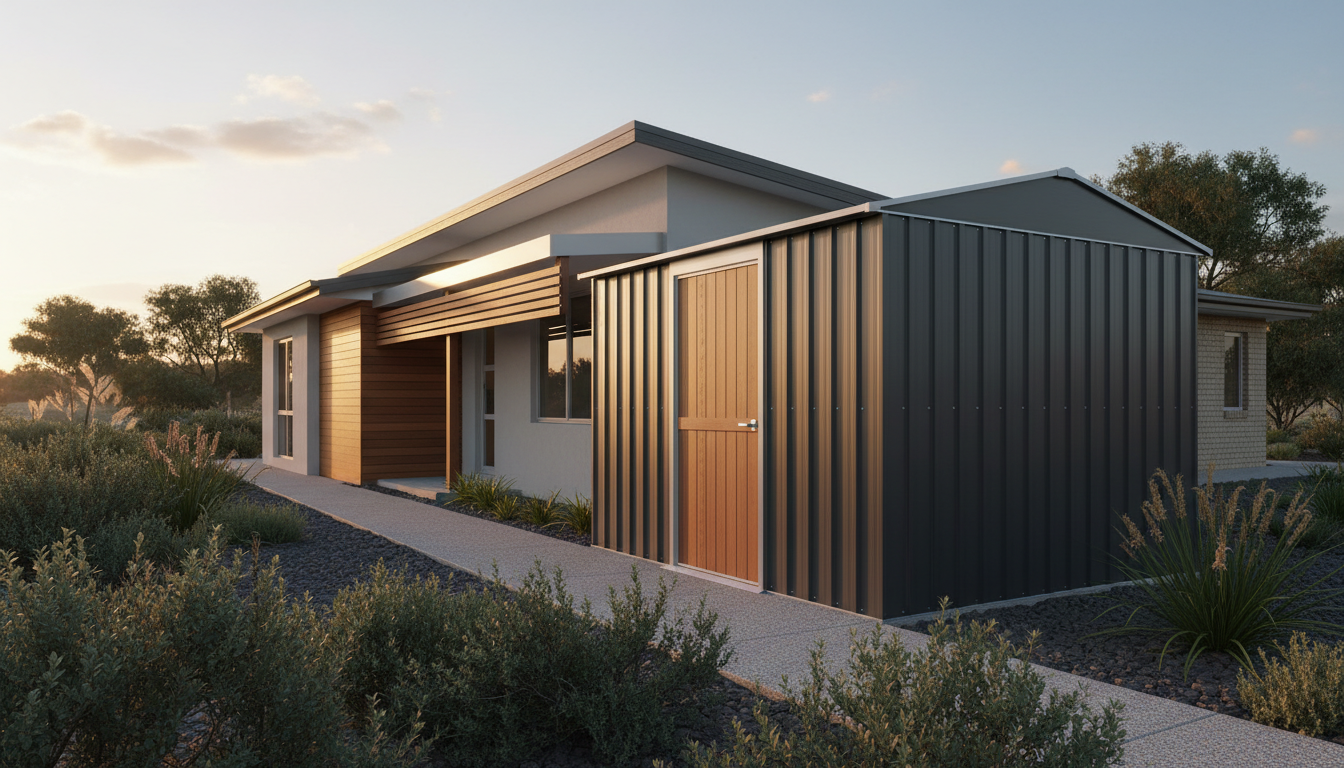
Coordinate shed roofline or fascia with the house and use low planting in front to prevent the shed from dominating the narrow vista. Architectural screens or lattice painted to match the shed can soften edges while maintaining airflow.
Case Studies: Successful Side of House Shed Installations
Slimline Shed in Sydney — Problem and Outcome
Jane’s 1.2m side yard required discreet storage for tools and bikes. Solution: a 1.2m x 2.8m slimline Colorbond shed with sliding side door, vertical bike hooks and fold-down potting bench. Council approval was straightforward under local thresholds after submitting a site plan and materials spec. Outcome: reclaimed walkway function, concealed storage and no visual impact from the street.
Side Entrance Shed in Brisbane — Process and Lessons
Michael’s 2m side yard stored bins and sports gear. He chose a 1.5m x 3.0m side entrance Colorbond shed placed 300mm from the boundary, using stainless fixings for coastal resilience and a multi-point lock for security. Brisbane City Council process required a building certifier sign-off but offered fast turnaround. Lesson: early council contact and selecting experienced local suppliers saved time and cost.
Melbourne Compliance and Visual Integration
Karin wanted a shed that matched her Victorian façade. Her supplier coordinated colours and planting to meet council streetscape expectations. A 1.0m x 3.2m slimline unit installed with 900mm setback and native screening blended with the garden and satisfied planning conditions. Lesson: supplier experience with councils is valuable.
Selecting Suppliers and Manufacturers
Overview of Australian Manufacturers and Retailers
Recommended manufacturers and industry resources:
- BlueScope/Colorbond® — Material source and technical specifications: BlueScope Colorbond;
- Stratco — National retailer offering Colorbond kits and installation options;
- Grange Sheds — Known for modular and custom steel sheds;
- Local specialist shed fabricators — Often provide council liaison and site-measure services (search local providers in your LGA).
When seeking suppliers, prioritise Colorbond certification, clear warranty terms (paint and structural), lead times, inclusion of site-measure services, and willingness to assist with council documentation.
Custom Versus Off-the-Shelf Options
Custom units: tailored to exact widths and features but costlier and longer lead times. Off-the-shelf: faster and cheaper, may need small yard adjustments. Decide by assessing whether precise clearance or special security/ventilation features are required.
Internal link: compare materials at Colorbond vs Zincalume sheds.
Summary and Best Practices
Key Takeaways
- Measure your side yard accurately and allow for door clearance and maintenance access;
- Choose between slimline and side entrance designs based on access needs and items stored;
- Colorbond® offers a resilient, low-maintenance option suited for many Australian climates;
- Consult your local council early to confirm setbacks and approval requirements;
- Enhance security with multi-point locks, reinforced frames and motion lighting.
Maintenance Tips
- Inspect fixings and paint annually, especially in coastal zones;
- Keep vents clear to prevent mould and condensation;
- Service locks and lighting every 12 months;
- Trim surrounding vegetation to limit moisture and pest access.
Frequently Asked Questions
What is a side of house shed and how is it different from a traditional garden shed?
A side of house shed is an outbuilding designed specifically for narrow side yards. Unlike traditional garden sheds with front-facing doors and wider footprints, side-of-house units prioritise slimline dimensions or side entrance layouts, vertical storage and door placement along the long side to optimise access and minimise impact on backyards.
How narrow can a slimline shed be while remaining functional?
Practical slimline widths commonly range from 0.75m to 1.2m. While 0.75m is possible for simple tool storage, 0.9–1.2m is recommended for organised shelving, safe door operation and basic manoeuvring. Consider door type, internal shelving depth and what you plan to store before choosing the narrowest option.
Are side entrance sheds suitable for all Australian climates?
Yes—when specified correctly. Side entrance sheds built from Colorbond® or coated steel suit coastal, arid and tropical zones if you choose appropriate coatings, stainless fixings, ventilation, and suitable roof pitches. Climate-specific details like reflective colours and sealed joins will extend service life in each region.
What are typical council setback requirements for side of house sheds in Australia?
Setbacks typically range from 300mm to 900mm depending on state, shed height and local council rules. For example, NSW often requires ~0.9m for taller outbuildings while some QLD councils allow reduced clearances with non-combustible materials. Always check your local council or planning portal for exact requirements.
Do I need planning approval to install a side of house shed?
It depends on shed size, height and local planning controls. Small sheds under specified floor area or height thresholds may be exempt, but many installations require a building or development approval. Contact your local council or a private certifier to confirm before ordering or installing a shed.
How can I optimise storage in a narrow side of house shed?
Use vertical storage: wall-mounted hooks, pegboards, adjustable shelving (150–400mm depth) and overhead racks. Zone the interior (bins near door, tools mid-zone, seasonal gear at the rear), install sliding doors to save clearance, and use fold-down benches to keep the footprint flexible and clutter-free.
Which materials are best for durability in different Australian climates?
Colorbond® is the most versatile for Australian climates due to coatings and colour options; Zincalume is cost-effective but may need extra protection in marine areas. Timber requires high maintenance. Select stainless fixings and corrosion-resistant coatings for coastal sites, and light colours or insulation for hot, arid zones.
What security features should I consider for a side entrance shed?
Prioritise a reinforced door frame with multi-point locking, stainless steel hasps or mortice locks, motion-sensing LED lighting, and mesh-protected vents. For high-value items use lockable cabinets or an alarm sensor. Choose hardware rated for your climate (marine-grade in coastal areas) to maintain long-term security.