

Choosing between a tent shed (portable fabric shelter) and a Colorbond steel shed (permanent steel structure) is a key decision for Australian homeowners in 2025. This guide compares portability, council approvals, wind ratings (AS1170.2), installation, maintenance, lifecycle cost and suitability by region so you can select the right shelter for your site and budget.
Overview of Tent Sheds and Colorbond Steel Sheds in Australia 2025
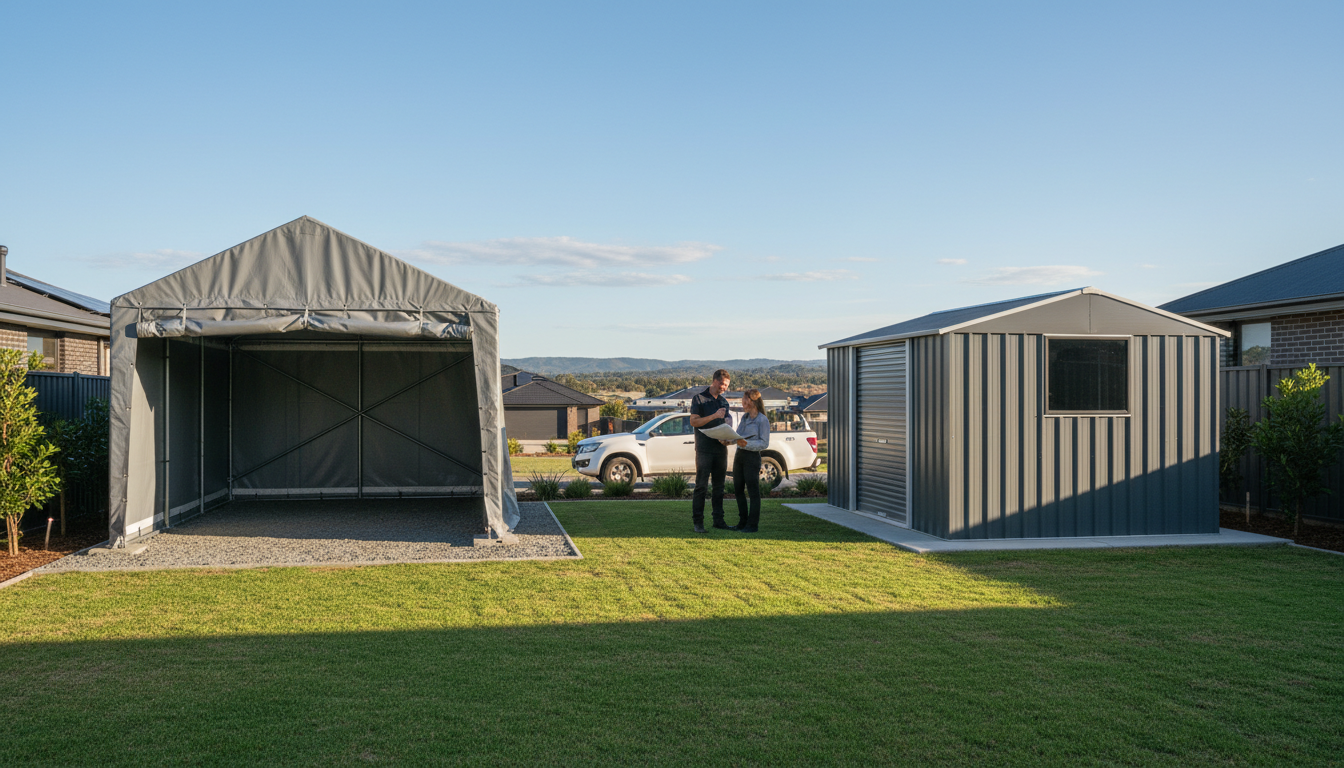
Tent sheds (also called temporary sheds, storage tents or garden shed tents) are fabric-based structures made from PVC-coated polyester or heavy textile membranes on light steel frames. They are designed for mobility — folding, collapsible or modular — and are usually pitched for short to medium-term storage, small workshops and event shelters. Typical benefits include low upfront cost, fast installation and relocation flexibility; key drawbacks are lower wind resistance, UV degradation and limited long-term security.
Colorbond steel sheds use Bluescope Colorbond pre-painted steel (or equivalent pre-finished steel) with galvanised base layers and corrosion-resistant coatings designed for Australian climates. These are permanent or semi-permanent structures engineered to meet national building requirements, including structural design to AS1170.2 wind load provisions and connection to concrete footings. Advantages include long service life, higher resale value and compliance ease for high-wind or cyclone-prone areas; trade-offs are higher initial cost and the need for foundations and professional installation.
Portable Shelter Concepts and Mobility Comparison
Portability and Mobility Features
Tent sheds prioritise mobility through folding frames, collapsible sections and modular panels. Typical features include tubular steel frames that dismantle, ratchet straps for tensioning, and roll-up doors. Mobility advantages: quick setup (often 1–4 hours), easy transport and low-cost entry. Disadvantages include lower structural redundancy, vulnerability to uplift and fabric wear over time, and limited insurance acceptance for permanent storage.
Temporary vs Permanent Installation
Temporary installations use removable anchors (ground pegs, deadman anchors, ballast) and generally avoid permanent ground penetration. Permanent installations (Colorbond) require engineered foundations (concrete slab or isolated footings), bracketed anchor plates and sealed fixings to comply with the National Construction Code (NCC) and AS1170.2. Mobility reduces lifespan and increases maintenance for fabric shelters; permanence increases upfront cost but lowers lifecycle replacement frequency.
Impact of Portability on Lifespan and Maintenance
Typical tent shed life is 3–7 years in moderate climates, shorter in high UV or coastal conditions. Common maintenance includes re-tensioning, UV treatment, patch repairs and frame corrosion control. Colorbond sheds typically exceed 20 years with basic upkeep—periodic washing, prompt repaint or touch-up of scratches, and door/fastener servicing. Consider resale value, insurance, and intended duration when choosing.
Australian Council Approval Requirements for Tent Sheds and Colorbond Steel Structures
National baseline and how states differ
The National Construction Code (NCC) provides the baseline for structure safety, but local planning and building authorities set specific approval pathways, exemptions, and documentation requirements. See official NCC guidance at the Australian Building Codes Board: abcb.gov.au. For wind maps and localised climate info, consult the Bureau of Meteorology: bom.gov.au. For AS1170.2 references and standards search, see Standards Australia: standards.org.au.
State-by-state summary (practical guidance)
Below are typical thresholds and examples; these vary by council and you must confirm locally.
- New South Wales (NSW) — Many councils adopt streamlined exemptions for non-permanent structures under 10m², but metropolitan councils increasingly require temporary occupancy permits for portable structures used beyond several months. See the NSW Planning Portal for details: planningportal.nsw.gov.au.
- Queensland (QLD) — Coastal and cyclone-prone areas demand certified designs. Queensland Building and Construction Commission guidance and Brisbane City Council provide local rules; consult QBCC and Brisbane pages: qbcc.qld.gov.au, brisbane.qld.gov.au/planning-building.
- Victoria (VIC) — Planning.vic.gov.au and local councils set permit triggers; small, removable tents are often exempt but time and anchorage rules can apply: planning.vic.gov.au.
- Western Australia (WA), South Australia (SA), Tasmania (TAS), Northern Territory (NT) — Each jurisdiction has specific guidance on outbuildings and temporary structures; councils may require certificates of design compliance for permanent sheds and stricter oversight for long-term temporary tents.
Temporary tent shed approval — common council requirements
Many councils assess tent sheds on size, intended duration, anchorage method and site impact. Since 2025 several councils have introduced clearer time limits on temporary structures (commonly between 3–12 months depending on location). Typical requirements include:
- Site plan and location relative to property boundaries
- Manufacturer’s structural data and wind rating (if available)
- Anchorage details to show no unacceptable ground damage
- Temporary occupancy permit or development approval if used beyond local time limits
Colorbond steel shed approval — common process
Permanent Colorbond sheds usually require a building permit or development approval if over a set area (commonly 10m²), if they alter site drainage, or if they affect setbacks. Typical submissions include:
- Detailed plans and elevations
- Engineering certification for wind loads and footing connections (AS1170.2 referenced)
- Soil/site classification or geotechnical note for larger sheds
- Plumbing/electrical permits if services are installed
Step-by-step checklist for permit applications (tent and Colorbond)
- Confirm local council thresholds via council website or planning office (link to local council contact pages).
- Obtain site plan showing setbacks, trees, easements and contour (survey preferred for permanent sheds).
- Collect manufacturer datasheets, wind-rating certificates (if available) and anchorage plans for tent sheds.
- For Colorbond, request engineering drawings and a footing/slab specification from supplier or structural engineer.
- Submit development or building permit application with any fees and expected timeframes (typically 2–6 weeks depending on complexity).
- If required, obtain a post-installation certification or occupation approval from a registered building practitioner.
Wind Ratings and Safety Compliance in Australian Conditions
What AS1170.2 means for sheds
AS1170.2 (Wind actions) is the Australian Standard that defines wind actions on structures. It describes wind regions, terrain categories, site classification and design wind speeds used for structural design and connection detailing. AS1170.2 uses wind regions (N‑zones) and cyclone categories to inform design; local authorities reference it for certification. For standard information see Standards Australia and design guidance available via state building authorities and the ABCB: abcb.gov.au, standards.org.au.
Common terminology explained
- Wind classification (N1–N4) — non-cyclonic zones where N1 is lowest and N4 highest. These guide basic design pressures.
- Cyclone categories (C1–C4) — higher-level design categories used in northern Australia; C4 denotes more severe cyclone action. Check BOM and local maps for your location.
- Design wind speed (Vr) — the reference wind speed used in calculations (m/s). Engineers use Vr and terrain factors to derive pressures.
- Ultimate Limit State (ULS) — design checks that ensure structural safety under extreme loads.
Regional mapping and example design wind speeds
Use the Bureau of Meteorology wind zone maps as a guide: bom.gov.au. The table below gives indicative design wind speeds (Vr) for common regions; these are illustrative — always obtain site-specific data from BOM or a certified engineer.
| Region | Typical Wind Zone | Example Vr (m/s) | Tent Shed Suitability | Colorbond Suitability |
|---|---|---|---|---|
| Sydney & surrounds (NSW) | N2 – Moderate | 35–40 m/s | Suitable for short-term use with rated anchorage | Suitable; standard designs meet N2 |
| Brisbane & coastal QLD | C2 – Cyclone category 2 common coastal | 45–55 m/s | Not recommended without engineer-specified reinforcements | Recommended; cyclone-rated Colorbond available |
| Perth & SW WA | N3 – High | 40–50 m/s | Short-term possible; risk in storms | Ideal; standard engineered designs apply |
| Darwin & far north QLD | C4 – Severe cyclone | 60+ m/s | Prohibited; unsafe | Mandatory cyclone-rated, engineered sheds required |
Source guidance: Bureau of Meteorology wind maps and AS1170.2 are the primary references for design wind speeds; consult BOM and a certified structural engineer for site-specific Vr values.
Safety mitigation and anchorage recommendations
Anchorage is critical. Typical anchorage options and guidance include:
- Soft soil: galvanised ground auger anchors or long ground pegs combined with deadman anchors (trenched sandbags) — use multiple anchors and rated hold-downs.
- Rocky/hard ground: chemical (resin) anchors fixed into drilled holes or bolted base plates keyed to concrete footings.
- Hard surfaces (concrete/asphalt): use engineer-specified mechanical anchors or weighted ballast systems rated to uplift forces.
Recommended minimum anchor embedment/ratings vary by site and wind load; typical domestic guidance suggests anchor capacities from 5–20 kN per anchor depending on Vr — consult a qualified structural engineer for exact sizing and spacing. For permanent Colorbond sheds, anchor and footing details must be engineered (concrete socket depths, reinforcing, and edge beam design) to AS1170.2-derived loads.
Professional advice: The Australian Institute of Building Surveyors and local building surveyors recommend engaging a registered structural engineer to certify wind-rating compliance and connections when in doubt. See AIBS guidance pages for building surveyor recommendations.
Comparative Analysis: Installation, Durability, and Maintenance
Installation step-by-step: Tent sheds
- Site selection: flat, well-drained area away from overhanging trees and services.
- Unpack components and assemble frame per manufacturer instructions (typical time 1–4 hours for 3–6m structures).
- Fix fabric to frame and tension; check for clearances and door operation.
- Install anchors: soft soil — use auger ground anchors or long pegs with ratchet straps; hard surfaces — use weighted ballast (poly water tanks or concrete blocks) or chemical anchors if penetrating a slab is permitted.
- Safety checklist: check all fasteners, tension evenly, ensure storm straps in place, keep interior clear of heavy concentrated loads, and register temporary occupancy with council if required.
Installation step-by-step: Colorbond steel sheds
- Site preparation: confirm setbacks, level ground, and drainage (address slopes and stormwater).
- Concrete slab specification: domestic garden sheds commonly use 75–100mm thick concrete over compacted subgrade for small sheds (3x3m); larger or workshop sheds typically need 100–150mm slab with edge beams or isolated footings — engineer to specify based on load and local soil.
- Anchor/fixings: install anchor plates or chemical anchors in slab prior to erection; fix base rail and erect frames per engineered drawings.
- Finish: flashings, gutters, doors, and internal fit-out. Obtain building inspection sign-off and structural certification if required.
- When to involve professionals: for slabs, services, or wind-rated/cyclone designs, use a builder or structural engineer to ensure compliance.
Material longevity and practical maintenance tips
Fabric: clean annually, store when not in use or during long storms, check seams and re-tension. Steel: wash annually in coastal areas, touch-up scratches with manufacturer touch-up paint, clear gutters and keep door seals functional. Keep records of maintenance and certificates to support insurance claims or council queries.
Cost Implications and Typical Use Cases for Both Shelter Types
Upfront vs lifecycle costs — assumptions and examples
Below are typical market ranges (2024–2025 market checks and supplier pricing). Prices vary by region, supplier, customization and permit costs. Assumptions: tent lifespan 5 years (average), Colorbond lifespan 25 years; maintenance and replacement costs estimated conservatively.
| Size (m) | Tent shed upfront (AUD) | Replace cycle (yrs) | 10-year cost (tent, AUD) | Colorbond upfront (AUD) | 10-year cost (Colorbond, AUD) |
|---|---|---|---|---|---|
| 3 x 3 | $500 – $1,200 | 5 | $1,000 – $2,400 (includes one replacement + minor maintenance) | $3,000 – $5,000 | $3,200 – $5,800 (includes maintenance & touch-ups) |
| 6 x 4 | $1,200 – $3,000 | 5–7 | $2,400 – $6,000 | $6,000 – $12,000 | $6,500 – $13,500 |
| 10 x 6 | $3,000 – $6,000 | 5–7 | $6,000 – $12,000 | $12,000 – $30,000+ | $13,000 – $32,000 (includes slab & engineering) |
Example calculation: a 6×4 tent at $2,000 replaced every 6 years gives approx $4,000 over 10 years (one replacement + maintenance). A comparable Colorbond at $8,000 with $500 annual maintenance gives approx $10,000 over 10 years — higher upfront but often preferable for security and council compliance.
Sources: supplier price checks, internal product pages and market averages (prices vary by region and customization). For product pricing see related pages: 10×20 Colorbond steel sheds, Affordable Colorbond sheds.
Use-case guidance
- Renter / short-term project: tent shed for low cost and mobility (ensure permit compliance if used >3 months).
- Long-term homeowner needing workshop/garage: Colorbond for durability, security and council compliance.
- Coastal or cyclone-exposed property: cyclone-rated Colorbond with engineer certification is typically required.
Regional Examples and Micro Case Studies
Example scenario — Sydney renter (suburban backyard)
A renter in western Sydney chose a 3×3 tent shed for two years of storage while renovating. They checked the local LGA planning page, confirmed a 6‑month permit would be required for longer use, and used ground auger anchors plus deadman straps. No council action was needed for the temporary stay, but the tenant documented installation and removal dates for their landlord.
Example scenario — Coastal Queensland homeowner
On the Sunshine Coast a homeowner installed a cyclone-rated Colorbond shed with engineered footings and a Certificate of Design Compliance. The supplier provided wind-rating documentation compliant with AS1170.2 and the council approved the development application after an engineering peer review. Upfront costs were higher, but insurance discounts and peace of mind justified the investment.
Example scenario — Perth hobbyist upgrade
A Perth hobbyist initially used a fabric shelter for woodworking but after seasonal storms upgraded to a 6×4 Colorbond shed on a 100mm slab with perimeter beams. Over five years, replacement costs and downtime of the tent exceeded the one‑off cost of the steel shed, validating the long-term investment decision.
Decision-Making Framework for Australian Homeowners in 2025
Checklist: decide by need, site and compliance
- Define duration: temporary (<12 months) vs permanent (multi-year).
- Identify wind zone: use BOM maps and local council guidance
- Confirm council thresholds: consult your local council site or the state’s planning portal.
- Estimate total lifecycle cost (purchase + maintenance + permit/engineering fees).
- Decide on mobility needs: portability vs security and permanence.
When to get professional help
Engage a registered structural engineer when: your site is in a cyclone/high wind zone, you need certified wind ratings, you require a slab or footing design, or your shed will contain hazardous materials or heavy machinery. Contact a licensed builder for slab and electrical/plumbing works.
E-E-A-T, Sources & Professional Guidance
Trusted sources and further reading:
- National Construction Code / Australian Building Codes Board — abcb.gov.au
- Standards Australia (AS1170.2 reference) — standards.org.au
- Bureau of Meteorology wind maps — bom.gov.au
- NSW Planning Portal — planningportal.nsw.gov.au
- Queensland Building and Construction Commission — qbcc.qld.gov.au
- Brisbane City Council planning & building — brisbane.qld.gov.au
- Professional recommendation: Building surveyors and the Australian Institute of Building Surveyors advise that “for any structure likely to be exposed to sustained wind or that will remain in place beyond temporary thresholds, obtain a registered engineer’s certification for wind-rating and anchorage.”
Conclusion
Deciding between a tent shed and a Colorbond steel shed comes down to intended duration, site wind exposure, council requirements and budget. Tent sheds are cost-effective for short-term, mobile needs but have shorter lifespans and stricter temporary-use conditions in many LGAs. Colorbond sheds cost more upfront but provide long-term durability, security and clear pathways to compliance in higher wind or cyclone zones.
For detailed selection help, see our buyer’s guide and consult the building codes and Australian standards guide. If unsure, contact your local council or get a written quote and wind‑rating certificate from a certified shed installer/engineer —
Frequently Asked Questions
What are the main differences between tent sheds and Colorbond steel sheds?
Tent sheds are lightweight, portable fabric structures meant for short-term use; Colorbond steel sheds are permanent, engineered buildings with steel cladding and concrete footings. Choose tents for mobility and lower upfront cost; choose Colorbond for durability, security and compliance with building codes and wind‑rating requirements. Confirm local permit rules before installing either.
Do tent sheds require council approval in Australia?
Council approval depends on size, duration and local policy. Many councils allow small, removable tents exempt from permits for short periods; extended use (commonly beyond 3–12 months) or larger tents often need a temporary occupancy permit. Always check your local council website or planning office for exact thresholds and documentation requirements.
How do wind ratings affect the choice of outdoor shelter?
Wind ratings (per AS1170.2) determine required structural strength and anchorage. Higher regional wind speeds or cyclone categories require engineered designs and certified connections. Tent sheds have lower wind resistance and are unsuitable for cyclone-prone zones; Colorbond sheds can be engineered to meet required wind classifications for safe, compliant installations.
Can I use a tent shed in cyclone-prone areas?
Tent sheds are generally not suitable for cyclone-prone areas. In regions with cyclone categories (C2–C4) local rules usually require cyclone-rated, engineered permanent structures. If you are in a cyclone-exposed zone, choose an engineered Colorbond shed and obtain the required certifications and council approvals.
What are typical installation requirements for Colorbond steel sheds?
Colorbond sheds typically need a level site, engineered concrete slab or footings (thickness varies by size — commonly 75–150mm), anchor plates or chemical anchors, and compliance with AS1170.2 wind design. Many councils require plans, engineering certification and a building permit. Use licensed trades for slabs, electrical and plumbing works.
How long do tent sheds typically last compared to steel sheds?
Tent sheds commonly last 3–7 years depending on UV exposure, maintenance and storms; Colorbond steel sheds usually exceed 20 years with regular upkeep. Lifecycle costs for tents can be higher over time due to replacements; steel sheds are higher upfront but cheaper over a 10–25 year horizon for many homeowners.
Are Colorbond steel sheds more cost-effective over the long term?
Colorbond sheds often deliver better long-term value despite higher initial cost because of greater durability, lower replacement frequency, and compliance in high-wind areas. Compare 10‑year lifecycle costs including purchase, slab, engineering and maintenance to determine value for your situation; see the cost table above for examples.
How do I decide between a temporary tent shed or a permanent Colorbond steel shed?
Decide by duration, wind zone, council rules and budget. Use a tent for short-term, low-cost needs if local rules permit; choose Colorbond for long-term, secure storage or if you need wind-certified, council‑approved works. When unsure, consult your local council and a registered structural engineer for site-specific advice.