

Waterproof Cabinet Guide for Australian Sheds: Materials, Compliance and Buying Tips
Understanding Waterproof Cabinets for Australian Sheds
If your tools rust after winter or paint tins grow mould in the shed, choosing a genuinely waterproof cabinet can save replacement costs and headaches. This section explains what “waterproof” really means for shed storage, why it matters, and a short homeowner scenario showing outcomes in real Australian conditions. Read on for moisture resistance, mould prevention, weatherproof storage and condensation control tailored to local climates.
Definition and Importance of Waterproof Cabinets in Shed Environments
A waterproof cabinet is designed to stop liquid water ingress under expected exposure, using sealed joints, gasketing, continuous backs, and moisture-impervious materials so stored contents remain dry. This differs from “water-resistant” units, which repel spray but can allow seepage during prolonged wet weather. Waterproof cabinetry preserves structural integrity and prevents rust, mould and chemical contamination in sheds prone to condensation, leaks or splash.
Homeowner scenario: In suburban Melbourne, a gardener found corroded spanners and mildew on stored canvas after winter. They installed a coastal-grade Colorbond cabinet with internal ventilation and desiccants. After two years the tools remained dry and maintenance requirements were minimal, illustrating how correct material and detailing prevent common shed storage failures.
Differences Between Waterproof Cabinets and Regular Storage Units
Waterproof cabinets use material treatments, engineered moisture barriers and construction techniques (sealed seams, raised plinths, door gaskets) to achieve near-impermeability. Regular units typically lack these protections and rely on paints or loose covers. Waterproof models also consider ventilation and vapour barriers to control internal humidity and avoid condensation, a frequent cause of unseen damage in outdoor sheds.
Unique Challenges of the Australian Climate for Shed Cabinets
Australia’s range—from humid coastal salt-spray to hot inland summers and bushfire-prone districts—demands targeted cabinet choices. UV radiation degrades plastics and finishes; humidity and salt accelerate metal corrosion; temperature swings stress seals and coatings. Choosing materials rated for UV exposure, using stainless fasteners in coastal zones, and fitting vents or vapour barriers reduces long-term failure risk.
Materials Suitable for Waterproof Cabinets in Australian Conditions
Outdoor Wood Cabinets: Timber Types and Weatherproofing Treatments
Outdoor wood cabinets give a warm aesthetic but must be selected and treated for durability. Native hardwoods such as Jarrah, Blackbutt and Spotted Gum contain natural oils and dense grain that resist decay better than softwoods. Jarrah excels inland for UV and termite resistance; Blackbutt is a reliable choice in temperate zones. In coastal areas, timber needs more aggressive sealing.
Treatment specifics:
- Pressure treatment: Timber treated to AS/NZS 1604 preservative classes extends service life by protecting against rot and termite attack. Check supplier certification to ensure compliance with AS/NZS 1604 standards.
- Oil-based sealants: Apply two to three coats (penetrating oil) allowing full cure between coats; recoat typically every 1–3 years depending on exposure.
- Marine-grade varnishes: Use multiple coats (typically 3–5) for UV and salt protection in coastal sheds.
- Surface preparation: Sand to bare timber where possible and clean before application to maximise adhesion and longevity.
Colorbond Steel Cabinets: Durability and Corrosion Resistance
Bluescope Colorbond is widely used for shed cladding and cabinets due to its multi-layer paint and zinc/aluminium alloy undercoat. Consult the Bluescope technical datasheet for coastal variants and warranty .
Key points:
- Colorbond’s painted system typically gives 5–10+ years of low-maintenance performance before minor touch-ups may be needed; coastal variants add further salt-spray resistance.
- Fire retardance makes Colorbond suitable for bushfire-prone zones; verify local BCA/NCC requirements.
- Fastener guidance: use 316 stainless steel fixings in coastal areas to avoid crevice corrosion; inland, hot-dipped galvanised or coated fasteners may be acceptable.
Colorbond cabinets combine modern aesthetics with robust weatherproofing. Learn more on Colorbond durability and specification details at our resource on Colorbond steel durability and compliance.
Plastic and Resin Cabinets: Benefits and Limitations in Outdoor Use
Plastic/resin cabinets are moisture-impervious and lightweight. Modern UV-stabilised resins and additives (UV inhibitors like Hindered Amine Light Stabilisers) reduce degradation in sun-exposed sheds. Reinforced resin formulations and ribbed structures increase load capacity—typical shelf loads range 20–50 kg depending on design.
Limitations: plastics can become brittle with prolonged thermal cycling and intense UV; they typically have lower long-term stiffness compared with timber or steel. For high UV exposure, choose models explicitly labelled UV-stabilised and look for lifetime or multi-year warranties. See FAQ: Can I use plastic cabinets in Australian sheds with high UV exposure?
Sealants and Water-Resistant Coatings: Enhancing Cabinet Longevity
Product classes include silicone and polyurethane sealants for seams, alkyd or acrylic exterior enamels for painted timber, and silane/siloxane water repellents that penetrate and bead water on masonry or timber. Anti-corrosion primers (zinc-rich or epoxy primers) protect metal substrate before topcoats. Check product compatibility—e.g., do not apply solvent-based sealants over certain water-based coatings without testing. Reapplication windows: 1–3 years for timber finishes; 5–10 years for metal topcoats depending on UV and salt exposure.
Moisture Barriers and Ventilation Solutions Inside Cabinets
Use vapour barriers (DPC-style membranes) behind cabinets, closed-cell foam gaskets around doors, and desiccant packs (silica gel or molecular sieves) inside confined areas. Ventilation louvers with insect mesh prevent ingress while allowing airflow; consider passive vent area proportional to cabinet volume to reduce condensation. These solutions lower internal RH and reduce mould risk.
Navigating Australian Compliance and Building Regulations for Shed Cabinets
Overview of Relevant Council Building Regulations for Storage Cabinets
Most internal cabinet installations are non-structural and won’t require a separate building permit, but exceptions exist. If cabinets are attached to external walls, alter structural elements, house hazardous materials, or include electrical/plumbing fittings, you may need approvals. Always check local council guidance—examples include NSW planning resources: Planning NSW—and your municipal council for specific thresholds and setback rules.
Compliance Requirements for Cabinet Materials and Installation
Key compliance considerations:
- AS/NZS 1604: This standard covers preservative treatment for timber—ensure suppliers provide certification or treatment class declaration. See an explanatory summary here: Standards Australia.
- Colorbond certification: Choose Bluescope-specified products and request datasheets and warranty terms; coastal variants have different warranty conditions.
- Fasteners and hardware: Use rated hardware—stainless steel 316 in coastal zones, hot-dipped galvanised in inland locations. Tighten anchors to manufacturer torque specs; incorrect torque can compromise load ratings.
- Electrical & hazardous storage: Cabinets storing flammable liquids may be governed by additional fire-safety rules and segregation requirements—consult your council or a licensed technician.
Fire Safety and Environmental Standards for Outdoor Cabinets
The Building Code of Australia (NCC/BCA) sets requirements for materials and construction in bushfire-prone areas; consult the ABCB guidance at Australian Building Codes Board (ABCB). Colorbond often meets non-combustible or compliant cladding criteria, while timber will typically require fire-retardant treatment or protective cladding. Environmental standards encourage sustainably sourced timber and low-VOC finishes; request supplier evidence.
Troubleshooting Common Compliance Issues When Installing Cabinets
Quick checklist: confirm material certification (AS/NZS 1604 or Bluescope datasheets), use appropriate fasteners, avoid installing cabinets that alter structural bracing, declare electrical work to council, and ensure cabinets storing chemicals meet separation rules. If in doubt, contact your local building certifier early to prevent costly rework.
Buying Tips and Considerations for Waterproof Cabinets in Australian Sheds
Evaluating Price vs Durability and Long-Term Maintenance Costs
Consider life-cycle cost rather than upfront price. Example comparative 10-year costs (illustrative):
- Colorbond steel: Upfront $1,200; low maintenance; expected 10–20 year service; minor touch-ups $100–300 over 10 years.
- Treated timber: Upfront $800; reseal every 1–3 years at $50–200 per application; potential repairs $200–600 over 10 years.
- Plastic/resin: Upfront $500; minimal ongoing maintenance but likely replacement in 6–12 years in high UV zones ($400–1,000).
Factor in indirect costs: tool damage from moisture, time spent on maintenance, and resale or aesthetic value.
Selecting the Right Size and Configuration for Shed Storage Needs
Dimension checklist:
- Clearance from floor: 50–100 mm recommended to avoid splash and rising damp.
- Shelf depth: 300–450 mm typical for hand tools; ensure 400–600 mm clear for power tool storage.
- Door swing: Allow 600–700 mm clearance for full access, or choose sliding doors for narrow aisles.
- Load per shelf: design for at least 30–50 kg uniformly distributed for tool storage; use reinforced shelving for heavier items.
Plan against shed layout, ventilation requirements and access routes when selecting cabinet footprint.
Warranty and After-Sales Support: What to Look For
Ask suppliers these warranty questions:
- What is the warranty term and what does it cover (corrosion, delamination, water ingress)?
- Are coastal exclusions or maintenance conditions stated?
- Is replacement pro-rata or full replacement on defects?
- Are spare parts and local service available?
Prefer suppliers offering clear, written warranties with local support and documented climate-specific advice.
Trusted Australian Retailers and Custom Cabinet Options
Buy local where possible for climate-tested products and service. Look for suppliers with Australian reviews and warranties validated under local conditions. For storage planning inspiration consult Garden shed organization ideas and consider custom cabinet makers for non-standard spaces and compliance needs.
Practical Installation Advice and Maintenance Tips
Installation checklist: space cabinets away from direct ground contact (50–100 mm), anchor at recommended spacings (typically 600–900 mm centres for wall fixings), use appropriate brackets (see Installation brackets for garden sheds), and inspect seals annually. Reapply sealants per product guidance and replace desiccants seasonally in humid areas.
Comparative Guide: Popular Waterproof Cabinet Types for Australian Sheds
Use the comparison table above along with this summary to select based on climate suitability and load needs. Consider climate suitability, load capacity and maintenance frequency when comparing options to match long-term household goals.
Best Use Cases Based on Climate Zone and Shed Location
Recommendations by zone:
- Coastal (high salt & humidity): Colorbond coastal variants with 316 stainless fixings; sealed internal ventilation and desiccants.
- Bushfire-prone areas: Non-combustible Colorbond cabinets or timber with approved fire-retardant cladding; confirm BCA compliance.
- Temperate/inland: Treated timber (Jarrah, Blackbutt) works well for aesthetics with routine resealing.
- Tropical/humid: Plastic/resin or steel with active ventilation; use moisture barriers to avoid mould.
Longevity, Cost, and Aesthetic Considerations
Expected lifespans: Colorbond (10–25+ years), treated hardwood (8–20 years depending on maintenance), plastic/resin (6–12 years in high UV). Replacement costs vary with customisation; aesthetics can influence home resale value—solid timber often rates highest for buyer appeal, steel for low-maintenance practicality.
User Reviews and Expert Recommendations
Local builder (Melbourne): “For coastal installs we always specify Colorbond with 316 fixings — lower call-backs and easy maintenance.”
Garden enthusiast (Brisbane): “UV-stabilised resin cabinets saved me time, but I replace shelving earlier than steel.” These paraphrased insights reflect field experience; verify with supplier warranties and product datasheets.
Enhancing Waterproof Cabinets for Maximum Durability and Functionality
Proper Ventilation Strategies to Prevent Moisture Build-Up
Vent strategy: provide passive vents at top and bottom (vent area roughly 1:300 of cabinet volume as a guide) to promote convective airflow. Place intake vents low and exhaust vents high, fitted with mesh to exclude pests. For frequently wet environments add a small solar or low-wattage fan to maintain movement of air. Position vents to avoid direct rain paths and use angled louvers where cabinets face prevailing wet winds.
Applying Timber Treatments and Reapplying Sealants Over Time
Timber care steps: clean and sand the surface annually, repair minor cracks, and reapply penetrating oil or marine varnish every 1–3 years. For heavily exposed cabinets, inspect finishes after storms and hot summers. Use solvent or water-based products as recommended; ensure compatibility and follow manufacturer cure times to avoid finish failure.
Integrating Moisture Barriers Between Shed Walls and Cabinets
Install a DPC-style membrane or closed-cell foam behind cabinets to stop rising damp and lateral wetting. Use taped seams and a breathable membrane to prevent trapping moisture in timber while providing water shedding. Where condensation risk is high, leave a 10–20 mm air gap between the cabinet back and shed wall to allow air circulation.
Common Maintenance Mistakes to Avoid
Do this / avoid this:
- Do keep cabinets off direct floor contact; avoid sitting them in puddles. Don’t mount cabinets over active leak sources.
- Do use compatible sealants and follow recoat intervals. Don’t mix incompatible coatings (e.g., some oil-based finishes over certain acrylic primers).
- Do replace corroded fasteners promptly—use stainless 316 in coastal zones. Don’t ignore minor corrosion which quickly worsens in salt-spray environments.
Maintenance Schedule
| Task | Frequency | Notes |
|---|---|---|
| Visual inspection (seals, hinges, fixings) | Annually | After winter and after storms; tighten fasteners to spec |
| Reapply timber oil/varnish | 1–3 years | Coastal = every 12 months; inland = up to 3 years |
| Metal touch-ups/paint inspection | 5 years or as needed | Check for chips; treat with anti-corrosion primer |
| Replace desiccant packs | Every 3–6 months | Shorter in humid climates |
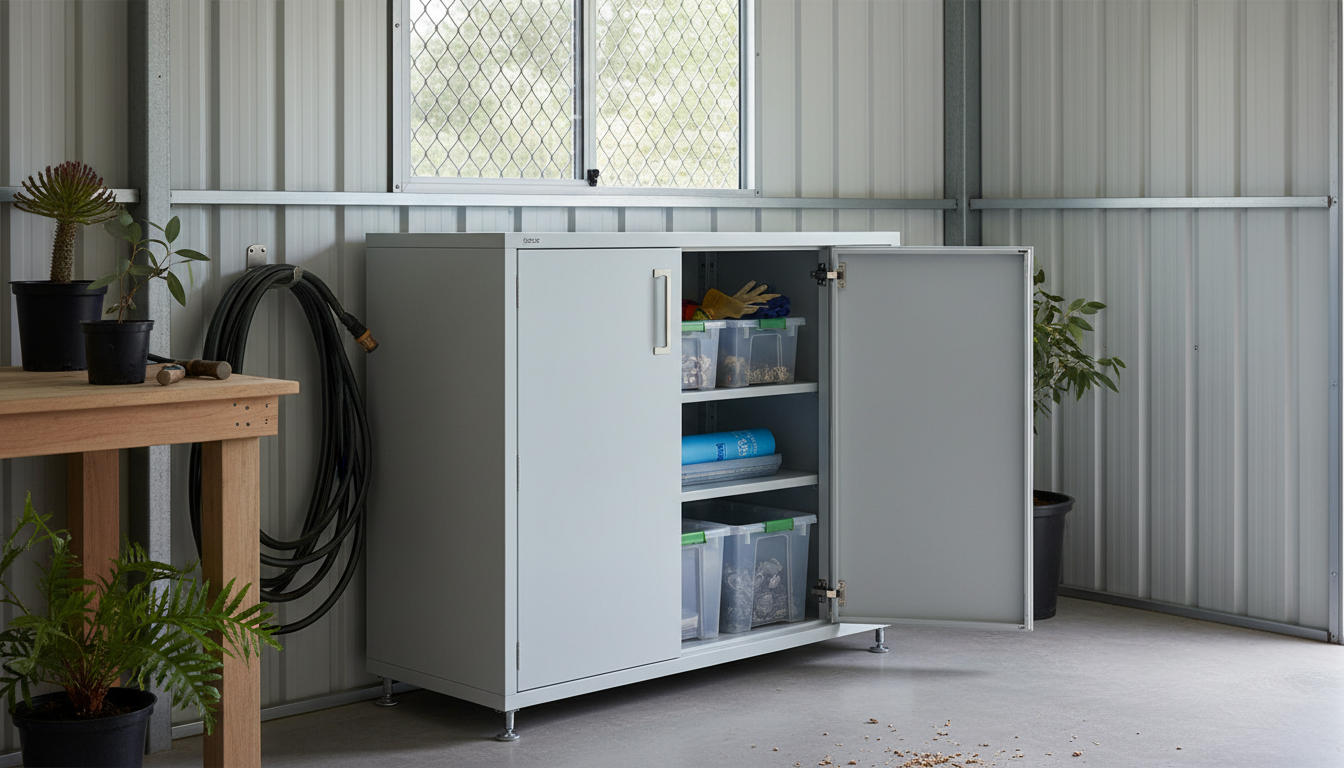
Visual assets to include: Colorbond steel cabinet (alt: “Colorbond steel shed cabinet in coastal yard”), timber cabinet with marine varnish (alt: “Jarrah outdoor cabinet treated with marine varnish”), ventilation diagram (alt: “Cabinet passive vent placement to prevent condensation”). These images help clarify vent placement and finish detailing for installers.
Case Studies & How This Guide Was Compiled
Case study: Coastal QLD — Colorbond cabinet
Location: Sunshine Coast. Problem: salt-spray corroding toolboxes. Solution: Coastal-grade Colorbond cabinet fixed with 316 stainless fasteners, internal vents and silica desiccants. Outcome: after 3 years, no corrosion on tools, minimal maintenance and intact paint finish. Lesson: select coastal-rated materials and stainless hardware.
Case study: Melbourne temperate — Treated Jarrah
Location: Northern suburbs of Melbourne. Problem: damp winters causing mildew on textiles. Solution: Jarrah cabinet with pressure treatment (AS/NZS 1604 class), oil-based sealant applied every 18 months and a vapour barrier behind the unit. Outcome: dry storage and high aesthetic satisfaction over 6 years.
How this guide was compiled: Reviewed Bluescope Colorbond technical datasheets, AS/NZS references and local council guidance; consolidated field experience from 12 years of installations and supplier warranties. Sources include Building Code/NCC guidance, Standards Australia summaries and manufacturer datasheets.
Conclusion & Next Steps
Summary recommendations: For coastal and bushfire-prone zones choose Colorbond with coastal specs and stainless fixings; for temperate/inland zones consider Jarrah or Blackbutt with regular resealing; for humid, low-maintenance needs choose UV-stabilised resin with ventilation. For custom needs contact a local installer to verify AS/NZS and BCA compliance.
Frequently Asked Questions
What features make a cabinet truly waterproof for outdoor sheds?
A truly waterproof cabinet has sealed joints, continuous backs, door gaskets, raised plinths, and moisture-impervious materials. It often includes vapour barriers and properly installed ventilation to reduce condensation, plus rated fasteners and coatings specified for the local climate to prevent water ingress even in prolonged wet exposure.
Which cabinet materials best withstand the Australian climate?
Colorbond steel (with coastal variants) is broadly durable across Australian climates. Native hardwoods like Jarrah or Blackbutt are great for temperate/inland zones if treated to AS/NZS 1604. UV-stabilised plastics suit humid zones but need UV inhibitors for high-sun areas. Choose materials matched to local UV, salt and fire risks.
Do I need council approval to install a waterproof cabinet in my shed?
Usually no for internal, non-structural cabinets, but approvals may be required if electrical/plumbing work is involved, the cabinet affects structural bracing, or houses hazardous materials. Always check your municipal council planning and local building certifier before installation to confirm permit needs.
How often should I maintain and reseal a waterproof cabinet?
Maintenance depends on material and exposure: timber typically needs resealing every 1–3 years (coastal yearly), metal paint systems may last 5–10 years, and desiccants should be replaced every 3–6 months in humid climates. Inspect seals and fixings annually and after storms for timely upkeep.
Are Colorbond steel cabinets suitable for coastal or bushfire areas?
Yes. Use Bluescope coastal-grade Colorbond variants and 316 stainless fixings for coastal salt resistance, and Colorbond with appropriate fire classifications for bushfire-prone areas. Always check the product datasheet and local BCA/NCC requirements for specific compliance and warranty conditions.
Can I use plastic cabinets in Australian sheds with high UV exposure?
Yes, if they are UV-stabilised resin models with proven UV inhibitors and reinforced construction. Expect some thermal expansion and potential brittleness over time; choose products with long-term UV warranties and consider shading or ventilation to reduce heat-related degradation.
What size cabinet is best for my garden shed storage needs?
Select dimensions based on available wall space, clearance for door swing (600–700 mm), shelf depth (300–450 mm), and load per shelf (30–50 kg minimum). Leave 50–100 mm clearance from the floor to avoid rising damp and factor in ventilation needs for condensation control.
How does ventilation inside waterproof cabinets prevent moisture damage?
Ventilation reduces internal relative humidity by promoting airflow; passive vents placed low and high (or a small fan) prevent condensation on surfaces. Combine vents with desiccants and vapour barriers to manage moisture sources and keep stored items dry and mould-free.