
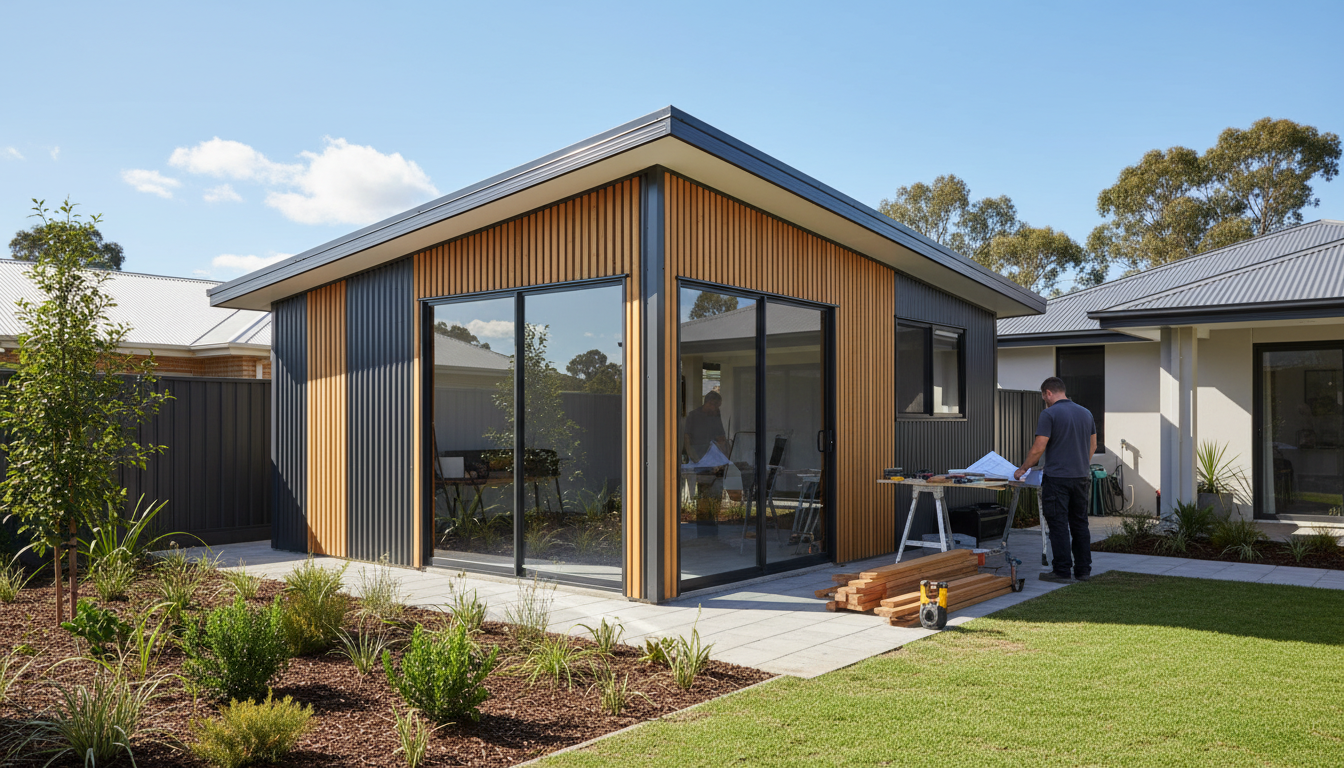

Skillion Shed Guide (Australia): Designs, Plans, Pricing Factors, Approvals, and Materials
This guide helps you determine the right skillion shed design, materials and approvals for your location. It includes practical plans, compliance guidance, cost factors (as of Apr 2026), case studies and supplier links to help you build or buy with confidence.
Introduction to Skillion Sheds in Australia
What Is a Skillion Roof Shed?
A skillion roof (also called a monopitch roof) is a single, sloping roof plane with no ridge. Skillion sheds are valued for their minimalist lines, straightforward construction and excellent rainwater drainage. Their single slope simplifies guttering and solar panel placement, and gives higher ceiling volume at one end — useful for workshops or mezzanines.
Why Choose a Skillion Roof Design?
Skillion roof sheds are usually quicker and cheaper to build than complex gable systems because they use simpler framing and fewer truss connections. The roof angle supports solar arrays, clerestory windows and natural cross-ventilation.
Australian Market Trends (2024–2026)
Demand for modern skillion garden sheds, garages and small studio conversions has grown steadily. According to the Housing Industry Association (HIA) 2024 installation trends summary, single-slope roofs accounted for over 35% of new backyard structure installs nationally (HIA, 2024). This growth is strongest in Queensland and New South Wales where both coastal and suburban owners favour low-maintenance steel-clad solutions.
Key LSI terms: single slope roof, rainwater drainage, urban shed designs, Australian backyard sheds.
Skillion Shed Design Principles and Inspirations
Key Design Features
Effective skillion shed design balances roof pitch (typically 5°–15° for most Australian locations), orientation for solar gain, cross ventilation and durable cladding such as Colorbond steel cladding. Clerestory windows on the high wall add daylight while preserving security and wall storage on the low side. For workshops, plan bench height and door clearances before finalising roof height.
Roof Pitch: Performance vs. Aesthetics
A lower pitch (5°–8°) is common for cleaner lines and reduced material use, but steeper pitches (10°–15°) shed heavy rainfall better and can improve solar panel angles in some latitudes. Consider prevailing wind direction — in cyclone-prone zones a moderate pitch reduces uplift risk and simplifies bracing.
Natural Ventilation and Solar Orientation
Design for cross ventilation by placing intakes on the low wall and exhausts or louvres high on the opposite wall. Position the high wall facing north in southern Australia to bring in winter light and shade glazing in summer with eaves or external screens. Solar orientation is particularly effective with a skillion roof because the single plane can be optimised for panel tilt.
Material & Finish Choices
Pair Colorbond or Zincalume cladding with timber or composite screens to soften industrial finishes. For external colours, choose reflective shades like Surfmist to reduce heat absorption; darker tones like Deep Ocean are architectural but may require more insulation in hot regions. See our comparison to compare cladding options.
Design Inspirations
- Minimal workshop: low-pitch skillion, clerestory windows, mezzanine storage.
- Architectural studio: high rear wall with full-height glazing and Colorbond screening.
- Garage variant: wide roller door on low wall plus extended eave for shade.
Detailed Skillion Roof Shed Plans and Layouts
Standard Plans and Customisation
Standard plans typically use rectangular footprints and roof slopes of 7°–12°. Common widths run 3m–6m with lengths from 3m to 12m. Custom plans allow relocated doors, larger openings for vehicles or different internal partitions for workshops and studios. Ensure your plan includes site orientation, structural wind rating inputs and drainage paths.
Creating Functional Interiors
For a workshop include clear work aisles at least 900–1200mm wide, bench heights of 900mm, and outlet spacing for power tools. Garages need a door clear opening 2.4–2.8m wide for single vehicle access; trafficable headroom should be at least 2.1m. For studio conversions plan for services (electrical, plumbing) early, as they affect foundation and wall construction.
Windows, Doors and Ventilation in Layouts
Place windows high on walls under the roof slope to preserve storage space. Use louvre or whirlybird vents near the top of the high wall and inlet vents low on the opposite wall to create a natural exhaust path. Consider security screens on accessible windows and theft-resistant roller doors for tools and vehicles.
How to Read a Skillion Shed Blueprint — Practical Example
Example callouts on a typical elevation:
- Front elevation: 2.4m low wall height; rear elevation: 3.6m high wall height — gives a 1.2m rise over a 4.0m span (~17°). (Plans may show pitch as 1:5 or 11°.)
- Roof framing: purlins at 900mm centres (steel), screw-fixed to primary rafters; roof sheeting laps and flashings noted with fastener type and spacing.
- Foundation note: 100mm reinforced slab with D20 steel mesh and 75mm fall to an outlet; edge beam 150mm x 300mm where required for anchored connections.
For downloadable examples and editable templates, explore our shed plans.
Australian Building Codes and Council Approvals for Skillion Sheds
Key Regulations and Where to Find Them
Sheds are normally Class 10a structures under the National Construction Code (NCC). For authoritative guidance, consult the Australian Building Codes Board (ABCB) — ABCB — and Standards Australia for AS1170.2 details — Standards Australia. Builders and certifiers commonly reference these when preparing engineering and compliance documentation.
State-by-State Permit Triggers (summary)
Regulations vary by state and local council; below are indicative triggers and links — always confirm with your local council.
- New South Wales — permits often required for structures >20m² or where services are added. See the NSW Planning Portal.
- Victoria — many small sheds may be exempt under certain size/height conditions; check the VBA.
- Queensland — coastal councils enforce stricter cyclone requirements regardless of size; see local council pages and our guide to cyclone-rated shed compliance.
- Other states/territories — check your state planning/building authority web pages; if in doubt, lodge a pre-lodgement enquiry with your council.
For approvals guidance tailored to Colorbond sheds, see Australian building approvals for sheds.
Understanding Permit Requirements and Exemptions
Permit exemptions commonly exclude habitable conversions and structures that have services (power or water). Converting a Class 10a shed into a habitable Class 1 or 2 space will usually require full consent, insulation to NCC energy provisions, and often engineered foundations. Early engagement with a certifier can save rework and delays.
Structural Wind Ratings & Cyclone Compliance (AS1170.2)
AS1170.2 sets wind actions for structural design, defining site wind classifications (e.g., N2, C3, C4, C5). Your site classification determines design wind pressures and affects bracing, anchor bolt sizes and spacing. Find local wind maps via state or engineering resources, and request a Site Wind Classification from an engineer for permits.
Practical example (illustrative): a 6m x 4m skillion in coastal QLD with a C4 classification typically needs M16 chemical anchors at 1.2–1.6m spacing and additional diagonal bracing on wall frames; engineering fees for certification commonly range $800–$1,800 (Apr 2026 market).
For cyclone-specific guidance see our link to cyclone-rated shed compliance and consult a structural engineer for site-specific requirements.
Approval Process: Step-by-Step
- Check council triggers online; request pre-lodgement advice if available.
- Engage designer/engineer to prepare plans and any required structural certificates.
- Submit application with drawings, engineering and product certificates (e.g., Colorbond compliance).
- Respond promptly to council requests; arrange inspections at required stages.
- After approval, retain documents for insurance and resale disclosure.
Materials for Skillion Roof Sheds in Australia
Colorbond Steel — Technical & Warranty Notes
Colorbond (BlueScope) is popular for Australian sheds due to its pre-painted finish over a Zincalume core. BlueScope publishes technical data and warranty periods — typical paint system warranties range from 10 to 15 years depending on product and location (see BlueScope for exact terms) — BlueScope. Lifespan varies: coastal, high-UV or industrial areas reduce expected service life and may require more frequent maintenance.
Zincalume and Other Options
Zincalume offers a cost-effective unpainted option with strong corrosion resistance from aluminium and zinc layers. It’s suitable for internal or sheltered applications; in exposed coastal settings Colorbond’s painted protection is usually preferred. Aluminium cladding is lightweight and corrosion resistant, but more expensive.
Material Selection by Climate
- Tropical/Humid: Colorbond with high-corrosion-grade pre-treatment, raised floor/ventilation, and stainless fixings where possible.
- Coastal: Use Colorbond and stainless fasteners; increase maintenance checks for flashings and gutters.
- Temperate: Standard Colorbond and insulation with a focus on thermal breaks and sealants.
- Alpine/Cold: Use insulated panels and consider higher R-values to prevent condensation and heat loss.
Insulation, Thermal Performance and Energy Efficiency
Combine reflective Colorbond colours with insulation to control heat transfer. Recommended minimum roof R-values depend on climate zone — typical retrofits use R2.5–R4.0 roof batts with a reflective sarking to reduce radiant heat. Include ventilation (ridge vents, eaves) to manage condensation in humid or cold conditions.
Cost Estimates (as of Apr 2026)
Approximate cladding material costs per m² (indicative): Colorbond $40–$60/m²; Zincalume $30–$50/m². Prices vary by profile, coating and supplier — always request a written quote. See our compare cladding options page for deeper comparisons.
Pricing Factors for Skillion Sheds
Cost Components
Shed costs include materials (cladding, framing, fasteners), foundations (concrete slab or piers), labour, engineering and permit fees. Typical prefab kit ranges and custom build ranges vary by size and features; see below and note costs are indicative as of Apr 2026.
Regional Labour and Market Examples
Labour rates vary: metropolitan installer rates often lie between $60–$120/hr inclusive of GST and overheads; regional areas may be 10–25% lower or higher depending on demand. For detailed local labour references consult HIA regional reports — HIA.
Prefab Kits vs Custom Builds — What’s Included
| Build Type | Typical Cost (AUD) | Typical Inclusions |
|---|---|---|
| Prefab Skillion Shed Kit | $7,000 – $25,000 | Framing, cladding, fasteners, basic plans. Excludes foundation, electrical, council fees. |
| Custom Build | $15,000 – $50,000+ | Full design, engineered foundations, permits, finishes, services included if contracted. |
Cost-saving Strategies
- Choose standard module sizes to reduce cutting and waste.
- Use standard Colorbond colours to avoid lead-times and surcharges.
- Consider prefab kit with professional erecting to balance cost and compliance.
- Obtain multiple quotes and request itemised lists of inclusions/exclusions.
Construction Process of Skillion Roof Sheds
Site Preparation and Foundations
Site prep includes vegetation removal, compaction and setting finished floor levels with falls for drainage. Foundations depend on soil: slabs for stable sites, piers or screw piles for disturbed soils or where minimal excavation is preferred. Soil testing should be done for larger or long-span sheds; typical test costs vary $400–$1,200 depending on scope.
Construction Sequence and Timelines
Typical timetable for a medium 6x4m shed if work proceeds smoothly:
- Site prep and excavation: 1–3 days.
- Concrete slab or footings pouring and curing: 3–7 days.
- Frame erection: 1–3 days (steel frames) or 3–5 days (timber).
- Cladding and roof sheeting: 1–3 days.
- Finishes, doors, electrics and inspections: 2–7 days.
Common Problems and Troubleshooting
- Water pooling behind shed — solution: create 1:100 fall away from shed and install gravel drainage or French drain.
- Loose flashings after storms — solution: use specified fastener patterns and check sealants annually.
- Condensation inside — solution: add vapour barrier and increase ventilation or use insulated roofing panels.
Inspections and Compliance during Build
Typical inspection stages include footing/slab prior to pouring, frame/anchor connection before cladding and final inspection. Keep engineering certificates and product warranties accessible for certifiers and future owners.
Skillion Shed Kits and Prefabricated Options
What Kits Include and What You Must Arrange
Most kits supply pre-cut framing, cladding, fasteners, and assembly instructions. Kits rarely include foundations, electrical, or council application fees. Always confirm whether door hardware, insulation packs or window assemblies are included.
Prefab Advantages and Limitations
Prefab kits reduce waste, speed construction and often provide cost certainty. They limit structural customisation; large or complex changes usually trigger the need for engineered modifications which add cost. If buying a kit, consider professional erection to ensure compliance in high wind zones.
Popular Australian Suppliers
- ReadySpan – engineered steel sheds with options for Colorbond cladding.
- Bunnings – entry-level kits for garden sheds and small workshops.
- DIY Sheds Australia – modular kits with Colorbond options.
- SmartSheds – prefab garages and workshops with skillion roof options.
For a curated supplier list and buying advice, check prefab shed suppliers and read our full prefab kit comparison.
Typical Kit Assembly Example
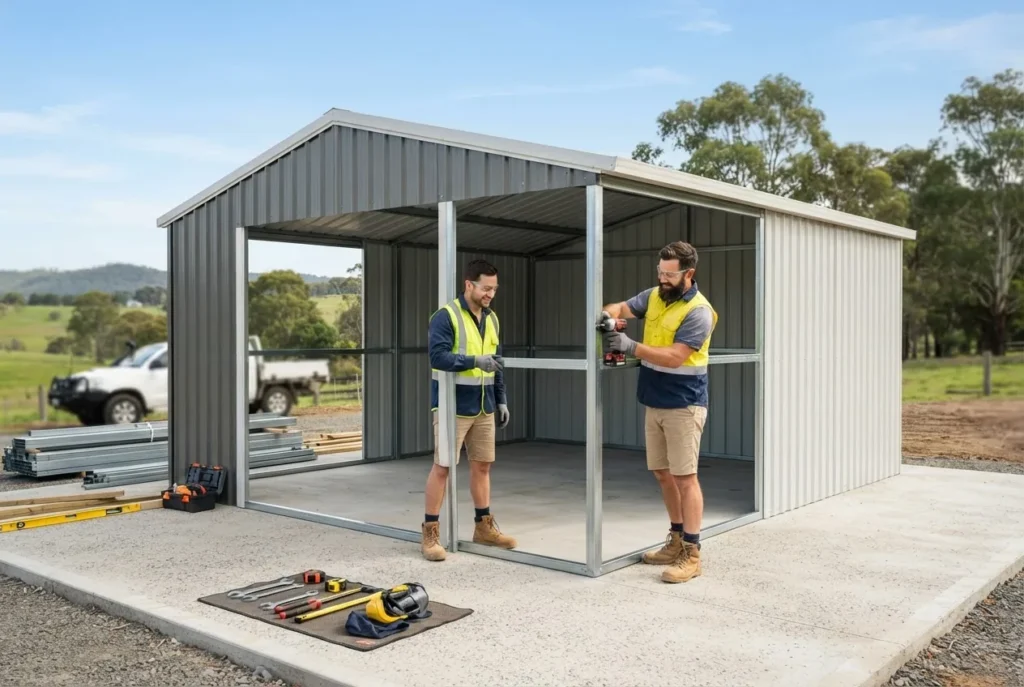
A 6x4m kit assembled by two competent tradespeople typically takes 2–4 days for frame and cladding (foundations not included). If DIY, allow additional time for accurate alignment and fastening; hire an installer for cyclone-compliant connections.
Comparing Modern Skillion Roof Sheds with Traditional Shed Styles
Architectural & Functional Differences
Skillion roofs deliver contemporary aesthetics and simpler waterproofing; traditional gable roofs provide attic-like space but require additional framing. Where thermal performance is critical, both approaches can achieve required R-values with appropriate insulation, but skillions often allow simpler continuous insulation across the roof plane.
Maintenance and Lifespan Considerations
Fewer joints and simpler flashings on skillion roofs generally reduce maintenance. However, correct detailing at the low end (where water concentrates) is essential. Colorbond warranties and periodic gutter maintenance will lengthen service life.
When to Choose One Over the Other
Choose a skillion for modern workshops, studios and sites prioritising solar performance or a compact footprint. Choose a traditional roof for architectural matching to existing homes, attic storage or where local streetscape rules favour pitched roofs.
Project Spotlights (Case Studies)
Project A — Cyclone-rated 6 x 4m Workshop (Townsville area, anonymised)
Scope: 6m x 4m skillion workshop in coastal QLD. Requirements: C4 wind classification, council building permit, engineered connections. Works: soil test, screw piles and deep piers, engineered steel frames, M16 chemical anchors at 1.4m centres, Colorbond cladding. Cost breakdown: materials $10,200; engineering & certifier $1,450; labour $6,300; permits $620 (total ~ $18,570 — Apr 2026). Lessons: secure engineered details early and budget for higher anchor/foundation costs in cyclone zones.
Project B — Suburban 3 x 3m Studio Conversion (Sydney region, anonymised)
Scope: 3m x 3m skillion garden shed upgraded to a studio with insulation, power and double-glazed window. Permits: class 10a to habitable Class 1 conversion required local council approval. Works: concrete slab, additional insulation (roof R3.0), controlled ventilation, upgraded doors and electrical fitout. Cost breakdown: materials $4,300; labour $3,200; permits & certs $900 (total ~ $8,400). Lessons: early council consultation avoided redesign and saved ~2 weeks on approval time.
Frequently Asked Questions
What defines a skillion roof shed and why is it popular in Australia?
A skillion (monopitch) shed has a single sloping roof plane. It’s popular in Australia for its simple construction, modern appearance, efficient rainwater run-off and suitability for solar panels. The single slope creates useful volume for mezzanines and clerestory glazing, making skillions versatile for workshops, garages and studios.
How do Australian building codes affect skillion shed construction and approvals?
Sheds are usually Class 10a under the NCC; approvals depend on state and council triggers such as size, height and intended use. High wind/cyclone zones require AS1170.2-compliant engineering. Always check your local council and provide engineering and product certificates when required to secure approvals.
What are the cost differences between prefab skillion shed kits and custom builds?
Prefab kits typically cost from $7,000–$25,000 and include framing and cladding but exclude foundations and services. Custom builds often start around $15,000 and can exceed $50,000 depending on size, finishes and engineering. Kits save time and offer fixed pricing; custom builds give full design control and permit-ready documentation.
Which materials are best suited for skillion sheds in different Australian climates?
Coastal areas: Colorbond with stainless fixings and frequent inspections. Tropical/humid: corrosion-protected products and elevated ventilation. Temperate: standard Colorbond plus adequate insulation. Alpine/cold: higher roof R-values and condensation control. Choose materials and fixings to match local exposure and maintenance capability.
How can I ensure my skillion shed meets cyclone and wind compliance?
Obtain a site-specific wind classification via a structural engineer referencing AS1170.2, use the specified anchor bolt types and spacing, and include engineered bracing in drawings. Submit engineering certificates with your council application and follow the engineer’s fastener and foundation schedules during construction.
What design features improve ventilation and energy efficiency in skillion sheds?
Use high-level clerestory windows, low inlet vents, ridge or turbine vents and reflective Colorbond colours. Add roof insulation (e.g., R2.5–R4.0 depending on climate) and sarking to reduce radiant heat. Proper orientation and shading of glazing improves passive thermal performance and reduces cooling loads.
Can I build a skillion shed myself or should I hire a professional builder?
DIY is feasible for experienced tradespeople with metalwork and carpentry skills, particularly using prefab kits. Hire professionals when your build requires engineering (cyclone zones), complex services or council-lodged documentation. Professionals reduce risk of non-compliance and speed up inspections.
Are skillion sheds suitable for conversion into livable or workspace areas in Australia?
Yes, but conversions typically change classification and require council approvals, energy-efficiency compliance, insulation upgrades, ventilation and possibly upgraded foundations and services. Early consultation with a certifier ensures the shed meets habitable standards and avoids costly retrofits.