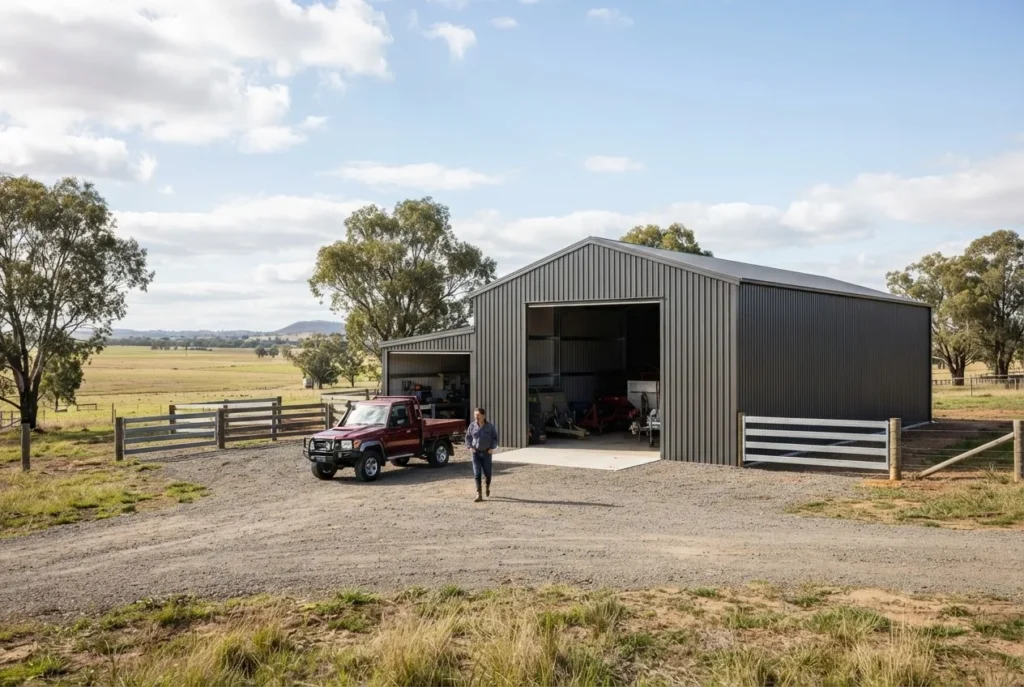


Building a modern garage in Australia isn’t just about parking. It’s about a wind-rated, council-approved, low‑maintenance structure that adds resale value and works as a workshop, storage bay, or caravan shelter. This expert guide covers custom Colorbond garages, cyclone & bushfire engineering, council approvals across WA/QLD/NSW/VIC, coastal corrosion upgrades, and practical buying steps for 2025.
What does “modern garage” mean in the Australian market?
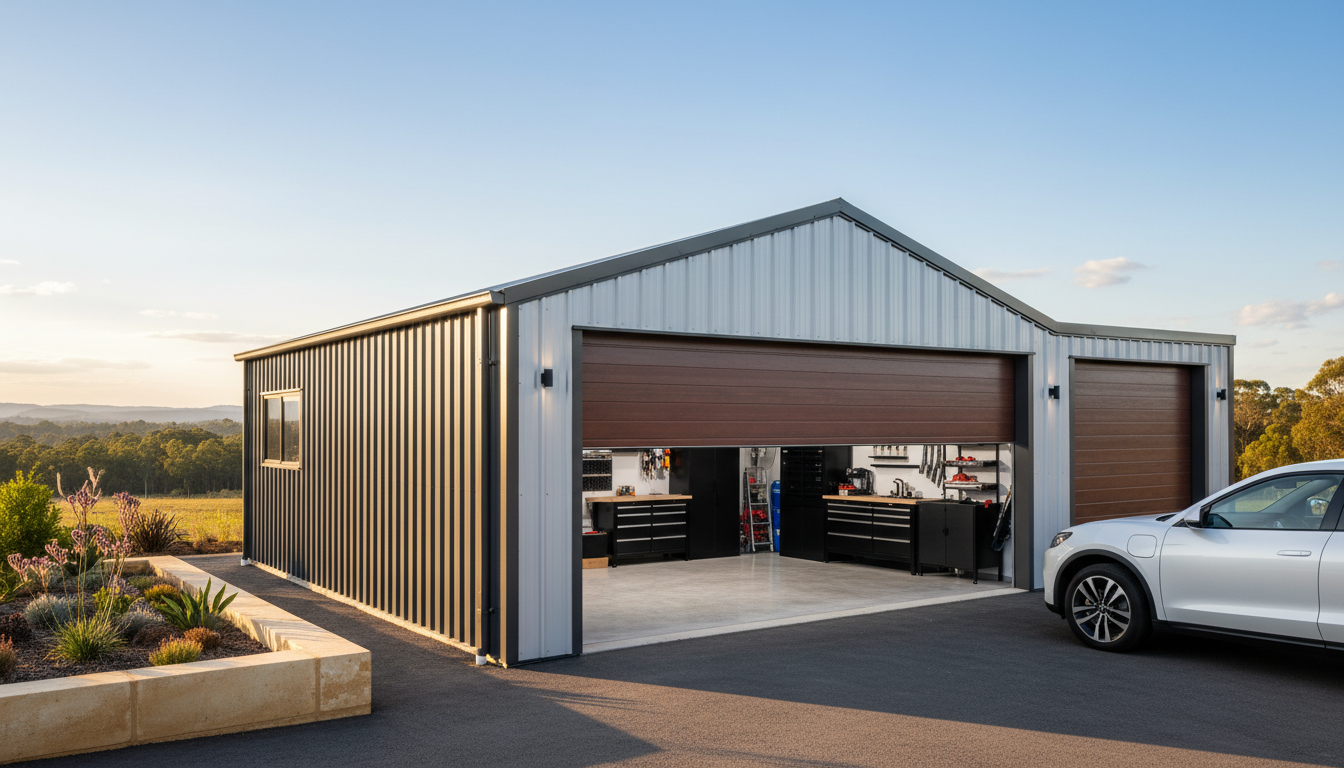
In 2025 a “modern garage” means a purpose-designed Class 10a steel structure—typically a steel portal frame with insulated roof panels and thoughtful detailing—that meets local NCC and Australian Standards. These garages combine durable external cladding (often Colorbond or Zincalume), insulated roof blankets or sandwich panels, vermin flashing at the slab perimeter, sealed eaves, and mezzanine storage engineered to live‑load requirements.
Key elements that separate a modern garage from an older shed:
- Structural system: steel portal frames or bolted RHS frames with continuous load paths and engineered footings to suit soil class.
- Thermal and condensation control: foil-faced roof blankets (R-ratings expressed in equivalent performance), thermal breaks at connections, and vapour-permeable wall linings for moisture control.
- Vermin and pest control: perimeter vermin flashing, sealed service penetrations and termite barrier details integrated with the slab.
- Usability features: mezzanine storage sized to live-loads (typical 1.5–2.5 kPa depending on use), LED lighting, multiple GPOs, and purpose-built workshop layouts.
Modern garages are also solar-ready: purlins and roof bracing are often specified to accept PV rail fixings and inverter access, and many buyers opt for pre-wired EV-ready circuits. Whether you’re planning a single-car garage or a triple bay workshop with mezzanine storage, planning for insulation, ventilation and pest control at the design stage saves retrofit cost and protects the structure from corrosion and condensation.
Best materials for Australian climates: Colorbond vs Zincalume
Choosing between Colorbond and Zincalume depends on climate, exposure, budget and aesthetic preference. Colorbond is pre-painted, baked‑on steel made by BlueScope in multiple paint systems (Standard, Ultra and Matt). Zincalume is an aluminium‑zinc alloy-coated steel with excellent baseline corrosion resistance and is often used for roofing and internal members.
Climate and exposure considerations:
- Coastal and marine zones (AS 4312 categories C3–C5): specify Colorbond Ultra or higher corrosion protection, stainless or Class 316 fasteners, and increased maintenance inspections. Use AS 4312 corrosion maps to select materials and fasteners.
- High UV/heat areas (Perth, northern WA): choose lighter, cool-roof colours, an insulated roof blanket and consider Colorbond Matt or Ultra for reduced solar reflectance issues and longer colour warranties.
- Inland and rural: Zincalume is cost-effective for roofs and internal framing, particularly where aesthetic options are secondary to durability and budget.
Other material notes: ensure thermal breaks where steel meets masonry or timber, use non-combustible linings in bushfire-prone (BAL) areas where required, and request material compliance statements from suppliers for paint system, substrate thickness (e.g., 0.42–0.48 mm BMT) and galvanic grouping where connections to aluminium or stainless occur.
Colorbond vs Zincalume — Which is better for WA conditions?
| Feature | Colorbond (incl. Ultra/Matt) | Zincalume |
|---|---|---|
| Best use | External cladding/roofing, coastal & urban areas; wide colour choice | Roofs, internal framing, budget builds; very good inland performance |
| Corrosion resistance | High; Ultra grade recommended inside 1 km of surf and C4–C5 zones | High inland; not recommended for severe splash zones without stainless fasteners |
| Heat performance | Cool colours reflect heat; pair with insulation for best results | Metallic finish reflects; use insulation or roof blanket to control internal temperatures |
| Aesthetics | Variety of colours and Matt finishes for architectural look | Industrial silver/grey; can be painted but requires prep |
| Cost & warranty | Higher upfront; typical warranties 20–25 years (see supplier T&Cs) | Lower upfront; warranties often similar but dependent on exposure |
WA-specific commentary: within Perth metro and coastal suburbs, the lifecycle cost of Colorbond Ultra using stainless fixings and anti-condensation blankets often outweighs initial savings on Zincalume when factoring corrosion-risk inspections and repainting over 10–20 years.
Engineering modern garages for cyclone and bushfire readiness
Designing a garage for cyclone or bushfire exposure requires compliant engineering to AS/NZS 1170.2 (wind actions) and AS 3959 (bushfire). Key engineering principles include continuous load paths, correct anchorage to slab or footings, wind-rated roller doors, and BAL-appropriate materials and detailing.
Essential engineering items and checklist:
- Site-specific engineering certificate: includes wind region per AS/NZS 1170.2, terrain category, shielding, height, and topography inputs; mandatory for Regions C and D.
- Continuous load path: connect roof, walls and slab using specified connector plates and bolts. Typical hold-downs use chemical anchors or M12–M16 mechanical anchors; final sizes must match the engineer’s design.
- Roller doors: request NATA-tested door certificates and ensure door wind ratings match calculated design pressure; add wind locks and deep bottom guides for cyclonic areas.
- Ember protection & BAL detailing: use stainless ember-proof mesh on vents, seal eaves, and select non-combustible or specially detailed cladding for BAL–12.5 to BAL–FZ as required by AS 3959.
- Material & fastener spec: request material compliance statements, galvanic corrosion groupings and specify stainless or hot‑dip galvanised fixings where coastal exposure dictates (AS 4312 guidance).
Supplier document checklist to request before signing:
- Site-specific engineering certificate (engineer’s stamp and scope)
- NATA-tested roller door compliance and wind test certificates
- Material compliance statement: paint system, steel substrate (BMT), and fastener grades
- Condensation control specification (roof blanket R-value or sandwich panel spec)
Practical note: in cyclone-prone QLD, many installers provide a cyclone upgrade pack (extra purlins, heavier bracing and certified doors).
Garage cost guide Australia 2025
Costs vary by region, site access, wind/bushfire upgrades and finish. Below are working example budgets (incl. GST) to help planning. Local uplift percentages apply for cyclonic or coastal corrosion protection and for difficult access requiring cranage.
Example A — Single suburban kit (non-cyclonic)
- Supply kit (single 3.0 x 6.0 m Colorbond): $5,000
- Delivery & cranage (metro): $800
- Concrete slab (100 mm, 25 MPa, SL72 mesh): $1,200
- Install and fixings: $1,500
- Permits & inspections: $500
- Total estimate: $9,000 (range $6,500–$10,000)
Example B — Custom double garage, Brisbane (installed, Region B/C borderline)
- Supply & manufacture: $9,000
- Engineering & site-specific cert: $1,200
- Delivery and cranage: $1,200
- Concrete slab (reinforced 100–125 mm, thickened edges): $3,000
- Install, doors, insulation, electrical: $6,000
- Permits & certifier fees: $1,000
- Total estimate: $21,400 (range $16,000–$28,000)
Example C — Cyclone-rated triple bay (FNQ/Region D)
- Supply & cyclone upgrade pack: $18,000
- Engineering & documentation: $2,500
- Delivery to remote site & cranage: $3,500
- Slab (engineered footings): $8,500
- Doors (wind-rated), insulation, electrical: $6,000
- Permits & BAL or coastal upgrades: $2,000
- Total estimate: $40,500+ (allow 15–30% uplift)
Regional cost notes:
- Remote delivery & cranage: add 10–40% depending on access.
- Cyclone uplift: typically +15–30% for engineering, doors and additional fixings.
- Coastal corrosion upgrades: stainless fasteners and Colorbond Ultra add 5–15% to material cost.
Choosing the right roof style and layout for your site
Roof style affects water run-off, internal headroom, solar compatibility and aesthetic outcome. Common options:
- Gable roof: classic appearance, good attic ventilation and simple ridge vent installations. Eave heights commonly 2.4–3.0 m for cars, 3.0–3.6 m for caravans. Compatible with standard PV rail mounts.
- Skillion (mono-pitch): modern look, high single-side eave for solar arrays and water harvesting. Easier to provide a continuous roof plane for PV mounting—consider orientation for optimal generation.
- Flat roof / parapet: contemporary but needs careful box-gutter design and overflow provisions to prevent ponding and water ingress—suitable when concealed gutters are required.
Layout tips: for boat or caravan storage allow roller door heights 2.7–3.3 m and internal clearance 200–300 mm above vehicle roofline for roof racks. Provide a 3–6 m awning or lean-to on the leeward side for sheltered workspaces and attach with appropriate structural ties to maintain continuous load path—
How to get council approval faster
Faster approvals come from complete documentation and using private certifiers where available. Below are state-by-state practical steps and typical timings.
WA — Council-approved sheds WA (certified route)
- Confirm zoning, setbacks and permitted heights with local council or via the property’s planning portal.
- Obtain site-specific engineering (terrain, shielding, wind region) from a WA-registered engineer.
- Prepare full plans: site plan, elevations, slab details, stormwater plan, termite barrier detail and NCC 2022 compliance notes.
- Submit a certified application (BA1/BA2) when possible to reduce council review time; include material compliance statements and door wind certificates.
- Typical lead times: certified applications 5–15 business days; council assessed 15–40 days depending on LGA complexity.
QLD — private certifier or council route
- Provide site plan, flood overlay check, BAL if in bushfire overlay, and site-specific wind certificate for Region C/D areas.
- Private certifiers often deliver faster turnaround (7–20 business days) for compliant certified applications; councils may take longer.
- Fees: typical building application fees $300–$1,200 depending on valuation and LGA; engineering fees extra.
- Tip: include NATA door certificates and termite details at lodgement to avoid requests for further information.
NSW & VIC — typical steps
- NSW: check Local Environmental Plan (LEP) and Development Control Plan (DCP) first; some sheds are exempt development if under size/setback thresholds—otherwise DA or CDC may be required.
- VIC: use private building surveyors for faster processing; ensure BAL and flood overlays are addressed in the documentation.
- Typical lead times: 10–30 business days with private certifier; council DA or permit routes longer.
Common refusal reasons and how to avoid them:
- Incomplete site details — include accurate site levels and stormwater plans.
- Incorrect wind loading inputs — supply the engineer’s assumptions (terrain, shielding).
- Missing termite or BAL documentation — provide details up front.
DIY kits vs custom-built garage: Pros and cons
Deciding between a DIY kit and a custom build depends on site complexity, your skill level and risk tolerance.
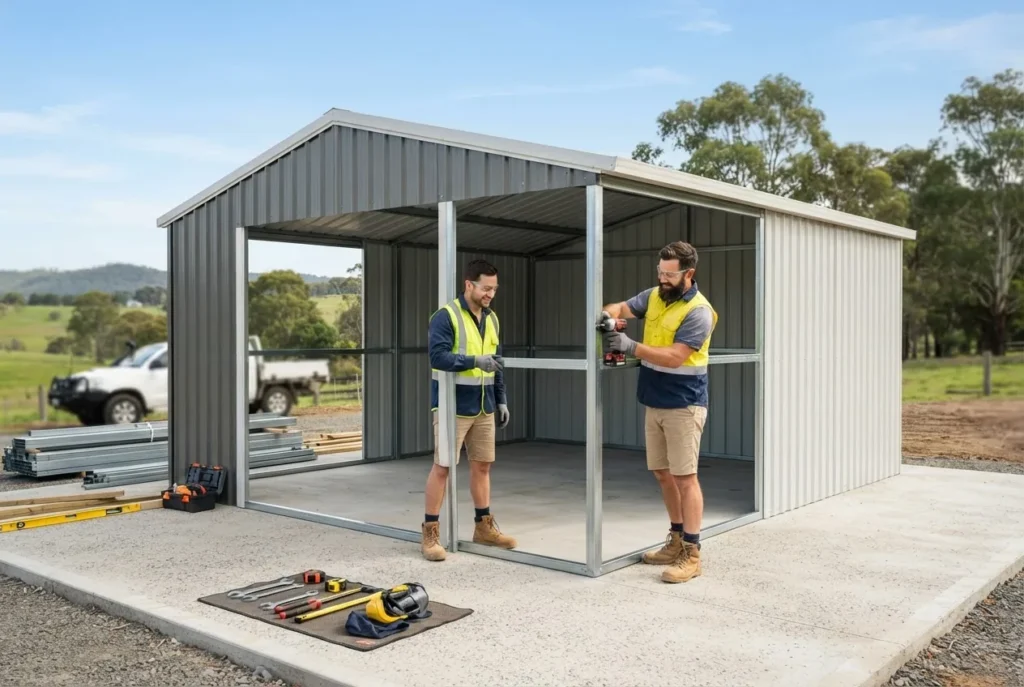
- DIY kits: Lower upfront cost, faster dispatch, and suitable for flat, accessible suburban sites. Kits typically include pre-punched members, simple connection details and installation manuals. Owner-builder permits may be required—. Risks: warranty limits, transport damage, and incorrect erection if instructions are not followed.
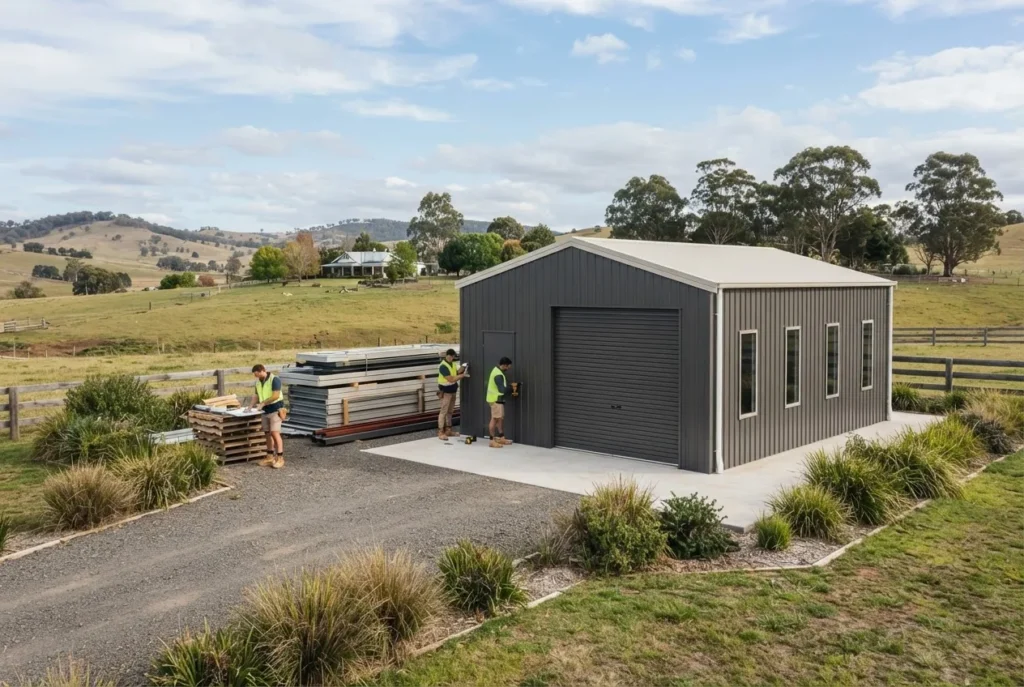
- Custom-built: Turnkey service with site measure, engineered footings, coordinated council approvals and warranty-backed installation. Better for sloping blocks, cyclonic regions, or where integrated services (electrical, drainage) are needed. Expect higher cost but lower compliance risk.
Practical kit upgrade recommendations: specify corrosion upgrades for coastal sites, crank up purlin spacing for extra load, add anchor upgrade kit (M12–M16 chemical anchors) and order factory-cut openings for doors and windows to reduce on-site cutting and water-tightness risk. For portable options see our portable garage in Australia explainer.
Real Australian build examples
Project notes below include non-identifying client/location/date details and a short challenge/solution summary.
- Perth double garage (Client P.R., 2023): 6 x 6 m gable, Colorbond Ultra cladding, 75 mm polyester roof blanket, whirlybird vents and vermin flashing. Challenge: coastal salt exposure on nearby shoreline—solution: stainless fasteners, Colorbond Ultra, 2-year maintenance rinse schedule.
- Cyclone-rated workshop, QLD (Client J.T., 2024): 7 x 9 m skillion, Region C site certificate, wind-locked roller doors with NATA certificates, upgraded purlin spacing and continuous hold-downs. Challenge: wind uplift—solution: detailed continuous load path and certified doors;
- Rural triple bay, NSW (Client M.S., 2022): 9 x 12 m with 4 m eave, mezzanine storage rated to 2 kPa, Zincalume roof and Colorbond walls, 10 kW solar-ready purlins. Challenge: heavy machinery access—solution: engineered thickened slab and wide bay spacing.
- Victoria garden workshop (Client L.B., 2024): 4.5 x 9 m skillion, insulated panels and daylight polycarbonate panels, integrated carport lean-to. Challenge: strict DCP—solution: matched roof pitch and shadow diagrams for planning.
Photo caption suggestions: “Perth 6×6 Colorbond Ultra double garage — stainless fixings and ridge ventilation.” (Add ALT text: “Perth Colorbond double garage with ridge vents and raised eaves”)
Essential inclusions for comfort and usability
Well-specified inclusions make a garage usable year-round and protect the structure.
- Insulation and condensation control: Roof blankets (metal foil-backed) or insulated sandwich panels. Aim for an R-equivalent matching local practice (e.g., roof blanket plus reflective foil can approximate R1.5–R2.5 depending on installation). Ensure vapour-permeable wall linings where condensation risk is low, and use thermal breaks at steel-to-masonry junctions.
- Ventilation: Cross-flow ventilation (whirlybirds or ridge vents) sized to provide passive airflow; mechanical extraction for workshop fumes. Typical whirlybird capacity guidance: 1–2 whirlybirds for a double garage depending on roof volume; target increased air changes per hour when working with paints or solvents.
- Security & access: Wind-rated roller doors with multi-point locks, pedestrian PA doors with deadbolts, motion-sensor lighting and CCTV. Use tested roller doors with certified wind-locks in Regions C/D.
- Electrical & services: Minimum 3–4 GPOs for a double garage, dedicated 15 A circuits for welders, and provision of an EV-ready conduit or 32 A circuit if required. Plan lighting as LED strips for even workshop illumination.
- Daylighting & finishes: Polycarbonate skylights or translucent sheeting for natural light while maintaining security. Non-slip floor sealer, skirting flashings and robust shelving fixed to masonry where possible.
5-Step buying guide for custom sheds in Australia
- Define the use-case: checklist—vehicle types, workshop equipment, mezzanine loads (kPa), future-proofing (EV charging, solar).
- Set size & clearances: include door headroom +200–300 mm for roof racks; plan for service runs and drainage. Consider a site-access checklist for delivery/cranage.
- Choose materials: select Colorbond grade vs Zincalume, specify paint system (Standard/Ultra/Matt), insulation package and corrosion category per AS 4312.
- Engineer the building: request site-specific engineering (AS/NZS 1170.2 wind inputs, soil class for slab, BAL where applicable). Ask suppliers for NATA door tests and material compliance statements.
- Approvals & build: compile a council pack or use a private certifier, pour slab, coordinate delivery and install, and conduct final inspection. Expect staged payments tying release of materials to site readiness.
Local standards, climate and data
- NCC 2022/2025: Class 10a buildings referenced for non-habitable structures—structural provisions and condensation management apply; check updated NCC guidance for 2025 changes affecting energy/condensation clauses.
- AS/NZS 1170.2: wind region and design pressure tables; specify Region A–D and terrain category in engineering briefs.
- AS 3959: bushfire construction requirements—BAL detailing for eaves, vents and cladding for BAL–12.5 to BAL–FZ.
- AS 4312: atmospheric corrosion categories C1–C5 used to select cladding grade and fastener materials in coastal zones.
- BOM climate maps: use Bureau of Meteorology wind and cyclone maps to confirm regional cyclone risk for insurance and engineering inputs.
Methodology: cost estimates compiled from 2024–2025 supplier quotes, installer rate cards, and regional uplift percentages. Example projects use anonymised client initials and year to demonstrate real-world outcomes.
Trusted resources and citations
- Housing Industry Association – outdoor structures trends
- Australian Steel Institute – steel durability and design
- Bureau of Meteorology – wind and cyclone climate data
- CSIRO – bushfire and building research
- Standards Australia – search NCC, AS/NZS and AS documents
Ready to design your modern garage?
Whether you want a garage workshop Sydney style, a Custom Colorbond garages Perth package, or Council-approved sheds WA engineered for Region B, we’ll tailor a solution. Building in cyclone territory? Ask about our Cyclone-rated sheds QLD designs with wind-locked roller doors and site-specific engineering.
Frequently Asked Questions
What wind rating do I need for a garage in Australia?
Your required wind rating depends on AS/NZS 1170.2 wind region (A–D), terrain category, topography and shielding. A registered engineer will use these inputs to calculate design pressures and specify fixings, purlin spacing and door wind ratings—Regions C/D require cyclone-grade detailing and certified doors.
How much does a custom Colorbond garage cost in 2025?
Custom Colorbond garage costs in 2025 typically range from $16,000 for a basic double to $28,000+ for higher-spec builds, excluding unusual site works. Cyclone or coastal upgrades, engineered slabs and remote delivery can raise totals by 15–40% depending on location and finish level.
Should I choose Colorbond or Zincalume for my coastal garage?
For coastal garages within about 1 km of breaking surf or in AS 4312 C4–C5 zones, Colorbond Ultra with stainless fasteners is recommended for corrosion resistance. Zincalume can be used further inland or where stainless fixings are used, but lifecycle maintenance costs should be considered.
What approvals are required to build a garage in WA?
In WA you typically need a building permit (certified BA1/BA2 or council assessed), site-specific engineering to AS/NZS 1170.2, termite barrier details and NCC 2022 compliance documentation for Class 10a buildings. Lead times vary—certified applications often take 5–15 business days.
How do I make my garage cyclone- and bushfire-ready?
Make a garage cyclone-ready by supplying site-specific engineering, wind-rated roller doors with NATA certificates, cyclonic hold-downs and continuous load path detailing to AS/NZS 1170.2. Make it bushfire-ready by following AS 3959: ember-proof mesh, sealed eaves, BAL-appropriate cladding and non-combustible detailing.
Can I install a DIY shed kit or is custom build better?
DIY kits suit flat, accessible sites and experienced owner-builders and are generally cheaper. Custom builds offer turnkey services, site-specific engineering and better warranty/approval handling—recommended for sloping, coastal or cyclonic sites. Owner-builder permit obligations vary by state.
How long does it take to get a garage built from order to install?
Typical timeline: design and approvals 3–6 weeks, manufacture 2–4 weeks, and install 2–5 days for a standard double garage. Cyclone upgrades, remote delivery or complex site works extend timelines—plan for 6–12+ weeks end-to-end in those cases.
What is the best roof style for an Australian garage?
There’s no single best style—choose by use and site. Gable is versatile and ventilates well; skillion is ideal for solar and modern aesthetics; flat roofs need careful drainage. Consider eave height, PV orientation and clearance for caravans or boats when choosing the roof style.