

Storage Shed with Loft: Australian Buyer’s Guide to Colorbond Steel Sheds, Wind Ratings, and Council Approvals
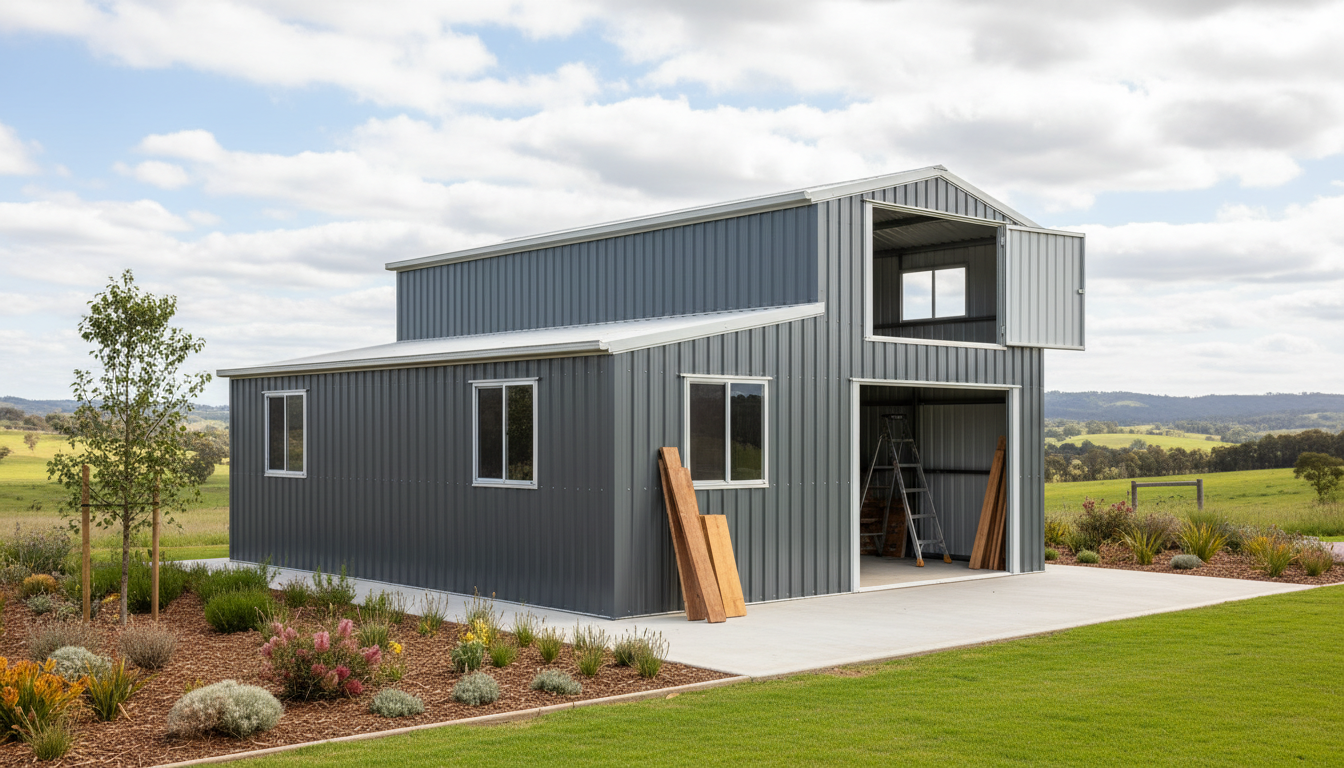
Storage shed with loft: A steel shed designed with an integrated mezzanine floor (loft) to increase usable storage area without expanding the shed footprint. Typical uses include farm machinery spares, camping gear, seasonal stock, and workshop overflow.
Need more storage without losing yard space? A storage shed with a loft (mezzanine) can add 20–40% usable area — but you must get materials, engineering and approvals right for Australian conditions. This guide explains materials (Colorbond vs Zincalume), wind ratings, council approval pathways, costs (2025) and buying steps so you can specify and build with confidence.
What is a storage shed with a loft, and why choose one in Australia?
A loft (mezzanine) installed in a steel shed creates a second level for storage or light workspace without changing your building footprint or increasing site coverage. Benefits for Australian buyers include:
- Space efficiency: typically 20–40% extra usable floor area without expanding slab size.
- Cost control: mezzanines often cost less per square metre than extending a concrete slab or building a new structure.
- Versatility: use for seasonal equipment, archives, light workshop, or insulated storage.
- Resale appeal: organised storage and well-finished Colorbond garages often improve property perception.
Typical mezzanine forms: partial loft (covers part of the footprint), full mezzanine, or raised platform with central clearance for tall equipment. Early decisions (headroom, access, live load requirement) determine structural layout, stair design and planning approvals.
– NCC 2022 (ABCB): National Construction Code sets performance requirements and references structural standards. See https://www.abcb.gov.au.
– AS/NZS 1170.2: Wind actions — defines basic wind speeds and how to apply terrain and shielding factors for member design; engineers convert values to pressures for portals and cladding. See BOM wind maps at https://www.bom.gov.au/climate.
– AS 3959: Bushfire construction — sets BAL levels and material/vent requirements for bushfire-prone areas.
– AS/NZS 4600 / AS 4100: Cold-formed and hot-rolled steel member design; used for portal frames, purlins and connections.
– AS 3600: Concrete structures — slab and footing design for shed bases and hold-down capacity.
Best materials for Australian conditions: Colorbond vs Zincalume
Choosing cladding and roof material is a balance of corrosion resistance, thermal performance, cost and appearance. Below is a national comparison; a Perth / WA subsection follows with local notes.
| Criteria | Colorbond (pre-painted steel, incl. Ultra) | Zincalume (AZ150) |
|---|---|---|
| Corrosion resistance | Pre-painted with corrosion-resistant coatings; Colorbond Ultra has enhanced corrosion protection for close coastal exposure. (See BlueScope technical pages.) | Aluminium-zinc alloy coating with good inland performance; less tolerant in high chloride coastal zones without additional protection. |
| Heat reflectance | Light colours and specific product ranges offer higher solar reflectance, reducing internal heat gain. | Metallic finish reflects reasonably; colour selection limited unless painted or powder-coated. |
| Durability & warranty | Strong manufacturer warranty when installed per BlueScope guidance; warranties vary by product and exposure zone. | Good service life inland; warranty may be more restricted in marine exposure. |
| Cost | Higher upfront cost for Colorbond vs Zincalume; value often recovered via aesthetics and lower maintenance near coast. | Lower initial cost — common for barns and rural sheds. |
Coastal guidance: Use Colorbond Ultra within closer surf exposure (manufacturer guidance suggests consideration within ~150–400 m of open surf depending on local exposure). For exact warranty zones and recommendations, consult BlueScope product pages and the Colorbond warranty PDF.
Corrosion zones (C1–C4): Choose coatings and maintenance schedules to match the coastal/inland classification:
- C1–C2 (inland/suburban): standard Colorbond or Zincalume with routine maintenance.
- C3–C4 (coastal / high chloride): Colorbond Ultra or hot-dip galvanised portals; wash-downs every 1–3 months and sacrificial flashings recommended.
Pro Tip: Insulated roof panels or an anti-condensation blanket plus sarking can reduce internal peak temperatures by several degrees — reference Energy.gov.au and CSIRO guidance on roof insulation and thermal performance (https://www.energy.gov.au, https://www.csiro.au).
Perth / WA considerations
Perth experiences hot, dry summers with coastal salt from sea breezes. Use light roof colours to reduce heat gain, specify Colorbond Ultra for close coastal properties, and check local council design overlays for approved colours.
Loft sizing and load capacity requirements
Designing a loft starts by setting the intended use and selecting the live load. Typical live loads used in practice (confirm with your engineer):
| Use-case | Recommended design live load (kPa) |
|---|---|
| Light storage (boxes, small totes) | 2.0 kPa |
| General storage / workshop benches | 2.5–3.0 kPa |
| Heavy storage (pallets, machinery spares) | 3.5–5.0 kPa — engineer design required |
Example calculation: A 4.0 m x 2.5 m loft area at 2.5 kPa = 4.0 x 2.5 x 2.5 kN/m2 = 25 kN total live load (equivalent to ~2.5 tonnes) distributed; design must ensure joists, bearers and portal reactions safely transfer loads to foundations.
Checklist for loft design:
- Define live load and clear access routes.
- Minimum headroom below loft: 2.1 m recommended for functional workshop areas; stairs require adequate landing space.
- Specify engineered joists (C-section or timber) with span tables and bearer spacings included in drawings.
- Balustrade: minimum 1.0 m height for residential; infill spacing to limit 125 mm sphere passage where children present.
- Stair compliance: 900 mm clear width minimum, consistent rise/run, handrails and non-slip tread finish.
- Include load paths to portals and hold-downs in structural drawings; show ledger details and connection hardware.
Always have a registered structural engineer provide stamped drawings and connection schedules — this prevents costly on-site redesigns and ensures councils accept your permit application.
Understanding wind ratings and structural compliance across Australian regions
Wind actions per AS/NZS 1170.2 are central to shed design. The classification process uses: basic wind speed (map), terrain category (1–4), shielding, and importance level. Engineers apply these factors to determine pressures on portals, cladding and connections. See BOM wind maps: https://www.bom.gov.au/climate.
How to obtain a site wind classification:
- Check the BOM basic wind speed map for your site; identify nearest weather stations and topography.
- Assign terrain and shielding factors (Terrain Cat 1–4) based on surrounding vegetation and buildings.
- If site is exposed or near coastal escarpments, commission a site-specific wind report ($500–$1,200 typical).
- Engineer uses the report to size portals, purlins, cladding fixings and hold-downs; include the report with council submission.
Representative structural details used in practice:
- Hold-downs: common solutions include M16 chemical anchors or mechanical anchors rated >80 kN design capacity depending on uplift demands; strap systems used where concrete conditions limit anchor capacity.
- Portal frames: Region C/D portals often specify thicker RHS or hot-dip galvanised members and additional bracing gussets.
- Purlin spacing: increased wind loads may reduce allowable purlin spans, affecting loft floor joist layout and bearing positions.
- Doors: wind-lock roller doors, reinforced guides and extra fasteners on door surrounds to resist uplift; check manufacturer cyclone-rated options.
When to ask the engineer (quick checklist): portal sizing, increased stud/portal thickness, additional bracing, increased hold-down capacity, roller door uplift capacity and slab anchorage design. .
Navigating council approval processes by state
Council expectations vary by state and council. Below are typical document requirements and timeframes; always confirm with your local council or private certifier.
Western Australia (WA)
- Documents commonly required: site plan with setbacks, elevations showing eaves and ridge height, colour schedule, signed structural drawings and connection schedule, footing/slab detail, termite protection details, stormwater discharge plan, and BAL certificate where applicable.
- Application processing: 4–8 weeks typical; add time for BAL or site wind reports.
- Fees: $300–$1,200 (varies by council).
Queensland (QLD)
- Additional attention in Region C/D cyclone areas: certified cyclone design, portal and hold-down schedules, and specific roller door details.
- Turnaround: allow extra 2–4 weeks for cyclone checks and clarifications.
- Fees: $300–$1,500 depending on council and classification.
New South Wales (NSW)
- Many rural sheds may be exempt development if under thresholds — check local LEP. If not exempt, provide stamped structural drawings, slab details, and stormwater plans.
- Turnaround: 2–6 weeks for basic applications; longer if planning overlays apply.
Victoria (VIC)
- Planning permits may be needed for height or site coverage; show site classification for reactive soils where applicable.
- Snow load considerations apply in alpine/high country areas; combine load checks with wind uplift design.
Common council checklist items (all states): site plan, elevations, structural drawings with engineer stamp, connection schedule, footing/slab details, stormwater and eaves/gutter details, BAL assessment if required, and appropriate fee payment.
DIY kits vs custom-built sheds: pros and cons
Deciding between a DIY kit and a custom supply & install depends on complexity, live load, site conditions and local regulations.
| Factor | DIY Shed Kits | Custom-Built (Supply & Install) |
|---|---|---|
| Speed | Fast delivery; installation time depends on owner skill | Professional crew; predictable timeline |
| Cost | Lower upfront; may need paid engineering or upgraded fixings | Higher upfront; includes engineering and warranty |
| Complexity | Best for simple gable/skillion roofs without mezzanines | Recommended for lofts, cyclone areas or complex sites |
| Compliance | Owner manages permits and inspections; risk of non-compliance if not done correctly | Builder/installer manages engineering, permits and QA |
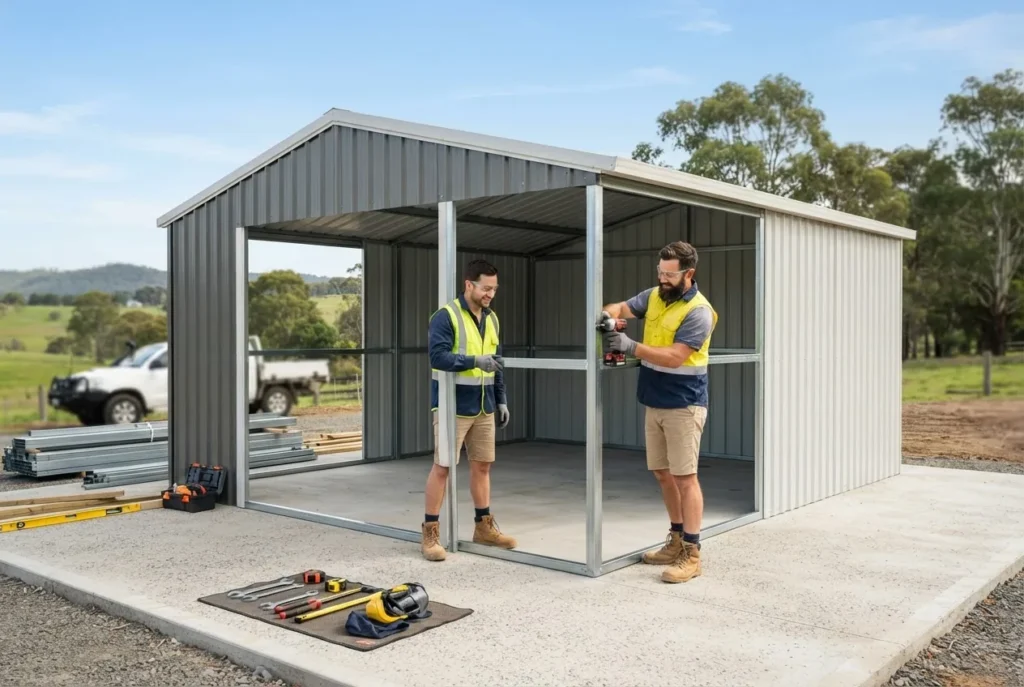
Decision matrix: if you require a mezzanine with live loads >2.5 kPa, are in Region C/D, or in BAL zones, choose custom supply & install with an engineer. For simple garden sheds under 20 m² without loft, DIY kits are often cost-effective. Hidden kit costs include engineering certification, stronger anchor bolts, upgraded footings and possible extra labour (estimate 40–120 labour hours depending on complexity).
Real Australian build examples by region
Perth, WA – Custom Colorbond garage with loft
- Size: 7.0 m x 7.0 m x 3.2 m eave; 50% loft at 2.5 kPa live load
- Spec: Colorbond Monument walls, Surfmist roof; anti-condensation blanket + ridge vent
- Engineering: Region A, Terrain Cat 3; M16 chemical set hold-downs; engineered stairs
- Outcome: Boat storage below; loft for camping gear and parts. Installer provided stamped drawings for council approval.
Image (permission granted): Perth garage before/after — caption: 7×7 Colorbond garage with 50% mezzanine. (Image placeholder)
Townsville, QLD – Cyclone-rated shed with mezzanine
- Size: 9.0 m x 6.0 m; 30% mezzanine at 3.0 kPa
- Spec: Region C design; hot-dip galvanised portals; wind-lock roller door; strap bracing
- Cladding: Colorbond Ultra specified for coastal exposure ~300 m from surf
- Outcome: Approved on first submission with engineer’s site wind report; final cost in expected cyclone-rated band.
Central West NSW – Rural barn-style shed
- Size: 12 m x 9 m with central gable and two lean-tos
- Use: Farm machinery storage at ground; hay and seed on loft (3.5 kPa design)
- Spec: Zincalume roof, Colorbond walls; whirlybirds and louvre vents for ventilation
Melbourne urban garage loft (added case)
- Size: 6.0 m x 4.0 m with full loft for archive storage; insulated roof, R3.0 equivalent
- Spec: Colorbond Monument with acoustic underlay; engineered slab designed for slab edge and hold-downs
- Outcome: Low visual impact, passed council planning with muted colour palette.
Enhancements and upgrades for loft sheds
Upgrades improve comfort, longevity and compliance. Typical and recommended options:
- Insulation: roof blanket or insulated sandwich panels. Recommended roof R-values: R2.5–R4.0 for hot climates, R1.5–R2.5 for temperate regions. See Energy.gov.au for state-specific guidance.
- Condensation control: sarking, anti-condensation blanket and sealed eaves; ensure continuous ridge ventilation and eave seal to prevent vapour migration.
- Ventilation: provide at least one ridge vent per typical ridge length plus whirlybirds (ventilation count depends on roof area; installers often specify one whirlybird per 30–50 m² roof area).
- Stairs and safety: stair rise/run to NCC; handrail height 900–1,000 mm typical; balustrade infill spacing <125 mm for child safety.
- Electrical readiness: pre-run conduit for solar-ready roof and locations for LED task lighting and GPOs on loft level.
- Corrosion protection: hot-dip galvanised portals or powder-coated portals in C3–C4 zones; sacrificial flashings and stainless fixings in high-exposure areas.
Bushfire, condensation, and corrosion considerations
Address three environmental risks up-front to avoid retrofit problems.
| BAL level | Material/vent requirement (summary) |
|---|---|
| LOW | Standard construction; ember guards recommended |
| 12.5 | Non-combustible materials recommended for eaves/vents; ember-proof vents |
| 19–29 | Limit combustible external elements; ember guards and screened vents per AS 3959 |
| 40–FZ | Strict non-combustible materials and construction; consult AS 3959 and local bushfire planning |
Condensation management sequence: sarking under cladding, anti-condensation blanket on underside of roofing, sealed eaves and continuous ridge venting. Common failure points: missing sarking laps, inadequate eave sealing and un-vented skylights. Routine inspection and a well-specified condensation blanket reduce noise and rust.
Corrosion maintenance (C1–C4): rinse coastal cladding and flashings monthly within 1 km of open surf, quarterly within 1–5 km. Inspect portal baseplates and anchors twice yearly; recoat sacrificial components per manufacturer guidance.
Cost guide for sheds with loft in 2025
Indicative supply-and-install pricing (metro, engineer-certified, slab excluded):
- Small (6 x 4 m with 25% loft): $10,000–$16,000
- Medium (7 x 7 m with 40–50% loft): $18,000–$30,000
- Large (9 x 7 m with 50%+ loft, cyclone-rated): $35,000–$55,000+
Additional line items:
- Engineering fees: $800–$2,500 (site wind report and stamped drawings increase cost).
- Permit/council fees: $300–$1,500 depending on council and scope.
- Delivery: $200–$2,000 (regional delivery and remote sites higher).
- Insulation and condensation blanket: $800–$3,000 depending on area and product.
- Stairs and balustrade: $1,200–$5,000 depending on materials and finishes.
Example totals (including typical addons): small build ~ $12k–$20k (with slab add-on extra), medium build ~ $22k–$35k, large cyclone-rated build ~ $40k–$70k depending on Colorbond Ultra, insulated roof and remote delivery.
5-step buying guide for custom sheds in Australia
- Define use-case: Answer: what will you store, max point loads, frequency of access, and required headroom. Checklist questions: will you store vehicles, pallets, or light boxes?
- Pick materials: Choose Colorbond vs Zincalume based on exposure; consider Colorbond Ultra near surf and select low-glare colours for planning overlays.
- Engineer early: Provide site address and intended live load. Ask for site wind classification, footing depth, slab rebar schedule, mezzanine nodal loads, and connection schedule. Expect an engineer to require $800–$2,500.
- Permits: Prepare drawings, BAL certificate if needed, site plan, and connection schedule. Request these document filenames from your installer: “Structural Drawings (Stmp)”, “Connection Schedule”, “Site Classification Report”, “BAL Certificate”.
- Install plan: Decide installer vs DIY. If DIY, budget for engineering retrofit costs and appropriate footings. For lofts and cyclone areas choose accredited installers with warranty management.
Spec sheet: Essentials your quote should include
- Cladding: Product name (Colorbond product and colour), and warranty PDF link from BlueScope.
- Structure: Portal section, portal spacing, bracing and whether portals are hot-dip galvanised.
- Doors: Roller door size, wind rating and wind-lock specification.
- Loft: Design live load stated (kPa), joist type and spacing, balustrade details.
- Slab: Concrete strength (25–32 MPa), mesh type and thickened edge details.
- Fixings: Anchor type and design capacity; cyclone hold-downs if required.
- Ventilation & insulation: Type of blanket, ridge vents, whirlybirds.
- Engineering: Stamped drawings, connection schedule, and site wind report if used.
Local notes that competitors often miss
- AS 3959 BAL upgrades alter door and vent specifications in bushfire zones; door frames may need screening.
- Snow + wind combined checks are required in VIC High Country; ensure engineer checks both loads.
- Councils in WA increasingly require a detailed connection schedule and proof of anchor capacity —
Citations and further reading
- ABCB / NCC 2022
- Bureau of Meteorology wind maps
- BlueScope / Colorbond technical pages and warranty
- CSIRO — building and bushfire research
Disclaimer: This guide provides general information only. Consult a registered structural engineer and your local council for site-specific compliance and stamped drawings before construction.
Frequently Asked Questions
Do I need council approval to build a storage shed with a loft in Australia?
Most mezzanines/lofts are structural elements and typically require certified engineering and building approval even if the base shed could be exempt. Check local planning overlays and building thresholds. For WA and cyclone or BAL zones, include a connection schedule, footing design and signed drawings with your application.
What is the difference between Colorbond and Zincalume for sheds?
Colorbond is pre-painted steel with superior coastal corrosion resistance and a range of colours; Zincalume is a galvanised/aluminium alloy finish with lower upfront cost and good inland performance. Choose Colorbond Ultra for near-coast or high-exposure sites; specify wash-down regimes and warranty terms for both.
How big can the loft be, and what load should it support?
Loft size depends on portal spacing, purlin spans and headroom. Typical live load guidance: light storage 2.0 kPa, general storage/workshop 2.5–3.0 kPa, heavy storage 3.5–5.0 kPa. Have a structural engineer specify joists, bearers, and connections for the chosen live load.
How do wind ratings affect shed design in different Australian states?
AS/NZS 1170.2 defines wind regions A–D and requires engineers to apply terrain and shielding factors. Higher regions or exposed sites need stronger portals, more hold-down capacity, strap bracing, and wind-lock doors. Obtain a site wind report for accurate member sizing and council approval.
Can I add a loft to an existing shed later on?
Yes if the original shed was pre-engineered for future loads. Otherwise you’ll need a retrofit design that may require upgraded purlins, footings, or portals. Always get a structural assessment before adding a mezzanine; expect to add tie-downs and possibly upgrade roller door fixings.
What roof style is best for sheds with a loft — flat, gable, or skillion?
Gable roofs typically provide the most usable loft headroom and storage volume. Skillion roofs suit tight height limits and can optimise solar PV orientation. Flat roofs are less common due to drainage and condensation risks; choose roof style based on local planning, headroom needs and water management.
How much does a custom shed with a loft cost in 2025?
Indicative supply-and-install costs vary: small (6x4m) $10k–$16k; medium (7x7m) $18k–$30k; large/cyclone-rated $35k–$55k+. Add engineering ($800–$2.5k), permit fees ($300–$1.5k), delivery and insulation upgrades. Final price depends on wind region, Colorbond Ultra choice and stair/hoist fit-out.
What upgrades improve comfort and durability in steel sheds with lofts?
Key upgrades: insulated roof panels or blanket plus sealed sarking, ridge and eave ventilation, anti-condensation membranes, hot-dip galvanised portals in coastal sites, Colorbond Ultra cladding near surf, and wash-down points. For bushfire-prone areas follow AS 3959 material and venting requirements.