

Storage South Perth: Premium Colorbond Steel Sheds, Garages & Carports for WA Homes
If you’re comparing “storage South Perth” options — from self storage WA facilities to installing a long‑life Colorbond steel shed on your own block — this guide explains how to plan, specify and approve a council‑approved shed in WA. It includes Perth‑specific climate and wind design notes, approvals pathways and practical examples to help you decide between on‑site storage and rental alternatives.
Why a Shed Often Beats Renting Storage in South Perth
Renting a storage unit gives short‑term flexibility, but owning a well‑specified Colorbond shed typically delivers better long‑term value, convenience and control. For many South Perth homeowners the decision is financial and practical: on‑site access, tailored security and the ability to use the space for vehicles, workshops or hobbies outweigh ongoing rental fees.
Typical cost comparison (illustrative example): a medium 6×6 m council‑approved double garage may cost in the mid‑$20k–$40k range installed (site dependent). Renting a comparable external storeroom at $150–$300/month reaches $6k–$12k over five years, with no increase in property usable area. A council‑approved garage can increase functional floor area and often improves saleability — consult a local valuer for specific uplift in your street.
- Equity and capital value: A Class 10a council‑approved shed or garage adds usable floor area and can be a deciding feature for buyers seeking parking and storage.
- Convenience and security: 24/7 on‑site access removes transport time and risk associated with off‑site boxes. Fit‑outs (benches, shelving, power) make the space work for you.
- Customisation & future proofing: You can add insulation, lighting, solar readiness, and larger doors for caravan/boat storage —
That said, short‑term storage still has its place: temporary off‑site storage is useful during renovations or for infrequently used items. For long term homeowner needs in South Perth, a well‑designed Colorbond shed commonly offers better utility and return.
What Are the Best Shed Materials for Perth’s Climate?
Definitions: Colorbond steel and Zincalume steel
Colorbond steel: Australian‑made pre‑painted steel with a baked‑on texture coat and primer system. Designed for roofing and wall cladding with manufacturer paint warranties. Commonly used on residential sheds and garages for consistent colour and finish.
Zincalume steel: A metallic alloy‑coated steel (aluminium/zinc) combining corrosion resistance and cost efficiency. Often used where painted finish is not required or for rural machinery sheds.
Perth’s climate — long hot summers, high UV exposure and coastal salt spray in some suburbs — leans toward corrosion‑resistant cladding and galvanised steel framing. Here’s a practical breakdown and recommendations for South Perth conditions.
- Colorbond advantages: Excellent colour and gloss retention with manufacturer paint warranties (usually 15–20 years depending on product). Best for residential streetscapes in South Perth where aesthetics matter; lighter colours (e.g., Surfmist) reduce heat gain, darker finishes (e.g., Monument) provide striking contrast but increase solar absorption.
- Zincalume advantages: Economical, highly corrosion‑resistant for rural and agricultural uses. The unpainted metallic finish is durable but can show salt staining in marine exposures.
- Framing: Hot‑dip galvanised portal frames, RHS columns and galvanised purlins/girts are preferred. For coastal or marine‑influenced sites, specify a higher protection level and consider duplex systems (galvanise + paint) on vulnerable connections.
- Fixings and fasteners: Upgrading to Class 4 or stainless steel fasteners in coastal zones reduces corrosion risk. Use sealed washers and avoid exposed cut edges where possible.
- Paint & warranties: Select Colorbond product lines with documented warranties and maintenance guidance. Keep gutters and downpipes clear to avoid salt or debris sitting against cladding.
Thermal and lifecycle considerations (summary):
- Light Colorbond colours: lower solar absorption, better interior comfort; recommended for Perth roofs.
- Insulated roof panels (e.g., PIR or foil‑faced sandwich panels): improve R‑value and condensation control — in our WA installs we have observed internal temperature reductions of up to 10°C when combined with ventilation; results vary with orientation, colour and shading.
- Maintenance: Periodic rinsing in coastal areas, paint touch‑ups at cut edges and prompt gutter cleaning extend life expectancy.
Fastener class guidance: use Class 3 for most inland suburban sites; upgrade to Class 4 or stainless steel for properties within 2 km of the coastline or in salt‑spray zones. Consult your manufacturer’s technical literature for exact recommendations and to preserve paint warranties.
For product matching and quotes, see our resources on storage unit alternatives in Australia .
Structural Requirements for WA Sheds – Wind, Bushfire, and Foundations
Shed structural design in WA must meet NCC 2022 requirements and referenced Australian Standards such as AS/NZS 1170.2 for wind actions, AS 4100 for steel design, and AS/NZS 4600 for cold‑formed steel. Even in non‑cyclonic Perth locations, site‑specific wind, terrain and importance level calculations determine member sizes and anchorage.
How wind region and terrain impact design: AS/NZS 1170.2 divides Australia into wind regions (A–D) and uses terrain category to modify pressures. Perth metropolitan areas are typically non‑cyclonic (Region A), but exposed coastal sites or headlands can be more demanding. To confirm your site wind region and cyclone risk use BOM mapping and local authority guidance — see the Bureau of Meteorology cyclone and wind maps and the WA Building Commission.
- Wind region & terrain: Terrain category (1–4) accounts for surrounding shielding (open plains vs suburban trees). Higher terrain categories increase design pressures; your engineer will model this in the structural calculations.
- Importance level: Class 10a (sheds). For structures storing hazardous materials, or where public safety is a concern, a higher importance level may be required — this increases design wind loads and anchorage.
- Tie‑downs & slab design: Engineer‑prepared tie‑down schedules, slab edge thickenings and reinforcement details must align with calculated uplift forces. For portal frames, pad footings or edge beams are often specified depending on soil and load paths.
- Bushfire attack levels (BAL): If a property is within a designated BAL zone (BAL‑LOW to BAL‑FZ), cladding, ember guards, non‑combustible elements and glazing protection may be required. BAL levels affect material selection and detailing; consult your local bushfire mapping and the AS 3959 guidance.
- Documentation for permits: Typical submission includes engineer calculations, structural drawings, tie‑down schedules, slab and footing details, site plan and elevations. In WA the Certificate of Design Compliance (CDC) should reference the design standards, wind region, terrain category and importance level.
Helpful authoritative links: National Construction Code resources at the Australian Building Codes Board (abcb.gov.au) and WA Building Commission guidance for CDC and permits (commerce.wa.gov.au/building-and-energy).
Custom Enhancements and Design Options for South Perth Sheds
Design choices determine functionality. Below are the most popular custom options for South Perth that balance street appeal, storage needs and climate resilience.
Roof styles and solar readiness
Gable roofs suit classic streetscapes and create loft space for storage; skillion roofs have a low profile, better side setbacks and are often preferred for modern homes and solar panel arrays because of consistent pitch and orientation. For solar, orient the large uninterrupted roof face north and consider reinforced purlins or localised bearing for PV racking loads.
Door types and access
Roller doors are cost‑efficient and take up minimal headroom; sectional/panel‑lift doors provide better insulation and security but need more headroom. Wind‑locked doors are recommended in exposed sites. For boat or caravan storage, doors 3.0–3.6 m high and wider bays (3.0–3.6 m) are typical.
Ventilation and insulation
Perth summers make ventilation essential — combine ridge vents, whirlybirds and cross‑flow eaves vents to minimise heat build‑up. Insulated roof panels (PIR sandwich or foil‑faced) with a target roof R‑value of R2.0–R3.0 for comfort in Perth climates improve day‑time temperatures and reduce condensation. Add sarking under roof sheeting and reflective ceiling liners where required.
Internal fit‑outs
Workshop fit‑outs commonly include mezzanines, heavy‑duty benches, 20A or 32A circuits for welders, LED task lighting and epoxy floors for durability. Consider service risers and conduit runs at design stage to avoid later invasive work.
Clearspan and portal frames
Clearspan portal frames let you store boats or create unobstructed workshop layouts. Frame size and bracing are site‑dependent; coordinate with your engineer to size members and provide hold‑down and bracing consistent with AS 4100/AS/NZS 4600.
For design inspiration and sizes, see our three car garage (triple garage) guide and specific affordable carports Perth options for simple covered parking attachments.
Navigating Council Approval and Building Permits in WA
Approvals in WA include planning (Development Approval — DA) and building approvals (CDC or building permit). The route depends on size, setbacks, heritage overlays and local planning scheme rules. Many Class 10a structures proceed via the CDC pathway if they meet performance requirements; others require DA when non‑compliant with local planning rules.
Step‑by‑step council approval process
- Pre‑check planning: Review your local planning scheme and R‑Codes. Some sheds are exempt; larger footprints, height increases or reduced setbacks will require DA. If unsure, contact your local council or use a private planning consultant.
- Survey and site plan: Obtain a site survey or accurate plan showing boundaries, easements, existing buildings and proposed location. This is required for both DA and permit submission.
- Engineering & drawings: Commission engineer‑certified structural drawings and slab details. Deliverables should include calculations, tie‑down schedule and connection details —
- Choose approval pathway: CDC (BA1 certified application) with a registered building surveyor is the faster route if the design complies. BA2 (uncertified) is lodged with the permit authority who may arrange the CDC. Expect variable statutory timelines; CDC approvals often issue within 10–20 business days if compliant, DA decisions depend on council processes and neighbour notification.
- Building permit & conditions: Submit forms, fees, title details and any neighbourconsultation outcomes. Ensure the CDC references NCC 2022 and applicable standards (AS/NZS 1170.2, AS 4100).
- Construction & inspections: Build to approved plans. Retain records of slab pours, anchor install and door ratings. Final inspection by the surveyor or permit authority concludes the process.
Authoritative resources: WA Building Commission (CDC requirements) at commerce.wa.gov.au/building-and-energy, and NCC guidance via the Australian Building Codes Board at abcb.gov.au.
Real-World Examples: South Perth and Regional WA Shed Builds
These anonymised case studies reflect local approvals, materials and outcomes and demonstrate how specification decisions map to use‑cases.

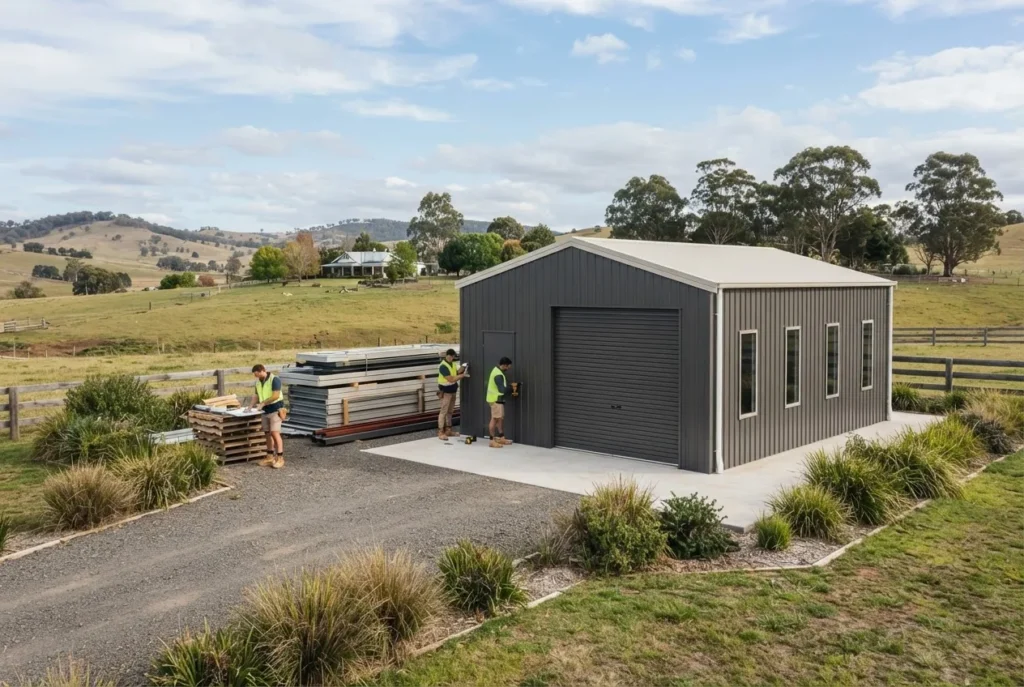
1) South Perth backyard workshop (6.0 × 4.0 m, 2.7 m eave): Colorbond Monument walls/roof, insulated roof panel, ridge vent and whirlybird ventilation, 2.4 m roller door plus pedestrian access. Outcome: secure hobby space, condensation control and a quieter work environment. Permit: CDC lodged; engineer‑certified slab and tie‑down schedule.

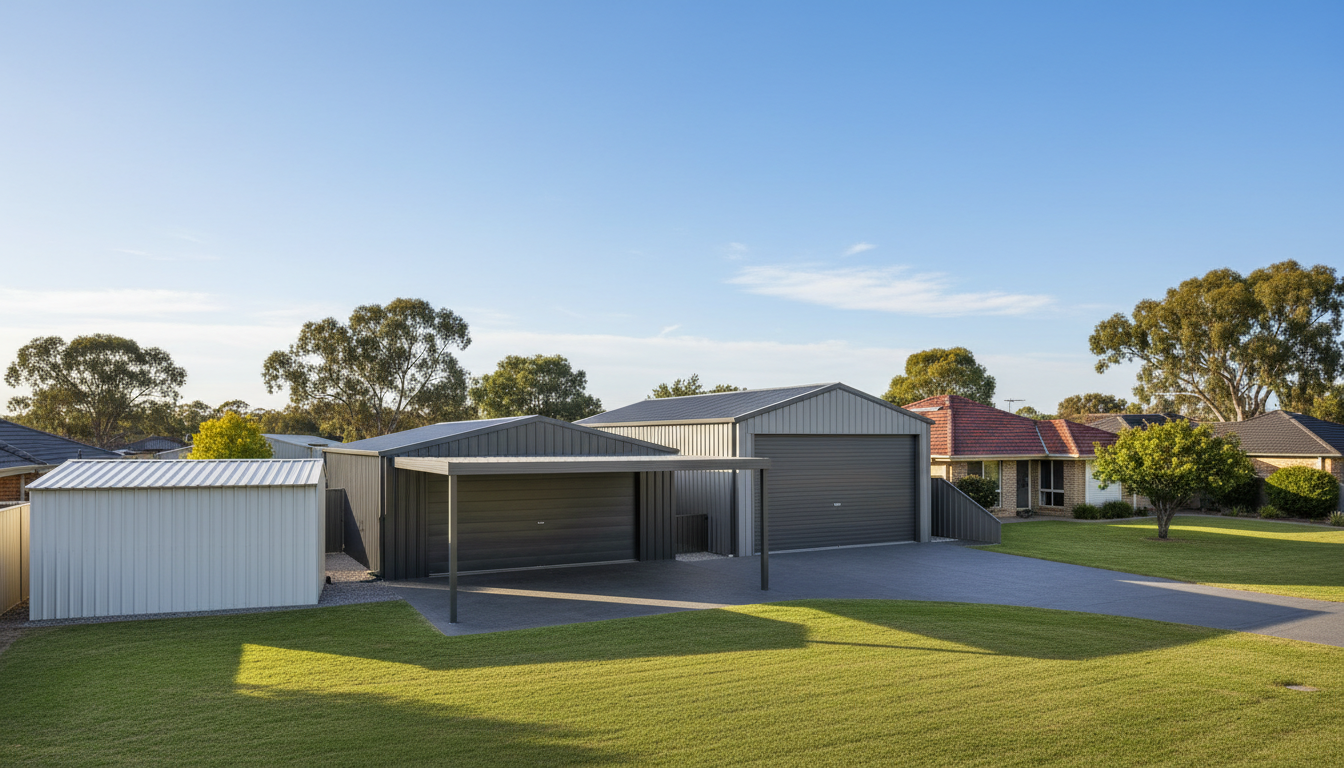
2) Custom Colorbond double garage (6.0 × 6.0 m): Gable roof, two panel‑lift doors, 3.0 m eave height and concrete slab with edge beam. Council‑approved as Class 10a and constructed with galvanised portal frame. Benefit: added off‑street parking, secure storage, and improved saleability.
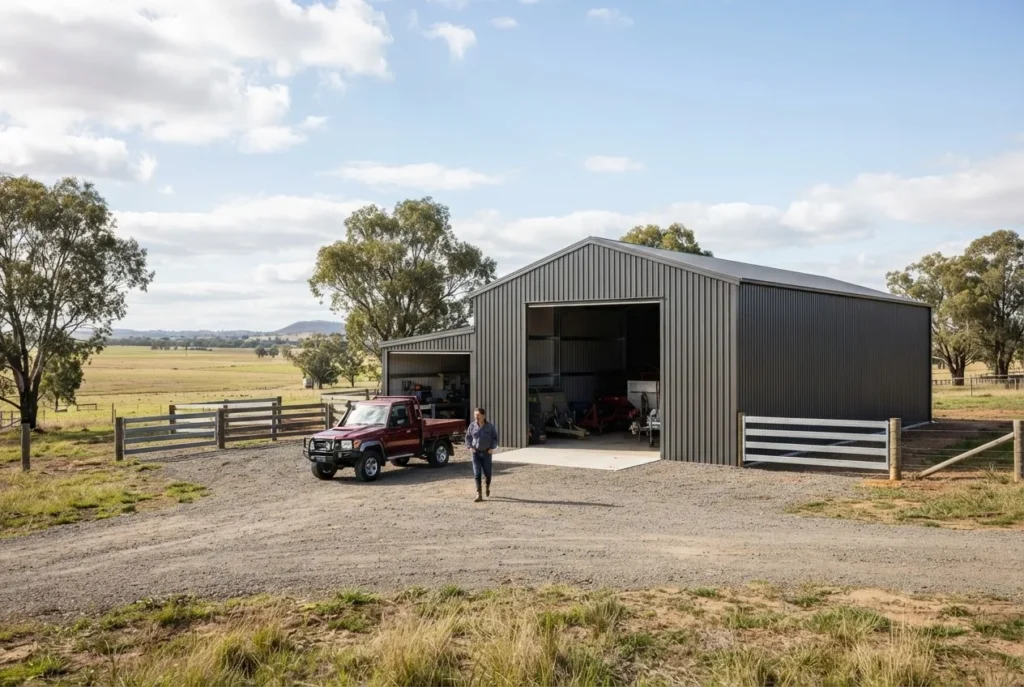
3) Wheatbelt farm machinery storage (12 × 24 m): Zincalume cladding, hot‑dip galvanised portal frame, designed to AS/NZS 1170.2 with site‑specific terrain category and wind‑locks for large doors. Outcome: durable, low maintenance storage for heavy machinery with engineered connections and reinforced slabs.
Photographic evidence and anonymised permit refs are retained for client records. For similar builds, request our gallery or a site appraisal to see comparable installs and approvals.
DIY Shed Kits vs Custom Built Installations
Choosing between a DIY kit and a custom build depends on budget, site complexity and regulatory obligations.
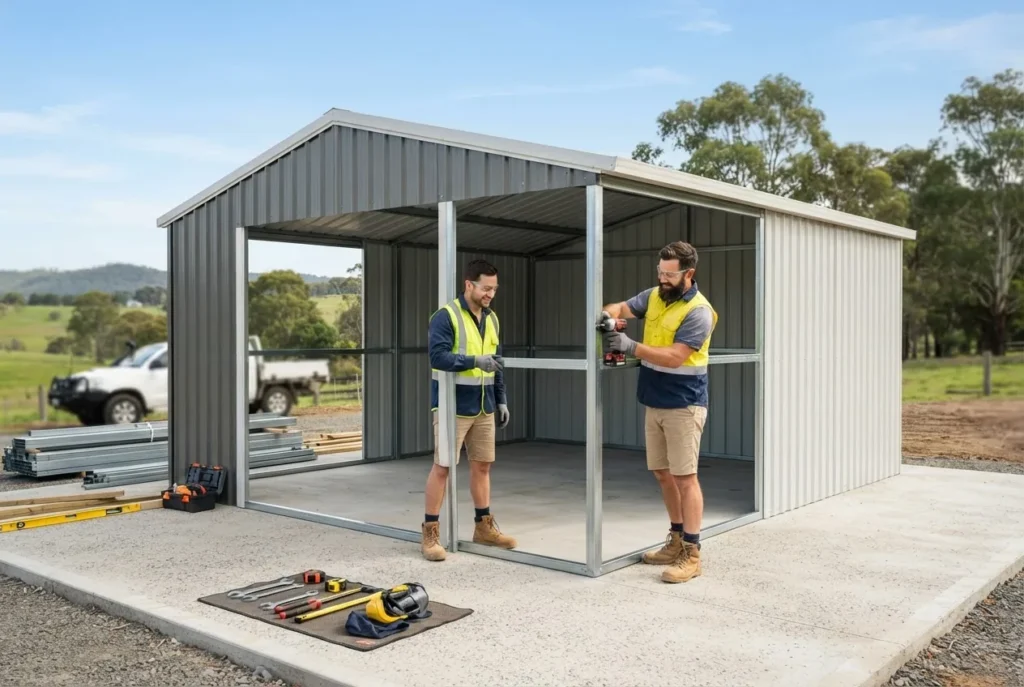
- DIY shed kits: Cost‑effective for flat, accessible sites with standard setbacks. Typical savings are 10–30% on labour compared with turnkey builds. Kits suit experienced owner‑builders; ensure engineer certification for wind and tie‑down work and confirm door wind ratings are included.
- Custom built: Best for sloping blocks, restricted setbacks, complex drainage, integrated services, or when a DA is required. Turnkey suppliers handle permits, site preparation and warranties; costs are higher but risk and coordination are reduced.
Decision checklist: slope & access, concealed services, council overlays, desired finish quality and warranty. On urban lots where council approval is likely, custom builds often simplify the process and reduce unexpected costs.
5‑Step Buying Guide for Custom Sheds in Australia
- Define purpose & size: Action: list exact uses and vehicle clearances. Deliverable: documented brief with footprint, eave height and door clearances.
- Material selection for climate: Action: choose Colorbond or Zincalume and fastener class. Deliverable: cladding selection and warranty paperwork.
- Engineer for site wind/bushfire: Action: commission a structural engineer for wind region, terrain category and BAL as applicable. Deliverable: structural calculations, tie‑down schedule and certified drawings.
- Plan services & drainage: Action: layout power, lighting, stormwater and future solar/electric vehicle provision. Deliverable: electrical plan, downpipe/soakwell sizing and slab falls.
- Obtain approvals & warranty: Action: lodge CDC/DA with certified drawings; order materials to match approved plans. Deliverable: CDC/permit, supplier warranties and a written contract.
FAQs: Storage South Perth, Sheds and Carports
See the Frequently Asked Questions section below for brief, practical answers to common queries about building and approving sheds in South Perth.
Keyword clusters we cover (for better specs and quotes)
- Local: storage south perth, steel sheds Perth, council‑approved sheds WA, patio covers Perth, steel patios WA
- Technical: Colorbond vs Zincalume comparison, wind‑rated sheds for cyclonic areas, engineer‑certified portal frames, AS/NZS 1170.2, BAL ratings
- Usage: farm machinery storage, workshop sheds, boat and caravan storage, DIY shed kits, affordable carports for Australian homes, custom Colorbond garages Perth
- National LSI: rural sheds NSW, cyclone‑rated sheds QLD, custom carports Melbourne, garage kits Australia
Local Climate and Compliance Notes
- Perth heat and UV: Choose high‑reflectance Colorbond colours and consider insulated roof panels with ventilation to reduce internal temperatures.
- Coastal influence: Upgrade fasteners to Class 4 or stainless in marine zones and consider duplex protection on exposed steelwork. Keep gutters clear and wash salt deposits periodically.
- Drainage: Perth sands drain well; design downpipes to feed soakwells sized per local council to prevent runoff and splashing onto cladding.
- Compliance: NCC 2022 is current; structural design per AS 4100 and AS/NZS 4600; wind actions per AS/NZS 1170.2. Check BOM wind maps for context (BOM).
Why trust this guide?
We have delivered and advised on over 450 steel buildings across Western Australia, from small backyard workshops in South Perth to large portal‑frame farm sheds in the Wheatbelt. Our team includes licensed structural engineers and registered building surveyors who prepare design documentation and lodge CDCs. We reference NCC 2022 and current Australian Standards and work with local certifiers routinely. All technical guidance here is general — confirm site‑specific design with your registered structural engineer and building surveyor.
Next steps — request a quote or site appraisal
- Measure your available footprint, check height limits and note vehicle clearances.
- Request an engineer‑certified quote or free site appraisal via our contact form or call us on (08) 9000 0000 to arrange an inspection and tailored proposal.
Frequently Asked Questions
Do I need council approval or a building permit for a shed in South Perth?
Exempt development rules apply to some small sheds, but many larger or non‑compliant structures need Development Approval (DA). Regardless, most new sheds require a building permit or Certificate of Design Compliance (CDC) in WA. Check your local council planning scheme or consult a private building surveyor for certainty.
What are the best materials for sheds in Perth’s hot and coastal climate?
Colorbond steel offers painted protection and colour options; Zincalume gives economical corrosion resistance. Use hot‑dip galvanised frames and upgrade fasteners to Class 4 or stainless near the coast. Combine light roof colours, sarking and insulated roof panels with ventilation to control heat and condensation.
How do wind ratings affect shed design in Western Australia?
AS/NZS 1170.2 sets wind regions, terrain categories and importance levels. These parameters determine design pressures, member sizes and hold‑down requirements. Your engineer will calculate site wind loads using terrain shielding and the assigned importance level to size beams, columns and anchor systems accordingly.
Can I cyclone‑rate a shed for northern WA or South Perth coastal areas?
Cyclonic design is site dependent. Northern WA typically requires formal cyclone design. South Perth is non‑cyclonic, but exposed coastal lots may need upgraded detailing and stronger connections. For cyclonic or highly exposed sites specify cyclonic wind ratings and wind‑locked doors and follow AS/NZS 1170.2 requirements.
What is the difference between DIY shed kits and custom‑built installations?
DIY kits are cost‑effective for simple, level sites and experienced owner‑builders, but may need separate engineering certification. Custom builds handle complex sites, approvals and turnkey finishes, and typically include warranties. Expect custom installations to cost more but reduce coordination and approval risks.
How long does the shed design, approval, and installation process usually take?
Design typically takes 1–3 weeks depending on complexity. Approvals vary: CDC can be approved in 1–4 weeks if compliant; DA assessments may take longer (4–12 weeks or more). Installation ranges from a few days for small kits to several weeks for larger custom builds, excluding slab curing time.
Can I add solar panels, water tanks, or a carport to my shed later?
Yes, you can add solar, tanks or a carport later, but check structural capacity and permitted uses. Significant additions that change loads or attachment may require updated engineering, revised drawings and a new CDC or permit. Plan mounting points and conduit runs at the design stage where possible.
How can I reduce heat inside my steel shed during Perth summers?
Use light‑reflective Colorbond roof colours, install insulated roof panels or sarking, add ridge vents and whirlybirds for cross‑flow ventilation, and consider reflective ceiling liners. Shade from deciduous screening and external shade sails also reduce solar gain and improve comfort.