

Triple Carport Australia: Custom 3‑Car Colorbond Carports, Costs and Council Approvals
Disclaimer: This guide is for planning purposes only. Site‑specific engineering and local approvals are required — consult licensed professionals and your local council.
What is a triple carport and who needs one?
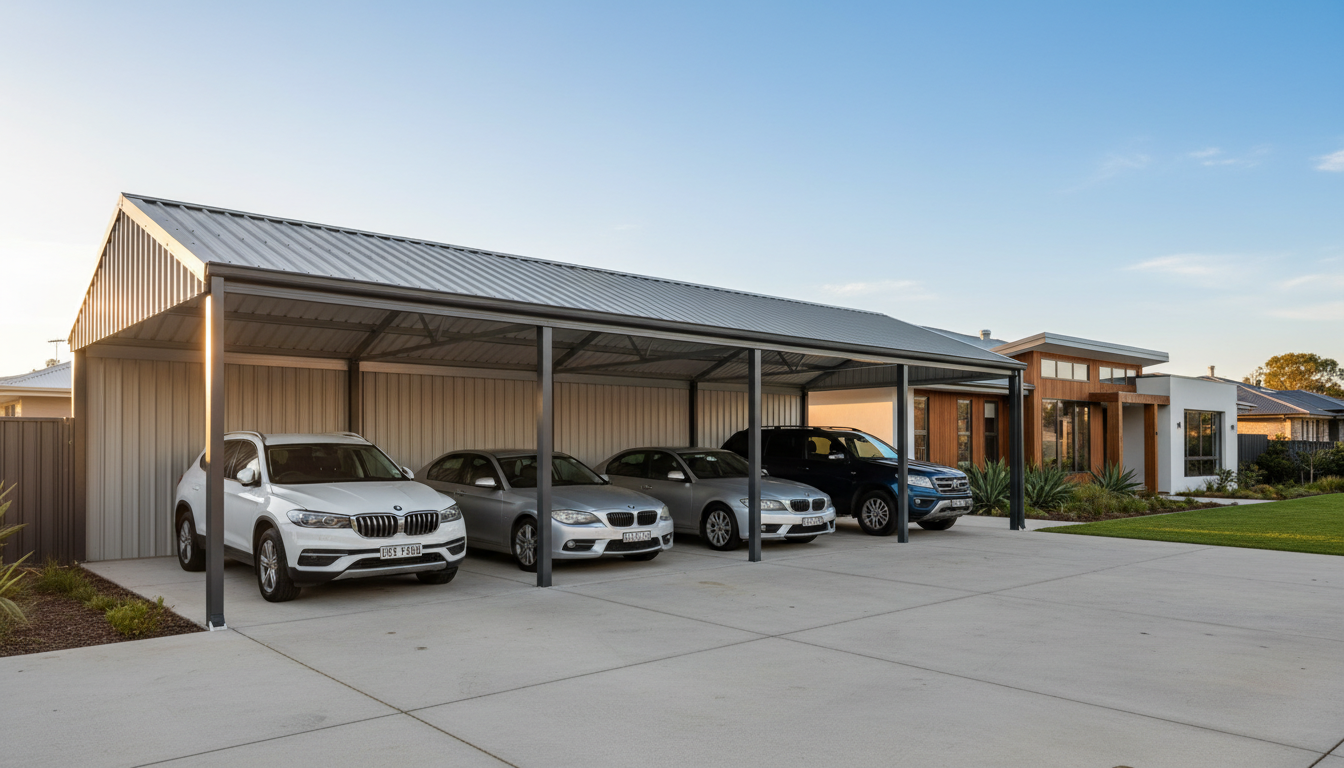
A triple carport is an engineered steel shelter sized to protect three standard vehicles (or two vehicles plus a caravan/boat) using freestanding columns or attached brackets. It combines clear-span roof framing, purlins and gutters and is specified to a site wind rating and terrain category under the NCC and Australian Standards.
- Typical clear spans: 8.4–10.8 m; bay widths 2.8–3.6 m; eave heights 2.4–3.6 m (higher for caravans/4WDs).
- Popular footprints: 9 × 6 m, 9 × 7.5 m, 10.5 × 7 m. See our triple carport designs for layout ideas.
- Common uses: family parking, caravan/boat parking, farm machinery cover, overflow parking for multi-occupancy sites.
How much does a triple carport cost in Australia (2025)?
Pricing depends on footprint, roof style, material finish, wind region, BAL, ground conditions and whether you choose a DIY kit or a fully installed, council‑approved solution. Below is a planning table and worked examples to help budget realistically.
| Item | Typical Cost (2025 AUD) | Notes |
|---|---|---|
| DIY kit (ex-factory) | $8,500–$18,000 | Includes steel framing, roof sheeting, flashings; excludes foundations, slab, delivery/assembly |
| Installed — Metro non‑cyclonic | $15,000–$32,000 | Fully installed, engineered, council‑approved; variance by finish and site access |
| Installed — Cyclone-rated (Region C/D) | $26,000–$45,000 | Heavier members, denser fixings, certified engineering and hold‑downs |
| Typical slab & footings | $110–$170/m² | 100–125 mm reinforced slab with edge works; soil and access dependent |
| Coastal corrosion protection | +10–20% | 316 stainless fixings, upgraded flashings, sacrificial coatings as required |
| Remote delivery / heritage overlay | +10–25% | Higher transport, scaffolding, specialist flashings |
Worked examples (site‑ready price)
Example calculations show how components add up (base price + slab + drainage + engineering):
- 9 × 6 m (54 m²) — DIY kit $10,500 + slab (54 × $140 = $7,560) + engineering/permits $2,000 = ~ $20,060.
- 9 × 7.5 m (67.5 m²) — Installed metro non‑cyclonic: base $22,000 + slab (67.5 × $140 = $9,450) + drainage & soakwells $900 = ~ $32,350.
- 10.5 × 7 m (73.5 m²) — Cyclone Region C: upgraded base $34,000 + slab (73.5 × $160 = $11,760) + engineering & certifier $3,500 = ~ $49,260.
How wind region, BAL and site conditions change price
Use these multipliers as a planning guide (final rates via site quote):
- Cyclone upgrades (Region C/D): +40–80% depending on severity and connection details.
- Coastal corrosion protection (splash/spray exposure): +10–20% for stainless fixings and coated members.
- Steep or rocky sites requiring engineered footings: +15–30% for excavation, engineered piers or batter stabilisation.
- BAL upgrades for bushfire zones: +5–20% depending on boundary clearances and material substitutions.
For a deeper cost breakdown, compare with our custom carport pricing guide.
Footings, concrete slabs and hold‑down guidance
Foundations are frequently the largest single site cost after the frame. Getting these right ensures compliance and long life.
- Typical slab thickness: 100–125 mm finished, with 20–30 mm fall where required for drainage. Use SL72 mesh or equivalent reinforcement; T10/T12 bars at edges where specified by engineer.
- Edge and perimeter works: continuous strip footing or turned-down slab edge commonly used for carports to resist uplift.
- Isolated pad vs continuous strip: isolated pads (concrete piers) are acceptable if engineered and when connecting to post base plates with appropriate chemset anchors or cast-in sockets.
- Embedment depth: as a rule, a minimum 300 mm of solid concrete encasement for posts is typical in M‑class soils unless an engineer specifies otherwise. In reactive soils or steep sites, deeper piers or screw piles may be required.
- Hold‑downs: chemset anchors (M12–M16) are common for light to medium frames; cyclone-rated installations typically use higher capacity through-bolts, plated straps and cast-in anchors sized by the structural engineer.
Example cost: 9 × 7.5 m slab (67.5 m²) × $140/m² = $9,450 (incl. reinforcement & edge works). Always request an engineered footing plan for your soil class.
Drainage and soakwell requirements
Managing roof runoff prevents erosion, council penalties and local flooding issues. Typical council requirements expect a drainage plan showing connection or on‑site infiltration.
- Rule of thumb soakwell sizing: volume = roof area × 0.002–0.005 m³ per m² depending on percolation. For a 70–80 m² roof, typical soakwell volumes range 1,000–2,000 litres in free‑draining sand soils.
- If your site has poor infiltration, design overflow routing to stormwater system or a dispersion trench. Some councils require a soil percolation test.
- Documentation for council: stormwater plan, soakwell details, overflow route, and connection points. Include product datasheets for proprietary soakwell systems and as-built locations in the final submission.
Perth and many WA councils commonly require soakwell sizing on drainage drawings for carports; include this when lodging permits with a certifier.
What are the best shed materials for Perth’s climate?
In Perth, UV, heat and coastal salt influence material selection. Colorbond is popular for its pre-painted finish and thermal options (solar-reflective colours). Zincalume is economical and highly reflective but offers no pre-painted colour. Both are manufactured to AS 1397; choose product grades per exposure.
Colorbond vs Zincalume — which is better for WA conditions?
| Criteria | Colorbond Steel | Zincalume Steel |
|---|---|---|
| Coastal resistance | Strong when Ultra/Marine options and stainless fixings specified | Good for inland; requires greater setback from high‑risk shorelines |
| Heat reflectivity | Solar reflective colours available | Very reflective in raw finish |
| Warranty | BlueScope warranty applies—paint and substrate periods; coastal exclusions possible | BlueScope substrate warranty applies; check coastal limits |
BlueScope manufactures both Colorbond and Zincalume to AS 1397 (prepainted and coated steels). Read the BlueScope warranty and product tech sheets to confirm eligibility for your build address; warranty cover depends on product selection and coastal setback. BlueScope warranty information is available here: https://www.bluescopesteel.com.au/warranties
Fastener guidance: In marine splash/spray zones use 316 stainless steel fasteners. For lesser coastal exposures, hot-dipped galvanised or high-corrosion coated fasteners may be acceptable—confirm with your engineer and manufacturer.
For more detail compare our Colorbond vs Zincalume sheds comparison.
Which roof style suits a three car carport?
Roof choice affects drainage, aesthetics and cost. Below are practical considerations, minimum drainage fall and typical purlin/span guidance (site‑specific calculations by an engineer).
| Roof Style | Pros | Considerations | Typical fall / purlin notes |
|---|---|---|---|
| Skillion | Simple, economical, modern | Require adequate fall (min 3° / 1:20) and single discharge point | Purlin spacing typically 900–1200 mm depending on sheeting and spans |
| Gable | Better airflow, higher central clearance | More complex flashings, potential wind uplift at ridge | Purlin spans longer; bracing at gable ends required |
| Dutch Gable | Premium look, matches federation homes | Most expensive and complex flashings | Requires detailed flashing & ridge ventilation design |
Consult your designer for minimum fall, internal guttering needs and purlin schedule per AS/NZS 4600 and the chosen sheeting profile.
Wind ratings, cyclones and bushfire: what specs matter?
Design must follow AS/NZS 1170.2 (wind actions) and AS/NZS 4600 (cold-formed steel). Site wind region, terrain category and topography change member sizing, purlin spacing and hold-down capacity.
Practical implications of AS/NZS 1170.2
- Regions A–D: region maps are used to set design wind pressures. Coastal QLD/WA/NT often in Region C/D and demand cyclonic detailing.
- Typical member changes: heavier C‑sections or SHS posts, reduced purlin spacing, increased screw density and larger plate anchors in cyclonic zones.
- Purlin spacing adjustments: non‑cyclonic sites commonly use up to 1200 mm spacings; cyclonic sites often reduce to 600–900 mm depending on profile and engineer direction.
- Hold‑down details: cyclone areas require through‑bolts, welded base plates or engineered strap anchors with verified uplift capacity.
See the cyclone-rated sheds QLD page for region-specific examples and certifier requirements.
Bushfire (AS 3959) — practical effects
AS 3959 defines BAL levels: LOW, 12.5, 19, 29, 40 and FZ (Flame Zone). Practical impacts for carports:
- BAL12.5–19: ember protection and non‑combustible guttering recommended; stainless or sealed gutters and metal fascias common.
- BAL29–40: roof cladding and flashings must meet higher ember/heat resistance; restrict timber components and consider ember screens on openings.
- FZ: open carports are rarely permitted without significant design controls — consult a bushfire consultant and local planning authority.
For a checklist of required documentation and upgrades, see our bushfire compliance for sheds guide. BAL upgrades typically add 5–20% to the project cost depending on level and materials used.
Standards links and practical notes: AS/NZS 1170.2 guidance and AS/NZS 4600 summaries are available via Standards Australia / SAI Global—buyers should request the relevant clauses from their engineer for their design. (Practical implication: confirm region, terrain category and topography to set the correct design pressures.)
Do I need council approval or a building permit?
Most triple carports require both planning clearance and a building permit or private certifier sign-off. The process differs by state and by whether the work is classed as Complying Development, a Development Application (DA) or standard building permit.
How to get council approval for your custom shed in WA
- Check your Local Planning Scheme and R‑Codes for setbacks and allowable heights.
- Obtain engineered drawings to AS/NZS 1170.2 and AS/NZS 4600.
- Engage a private building surveyor and lodge a BA1 (certified) application including site plan, structural certificate and drainage plan.
- Include product specs (Colorbond), corrosion protection details, and builder’s insurances.
- Typical turnaround: ~10 business days for certified applications once lodged by a certifier (varies by council).
Link: See our building permits in WA page for local council checklists and certifier contacts.
NSW — Complying Development Certificate (CDC) vs DA
In NSW small-scale carports may be eligible for a Complying Development Certificate (CDC) handled by a private certifier if they meet the State Environmental Planning Policy (SEPP) criteria and local development controls. Steps:
- Confirm eligibility for CDC (setbacks, height, impervious area criteria).
- Prepare certified drawings, engineering, and a BASIX certificate if required (for associated structures).
- Lodge with a private certifier for CDC (typical turnaround 5–20 business days) or submit a DA to council if not eligible (longer timelines, public notification possible).
- Provide drainage, soakwell and structural documentation; engage a private certifier for final occupancy/completion inspection.
Use the Complying Development pathway when eligible to speed approvals; otherwise expect a DA to take several weeks to months depending on objections and referral needs.
VIC — registered building surveyor pathway
Victoria requires a building permit issued by a registered building surveyor. Typical steps:
- Check planning overlays (heritage, neighbourhood character) with your council.
- Obtain engineer-certified drawings to AS/NZS 1170.2 and AS/NZS 4600.
- Lodge for a building permit with a registered building surveyor; include structural certificate, drainage plan and energy or BAL compliance if relevant.
- Typical timelines: 10–30 business days depending on council referrals and overlays.
Search for a registered building surveyor experienced in sheds and carports to avoid rework; see our building permit via a registered building surveyor page for more.
QLD — cyclone considerations and private certifiers
Queensland includes cyclone-prone zones (Regions C/D) across parts of the state — this affects approval and certification:
- Confirm wind region and required cyclone design level with a structural engineer.
- Engage a private building certifier and QBCC‑licensed builder for cyclone-rated builds where required.
- Lodge engineering, purlin schedules, hold‑down details and a drainage plan; certifier will issue building approval once compliant.
- Typical documentation for cyclone areas includes uplift schedules, strap details and certified connection designs — see our cyclone-rated sheds QLD guidance.
DIY kit vs custom-built: which should you choose?
DIY kits are attractive for cost savings but carry compliance and risk considerations. Use this checklist before committing:
- Permits: confirm you can obtain the necessary planning and building approvals as an owner-builder. See owner-builder permit guidance.
- Structural adequacy: ensure the kit is engineered for your AS/NZS 1170.2 wind region and terrain category.
- Footing design: obtain footing details for your soil class; many kits assume standard M‑class soils only.
- Corrosion protection: confirm fastener material and coating for coastal exposure.
- Insurance & warranty: check that warranties cover owner-assembly and whether installer labour warranties are offered.
See our DIY carport kits Australia page for kit options and what to expect in packaging, instructions and included fixings.
5‑Step Buying Guide for Custom Sheds and Carports in Australia
- Measure vehicles and desired clearance; choose footprint (9–10.5 m spans common) and eave height (2.7–3.6 m typical).
- Select materials — refer to Colorbond vs Zincalume sheds comparison and choose solar-reflective colours for heat management.
- Commission site-specific engineering: wind region, terrain, BAL rating and corrosion zone.
- Plan budget inclusions: slab, drainage (soakwells), gutters, lighting, electrical, and storage bays.
- Choose a builder or certifier: verify licences, past work and warranty terms. If owner-building, follow the owner-builder permit process and insurance requirements.
Case studies: triple carport builds
Perth coastal (non‑cyclonic, Region A)
- Size: 9 × 7.5 m, skillion roof 3° fall, 3.0 m eave.
- Spec: Colorbond Surfmist roof & gutters; SHS 100 × 100 posts; C200 purlins; M16 chemset hold‑downs; stainless fasteners on exposed flashings.
- Cost: Base installed ~$24,000 + slab $9,450 = ~$33,450. Lessons: early corrosion plan saved rework.
Cyclone-region QLD (Region C) — Case study
- Size: 10.5 × 7 m, gable roof for ventilation, 3.2 m eave height.
- Spec: Hot‑rolled SHS 150 × 150 posts, doubled C250 purlins, 900 mm purlin spacing, stainless or high-corrosion coated fasteners for critical joints, engineered uplift straps, welded base plates with M20 through‑bolts to cast‑in anchors.
- Approvals: Private certifier (QBCC-licensed), full cyclone engineering report required. Typical turnaround 2–4 weeks for certification.
- Cost: Cyclone upgrades +40% vs non‑cyclonic: installed ~$38,500 + slab $11,760 + certifier $3,800 = ~$54,060. Lessons: factor logistics and heavy‑lift gear for large sections.
Inland rural (Region A/B) — DIY kit completion
- Size: 9 × 6 m, skillion roof, post‑in‑ground piers with concrete encasement (300 mm min).
- Spec: Zincalume roofing, SHS 100 × 100 posts, C150 purlins, M12 chemset anchors; minimal corrosion protection sufficient for inland site.
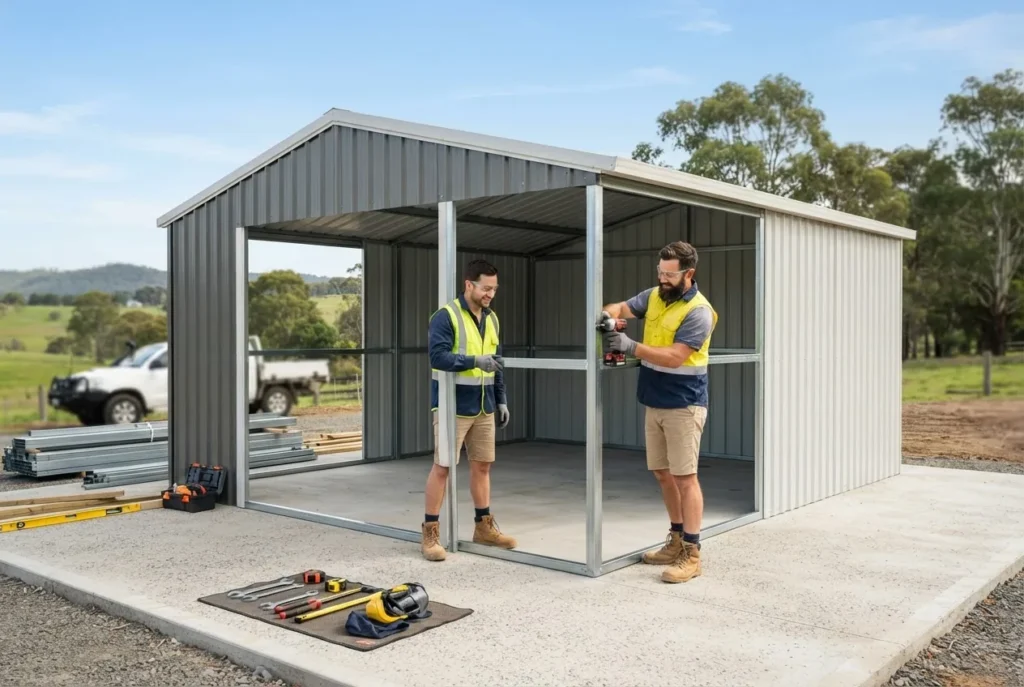
- Cost: DIY kit $9,200 + slab $7,560 + owner labour and tools = ~ $18,000 total. Time to complete: 4 weekends with two people.
- Lessons: obtain footing design for local soil and confirm permit pathway before purchase.
Images & diagrams


Warranty, standards and where to find them
Products should reference applicable Australian Standards and manufacturer warranties. Key documents:
- AS/NZS 1170.2 — Wind actions (practical implication: defines design wind pressures and region maps).
- AS/NZS 4600 — Cold‑formed steel structures (practical implication: member design and connection requirements for light steel frames).
- AS 3959 — Construction for bushfire prone areas (practical implication: BAL levels and construction requirements).
- AS 1397 — Prepainted and coated metals (practical implication: coating spec for Colorbond and Zincalume).
BlueScope Colorbond and Zincalume warranties cover paint performance and substrate corrosion for stated periods, with limitations for coastal exposure and unapproved installations. Always request a written BlueScope warranty confirmation for your build address and product grade — see BlueScope warranties for details: https://www.bluescopesteel.com.au/warranties
Conclusion & next steps
Key takeaways: choose a footprint and roof style that fits your vehicles and site, budget for slab and drainage, and commission site‑specific engineering for wind, BAL and corrosion requirements. Cyclone and coastal sites materially increase structural and fixings costs; BAL affects material choice.
Ready to proceed? Get a free site quote, download our 1‑page spec checklist or contact a local certifier for a permit pre-check. For detailed pricing and options see our custom carport pricing guide or request a free site visit.
Frequently Asked Questions
What size is a standard triple carport in Australia?
A standard triple carport footprint commonly ranges from 9 × 6 m to 10.5 × 7 m. Clear spans are typically 8.4–10.8 m with bay widths 2.8–3.6 m and eave heights 2.4–3.6 m. Choose height based on vehicle roof racks and caravan clearance requirements.
How much does a triple carport cost to install in 2025?
Installed prices in 2025 commonly run $15,000–$32,000 for metro non‑cyclonic installs, and $26,000–$45,000+ for cyclone-rated Region C/D builds. Add slab and site works ($110–$170/m²), drainage, engineering and coastal protection as required.
Do I need council approval to build a triple carport in WA?
Yes — most triple carports in WA require planning checks and a building permit lodged with a private building surveyor (BA1 certified application). Provide engineered drawings, drainage plan and product specs. Typical certified turnaround is around 10 business days once lodged by the certifier.
Which is better for Australian climates: Colorbond or Zincalume?
Colorbond offers pre‑painted colour choices and solar‑reflective options and is ideal for residential matching and heat management. Zincalume is cost‑effective and reflective. Both meet AS 1397; choose based on budget, coastal exposure and homeowner aesthetic preferences.
What roof styles are best suited for triple carports?
Skillion roofs are economical and modern, gable roofs offer ventilation and clearance, and Dutch gables provide a premium look. Consider drainage fall (min 3° for skillion), purlin spacing and streetscape/heritage requirements when selecting a style.
How do wind regions affect triple carport design and cost?
Wind regions (AS/NZS 1170.2 Regions A–D) set design pressures: Region C/D (cyclonic) requires larger members, closer purlin spacing, and stronger hold‑downs, increasing cost by 40–80%. Have an engineer confirm your region and terrain category for accurate pricing.
Can I build a triple carport myself using a DIY kit?
Yes if you are an experienced owner‑builder and the kit is engineered for your site. Confirm permit eligibility, footing design, wind rating compliance, corrosion protection and insurance. DIY saves on labour but shifts compliance and warranty risk to the owner.
What are the steps to get a building permit for a custom triple carport?
Steps: check planning overlays and setbacks, commission engineered drawings (AS/NZS 1170.2 & AS/NZS 4600), engage a private certifier or registered building surveyor for permit lodgement, provide drainage and structural certificates, and obtain final inspection/compliance certification.