
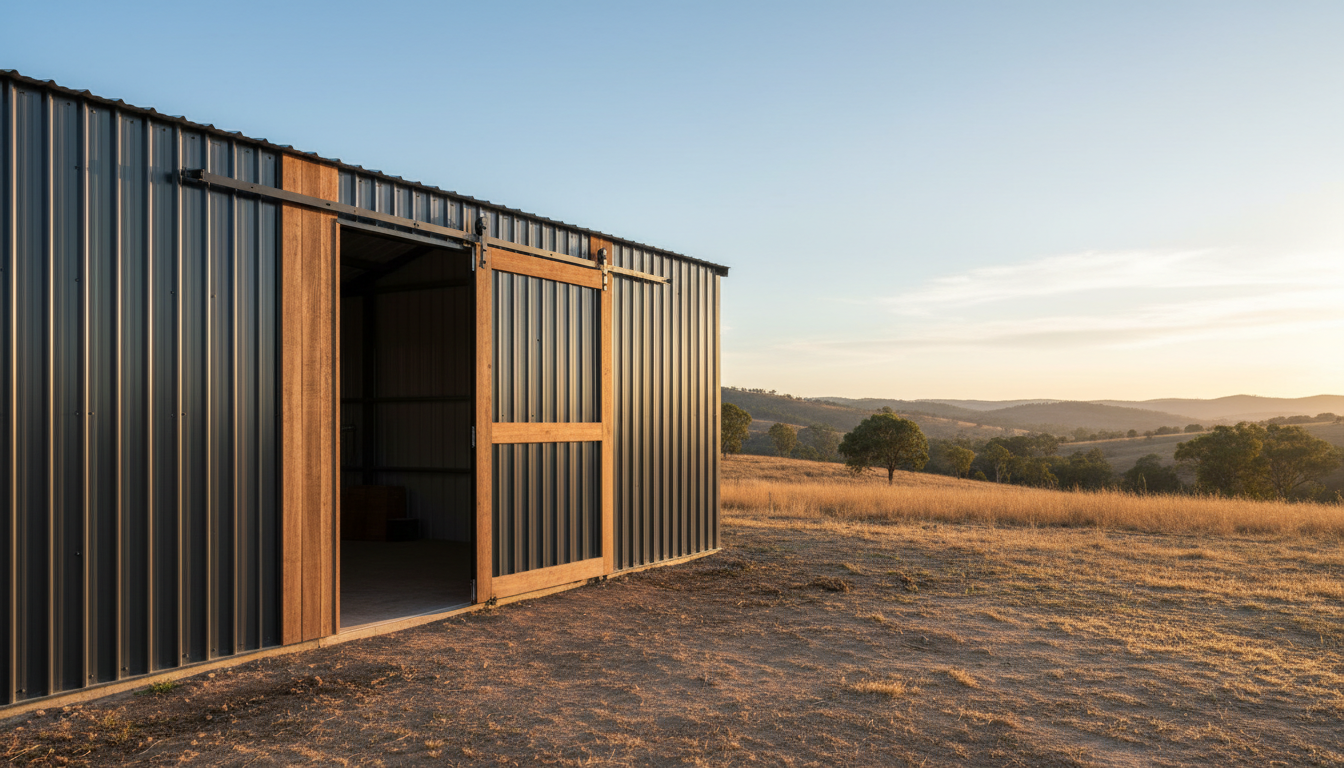

For many Australian sheds—farm machinery storage, workshop sheds, and custom Colorbond garages—nothing beats a well-engineered sliding shed door for wide, clear openings and low maintenance. This guide goes beyond the basics to cover wind-rated design, shed sliding door kits, Perth heat and coastal corrosion, and council approval steps across Australia.
Why choose a sliding shed door in Australia?
- Wide clear spans for tractors, utes, boats and caravans—often more economical than multiple roller doors.
- Fewer moving parts than roller doors; suited to rural sheds in NSW, VIC and WA where dust and debris are common.
- Low headroom requirement compared with roller doors on portal frame sheds.
- Robust in wind when correctly engineered (anti-lift, stays, guides, and bracing).
What Are the Best Shed Materials for Perth’s Climate?
Perth’s hot summers, sea breeze, and coastal corrosion zones demand smart material choices. Most premium Australian suppliers specify BlueScope steel cladding in Colorbond or Zincalume, fixed to cold-formed steel frames (C/Z purlins and girts) designed to AS/NZS standards. For coastal suburbs, consider Colorbond Ultra, marine-grade fixings, and brush seals to reduce salt ingress.
Colorbond vs Zincalume — Which Is Better for WA Conditions?
| Criterion | Colorbond (painted) | Zincalume (AZ coating) |
|---|---|---|
| Heat reflectance (light colours) | High; select lighter colours for Perth heat | Good; reflective but may heat up more |
| Coastal corrosion resistance | Colorbond Ultra recommended in severe zones | May require greater set-back; less suitable close to surf |
| Aesthetics | Wide colour range to match home/carports | Industrial look, silver-grey tone |
| Maintenance | Low; wash-down recommended in marine zones | Low; wash-down recommended |
| Cost | Typically higher | Typically lower |
| Best for | Premium steel sheds Perth, custom Colorbond garages Perth | Budget farm or workshop sheds inland |
Sliding shed door kit: what’s included and what to look for
A quality shed sliding door kit for Australian conditions should include:
- Galvanised or zinc-aluminium top track (heavy-gauge with anti-corrosion coating).
- Sealed-bearing trolleys/rollers (nylon-tyred or steel), rated for wind loads and door weight.
- Bottom guide (channel or adjustable guide post) with anti-lift hardware.
- Door stiles/rails, Colorbond or Zincalume cladding, interlocking edges.
- End stops, stay bars, wind locks/keeper plates, flush pulls and lock set.
- Brush/EPDM bulb seals, vermin flashing, threshold options.
- All fixings: Class 4 coated or 316 stainless steel near coast.
- Assembly drawings, council-ready specs, and warranty.
Typical sizes, clear opening and headroom
- Common leaf widths: 1.2–1.8 m; multi-leaf systems for 3.6–12 m openings.
- Allow 120–180 mm above the opening for track and brackets (varies by system).
- Clear opening = portal bay width minus overlaps and guide tolerances; confirm on engineering drawings.
- Consider double-track (bi-parting) doors for central clear access on wide sheds.
Tracks, rollers and seals: the details that matter
- Top-hung vs bottom-rolling: Top-hung is preferred for farm machinery storage to keep grit off tracks. Bottom-rolling suits very heavy industrial doors.
- Rollers: Sealed bearings with UV-resistant tyres reduce noise and maintenance.
- Wind resistance: Use stay bars and anti-lift brackets to prevent door derail in gusts.
- Seals: Brush seals and interlocks limit dust, water and ember entry in BAL-rated areas.
Coordinate door seals with glazing and flashing details; this Colorbond shed windows guide covers orientations, BAL screens and wind‑rated openings that complement sliding doors.
Code compliance: wind ratings, structure and bushfire
Ensure your sliding door and shed system are engineered to the National Construction Code (NCC) and relevant Australian Standards, including:
- AS/NZS 1170.2 (Wind actions) for wind region, terrain and shielding.
- AS/NZS 4600 (Cold-formed steel structures) for C/Z member design.
- AS 4100 (Steel structures) where applicable; AS 1562.1 (sheet roof/wall cladding).
- AS 3959 for BAL requirements in bushfire-prone areas.
Western Australia: wind region and terrain notes
Added 2024 WA wind-rating compliance notes Perth and the WA coast include wind Regions A–D. Geraldton, Exmouth and the Pilbara include cyclonic Regions C/D. Your sliding shed door must be checked for serviceability and ultimate wind pressures, with anti-lift and guide systems sized accordingly. For coastal Perth, specify marine-grade fixings and consider Colorbond Ultra.
Queensland: cyclone-rated design
In North QLD (cyclone Regions C/D), specify cyclone-rated sheds QLD with engineered door stays, higher track section modulus, and robust bottom guides. Avoid ground tracks that collect debris; use elevated guides with self-draining design. Confirm tie-downs and portal frame bracing for door openings.
NSW, VIC, SA: non-cyclonic but variable
Rural sheds in NSW and VIC often face high gusts in open terrain (Terrain Category 2). Ensure door leaf deflection is controlled and that purlins/girts around the opening have adequate stiffness. Consider shear wall bracing adjacent to large openings.
How to get council approval for a sliding door shed
Most councils require site-specific drawings, engineering certification, and siting approvals. If you’re aiming for council-approved sheds WA, factor in wind region mapping, setbacks, driveway access, and stormwater management. Urban lots may also need aesthetic controls (e.g., matching Colorbond colours to the main dwelling or carport).
How to Get Council Approval for Your Custom Shed in WA
- Confirm zoning and setbacks on your property’s R-Codes.
- Get site plan, slab design, portal frame and door engineering to AS/NZS 1170 and NCC.
- Nominate colours/materials (Colorbond vs Zincalume) and corrosion category treatments.
- Lodge a certified building application (BA1) or uncertified (BA2) with your local council.
- Book inspections as required (footings/slab/Final).
For national guidance, see the Housing Industry Association and Master Builders resources (industry guides and checklists):
HIA,
Master Builders Australia.
If the project is a full garage, this garage en kit overview explains approvals, wind ratings and door wind‑lock requirements across states.
Sliding vs roller vs hinged — which suits your shed?
- Sliding door: Best for wide openings, farm gates, machinery, less headroom; excellent for rural sheds and industrial sheds Brisbane.
- Roller door: Faster, good security, optional wind locks; needs more headroom and maintenance in dusty sites.
- Hinged door: Simple for small pedestrian access or garden sheds; limited width.
Installation: DIY shed kits vs professional build
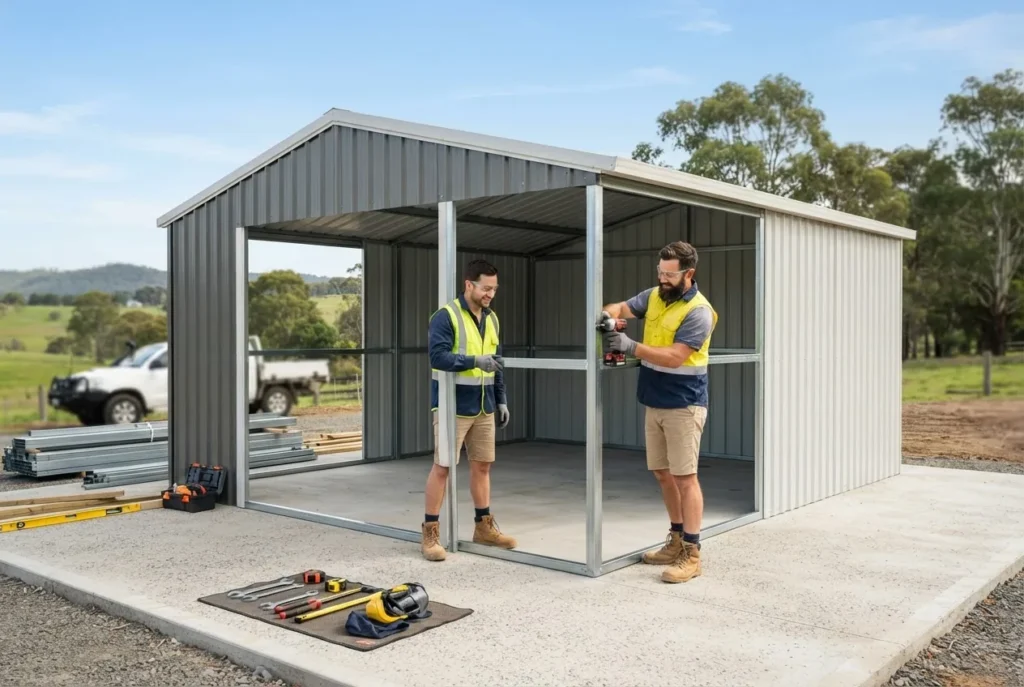
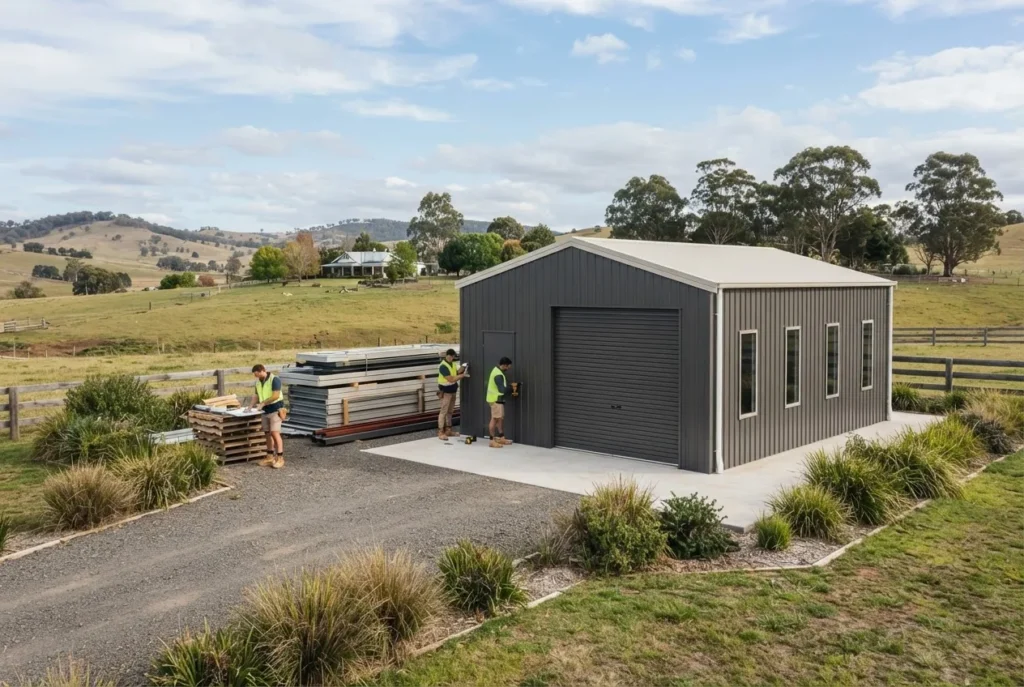
DIY shed kits with sliding doors are popular on acreages and for affordable carports for Australian homes. But heavy doors can be hazardous in wind—consider professional installers for large or cyclonic regions.
DIY overview (always follow your kit manual)
- Set-out and plumb the portal frame and jambs; verify diagonal measurements.
- Fix top track with specified fasteners (Class 4/316 near coast).
- Assemble door leaf: stiles/rails, clad with Colorbond/Zincalume; fit rollers and interlocks.
- Hang leaf, adjust roller tension and check level; install bottom guide/anti-lift.
- Add seals, end stops, lock set; test in low-wind conditions.
Safety essentials
- Never hang a door in strong winds; use temporary stays.
- Torque fixings to spec; use thread-lock where specified.
- Wear PPE; use rated lifting gear for oversized leaves.
Finish the opening right with storage shed accessories like brush seals, security hardware and lighting to keep large sliding doors practical year‑round.
Real-world examples across Australia
- Custom-built double garage in Perth: Bi-parting Colorbond sliding door, Ultra grade near coast, brush seals for sea breeze dust; insulated roof panels for heat reduction.
- Rural sheds NSW: 9 m opening with triple-leaf sliding door on top-hung track; vermin flashing to protect feed and tools.
- Cyclonic farm shed in QLD: Upgraded track section, reinforced guides and stay bars; engineer-certified to AS/NZS 1170 Region C.
5-Step Buying Guide for Custom Sheds in Australia
- Define use-case: Workshop sheds Adelaide, barn sheds Victoria, farm machinery storage, or patio enclosures Sydney.
- Choose materials: Do a Colorbond vs Zincalume comparison; pick BAL-compliant and corrosion-suitable options.
- Engineer for wind: Wind-rated sheds for cyclonic areas if in QLD/WA north; confirm terrain category and shielding.
- Door strategy: Sliding vs roller vs hinged; consider security, seals, headroom, and daily use.
- Permits & install: Prepare council pack, book slab, and select DIY vs professional crew.
Key technical tips and local context
- For coastal sites, specify marine-grade fixings and regular wash-downs per Australian Steel Institute guidance: Australian Steel Institute.
- Add roof insulation (blankets or insulated panels) for thermal comfort; see Energy.gov.au on insulation.
- Check seasonal winds with the Bureau of Meteorology when planning door orientation: BOM climate data.
- Discuss BAL with your certifier and review CSIRO bushfire research: CSIRO.
FAQs: Sliding shed doors in Australia
Are sliding doors suitable for cyclonic areas?
Yes, with engineered tracks, guides, stays and anti-lift hardware, and when the entire shed is certified for the correct wind region (C/D). Always obtain site-specific engineering.
What maintenance do they need?
Periodic wash-down, roller checks, re-tensioning of fixings, and seal inspection. In coastal zones, rinse more frequently to reduce salt build-up.
Will a sliding door keep out dust and rain?
With interlocking stiles and brush/EPDM seals, infiltration is greatly reduced. For exposed sites, consider a covered apron, sarking behind cladding, and correct flashing details.
Can I retrofit a sliding door to an existing steel shed?
Often yes, but the jambs, lintel and bracing may need upgrades. Get an engineer to assess portal frame capacity and fixings.
Pro Tip
Did you know? Using insulated roof panels can reduce internal shed temperatures by up to 10°C in summer. Pair with light Colorbond colours and ridge ventilation for best results.
Keyword clusters and related solutions
- Local builds: steel sheds Perth, custom carports Melbourne, workshop sheds Adelaide, industrial sheds Brisbane, rural sheds NSW.
- Technical: Colorbond vs Zincalume comparison, wind-rated sheds for cyclonic areas, bushfire BAL ratings, portal frame bays, C/Z purlins and girts.
- Lifestyle/usage: farm machinery storage, DIY shed kits, affordable carports for Australian homes, double garage kits, custom Colorbond garages Perth.
Planning checklist
- Wind region and terrain category confirmed (AS/NZS 1170.2).
- Corrosion category and fixings specified (marine-grade if required).
- Door clear opening, headroom, and track type selected.
- Seals, vermin flashing, and security hardware included.
- Council pack ready: site plan, engineering, colours, drainage.
References and industry context: For current market and construction trends, see the “2025 Australian Steel Market Outlook” and the “2025 HIA Outdoor Structures and Home Improvement Report.” For local compliance and weather guidance, consult HIA, Master Builders Australia, the Australian Steel Institute, BOM, CSIRO and Energy.gov.au via the links above.