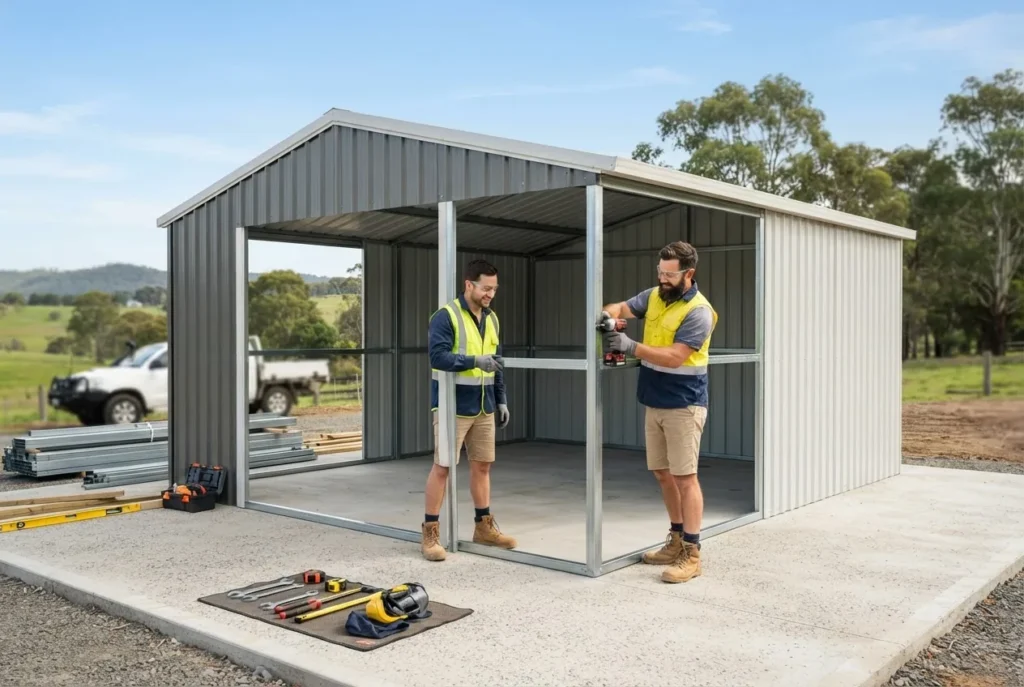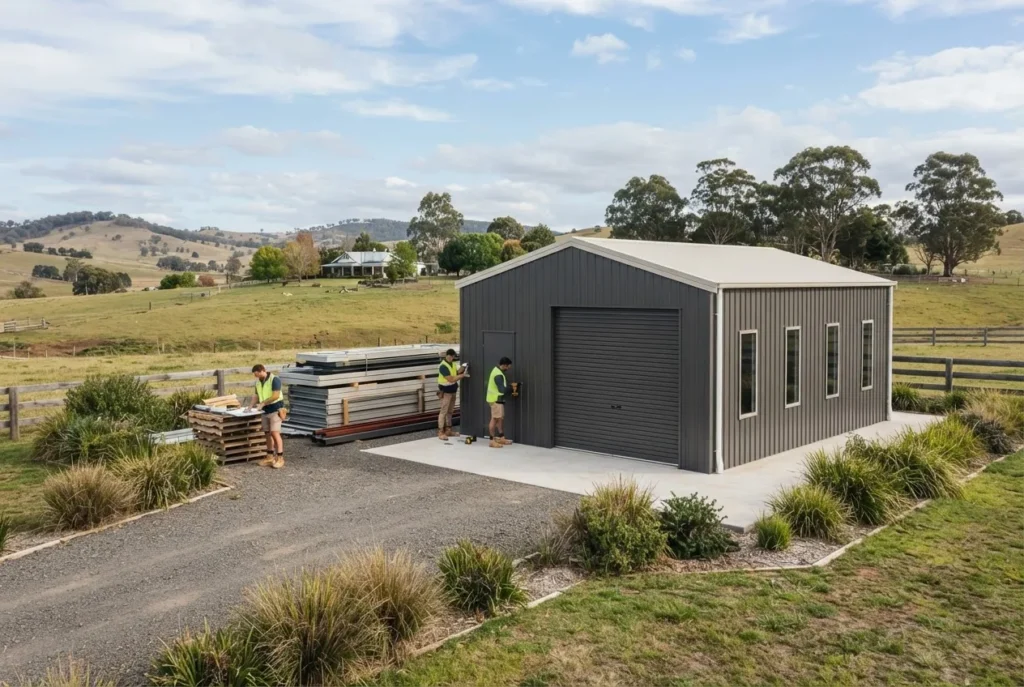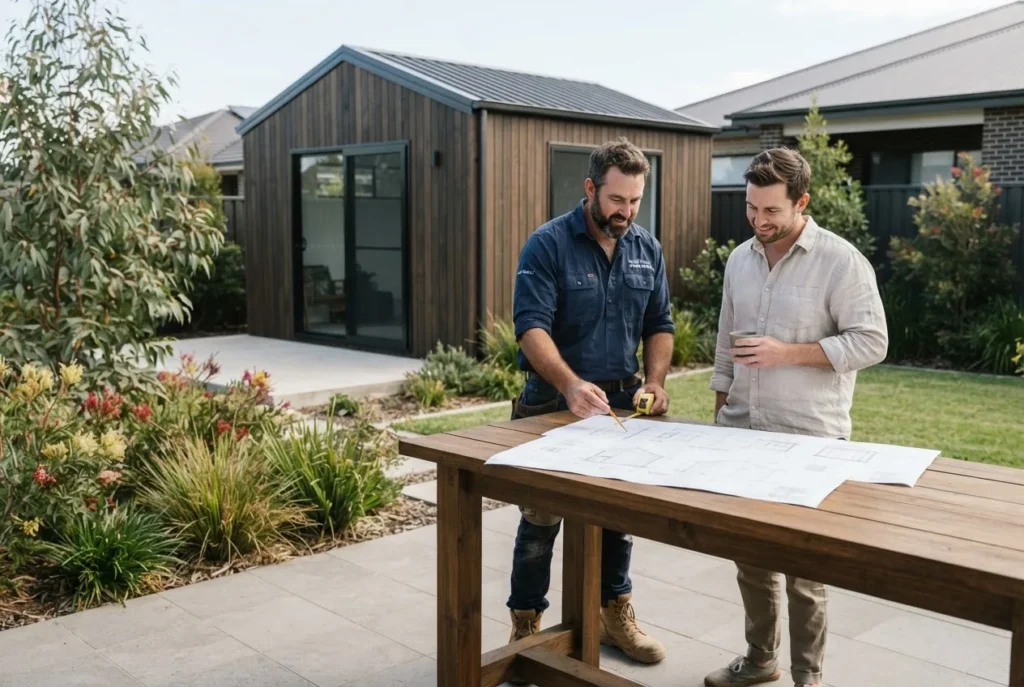

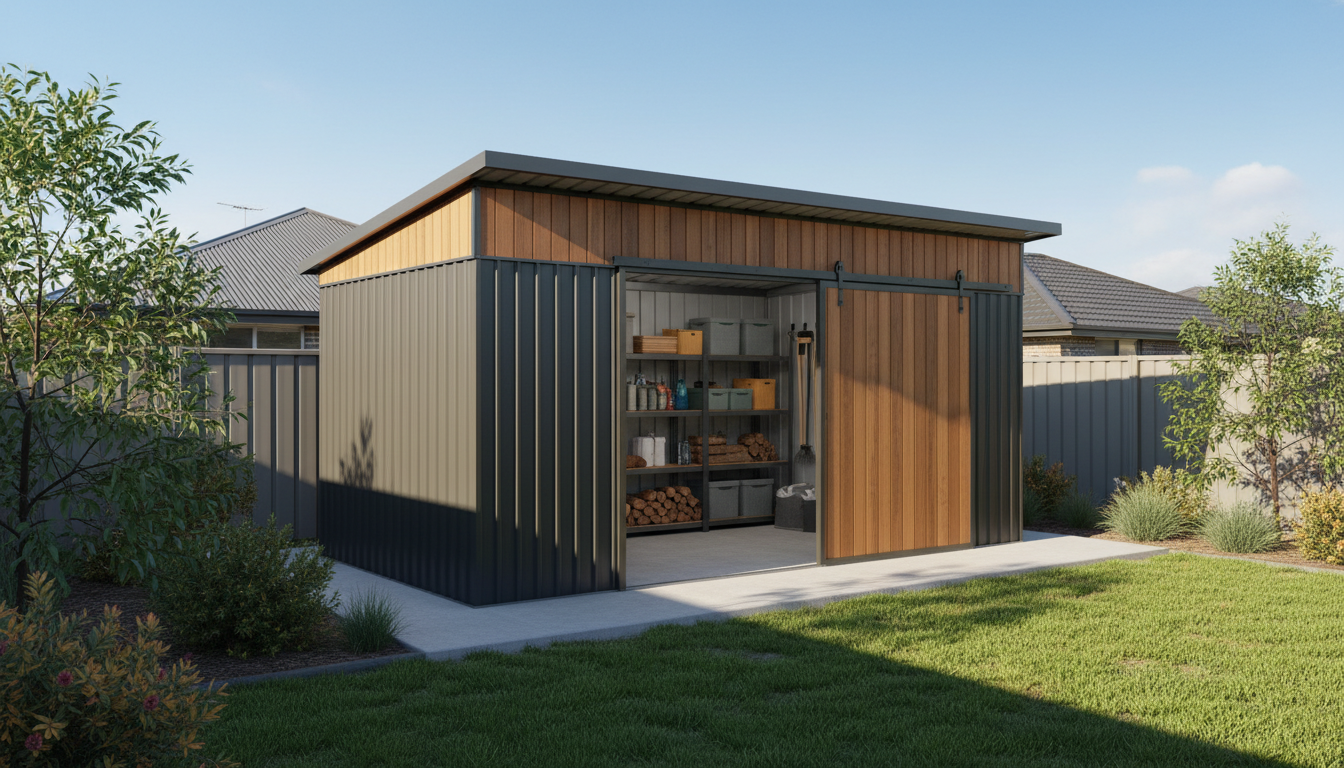

Whether you’re squeezing extra storage into a suburban lot or planning a rural shed upgrade, this guide gives you Australian-specific advice on sizes, pricing, wind ratings, materials, and council approvals. It’s built for homeowners, renovators, and property investors who want premium, long-lasting sheds.
What does a 9×12 storage shed mean in Australia?
In Aussie shed lingo, sizes are quoted in metres. The “9×12” term is often a US/imperial size:
- 9×12 feet ≈ 2.74 m x 3.66 m (about 10 m²). A handy backyard storage shed for tools, bikes, or a compact workshop.
- 12×9 feet is the same footprint flipped.
- Don’t confuse this with 12 m x 9 m (108 m²) — a large rural/industrial shed.
If you ask for a “9×12 shed” locally, clarify feet vs metres. Most Australian suppliers will propose the nearest metric equivalent (for example 3.0 m x 3.6 m).
Standard shed sizes in Australia (and what fits)
- 2.3 m x 2.3 m to 3.0 m x 3.0 m: “garden shed” range; lawn gear, bikes, shelving.
- 3.0 m x 3.6 m (≈ 9×12 ft): compact workshop; benchtop tools; fits most courtyards.
- 3.0 m x 6.0 m: single garage or long workshop; great for DIY shed kits.
- 6.0 m x 6.0 m: double garage; popular for custom Colorbond garages in Perth.
- 10 m x 6 m, 12 m x 6 m, 12 m x 8 m, 12 m x 9 m: farm machinery storage, rural sheds NSW/VIC, business storage, and big shed kits.
Tip: A “20 sqm shed” (e.g., 4 m x 5 m) is a sweet spot for storage without dominating smaller blocks and may fall under exempt development in some states (always check your council).
How much is a shed? 2025 price guide for Australia
Indicative kit-only price ranges based on leading national suppliers (actual costs vary by site, wind rating, doors, windows, and finish):
- 9×12 ft (≈ 3.0 m x 3.6 m) Colorbond garden/workshop shed: $1,400–$3,200+
- 3.0 m x 6.0 m workshop: $2,800–$5,500+
- 6.0 m x 6.0 m double garage: $9,000–$18,000+ (doors and windows can add $3k–$7k)
- 10 m x 6 m shed prices: $12,000–$23,000+
- 12 m x 6 m shed price: $14,000–$28,000+
- 12 m x 8 m shed price: $16,000–$32,000+
- 12 m x 9 m shed price: $18,000–$36,000+
- 10 m x 10 m shed price: $25,000–$45,000+
- Industrial sheds prices (portal frame): kit-only from ~$80–$150/m²; supply-and-install commonly ~$350–$900/m² depending on engineering, height, and cladding.
Indicative kit-only price ranges based on leading national suppliers (actual costs vary by site, wind rating, doors, windows, and finish). For broader national ranges and per‑size comparisons,
Installed cost drivers: slab/footings, wind region (N1–N5/C1–C4), cyclone upgrades, eave height, bay spacing, roller doors, insulation, vermin flashing, windows, and regional delivery/erection. Coastal and cyclonic specs cost more. Cyclone-rated sheds QLD will include heavier member sizes, extra hold-downs, and more fixings.
What Are the Best Shed Materials for Perth’s Climate?
Perth’s hot, dry summers and coastal air call for quality steel and coatings. Colorbond steel is standard for premium residential sheds; Zincalume is popular where budget matters. In high-corrosion coastal zones, consider upgraded paint systems and marine-grade fixings.
Colorbond vs Zincalume — Which is better for WA conditions?
| Feature | Colorbond (painted) | Zincalume (aluminium/zinc) |
|---|---|---|
| Finish & colour range | Wide Colorbond palette; premium look for homes and custom Colorbond garages Perth | Metallic silver appearance; limited aesthetic options |
| Coastal performance | Excellent with correct grade and maintenance; check marine warranty zones | Good but typically less tolerant within very close marine zones |
| Heat reflection | Choice of lighter colours can reduce heat load; pairs well with insulation | Highly reflective initially; can weather to a dull finish over time |
| Cost | Higher upfront cost | Budget-friendly |
| Best use | Residential, coastal, architectural, council-approved sheds WA | Rural/agricultural where durability and cost are key |
Pro Tip: Using insulated roof panels or blanket with sisalation can reduce internal shed temperatures by up to ~10°C in summer, cut condensation, and improve comfort.
Coastal and cyclonic notes
- Within a few hundred metres of surf, specify marine-grade Colorbond, stainless or class 4 fasteners, and diligent wash-down.
- North WA and coastal QLD require wind-rated sheds for cyclonic areas with compliant tie-down and cladding fixings.
5-Step Buying Guide for Custom Sheds in Australia
- Define use and size: Tools and bikes (≈ 3 x 3 m), small workshop (≈ 3 x 3.6 m), farm machinery storage (12 m spans), or custom carports Melbourne for driveways.
- Check planning rules: Many councils allow smaller “exempt” sheds. A 20 sqm shed may be exempt in some states with setbacks and height limits. Always confirm locally.
- Engineer to wind region: Get site wind category (N1–N5 or C1–C4). Added 2024 WA wind-rating compliance notes: Perth metro is commonly N2/N3; coastal and escarpment sites can be higher.
- Compare quotes apples-to-apples: Confirm steel grade, gauge, door sizes, inclusions (flashings, gutters, PA door), slab spec, erection, and lead time.
How to Get Council Approval for Your Custom Shed in WA
Most WA sheds need building approval unless exempt as a minor structure. You’ll typically provide site plan, elevations, structural certification, and energy/water run-off details. Coastal or bushfire-prone areas may need extra reports. For national guidance, see the HIA and your local council portal.
- Small sheds (often ≤10 m²) may be exempt with height and boundary controls.
- Rural and larger sheds require engineering to AS/NZS standards and drainage plans.
- For council-approved sheds WA, get a supplier who provides certified plans and can liaise with council.
Always verify current rules. Council thresholds and documentation differ by LGA.
Engineering, wind ratings, and codes every buyer should know
Relevant Australian Standards (specify on your quote)
- AS/NZS 1170.2: Wind actions for buildings
- AS 4100 / AS/NZS 4600: Steel structures (hot-rolled and cold-formed)
- AS 1397 & AS/NZS 2728: Steel and paint coatings (Colorbond/Zincalume performance)
- AS/NZS 1562.1: Sheet roof and wall cladding installation
- AS/NZS 3500: Plumbing (for gutters/downpipes)
Ask for a signed structural certificate. For cyclonic regions, ensure adequate sheeting screws, edge distances, and hold-downs per engineer’s details.
Case studies and build examples
- Perth metro (N2): 3.0 m x 3.6 m Colorbond storage shed with single sliding door, anti-condensation blanket, and vermin flashing. Kit + install + slab: mid-$4k to low-$6k depending on site access.
- North QLD (C2): 12 m x 9 m farm machinery storage with 3.6 m eave height, two 3.6 m roller doors, cyclone-rated fixings. Kit-only: high-$20ks to mid-$30ks; supply-and-install can exceed $60k with slab.
- Regional VIC (N3): 12 m x 6 m workshop with mezzanine bay and PA door. Kit: mid-teens; full build varies with slab thickness and fit-out.
DIY shed kits vs custom-built
- DIY shed kits: Cheapest upfront; best for small to medium sheds on level sites; ensure clear instructions and engineer’s certificate.
- Custom-built: Faster install, turnkey council pack, better for sloping sites, coastal zones, and larger spans.
FAQs
Is a 9×12 storage shed big enough for a workshop?
Yes for basic workbenches and storage. For larger tools or vehicle access, consider 3 x 6 m or 6 x 6 m.
Do I need a slab?
Small garden sheds can sit on pavers or a compacted base with anchor kits. Workshops and garages benefit from a reinforced slab designed to the shed’s loads.
Lead times in 2025?
Most backyard shed kits: 1–4 weeks. Custom rural/industrial: 4–12+ weeks including engineering and council time, subject to steel availability (Australian Steel Institute market conditions).
12×9 shed vs 12 m x 9 m?
12×9 feet is a small shed (~10 m²). 12 m x 9 m is a large structure (108 m²) suited to farm machinery storage or business use.
Which roofing profile is best?
Ribbed profiles with higher rib height perform better in high wind. In cyclonic areas, follow the engineer’s specified profile and fixing pattern.
Local climate and maintenance tips
- Coastal sites: Rinse salt regularly, specify marine-grade fasteners, and avoid trapped debris in gutters.
- Hot inland areas: Light roof colours with insulation reduce heat load; add whirlybirds or ridge vents for airflow.
- Bushfire zones: Check BAL requirements for ember protection and non-combustible construction.
Shed dimensions quick-reference
- 9×12 ft ≈ 2.74 x 3.66 m (≈10 m²)
- 12×9 ft ≈ 3.66 x 2.74 m (≈10 m²)
- 12 m x 6 m = 72 m²
- 12 m x 8 m = 96 m²
- 12 m x 9 m = 108 m²
- 10 m x 6 m = 60 m²
- 10 m x 10 m = 100 m²
Key inclusions to ask for in quotes
- Engineering for your wind region and terrain category
- Colorbond vs Zincalume specification and steel grade (per AS 1397)
- Door/roller door sizes, locks, windows, vermin and condensation control
- Gutters, downpipes, and stormwater connection
- Concrete slab design (thickness, mesh, footings) and erection costs
Useful resources and references
- Housing Industry Association (HIA) — national guidance on residential building and approvals
- Master Builders WA — local advice on approvals and contractors
- Bureau of Meteorology — cyclone regions and seasonal outlooks
- CSIRO — building science, condensation, and materials research
- Australian Steel Institute — market outlooks and steel guidance
- ABCB/NCC — building code framework used alongside AS/NZS standards
Market pricing is indicative as at 2025 and varies by brand, spec, location, and approvals. For current availability, see the “2025 Australian Steel Market Outlook” and the “2025 HIA Outdoor Structures and Home Improvement Report.”