

How much does it cost to build a shed in Australia in 2025?
Here are realistic, industry-aligned price ranges (incl. GST) for common shed types using Australian-standard steel frames and cladding.
Typical total project costs (supply, slab, install)
- Small garden shed (3×3 m): $1,800–$4,500 (kit: $900–$2,200; slab: $900–$1,500; install: $400–$900)
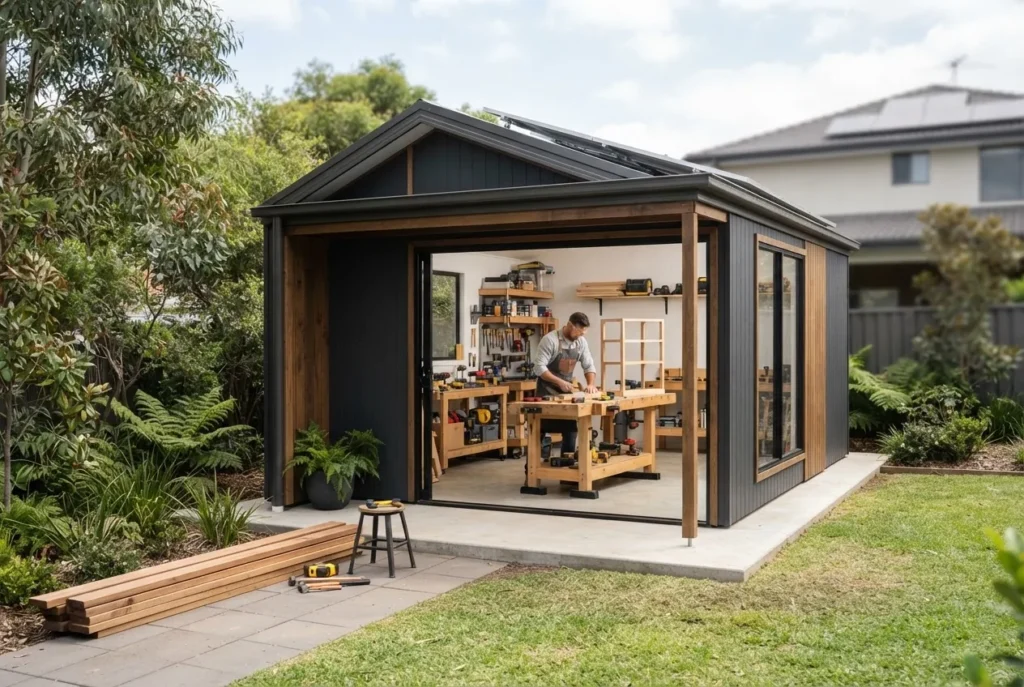
- Workshop shed (6×4 m): $11,000–$19,000 (kit: $4,500–$8,500; slab: $2,800–$3,600; install: $2,500–$5,000; doors/windows: $800–$2,000)
- Custom-built double garage in Perth (6×6 m): $18,000–$35,000 (kit, slab, install, doors, electrics). For current local ranges, see shed prices Perth.
- Rural machinery shed (12×24 m, open bays): $50,000–$120,000+ (frame/cladding kit: $28,000–$60,000; footings/slab or piers: $10,000–$35,000; build/plant: $12,000–$35,000)
Allow +10–30% for cyclone-rated sheds (Region C/D) or coastal/corrosion upgrades, and extra for complex sites, cut-and-fill, or cranage.
Class 10a buildings are non‑habitable (sheds, garages, carports). If you’re pricing liveable options, compare budgets in Shed Homes WA Prices.
Use the shed price estimator below to set a starting budget, then refine with site-specific quotes.
Quick shed cost estimator (Australia)
This simple shed cost calculator helps you ballpark your project. Multiply floor area by the relevant rate, then add options.
Base build rates (guideline ranges)
- Garden/utility sheds: $350–$700 per m² (thin kit to premium Colorbond)
- Residential garages/workshops: $500–$900 per m² (engineered steel, Colorbond)
- Rural/farm sheds: $300–$650 per m² (varies by bay spans and open/closed walls)
Add-ons and adjustments
- Concrete slab 100–125 mm: $110–$160 per m² (thicker/heavy-duty: $160–$240 per m²)
- Cyclone region (C/D): +10–30% to frame, fixings, doors
- Coastal/corrosion category C3–C4: +10–20% (Colorbond Ultra, stainless fixings)
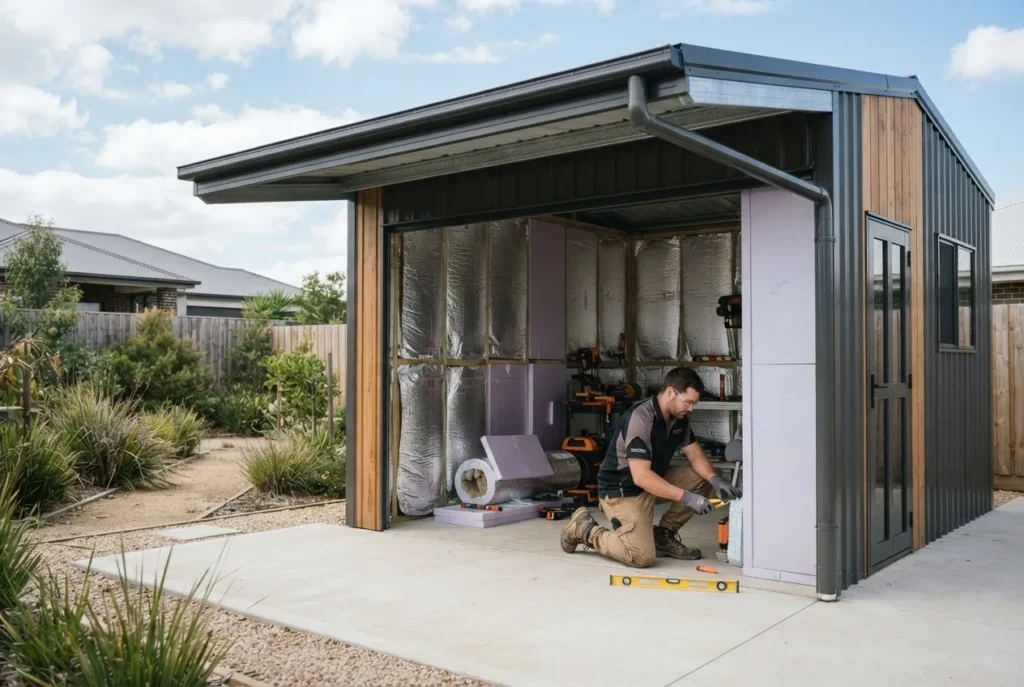
- Insulation: Foil blanket $8–$15 per m²; bulk insulation $25–$45 per m²; insulated roof panels $80–$140 per m²
- Roller doors: $900–$2,500 each (+$350–$900 for motors)
- Windows/PA doors: $300–$800 each (safety glazing may be required)
- Electrical: $1,000–$6,000+ (lights, GPOs, sub-board)
- Site works/drainage: $1,500–$8,000+ (access-dependent)
For a full quote, most builders will ask for site address (wind region), dimensions, eave height, number of bays, door/window schedule, and intended use (e.g., hoist loads).
What drives the cost of building a shed?
1) Wind region, terrain and engineering
Australian sheds must be engineered to AS/NZS 1170.2 (wind actions). WA and QLD have significant cyclonic zones; parts of the NT and North QLD are Region C/D. Taller eave heights, wider bay spans, and large roller doors all require stronger frames and hold-downs.
Added 2024 WA wind-rating compliance notes: In WA, your wind region (A, B, C, D), terrain category, and importance level (often IL2 for garages) determine tie-down design and purlin sizes. Expect additional cost for council-approved sheds WA requiring certified drawings and soil classification for footings.
2) Materials: Colorbond vs Zincalume
Colorbond is pre-painted steel ideal for premium residential and coastal-fringe settings; Zincalume is a durable aluminium/zinc coated finish with a metallic look and lower initial cost. See comparison below.
3) Slab and footings
Most garages/workshops use a 100–125 mm slab with mesh and thickened edges to AS 3600. Rural sheds may use pad footings/piers with or without a continuous slab.
4) Doors, openings, and height
Every extra roller door, increased clearance height, and wider span adds steel and bracing. Vehicle hoists or mezzanines also change engineering.
5) Site access and location
Remote/regional builds (Pilbara, Far North QLD) can add mobilisation and freight. Coastal sites may require Colorbond Ultra and stainless fixings due to higher corrosion categories.
Colorbond vs Zincalume — which is better for WA and coastal conditions?
| Feature | Colorbond | Zincalume |
|---|---|---|
| Finish | Pre-painted, wide colour range, premium look | Metallic/silver; minimalist, industrial look |
| Cost | Higher initial cost | Lower initial cost |
| Coastal performance | Use Colorbond Ultra in C3–C4 zones | May require upgrades near harsh coasts |
| Scratch visibility | Less visible due to colour coat | Scratches more noticeable |
| Heat reflectivity | Choice of Thermatech high-reflectance colours | High reflectivity inherent |
| Best for | Residential garages, custom Colorbond garages Perth, visible installs | Rural sheds NSW, farm machinery storage |
Always match product and fasteners to corrosion category and distance from surf.
Flat roof vs gable roof: cost and performance
| Aspect | Flat/Skillion | Gable |
|---|---|---|
| Cost | Generally lower (less steel, simpler build) | Higher (ridgeline, extra framing) |
| Headroom | Max height on high side only | Central headroom; better for hoists |
| Drainage | One-way fall; larger box gutters | Two sides; simpler gutters |
| Wind loads | Good if engineered; can see higher uplift on high edge | Even load distribution; common in high wind regions |
| Looks | Modern, matches skillion homes | Classic; suits suburban streetscapes |
DIY shed kits vs custom-built sheds
| Factor | DIY Shed Kits | Custom-Built (Supply & Install) |
|---|---|---|
| Upfront cost | Lower | Higher |
| Time/complexity | Weekend+ project; requires tools, know-how | Turnkey; faster and insured |
| Compliance | You manage permits and engineering | Builder manages council and certification |
| Customisation | Limited to kit options | Full custom spans, doors, heights |
| Best for | Small garden sheds Brisbane, DIY shed kits | Custom carports Melbourne, workshops, rural barns |
What are the best shed materials for Perth’s climate?
- Cladding: Colorbond steel with high solar reflectance (light colours) to reduce heat gain.
- Frame: Galvanised cold-formed steel to AS/NZS 4600; hot-dip galvanising for coastal fringe.
- Roof: High-rib profiles with anti-capillary side laps; consider insulated sandwich panels.
- Fixings: Class 4 screws; stainless near surf.
- Flashings/vents: Vermin flashing, ridge vents; add anticon blanket to limit condensation.
- Drainage: Oversize gutters, leaf-guards; plumb to soakwells per local council.
For cyclone-rated sheds QLD or North WA, specify extra hold-downs, heavier purlins, and wind-lock roller doors tested for Region C/D.
How to get council approval for your custom shed in WA
Step-by-step (typical process for Class 10a)
- Check R-Codes/local planning: Setbacks, height, and street impact. Some estates require matching Colorbond colours.
- Site plan and drawings: Provide location, slab setdowns, stormwater plan, and elevations.
- Engineering certification: Wind design to AS/NZS 1170.2; connection details; slab/footing design to AS 3600.
- Apply for a building permit: Form BA1 (certified) or BA2 (uncertified) with structural certification attached.
- Fees: Council lodgement + CTF (Construction Training Fund) levy 0.2% for works ≥ $20,000.
Timeframes vary by council; certified applications are usually faster. Similar processes apply interstate, but forms and fee names differ.
Hidden costs and how to avoid them
- Site prep: Access, tree removal, rock excavation.
- Stormwater: Soakwells/tanks, downpipe routing.
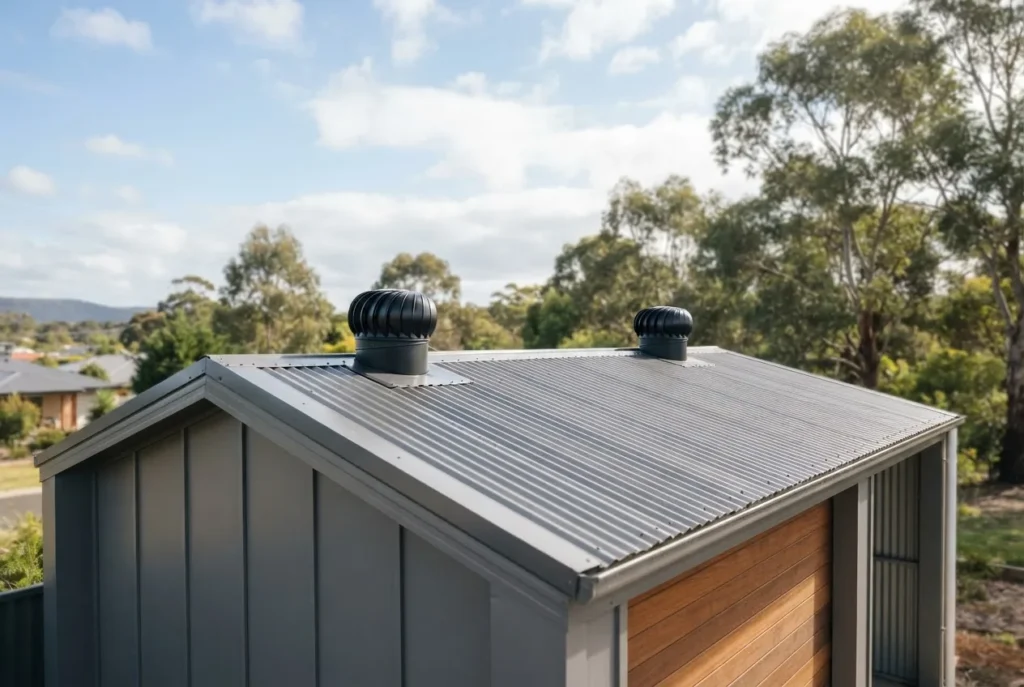
- Energy/comfort: Insulation, whirlybirds or ridge vents, fans, and lighting layout.
- BAL upgrades: Ember seals, sarking, metal screens (BAL-12.5 to BAL-40).
- Coastal corrosion: Colorbond Ultra, marine-grade fasteners.
- Security: Motorised doors, deadbolts, security lighting.
Real-world examples and budgets
1) Custom Colorbond double garage, Perth suburb
- Size: 6×7 m gable, 2.7 m eave
- Two 2.4 m roller doors (motorised), 1 PA door, 2 windows
- Colorbond Monument walls/roof, anticon blanket, 100 mm slab
- Budget: $24,000–$32,000 turnkey
2) Rural shed NSW — 12×18 m, 3 bays open, 1 bay closed
- Zincalume cladding, 4.2 m eave, gravel floor to open bays
- PA door, one 3.0 m roller, gutters to tank
- Budget: $42,000–$75,000 depending on slab area
3) Cyclone-rated shed QLD (Region C), 9×7 m
- Heavier frame, wind-lock roller door, upgraded fixings
- Budget uplift: +15–30% vs Region A equivalent
5-step buying guide for custom sheds in Australia
- Define use: Car storage, workshop, farm machinery storage, home gym, or boat.
- Lock in size and height: Check vehicle clearances and door widths early.
- Pick materials: Colorbond vs Zincalume; insulation; corrosion upgrades if coastal.
- Confirm compliance: Wind region, BAL, setbacks, stormwater, council-approved sheds WA or your state equivalent.
- Get 2–3 quotes: Ask for engineered drawings, inclusions list, lead time, and warranty.
FAQ: shed price estimator and common questions
How much does it cost to build a garden shed?
Basic kits start from a few hundred dollars; premium Colorbond garden sheds fully installed with a slab are usually $1,800–$4,500 depending on size and site.
How much do sheds cost for a home workshop?
Most 6×4–6×6 m workshops land between $11,000–$35,000 fully built. Add for insulation, power and motorised doors.
Do I need a concrete slab?
For garages and hoists, yes. For small storage or rural open bays, you can use compacted gravel or partial slabs, but check engineering and council requirements.
What permits are required?
Usually a building permit for Class 10a, engineered drawings, and a site plan. Some small sheds below certain sizes may be exempt from planning, but still require building approval. Always confirm with your local council.
Is Colorbond worth it over Zincalume?
For visible residential installs, yes—better aesthetics, colour choice, and often resale value. Zincalume suits budget or rural applications.
What about warranty?
Cladding warranties vary by brand/environment (often 10–20+ years). Frames and workmanship warranties vary by builder; ask for written terms.
Local compliance, standards and climate considerations
- Wind loads: AS/NZS 1170.2; cyclonic design for Regions C/D.
- Steel design: AS/NZS 4600; structural steel AS 4100.
- Roofing/install: AS 1562.1; fasteners per environment class.
- Concrete: AS 3600; slabs per soil classification.
- NCC 2022+: Class 10a requirements; BAL where applicable.
Consider local weather: Perth heat and sea breeze (glare and corrosion), Sydney storm events, Brisbane humidity/cyclones, Adelaide heat shifts, and Tas/VIC cold and condensation risk.
Get a precise shed quote
Ready to price your project? Use a shed quote calculator or request an itemised proposal with:
- Dimensions, eave height, roof type (gable/skillion)
- Cladding (Colorbond vs Zincalume), insulation, doors/windows
- Site address for wind-rated sheds and BAL checks
- Slab requirements and drainage plan
We supply and install steel sheds Perth, custom carports Melbourne, and rural sheds NSW with council-ready drawings and engineering.