
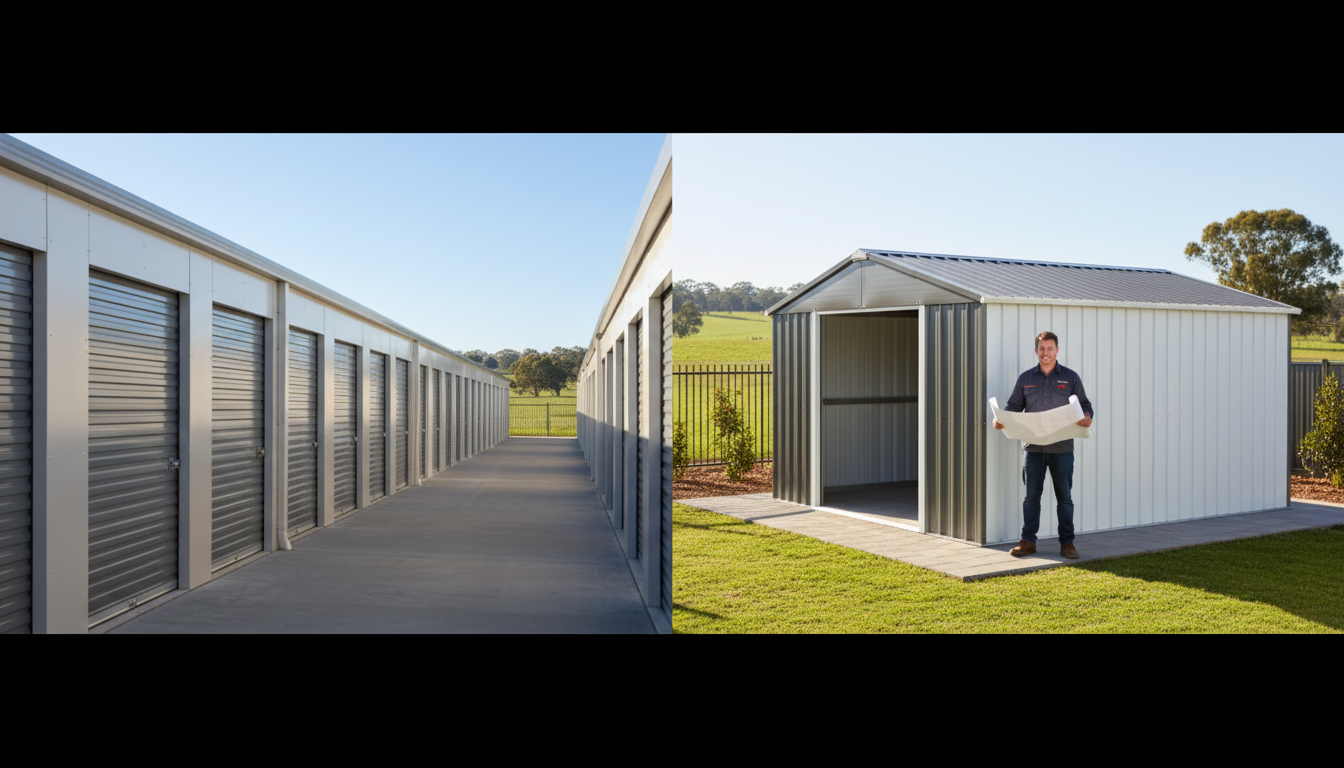

If you’re searching for the cost of storage units, you’re likely weighing monthly self storage prices against building a long‑term solution at home. This guide compares storage unit rates across Australia with the real cost of a premium Colorbond steel shed or custom carport, including council approvals, wind ratings, and climate considerations for Perth, QLD cyclonic regions, and beyond.
How much does a storage unit cost per month in Australia (2025)?
Prices vary by city, unit size, and features. Here’s what Australians are paying in 2024–2025 for self storage units prices (typical ranges):
| Unit size (approx.) | Common name | Typical monthly cost | Use case |
|---|---|---|---|
| 1–2 m² | Storage locker / mini storage | $50–$120 | Documents, small boxes |
| 3 m² | Small unit | $120–$220 | Apartment overflow |
| 6–9 m² | Medium unit | $220–$450 | 1–2 bedroom move |
| 10–15 m² | Large unit | $350–$650 | 3 bedroom home contents |
| 18–27 m² | Extra‑large / single garage size | $550–$1,000 | Vehicle or full house |
Capital cities trend higher (Sydney/Melbourne/Brisbane), with Perth and Adelaide often mid‑range. Regional towns can be 10–20% cheaper. Climate control usually adds 15–25% to storage room rates.
What drives self storage prices?
- Location and demand (CBD and inner suburbs cost more)
- Size/height, ground floor vs lift access
- Climate control and 24/7 access
- Promotions vs ongoing self storage rates
- Insurance and security level (CCTV, patrols)
Common add‑on fees to watch
- Admin fee or deposit: $15–$50
- Padlock: $15–$30
- Insurance: typically $1.50–$3.00 per $1,000 cover per month
- Late payment or exit notice fees
How much does it cost to build storage at home (Colorbond shed or carport)?
For many homeowners and investors, a well‑designed Colorbond steel shed or custom Colorbond garage can outperform ongoing storage space cost. Below are typical 2024–2025 supply and installed ranges using quality Australian steel for common sizes.
| Structure | Typical size | Supply only (kit) | Installed incl. slab and approvals |
|---|---|---|---|
| Garden/utility shed | 3 m x 3 m | $1,800–$3,500 | $4,500–$7,500 |
| Single garage | 3.5 m x 6 m | $4,500–$8,500 | $10,000–$18,000 |
| Double garage | 6 m x 6 m | $6,500–$12,000 | $14,000–$28,000 |
| Rural shed (open bay) | 9 m x 7 m | $12,000–$25,000 | $28,000–$55,000 |
| Carport (single/double) | 3 m x 6 m / 6 m x 6 m | $2,500–$6,500 | $5,500–$12,500 |
Options that add cost but improve performance and value:
- Insulated roof panels or anti‑condensation blanket
- Extra height, wider bays, mezzanine storage
- Roller doors (manual/motorised), windows, PA doors
- Electrical, lighting, whirlybirds, solar pre‑wire
- Upgrading to wind‑rated sheds for cyclonic areas
Case study: custom-built double garage in Perth vs renting
A homeowner compares a custom Colorbond garage in Perth (6×6 m, insulated roof, motorised door) at $22,000 installed to a 18–20 m² self storage unit at $650/month.
- Self storage: $650 x 60 months ≈ $39,000
- Built shed: ~$22,000 (once), adds property value and convenience
- Break‑even: ~34 months vs how much is a storage unit per month over the long term
Storage unit vs steel shed: total cost of ownership
| Factor | Self storage | Colorbond shed at home |
|---|---|---|
| Upfront cost | Low (bond/lock/admin) | Medium–High (kit, slab, install) |
| Monthly outgoings | Ongoing rent + insurance | Minimal (insurance/maintenance) |
| Convenience | Travel, limited hours unless 24/7 | On‑site, anytime access |
| Control & value | No capital value | Adds property value; flexible use |
| Climate/security | Varies by facility | Specify insulation, locks, cameras |
For homeowners asking “how much does storage cost long‑term?”, the tipping point is often 2.5–5 years. If you’ll need space beyond 24–36 months, owning a shed usually wins on total value.
What are the best shed materials for Perth’s climate?
Perth heat, coastal air, and afternoon sea breezes challenge cheap imports. Choose Australian steel and coatings designed for UV and corrosion resistance.
Colorbond vs Zincalume — Which is better for WA conditions?
| Feature | Colorbond | Zincalume |
|---|---|---|
| Finish | Pre‑painted colour top coat | Galvalume (zinc/aluminium) metallic |
| UV resistance | Excellent (Perth summers) | Very good, but can reflect glare |
| Coastal performance | Strong; check salt spray distance | Strong; similar coastal cautions |
| Aesthetics | Wide colour range, premium look | Industrial look, lower cost |
| Price | $$ | $ |
Wind ratings, NCC and Australian Standards you should know
Quality steel sheds Perth, rural sheds NSW, and cyclone‑rated sheds QLD must be engineered to Australian Standards and the NCC 2022.
- AS/NZS 1170.2 Wind actions: Wind Regions A–D, terrain category, shielding, importance level
- AS/NZS 4600: Cold‑formed steel design (typical shed frames)
- AS 4100: Steel structures (where applicable)
- NCC 2022: Structural and site requirements
- AS 3959: Bushfire (BAL) where relevant
Added 2024 WA wind-rating compliance notes: Most of Perth is Region A, but coastal and ridge sites can increase design pressures. Always supply the exact address, terrain category, and required importance level to your shed engineer.
How to get council approval for your custom shed in WA
- Confirm zoning and R‑Codes setbacks with your local council planning team.
- Engage an engineer for site‑specific wind-rated drawings (AS/NZS 1170.2).
- Prepare a site plan, elevations, and stormwater plan.
- Lodge a Building Permit (BA1/BA2). Allow 10–25 business days.
- Book footing and slab inspections if required, then final Occupancy/BA7.
We often deliver council-approved sheds WA as a turnkey service to save time.
Regional factors: Perth heat, QLD cyclones, coastal corrosion
- Perth: Prioritise insulation, lighter roof colours, and ventilation to handle 35–40°C spells.
- QLD north: Choose cyclone-rated sheds QLD with upgraded hold‑downs, purlin spacing, and door wind locks.
- Coastal areas: Consider marine‑grade fasteners and increased maintenance intervals.
DIY shed kits vs custom-built install
| Aspect | DIY shed kits | Custom-built |
|---|---|---|
| Cost | Lower upfront | Higher but turnkey |
| Time | Weekends over 2–4+ weeks | Professional crew: 1–5 days |
| Approvals | You manage | Builder manages |
| Quality control | Depends on your skills | Certified installers, warranties |
5‑Step Buying Guide for Custom Sheds in Australia
- Define use and size: storage, workshop, farm machinery storage, boat/caravan.
- Confirm site constraints: services, setbacks, driveway widths, slope.
- Pick spec: Colorbond vs Zincalume comparison, roof style (skillion, gable), insulation, door types.
- Engineering and compliance: wind region, BAL, slab design, council-approved sheds WA or your state.
- Compare quotes apples‑to‑apples: steel grade, sheet thickness, inclusions, self storage unit rates vs TCO.
When renting a storage unit makes sense
- Short‑term (renovation or move) under 6–12 months
- No space or no approvals possible at home
- Climate‑critical archive storage with monitored facilities
Keyword clusters and use‑cases we design for
- Residential: affordable carports for Australian homes, patio additions, custom carports Melbourne, custom Colorbond garages Perth
- Rural: Machinery and hay sheds, shearing sheds, rural sheds NSW, wind‑rated coastal barns
- Commercial: Warehousing bays, workshop sheds, mezzanine storage, trade depots
- Recreation: Boat/caravan covers, hobby workshops, home gyms
FAQs: storage prices and sheds in Australia
How much are storage units per month?
From ~$50/month for a locker to $550–$1,000/month for single‑garage‑sized units in major cities. Promotions may reduce the first 1–2 months of pricing for storage but check the ongoing rate.
How much is self storage per month vs building a shed?
Self storage costs can exceed $400/month for medium units. A 6×6 m shed installed at $18k–$26k breaks even against $400–$650/month storage in roughly 2.5–5 years.
How much does a storage shed cost to build?
From ~$4,500–$7,500 installed for a 3×3 m, ~$14k–$28k for a 6×6 m double garage, and $28k–$55k for larger rural sheds, depending on spec and location.
How much does a storage locker cost?
Expect $50–$120/month depending on suburb, facility, and access.
Are sheds council‑approved and safe?
Yes—when engineered to AS/NZS standards, installed on a compliant slab, and approved by your council. Add alarms, quality locks, and cameras for extra security.
Local compliance and references
- Housing Industry Association (HIA) — policy and market outlooks
- Master Builders Australia — building guidance
- Australian Steel Institute — steel design resources
- Bureau of Meteorology — wind regions and climate data
- energy.gov.au — insulation and heat management
Industry context: “2025 Australian Steel Market Outlook”, “2025 HIA Outdoor Structures and Home Improvement Report”, and CSIRO research on heat resilience inform specifications for WA and QLD climates.
Next steps: get a tailored quote
Whether you’re upgrading steel sheds Perth, adding a carport in Melbourne, or extending rural sheds NSW, we design, engineer, and install to Australian Standards with local wind ratings. Ask about custom Colorbond garages Perth and turnkey approvals to reduce delays.
Pricing is indicative for 2024–2025 and varies by site, specification, engineering, and market conditions. Always obtain a fixed quote and confirm council requirements.