

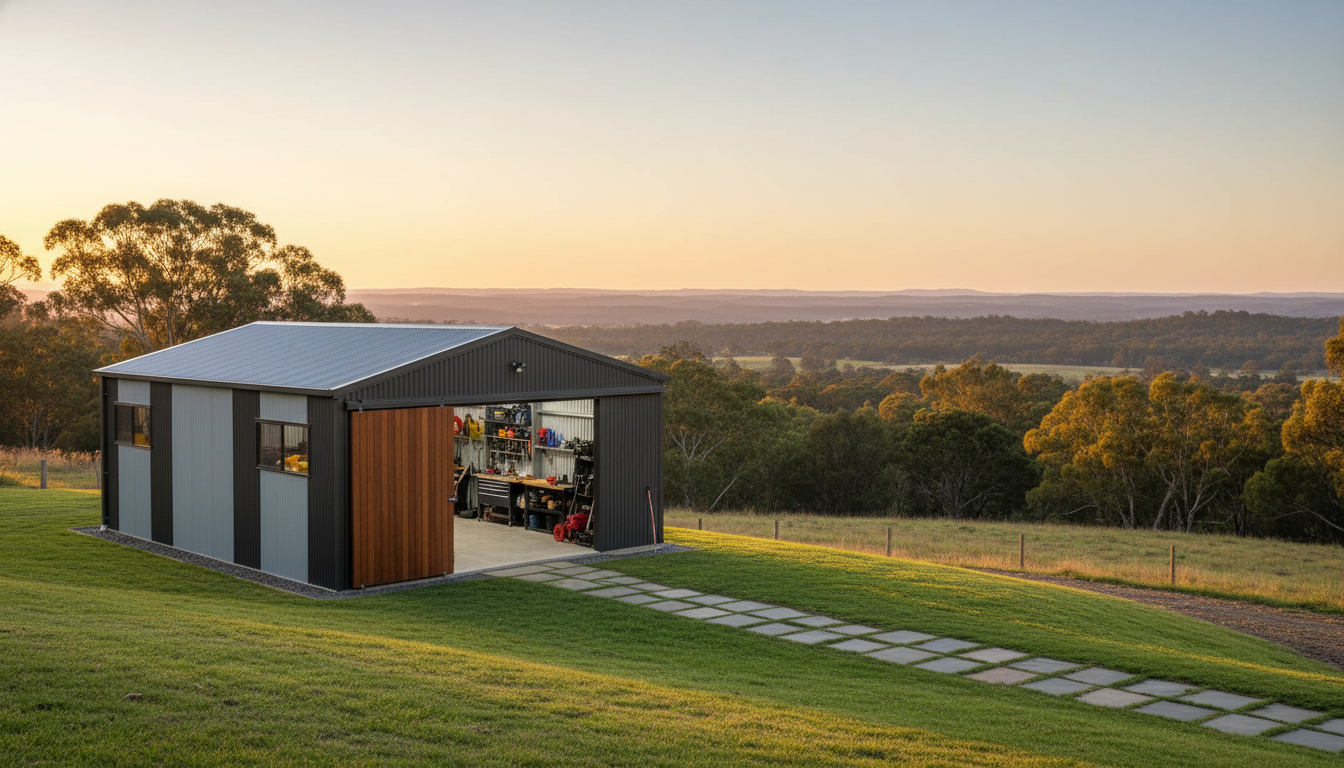

Whether you’re a Perth homeowner pricing a custom-built double garage, a NSW grazier planning farm machinery storage, or a QLD investor needing a cyclone-rated shed, this guide distils what top-ranking Australian suppliers cover—plus the critical details many miss.
What do Aussies mean by a “fairdinkum shed”?
Colloquially, a “fairdinkum shed” means a proper, no-nonsense, heavy-duty Colorbond steel shed. It’s also a well-known brand category in Australia. This guide is brand-neutral and helps you compare any fairdinkum shed against custom alternatives across steel sheds Perth, rural sheds NSW, custom carports Melbourne, and garage kits Brisbane.
- BMT: Base Metal Thickness (e.g., 0.42 BMT sheeting). Thicker generally means tougher.
- Girts & Purlins: Horizontal members that stiffen walls/roof, often cold-formed C/Z sections to AS/NZS 4600.
- BAL: Bushfire Attack Level (e.g., BAL-29) influencing cladding, ember sealing and flashing requirements.
- Wind Region: AS/NZS 1170.2 wind zones (A, B, C, D). Region C/D = cyclonic design (common in coastal QLD, WA northwest).
Fairdinkum shed price list (2025): realistic ranges
There’s no single “fair dinkum sheds price list” because pricing varies by span, height, wind region, footing design, Colorbond vs Zincalume, doors/windows, insulation, and whether it’s DIY or turnkey. Use these 2025 ballpark ranges (incl. GST, ex-slab/siteworks unless noted) to anchor quotes:
- Garden shed 3×3 m DIY kit: $1,500–$4,000
- Single garage 6×3 m kit: $8,000–$14,000 (installed: $14,000–$22,000)
- Double garage 6×6 m kit: $13,000–$24,000 (installed: $22,000–$36,000)
- Custom Colorbond garages Perth (6×7–7×9 m, 2.7–3.0 m eave): $28,000–$55,000 turnkey
- Rural machinery shed NSW (12×6 m open front, 3.6 m eave): $24,000–$55,000 (add bays/height as needed)
- Hay shed 18×9 m, 4.5 m eave: $45,000–$90,000
- Industrial workshop Adelaide (12×15 m, 4.2 m eave, enclosed): $95,000–$180,000
- Single carport kit: $3,500–$6,500; Double carport kit: $5,500–$13,000
Note: Cyclonic and coastal sites often add 15–40% for heavier frames, hold-downs and engineering. Concrete slabs and earthworks can add $120–$220/m² depending on site class and access.
How to read “price lists” and compare apples with apples
- Confirm wind rating to AS/NZS 1170.2 (Region, Terrain, Shielding) and Importance Level.
- Ask for BMT and frame section sizes; “0.42 BMT roof, 0.35 BMT wall” is common, but 0.48 BMT roof is better in high wind or snow.
- Clarify inclusions: vermin-proofing, sarking, insulation, gutters/downpipes, flashings, footings, and stormwater.
- Check doors: branded roller doors (wind-locked for Region C/D), motorisation, wicket doors with proper seals.
Fair dinkum sheds reviews: what actually matters
Online reviews can be mixed for any national shed brand. Focus on:
- Engineering & paperwork: Site-specific drawings, Form 15/16 or equivalent certifications (state-based), and council-approved sheds WA with R-Code setbacks noted.
- Lead times & logistics: National steel supply fluctuates (see “2025 Australian Steel Market Outlook”). Ask for realistic delivery windows.
- Install quality: Slab flatness tolerance, straightness of frames, door squareness, and proper cyclone hold-downs.
- After-sales: Warranty registration for BlueScope Colorbond/Zincalume and door/ motor suppliers.
What are the best shed materials for Perth’s climate?
Perth’s hot summers, coastal salt, and afternoon sea breeze call for heat-reflective roofing, anti-corrosion detailing, and solid ventilation. Here’s the core spec for premium steel sheds Perth:
- Roofing: Colorbond in lighter colours (e.g., Surfmist) with 0.42–0.48 BMT, anti-condenstation blanket or PIR insulated roof panels.
- Walls: Colorbond or Zincalume 0.35–0.42 BMT; consider Colorbond Ultra within 200–400 m of surf coasts.
- Frame: Galvanised cold-formed steel to AS/NZS 4600; hot-dip galvanised base plates and chemset anchors for durability.
- Flashings & seals: Quality flashings, sarking, and vermin-proofing to reduce dust and ember ingress (BAL-aware design).
Colorbond vs Zincalume — Which is better for WA conditions?
| Feature | Colorbond (incl. Ultra/Metallic) | Zincalume |
|---|---|---|
| Corrosion resistance (coastal) | Excellent with Colorbond Ultra near marine exposures | Good, but less suited within close coastal bands |
| Heat & energy | Lighter colours reflect heat; Thermatech tech can reduce heat gain | Highly reflective when new; dulls over time |
| Aesthetics | Large colour range, blends with new builds | Classic steel look, often cheaper |
| Cost | Higher | Lower |
| Best use | Residential garages, coastal projects, premium finish | Rural interiors/backs, budget-conscious utility areas |
Design choices that impact cost, durability and comfort
- Roof form: Skillion roofs are modern and cost-effective; gable roofs suit larger spans and water runoff. Higher roof pitch helps hot air escape.
- Open vs enclosed bays: Open-front rural sheds cut cost per m² and are ideal for tractors and farm machinery storage.
- Doors: Wind-locked roller doors in Region C/D; add lintel support for wide openings.
- Drainage: Box gutters or eave gutters with compliant overflow, downpipes to lawful point of discharge.
- Electrics & solar: Pre-plan submains, lighting, and roof tie-down points for PV arrays.
Wind ratings and compliance that protect your investment
Australian sheds must be engineered to AS/NZS 1170.2 (wind actions) and designed/fabricated to AS/NZS 4600 (cold-formed steel) and AS 4100 (steel structures). In practical terms:
- Non-cyclonic (Region A/B): Most of VIC, SA, inland NSW. Standard tie-downs and 0.42 BMT roofing often suffice.
- Cyclonic (Region C/D): Coastal QLD and WA northwest require cyclone-rated sheds QLD and WA with heavier frames, extra bracing, cyclonic roller doors, and upgraded hold-downs.
- BAL & ember protection: In bushfire areas, consider ember seals, metal flyscreens, and enclosed eaves. Check local planning overlays.
Added 2024 WA wind-rating compliance notes: Many Perth councils ask for a wind classification (e.g., N2/N3 or C1/C2), footing detail, wall heights, and site plan backed by an engineer’s certificate.
How to get council approval for your custom shed in WA
- Confirm planning: Check lot setbacks, easements and R-Codes; corner lots need sightline clearances.
- Engineering: Obtain site-specific drawings certified by a WA structural engineer.
- Building permit: Lodge BA2/BA3 with certificate of design compliance (CDC) where required.
- Stormwater: Provide roof area calc, gutter/downpipe sizing and discharge plan.
- Inspection: Footing/slab and final inspections as scheduled by your permit authority.
DIY shed kits vs custom-built: what’s right for you?
- DIY shed kits: Best for straightforward garden sheds or simple garages. Save on labour; allocate budget for slab, crane, and fixings. Ensure safe lifting and fall protection.
- Custom-built: Faster, cleaner and fully warrantied. Recommended for custom Colorbond garages Perth, council-approved sheds WA, and wind-rated sheds for cyclonic areas.
Case studies: real Australian builds
Perth: custom-built double garage
- Spec: 7×7 m gable, 2.7 m eave, Colorbond Surfmist roof/walls, 0.48 BMT roof, 2× wind-locked doors.
- Why it worked: High reflectance roof + insulation cut summer heat; engineered to N3 with robust hold-downs.
- Budget: $38–$46k turnkey incl. slab and power trenching.
Central NSW: rural machinery shed
- Spec: 15×6 m, 3-bay open front, 4.2 m eave, Zincalume walls, Colorbond roof, bird-proof purlins.
- Outcome: Low-maintenance farm machinery storage with great drive-through access.
- Budget: $55–$70k supplied and erected (ex-earthworks).
North QLD: cyclone-rated workshop
- Spec: 9×9 m enclosed, Region C, cyclonic doors, extra bracing, heavier base plates and anchors.
- Outcome: Fully certified cyclone-rated shed QLD that passed council easily.
- Budget: $75–$110k turnkey, driven by wind design and logistics.
5-step buying guide for custom sheds in Australia
- Define use: Garage, workshop, farm storage, or affordable carports for Australian homes. Span/height follows use.
- Lock wind/BAL: Get your wind region and BAL from council or an engineer early.
- Choose materials: Do a Colorbond vs Zincalume comparison; specify BMT and frame sections.
- Get comparable quotes: Same dimensions, doors, insulation, gutters, and engineering notes across suppliers.
- Plan install: Slab spec, site access, power, stormwater, final certificates and warranties.
FAQs
Is there an official “fair dinkum sheds price list”?
Most suppliers provide quote-based pricing due to site-specific engineering and inclusions. Use the ranges above to budget, then request a like-for-like written quote.
How long do sheds take in 2025?
Typical lead times: 4–10 weeks for kit supply; 8–16+ weeks for supply-and-erect depending on council and slab timing. National steel availability may affect schedules.
What slab do I need?
Common slabs are 100–120 mm with mesh over compacted base, thickened edge beams, and dowelled control joints. Engineer to site class (e.g., Class M-P) and wind actions.
Can I add solar?
Yes. Confirm purlin spacing, roof profile (e.g., Trimdek/Monoclad), and tie-down capacity. Allow conduits and isolator locations per AS/NZS 5033.
What warranties apply?
BlueScope warranties for Colorbond/Zincalume (registration required), door/motor warranties, and builder workmanship warranties. Keep maintenance logs to protect coverage.
Local codes, climate and research
- Bureau of Meteorology climate data for heat, wind and rainfall design.
- Housing Industry Association (HIA) guidance on permits and building market updates.
- Australian Steel Institute for best-practice steel design and durability.
- CSIRO research on bushfire/BAL and condensation in metal buildings.
- Energy.gov.au on cool roofs, insulation and energy performance.
Also reference NCC 2022, AS/NZS 1170.2 (wind), AS/NZS 4600 (cold-formed steel), and local council guidelines for shed approvals.
Keyword clusters to help plan your project
- Location: steel sheds Perth, shed builders Sydney, custom carports Melbourne, industrial workshops Adelaide, rural sheds NSW.
- Technical: Colorbond vs Zincalume comparison, wind-rated sheds for cyclonic areas, insulated panel roofing, vermin-proofing, sarking, coastal corrosion protection.
- Use cases: custom Colorbond garages Perth, DIY shed kits, farm machinery storage, affordable carports for Australian homes, American barns and hay sheds.
Market context: The 2025 HIA Outdoor Structures and Home Improvement Report indicates continued demand for detached steel structures, while the 2025 Australian Steel Market Outlook notes stable but specification-driven pricing. Always obtain a site-specific engineered design and written quote.