

Looking for a durable, council-ready hay shed that protects your bales and machinery? This expert guide covers hay shed prices and kit costs, Colorbond vs Zincalume, WA wind ratings, cyclone design for QLD, engineering, and step-by-step council approvals—plus real build examples across Australia.
What is a hay shed?
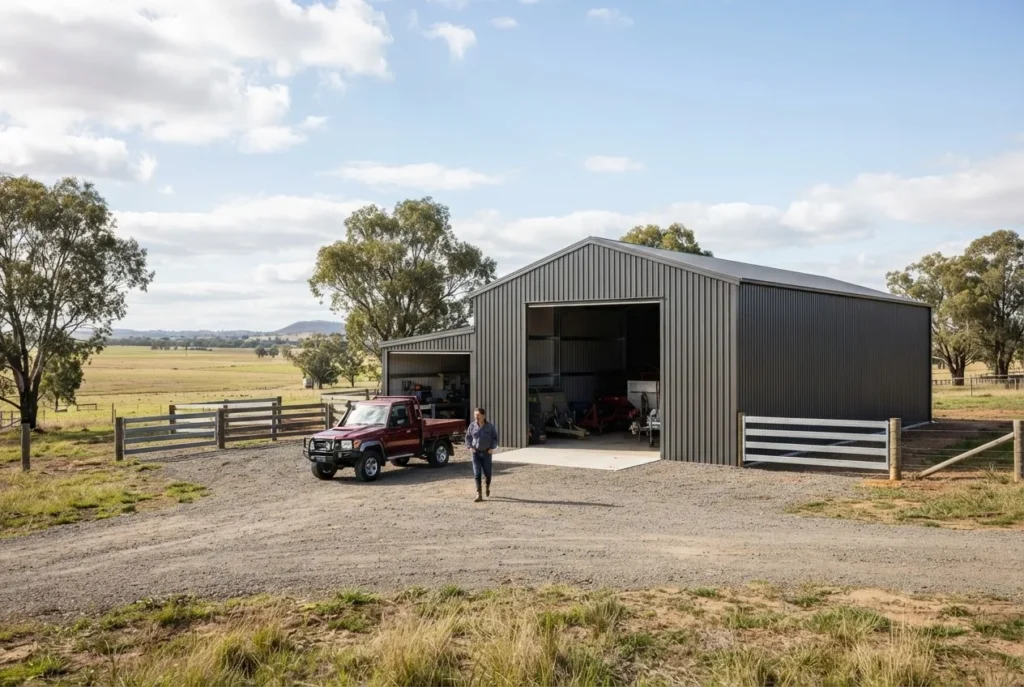
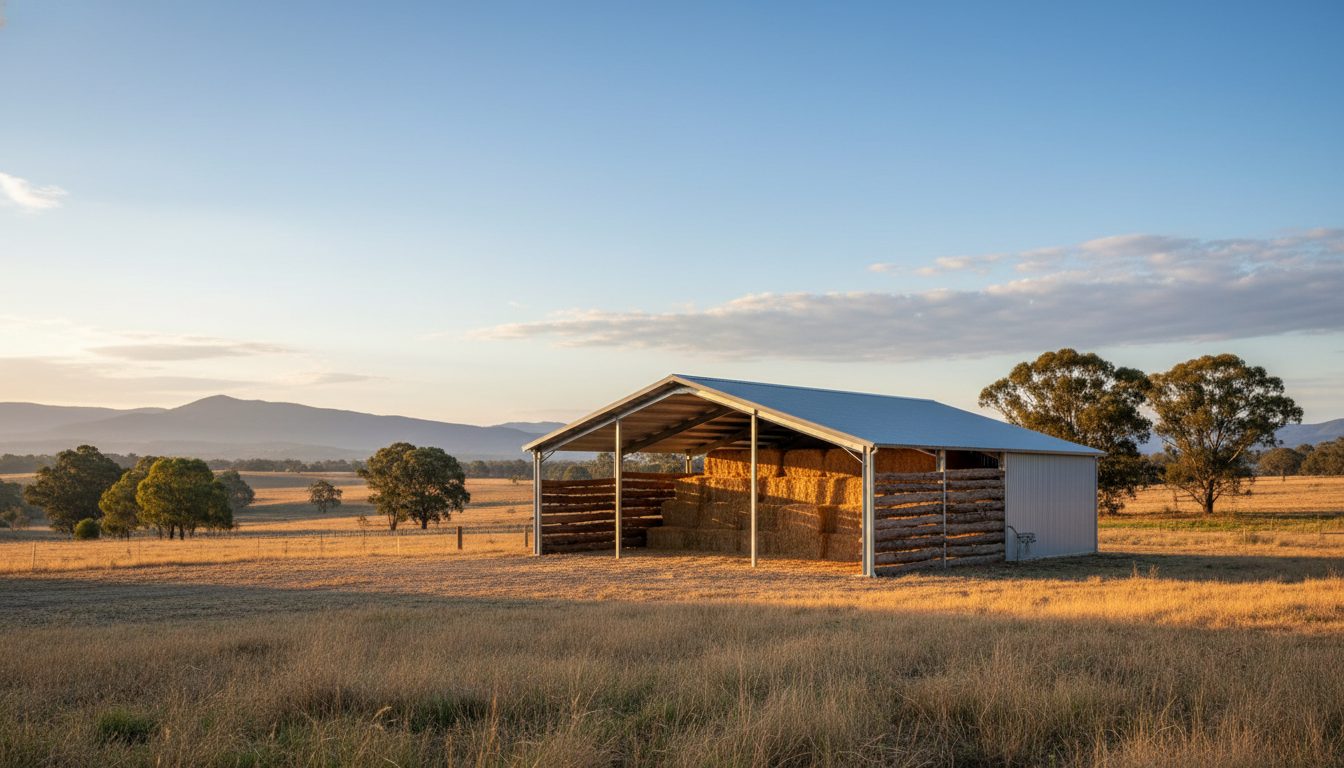
In Australia, a hay shed is typically a large, open-fronted, portal-frame steel structure with generous eave height and bay spacing designed for hay storage and farm machinery access. Most rural sheds in WA, NSW, VIC and SA use hot-dip galvanised frames, Colorbond or Zincalume cladding, and concrete pier footings with hold-down bolts.
Hay shed prices in Australia (2025)
Hay shed prices vary with span, length, eave height, wind region, and cladding. The figures below are indicative only and exclude site-specific engineering or remote logistics. Always obtain a fixed, itemised quote. To benchmark supplier categories, see Fairdinkum shed prices and reviews.
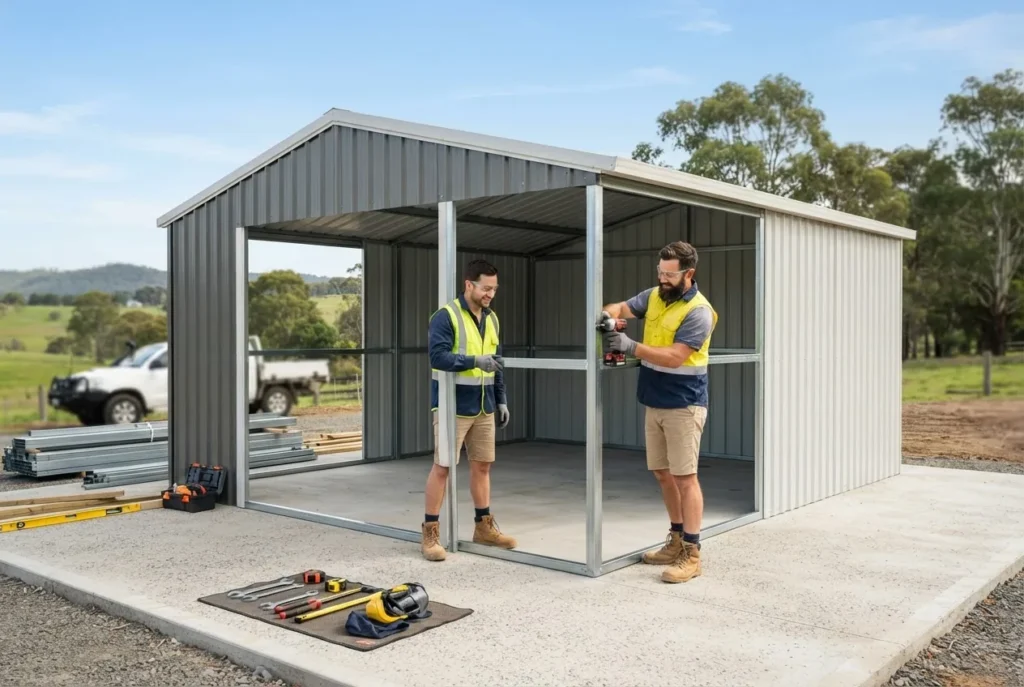
- Hay shed kit prices (supply only): Typically from $25,000–$55,000 for smaller farm sheds (e.g., 18 m × 9 m × 5 m), $60,000–$140,000+ for larger clear-span hay sheds (e.g., 24–36 m spans, 6–7.5 m eave).
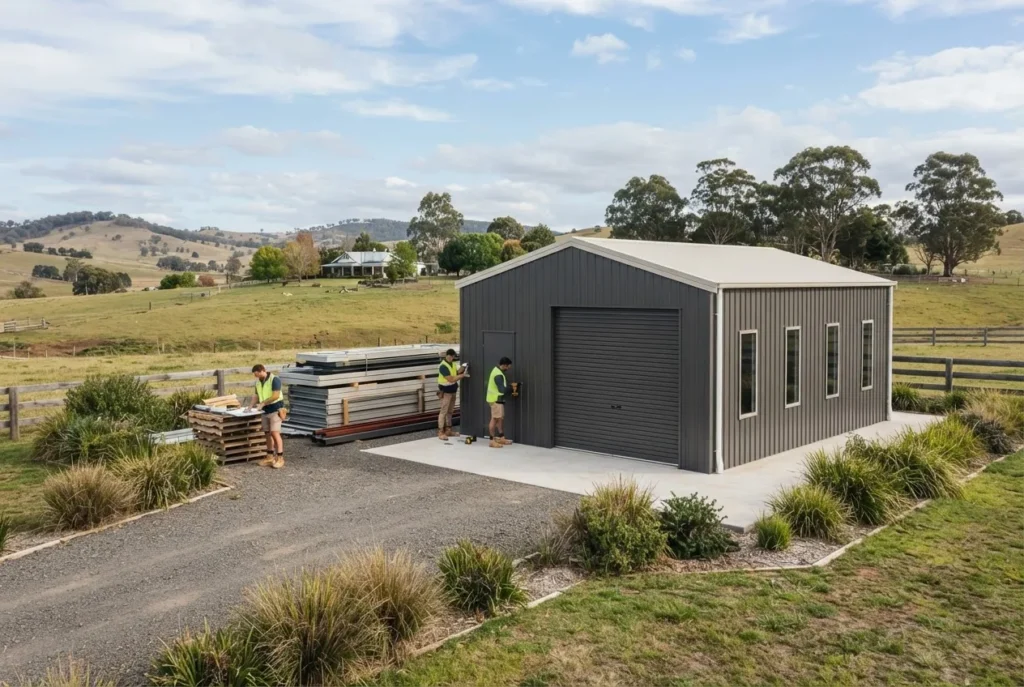
- Installed hay shed prices: Including slab/piers, erection and standard cladding, commonly $45,000–$220,000+ depending on site, wind rating (A, B, C or D), terrain category, and inclusion list (vermin flashing, gutters, downpipes, insulation).
- Extras that move the needle: Cyclone detailing (QLD/North WA), heavier purlins/girts, larger footings, enclosed bays, fire-resistant requirements (BAL zones), crane hire, remote delivery.
Searching “hay shed for sale” or “hay shed prices” will surface kit suppliers and DIY shed kits, but ensure the kit is ShedSafe-accredited and engineered for your exact site wind region and terrain.
If you’re considering ex‑farm frames, read our second‑hand sheds guide for inspections, transport and approvals.
What are the best shed materials for Perth’s climate?
Perth’s hot summers, coastal air in some suburbs, and occasional severe winds favour high-quality cladding and robust frames. The two common steel cladding choices are Colorbond and Zincalume from BlueScope.
| Feature | Colorbond | Zincalume |
|---|---|---|
| Coating | Painted finish over metallic coating | Aluminium/Zinc alloy metallic coating |
| Durability | Excellent; opt for Ultra/Marina near surf coasts | Excellent; can mark aesthetically over time |
| Heat performance | Light colours with solar reflectance (e.g., Thermatech) | Highly reflective when new |
| Aesthetics | Wide Colorbond palette (matches house/garage) | Raw metal look |
| Cost (typical) | Slightly higher per m² for cladding | Usually lower upfront |
| Best for | Residential and premium rural builds | Budget-focused rural/industrial sheds |
Design choices that protect your hay and your budget
- Orientation: Face the open bays away from prevailing rain. In WA’s Wheatbelt, a gable roof with open north or east bays often reduces weather ingress.
- Bay spacing: Common modules are 6 m–8 m. Match to bale and machinery dimensions for fewer posts and faster loading.
- Eave height: 5–7.5 m for stacked large-square bales; ensure telehandler headroom.
- Roof profile: Gable roof (classic rural look, good runoff) vs skillion roof (cost-effective, easier to extend). See below.
- Ventilation: Ridge vents, open gables, or high-level louvres to control moisture and heat build-up.
- Drainage: Gutters and downpipes sized to local Intensity-Frequency-Duration (IFD) rainfall; allow for water harvesting to stock tanks.
- For enclosed workshop or mixed‑use designs on farms, compare per‑m² benchmarks in our warehouse cost in Australia guide.
- Vermin control: Vermin flashing and tight sheeting laps keep grass seed-eating pests out.
- Foundations: Concrete piers with cast-in bolts are typical for rural sheds; slab-on-ground if using enclosed bays or forklift traffic.
| Aspect | Gable Roof Shed | Skillion Roof Shed |
|---|---|---|
| Cost | Moderate | Often lower |
| Water flow | Two directions | Single fall; simple plumbing |
| Height/clearance | Central peak adds clearance | Consistent height; easy future extensions |
| Appearance | Classic rural aesthetic | Modern, minimal look |
Wind ratings, cyclones and codes you must meet
Australian hay sheds must be engineered to the National Construction Code (NCC), AS/NZS 1170.2 (wind actions), and AS/NZS 4100 (steel structures), with site-specific wind region and terrain category. Added 2024 WA wind-rating compliance notes include stricter tie-downs and purlin/girt sizing in exposed terrain.
- Wind Regions: A/B (most southern/western inland), C (coastal QLD/WA north), D (most severe, limited areas). Cyclone detailing is required in Regions C and D.
- Tie-downs: Cyclonic hold-downs, increased connection capacity, and extra bracing for cyclone-rated sheds QLD and North WA.
- Materials: Thicker base plates, larger footings, and hot-dip galvanised columns/rafters in corrosive zones.
How to get council approval for your custom shed in WA
- Planning check: Confirm zoning and setbacks with your local council (Local Planning Scheme). Rural zones are simpler; semi-rural/residential may have R-Code limits.
- Site classification: Obtain wind region, terrain category, topographic multiplier, and soil class (for footings).
- Engineering: Request site-specific certified drawings (portal frame, purlins/girts, footings) from a ShedSafe-accredited supplier. Include council-approved sheds WA documentation.
- BAL (if applicable): If in bushfire-prone areas, comply with AS 3959 for construction in bushfire zones.
- Building permit: Lodge application with plans, engineering, energy/thermal notes (if enclosed), and owner-builder or builder’s details.
Tip: Regional Shires in WA often process rural shed approvals quickly when the engineering is complete and the site plan is clear.
DIY kit vs custom-built hay sheds
| DIY Shed Kits | Custom-Built (Supply & Install) | |
|---|---|---|
| Upfront cost | Lower | Higher |
| Flexibility | Standard spans/heights | Fully custom (bays, eaves, cladding) |
| Approvals | You manage | Builder often manages |
| Time | Longer if self-building | Faster with experienced erectors |
| Risk | On you (quality, compliance) | On builder (warranties, safety) |
Real build examples across Australia
Wheatbelt WA hay shed
- 24 m × 12 m × 6.0 m eave, gable roof, 4 × 6 m bays
- Zincalume roof/walls, three sides enclosed, open north
- Concrete piers; vermin flashing; gutters to tank
- Use: hay plus farm machinery storage
Riverina NSW rural shed
- 30 m × 15 m × 7.0 m eave, open-front
- Colorbond wall sheets for aesthetics facing residence
- Anticon roof blanket for condensation control
- Use: hay and workshop sheds Adelaide-style fitout in one bay
Central QLD cyclone-rated
- 18 m × 10 m × 5.5 m eave, skillion roof
- Region C detailing: heavier purlins/girts, extra bracing
- High-capacity hold-downs; enclosed end to block storm rain
- Use: hay shelter + tractor bay
5-step buying guide for custom sheds in Australia
- Define use-case: Bale size, stack height, machinery widths, future extensions.
- Site data: Wind region, terrain, soil class, access for delivery and cranes.
- Choose materials: Colorbond vs Zincalume comparison, insulation, gutters/tanks, vermin protection.
- Compliance: ShedSafe supplier, AS/NZS engineering, wind-rated sheds for cyclonic areas where relevant.
- Quotes: Get 2–3 itemised quotes for hay shed kit prices and installed options; check warranties and lead times.
Frequently asked questions
Do I need council approval?
Most hay sheds require a building permit. Rural zones are typically straightforward with certified engineering. In bushfire-prone or coastal areas, extra requirements may apply.
Colorbond or Zincalume for rural sheds?
Both are durable. Choose Colorbond for colour-matching homes or custom Colorbond garages Perth. Choose Zincalume for a cost-effective rural look. In marine environments, consider Colorbond Ultra or stainless fixings.
How long does a shed take to build?
Lead times vary with season and steel availability. Allow 2–6 weeks for engineering and approvals, 4–10 weeks for fabrication/delivery, and 1–3 weeks for erection depending on size and weather.
Slab or piers?
Piers are common for open-front hay sheds; slabs suit enclosed bays and forklift traffic. Your engineer will size footings to soil class and wind actions.
What about condensation?
Use roof blankets or insulated panels, include ventilation, and avoid closing a shed airtight unless designed for it.
Related shed solutions and local expertise
- Steel sheds Perth: Custom rural sheds WA, machinery sheds WA, and council-approved sheds WA.
- Rural sheds NSW: Large clear spans for hay and grain, plus affordable carports for Australian homes on farm dwellings.
- Custom carports Melbourne and industrial sheds Brisbane for mixed-use properties.
- Barn sheds Tasmania and custom Colorbond garages Perth to match the main residence.
Standards, climate and authoritative resources
- National Construction Code (ABCB) — governs structural compliance.
- Bureau of Meteorology — check local wind, rainfall and IFD design data.
- Standards Australia — AS/NZS 1170.2, AS/NZS 4100, AS 3959 references.
- HIA and Master Builders Australia — industry guidance and updates (see “Outdoor Structures and Home Improvement” insights).
- Australian Steel Institute — best practice in steel design and corrosion zones.
- Energy.gov.au — thermal performance and insulation guides for sheds.
Specification checklist you can copy into your quote request
- Span × length × eave height (e.g., 24 m × 12 m × 6.0 m), roof type (gable/skillion), roof pitch
- Open bays vs enclosed sides/ends; bay width (6/7.5/8 m)
- Cladding: Colorbond colour or Zincalume; roof blanket or insulated panels
- Wind region (A/B/C/D), terrain category, topographic multiplier
- Footings: concrete piers vs slab; vermin flashing; gutters/downpipes to tank
- Delivery location, crane access, desired timeframe
- Proof of ShedSafe accreditation and site-specific engineering
Why homeowners and investors choose premium hay sheds
Beyond protecting hay quality (reduced weather loss), a well-specified hay shed can lift farm efficiency, consolidate farm machinery storage, and add value to mixed rural-residential holdings. Matching cladding to your home or custom-built double garage in Perth also improves street appeal.
This guide is written for Australian conditions in 2025. Always seek site-specific engineering and council advice before ordering or building.
Excerpt: Planning a hay shed in Australia? This 2025 guide covers hay shed kit prices, installed costs, Colorbond vs Zincalume, WA wind ratings, cyclone design for QLD, council approvals, and real build tips to keep your hay dry and your project compliant.