
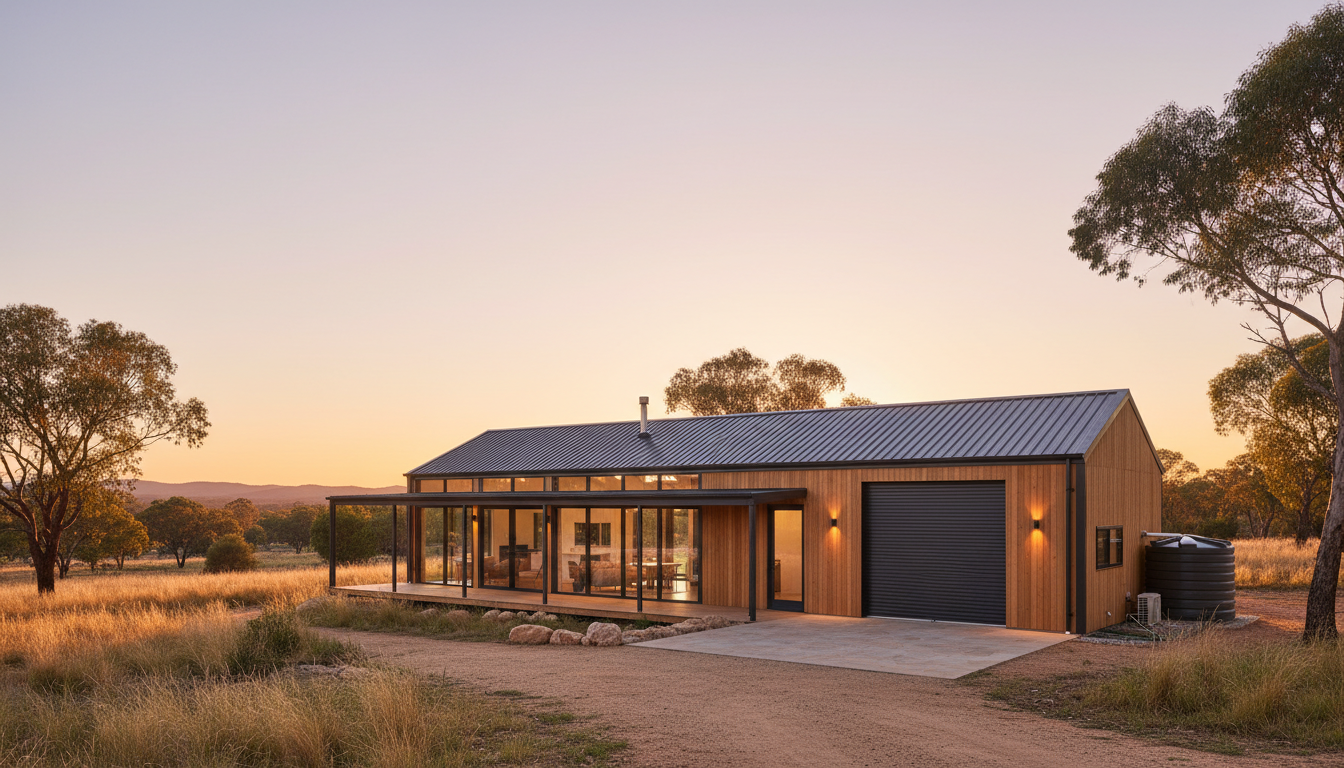

Introduction to Barndominiums in Australia 2025
Problem: hybrid barndominium projects face unpredictable costs and complex council approval pathways that vary by state and site. Promise: this guide delivers state-level cost bands, vetted kit suppliers, material recommendations, approval checklists and actionable next steps to plan, finance and build in 2025.
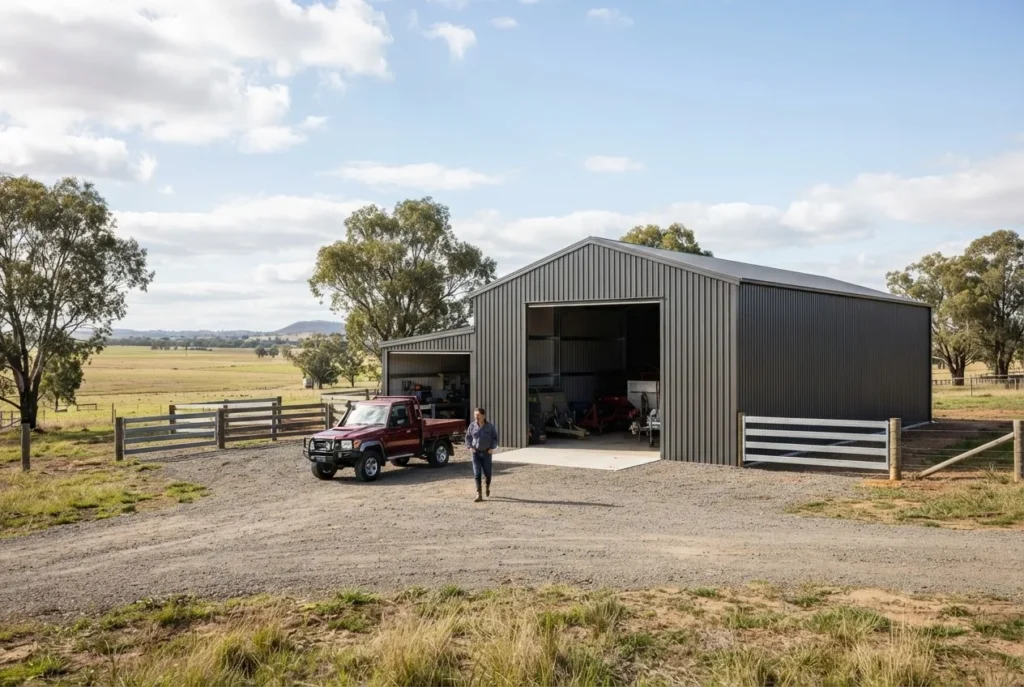
A barndominium is a multifunctional dwelling marrying barn-style utility (workshops, garages, storage) with residential living under one roof. In Australia in 2025 the market shows robust growth—Builder’s Matrix reported a ~12% year-on-year increase in enquiries for barn-style hybrid homes in 2024—driven by rural lifestyle buyers, hobby farmers and peri-urban homeowners seeking large, flexible floorplates with lower build time and maintenance.
Typical buyer profiles: weekend-rural owners (workshop-first), families seeking affordable large-volume living, renovators converting existing sheds, and lifestyle buyers prioritising multifunctional dwellings. Regulatory nuance is crucial: the National Construction Code (NCC) sets the baseline, but local council planning, bushfire (AS 3959) and zone overlays drive practical design and cost. For design-focused approval walkthroughs see our Barndominium homes design and approval in Australia guide.
Barndominium Pricing and Cost Breakdown in Australia (2025)
Average Cost Per Square Metre for Barndominiums
Typical build costs in 2025 range from approximately $1,800–$3,200 per m². These figures reflect differences in finish level, structural complexity, site access and regional labour markets. Expect lower bands in rural QLD and SA, and higher bands in coastal NSW and VIC peri-urban zones.
State Band Cost Guide (per m², 2025 estimates)
- Rural QLD/SA: $1,800–$2,250 per m²
- Regional VIC/TAS: $1,950–$2,600 per m²
- Peri‑urban NSW/ACT: $2,200–$3,200 per m²
- Coastal or difficult-access sites: add 10–25% contingency
Sample Budgets — Two Build Scenarios (illustrative, last updated April 2026)
Compact 100 m² semi-DIY build (rural QLD)
- Kit (shell only): $60,000
- Foundations & slab: $10,000
- Labour & trades (plumbing, electrical, fitout): $45,000
- Services (septic, water, power connection): $8,000
- Finishes & contingency (15%): $18,450
- Total approx: $141,450 (~$1,415/m²)
Family 300 m² turnkey build (peri‑urban NSW)
- Turnkey kit & installation: $220,000
- Foundations & slab: $36,000
- Services & connections: $25,000
- Interior finishes & landscaping: $60,000
- Contingency (10%): $34,100
- Total approx: $375,100 (~$1,250/m²)
Tables last updated: April 2026. Price sources: supplier pages and Builder’s Matrix 2024. Regional variations and site conditions can materially change totals.
Labour & Professional Fees
Professional labour rates (HIA/Master Builders data) place on-site labour and trades at roughly $900–$1,200 per m² for custom builds when fully contracted. These vary by state and trade availability—expect premium weekends/remote site loading charges.
Common Hidden Costs
- Site remediation, rock excavation or deep piers
- Retaining walls and drive access (heavy machinery)
- Bushfire upgrades (ember guards, non‑combustible cladding) if BAL rated
- Survey, engineering and BASIX/BCA documentation where applicable
Budget tip: build a 10–15% contingency and secure firm quotes for foundations and services early.
Barndominium Kits Suppliers and Options in Australia
Kit Supplier Tiers and Typical Inclusions
Kits generally fall into three tiers:
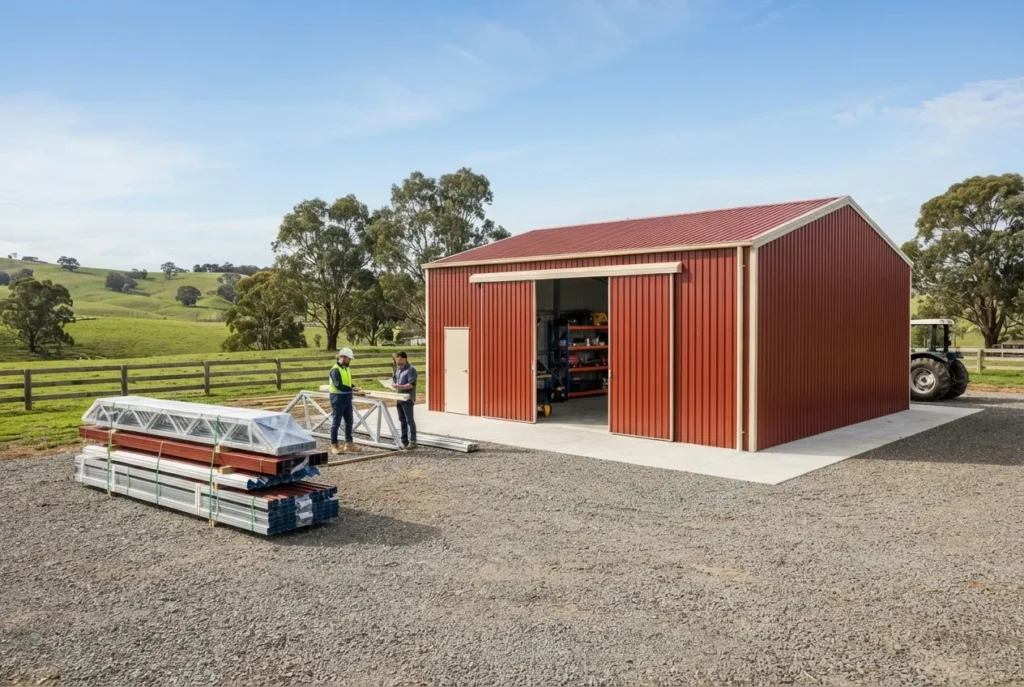
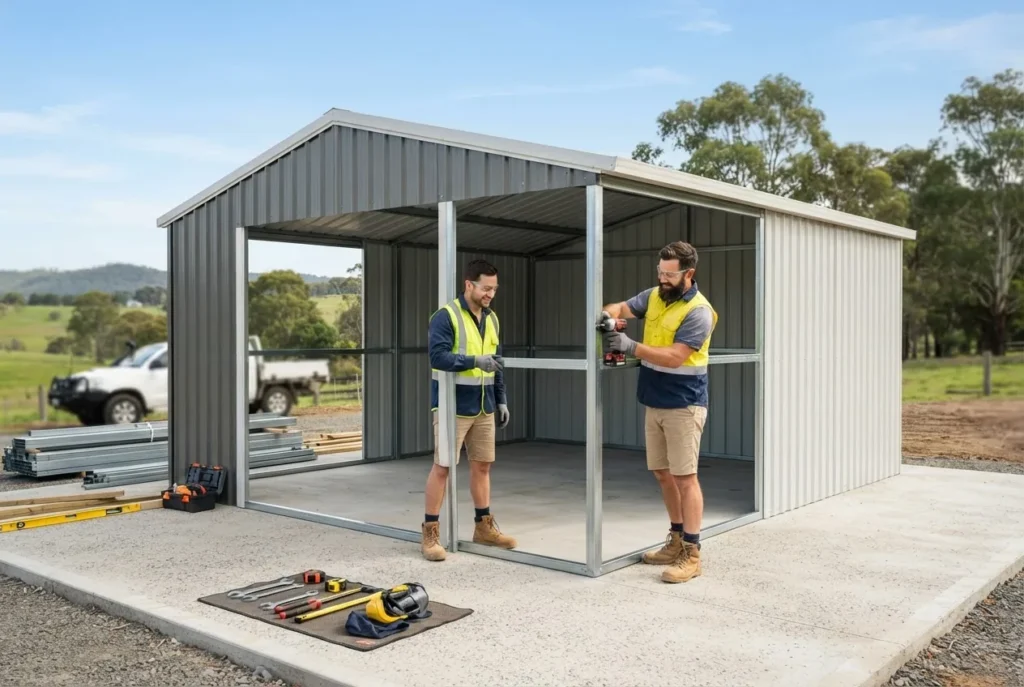
- Shell-only (frame, roof, cladding) — typically excludes foundations, windows, doors and services.
- Insulated panel kits — include insulated wall/roof panels, engineered frames and basic openings.
- Turnkey/prefinish kits — complete internal linings, kitchens, bathrooms and sometimes foundations and service connections.
Leading Australian Suppliers (2025)
- Aussie Barn Homes — shell and insulated panel kits (link to supplier specs on their site).
- Steel Barn Australia — engineered steel kits and assembly support.
- ProSteel — custom steel solutions with varied finish levels.
- Hayman Sheds — popular for hybrid shed-to-home conversions (supplier pages show lead times).
- Spanbilt/RapidShed — modular panel and insulated systems suitable for barndo conversions.
Ordering, Lead Times and Delivery
Lead times in 2025: shell kits 4–12 weeks; insulated/prefab modules 8–20 weeks; turnkey packages 12–30 weeks depending on supplier and customisations. Rural deliveries may add freight/escort costs. Always specify site access and crane requirements on order forms to avoid surprise costs.
For kit feature contrasts see the comparison table above and our detailed supplier checklist in the Barn Shed Guide Australia 2025.
Typical Barndominium Plans and Architectural Layouts in Australia
Annotated Mini-Plans (conceptual)
Compact 120 m² plan: open-plan living/kitchen with a single bedroom wing and a 30 m² workshop bay attached. Climate adaptation: broad eaves and cross-ventilation for summer cooling.
Family 200 m² plan: 3 bedrooms, open living with mezzanine study above garage/workshop, separate laundry/mudroom. Climate adaptation: north-facing living, verandahs on east/west to reduce heat gain.
Large 320 m² plan: 4 bedrooms, double garage, dual workshops and separate studio apartment. Climate adaptation: insulated panels, high thermal mass slab and solar-ready roof orientation.
Each plan can be adapted for bushfire-prone areas (see BAL requirements) and modular expansion. For plan libraries and compliance-focused layouts, visit Modern barn house plans and compliance in Australia.
Design Principles for Australian Zones
- Tropical: high ceilings, deep verandahs, cross-ventilation and corrosion-resistant fixings.
- Temperate: north-facing living, substantial insulation (see R-values below) and thermal mass where appropriate.
- Arid: shading, reflective roofing and water savings through rainwater capture.
Mezzanines, Workshop Integration and Circulation
Mezzanines are common to maximise volume without increasing roof footprint; ensure structural design accounts for load and compliant balustrading. Workshop integration requires separate entry and clear separation from living spaces for fire and acoustic compliance.
Navigating Council and Building Approval Processes for Barndominiums in Australia
Key Regulatory References
Primary references include the National Construction Code (NCC) — see ABCB guidance at abcb.gov.au — and bushfire construction standard AS 3959 (refer to Standards Australia guidance). Local council planning portals (NSW, VIC, QLD, SA) determine permitted use and overlays.
State-by-State Practical Callouts and Timelines
- NSW: BASIX may apply for energy provisions in many areas; pre-lodgement meetings recommended (see NSW Planning). Typical DA/CDC + BA pathway: 8–20 weeks.
- VIC: planning permit + building permit via council; bushfire-prone assessments often required—timeline 6–16 weeks .
- QLD: code assessment or impact assessment depending on zone; BAL assessments common—timeline 6–18 weeks (see QLD building & plumbing).
- SA/WA/TAS: check local council portals for rural use permits and potential heritage overlays.
BAL Ratings and Bushfire Requirements
AS 3959 BAL levels run from BAL‑LOW to BAL‑FZ. Above BAL‑29 you’ll need non‑combustible external materials, ember protection, and increased glazing protections. Typical documentation requested by councils: BAL assessment report, engineered footing details, and plans showing ember-proofing and access for firefighting. For a state-level bushfire checklist, see our bushfire construction guide.
Practical Approval Checklist
- Pre-lodgement council meeting (strongly recommended)
- Site survey, soil report and BAL assessment
- Engineered drawings and NCC compliance statements
- Service connection applications (water, sewer, power)
- Neighbor notifications and heritage checks if required
Typical approval durations: 6–16 weeks depending on documentation completeness. Engage certifiers early and use council pre-lodgement to reduce revisions.
Building Materials for Australian Barndominiums in 2025
Colorbond Steel and Steel Frames
Colorbond steel remains the dominant cladding and roof choice for Australian barndominiums due to durability and wide colour range.
Timber: Where It Works
Treated structural timber and engineered timber accents are ideal for interiors and non-exposed elements. In coastal or termite-prone areas, specify termite-resistant treatments and regular inspections. For comparative pros/cons see our timber barn kits versus Colorbond steel sheds.
Insulation: R-values by Climate (recommendations)
- Tropical (Zone 1–2): roof R2.0–R3.0; walls R1.5–R2.5
- Temperate (Zone 3–5): roof R3.0–R4.0; walls R2.5–R3.5
- Cooler regions (Zone 6+): roof R4.0–R5.0; walls R3.5–R4.5
Use reflective foil plus bulk insulation for steel-clad roofs. Window performance (low‑E glazing) and air-sealing are essential to meet NatHERS targets.
Foundations and Alternatives
Concrete slabs are standard for stability and termite protection. For sloping or flood-prone sites consider pier-and-beam or suspended slab options (engineer-specified). Foundation costs vary widely—include geotech and engineered footing costs in early budgets.
Environmental & Embodied Carbon Notes
Recycled steel and low-embodied carbon concrete mixes reduce lifecycle carbon. Consider lifecycle assessments if sustainability credentials are required for grants or council incentives.
Construction Process and Project Management for Barndominiums
Typical Construction Timeline (Gantt-style overview)
- Weeks 0–6: Final design, engineering and approvals
- Weeks 6–10: Site prep, footing and slab works
- Weeks 10–14: Frame delivery and erection
- Weeks 14–20: Roof, cladding and window installation
- Weeks 20–28: Services (electrical/plumbing/HVAC) and insulation
- Weeks 28–36: Interior finishes, cabinetry and commissioning
- Week 36+: Final inspection, certification and handover
Timelines vary with kit level, weather and supply chain constraints.
Project Management Checklist & Contract Clauses
- Define scope and inclusions in the contract (fixed-price preferred)
- Milestone payments tied to inspections and certifications
- Include defect rectification period and warranty clauses
- Specify who manages site inductions and OH&S responsibilities
Contract types: fixed-price (predictability) vs cost-plus (flexibility). For major unknowns (site rock, BAL upgrades) a hybrid clause with capped variations is recommended.
Financing Barndominiums in Australia
Common Lender Types & Documentation
Banks including the big four, regional banks and specialist construction lenders provide construction loans. Lenders typically request: full plans, fixed‑price contracts, council approvals or conditional approvals, and detailed budgets. Valuation considers final usable floor area and intended occupancy.
Are There National Grants in 2025?
No national HomeBuilder-style grant is current in 2025; check state schemes. Many states offer energy-efficiency rebates, solar battery incentives, or regional development grants—verify eligibility on state portals.
Practical Financing Tips
- Present a complete package: plans, quotes and timelines
- Get formal pre-approval before signing turnkey contracts
- Consider bridging finance for land plus construction financing
Energy Efficiency and Climate Considerations for Australian Barndominiums
NatHERS and Target Ratings
Aim for NatHERS 6+ stars as a practical target in most temperate regions to balance cost and comfort. Use high-performance windows, appropriate R-values and thermal mass to hit ratings without excessive cost.
Solar PV Sizing & Battery Integration
Typical 3–5 kW PV systems suit compact builds; 6–10 kW recommended for larger homes with electric appliances. Combine with battery storage (5–10 kWh) if off-grid resilience or time-of-use savings are targets. Check state incentives for solar battery rebates.
Passive Design Tips
- Orient living spaces north where possible
- Use eaves and shading to reduce summer heat gain
- Design cross-ventilation and stack ventilation for cooling
Comparison: DIY Barndominium Kits Versus Turnkey Builds
Cost Sensitivity & Risk Table (summary)
- DIY kit: lower initial outlay, higher time commitment, skill dependent; warranty often limited to manufacturer components.
- Turnkey: higher upfront cost, faster completion, comprehensive warranties and single-point responsibility.
Two Expanded Case Studies
Case Study A — QLD semi-DIY (2024): Rural QLD owner bought a shell-only kit ($58k), contracted slab and services locally ($22k), completed internal fitout over 12 months. Final spend ~$140k for 110 m². Lessons: save on labour but allow extra time and professional inspections for cert compliance.
Case Study B — NSW turnkey (2023–24): Peri-urban NSW family selected turnkey insulated kit and fixed-price build ($320k incl. slab). Council DA and BASIX required; project completed in 10 months. Lessons: higher cost but reduced admin and certainty for loan drawdowns and occupant timing.
For a deeper decision matrix see our Barn Shed Guide Australia 2025 and supplier comparison pages.
Conclusion and Actionable Next Steps
Start with a one-page planning checklist, refine budgets by state band, and request firm quotes. Recommended next steps:
- Download the 1‑page Barndominium Planning Checklist (internal download link).
- Book a council pre-lodgement meeting and obtain a BAL assessment if needed.
- Request 3 supplier quotes (use our recommended supplier shortlist).
- Secure conditional loan approval with detailed plans and fixed-price contracts.
Request 3 supplier quotes — use our recommended supplier shortlist via the Barndominium homes design and approval in Australia page or contact our team for intro support.
Sources & Further Reading
- Housing Industry Association (HIA)
- ABCB / National Construction Code (NCC)
- Standards Australia / AS 3959 bushfire construction
- State planning portals: NSW, VIC, QLD planning pages (links in body)


Frequently Asked Questions
What are the current costs of building a barndominium in Australia per square metre?
Average costs in 2025 range from approximately $1,800 to $3,200 per m² depending on state, finish level and site conditions. Rural regions sit at the lower end; peri‑urban/coastal areas push costs higher. Get state-specific quotes and include at least 10% contingency. See state bands in the Pricing section.
How do DIY barndominium kits compare to turnkey solutions in terms of price and quality?
DIY kits lower upfront material costs and offer control, but require skills and more time, with greater compliance risk. Turnkey solutions cost more upfront but provide faster delivery, coordinated trades and warranties. Hybrid approaches let you contract structural stages while DIY finishing to save money.
What approvals and permits are required to build a barndominium in Australia?
You typically need planning approval (if required by council), a building permit aligned with the NCC, engineering, site reports and any BAL assessment for bushfire-prone areas. Requirements vary by council—arrange a pre-lodgement meeting to confirm the exact documentation checklist for your site.
Which materials are best suited for Australian climates in barndominium construction?
Colorbond steel and steel framing are widely suited for Australian conditions due to corrosion resistance and durability; treated or engineered timber works indoors or as accents. Insulation and appropriate R-values tailored to local climate zones are essential for comfort and efficiency.
How long does the council approval process usually take for barndominiums?
Approval timeframes typically range from 6 to 16 weeks depending on council workload, the need for planning permits, and documentation quality. Complex or bushfire-prone sites can extend timelines—use pre-lodgement meetings and complete submissions to reduce delays.
Can I finance a barndominium build like a traditional home in Australia?
Yes—many lenders provide construction loans for barndominiums, but lenders often require complete plans, fixed-price contracts and council approvals. Valuations may treat hybrid uses differently; seek pre-approval and provide full documentation to avoid unexpected lending conditions.
What are common design layouts and features in Australian barndominiums?
Common layouts combine open-plan living with attached workshop or garage bays, mezzanines for storage or offices, and separate utility zones. Climate adaptations include verandahs, cross-ventilation, and north-facing living areas—see plan examples earlier for compact, family and large options.
How can I improve energy efficiency and sustainability in my barndominium build?
Improve efficiency with appropriate R-values, high‑performance glazing, airtight construction, and passive solar design targeting NatHERS 6+ stars. Add solar PV, battery storage and rainwater capture. State rebates for energy systems may be available—check state portals for 2025 incentives.