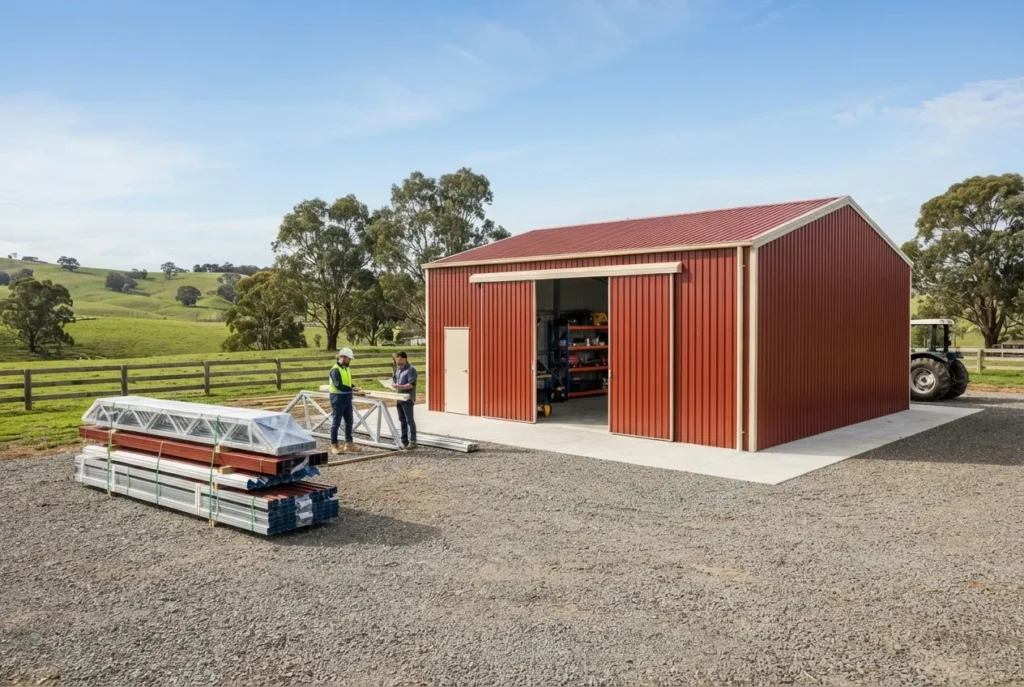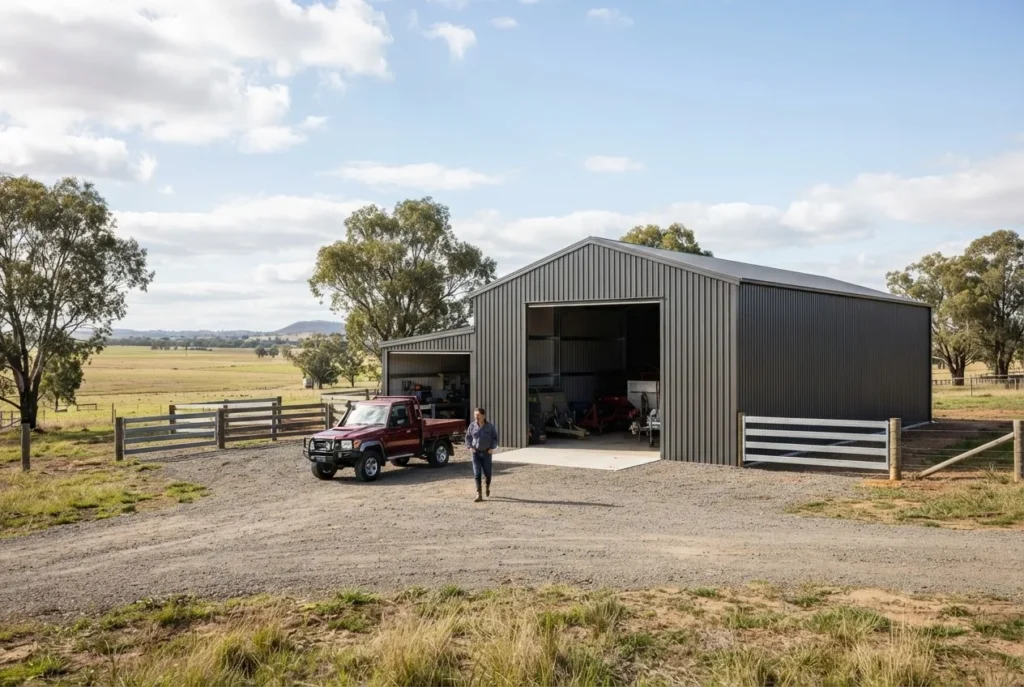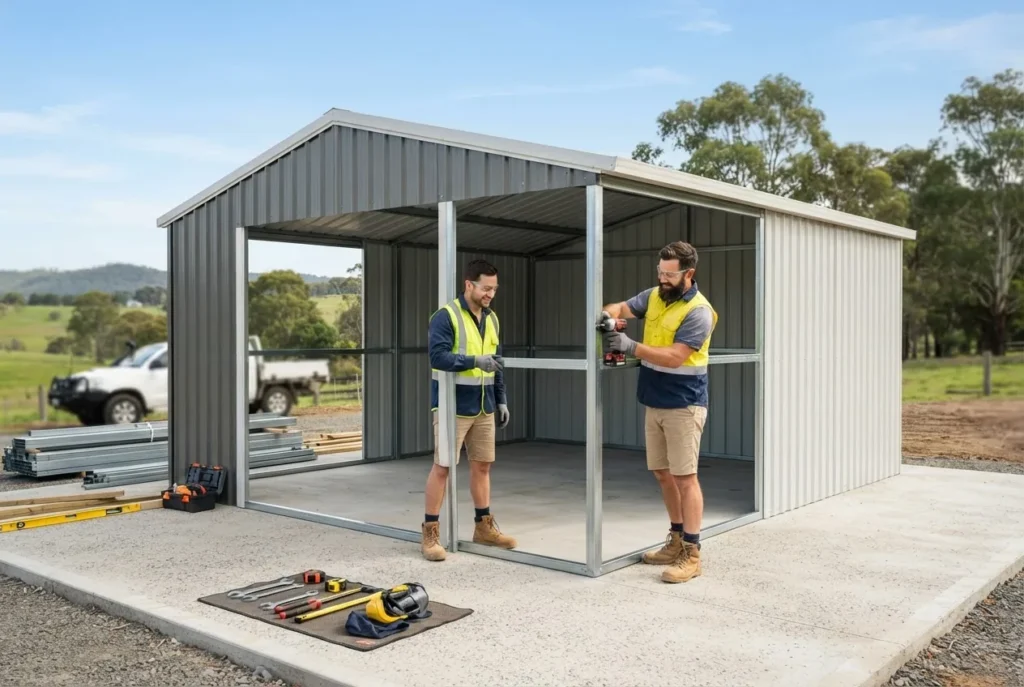

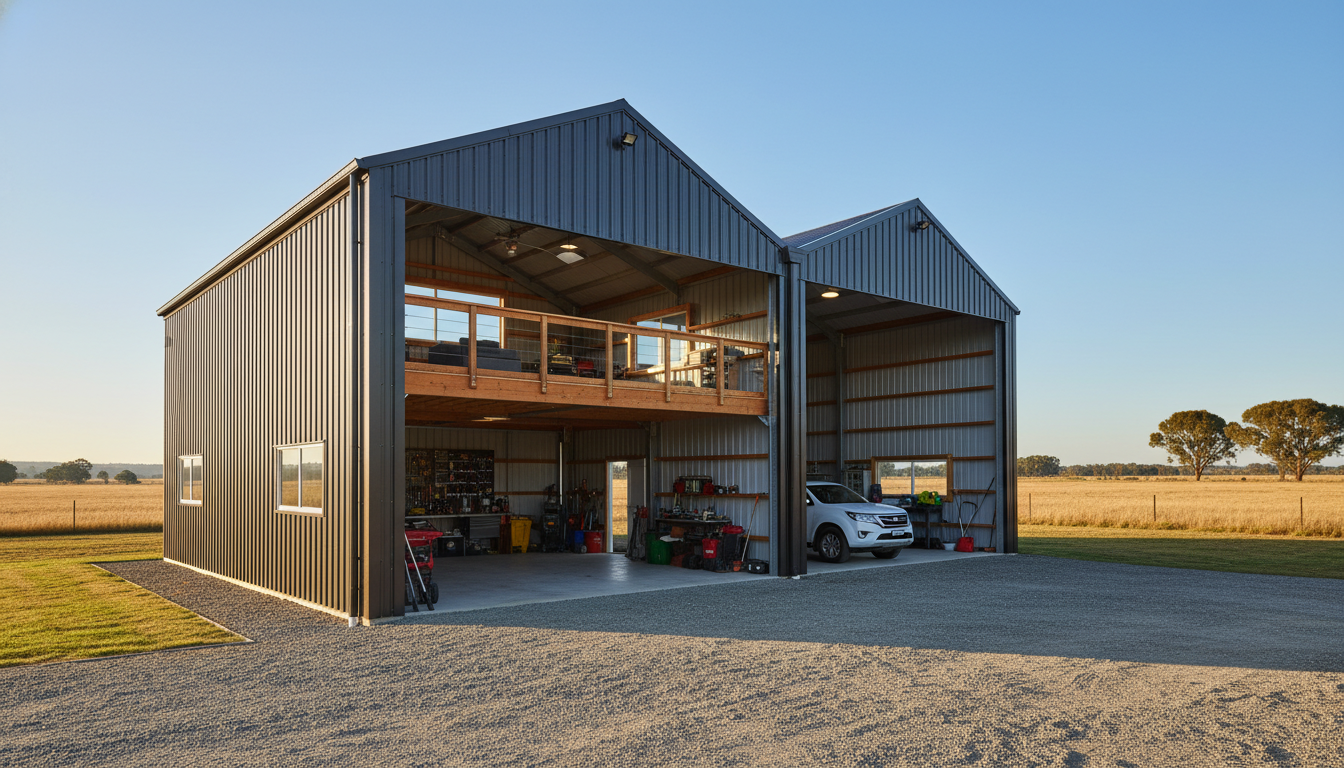

This guide is written for Australian property owners, tradies, small business owners, and DIY enthusiasts who want a realistic buying view. It draws on guidance from the ABCB, BOM climate data, local council building portals, Master Builders Australia, and the Australian Standards commonly used for shed and mezzanine design. Use it to shortlist options, compare quotes, and check whether your project is permit-ready before you spend on materials.
For a broader starting point, see our Barn sheds with mezzanine floors in Australia overview and our barn sheds with mezzanine floors in Australia resource for general sizing, style, and council planning context.
Understanding Mezzanine Floors in Barn Sheds
What is a Mezzanine Floor and Its Benefits
A mezzanine floor is an intermediate platform installed inside a shed between the ground floor and the roof space. In practical terms, it creates a second usable level without changing the external building footprint. For a barn shed, that is valuable because barn roofs usually provide more internal height than standard sheds, which makes the vertical space worth monetising.
The biggest benefit is storage density. Items that do not need daily access, such as seasonal stock, cartons, tools, spare parts, or archived files, can move upstairs and free the main slab for vehicles, machinery, workbenches, or open circulation. That improved separation also helps small businesses keep stock and operations organised. A mezzanine can also create a small office, break-out area, or parts room, which is especially useful where floor area is expensive or limited.
There is also a cost advantage. In most cases, adding mezzanine area is cheaper than extending the shed width or length, because you are using the roof volume you already paid for. That said, the savings are only real if the structure is engineered correctly. A poorly planned mezzanine can trigger expensive rectification works, permit delays, or load restrictions that make the space less useful than expected.
Buyers should think in terms of use case first and structure second. A light storage mezzanine may need only modest load capacity, while a workshop mezzanine used for equipment, shelving, or people traffic needs a stronger design, better access, and more robust safety details. The smarter the planning, the more useful the extra level becomes.
Types of Mezzanine Floors in Australia (Timber, Steel, Hybrid)
Australian barn sheds commonly use three mezzanine types: timber, steel, and hybrid. Each performs differently in cost, speed of installation, maintenance, and climate suitability.
Timber mezzanines are often built with engineered timber members such as LVL beams, which means laminated veneer lumber beams designed for predictable strength and straightness. Timber is popular in rural and semi-rural sheds because it can be easier to modify on site and can feel less industrial in an office or hobby space. It also provides a warmer surface for interior finishes. The trade-off is ongoing care: timber must be protected from moisture, termites, and movement caused by humidity changes.
Steel mezzanines use fabricated steel posts, beams, and sometimes steel decking or steel-framed flooring. They are the common choice where load demands are higher, spans are wider, or the owner wants a more durable solution with less long-term movement. Steel also pairs well with steel shed shells such as Colorbond structures. Properly coated or galvanised steel resists corrosion well, but coastal and high-humidity sites still require careful detailing and maintenance planning.
Hybrid mezzanines combine steel and timber, often using steel posts and beams with timber or plywood flooring. This can be a strong practical option because it balances durability, comfort, and cost. A hybrid arrangement is often chosen where the upper level is used for light office work or storage, but the owner wants the main frame to remain highly robust and stable.
As a rule, choose timber when you value ease of modification and lower upfront cost, choose steel when durability and load capacity are priorities, and choose hybrid when you want a middle-ground solution that can be adapted for mixed use.
Applications: Storage, Workshop, Office Uses
Mezzanine floors are most effective when they solve a real operational problem. For storage, the best approach is to keep heavier or less frequently moved items near structural supports and store lighter items in the outer zones. This reduces concentrated load points and makes access safer. Storage mezzanines often suit rural suppliers, farm operations, e-commerce stock rooms, and trades businesses with consumables or spare parts.
For workshops, a mezzanine can divide the space into clean and dirty zones. The lower level may hold machinery, welding bays, or assembly benches, while the mezzanine stores parts, manuals, or finished goods. That separation improves workflow and can reduce clutter around machinery. If a workshop mezzanine is intended for regular occupancy, stair design, guardrails, lighting, and ventilation need to be treated as primary features, not optional extras.
Office mezzanines are best suited to businesses that want an elevated admin space above a warehouse, barn shed, or workshop floor. The upper level should be insulated, quiet, and connected to data, power, and lighting services. For comfort, office spaces need more than just a platform and stairs. They need adequate ceiling height, thermal control, and safe egress. If the upper area is likely to be used by staff or clients, compliance becomes stricter and more visible.
The most successful mezzanine projects are usually designed around how the owner will move through the building every day. If access is awkward, if stair placement blocks the work zone, or if the upper level is too shallow to use properly, the extra floor area becomes wasted volume. Good planning avoids that outcome.
Load-Bearing Capacity and Safety Standards
Load-bearing capacity is the first structural question to resolve. A mezzanine floor is only useful if it is engineered for the actual live loads and dead loads expected in service. In plain language, dead load is the weight of the mezzanine itself, while live load is the weight of people, stock, tools, furniture, and movement on top of it.
The main design reference is AS/NZS 1170, the Australian/New Zealand Standard series for structural actions. It sets out the loads to be considered in design, including imposed loads, wind actions, and in some areas other environmental effects. For mezzanines, this standard helps the engineer determine whether the platform is intended for light storage, office occupancy, or a more demanding workshop arrangement.
Access and fall protection are commonly guided by AS 1657, which covers fixed platforms, walkways, stairways, ladders, and guardrails in industrial settings. If your barn shed mezzanine uses stairs or a fixed access ladder, this standard is highly relevant. It affects stair geometry, handrail placement, edge protection, and safe access arrangements.
Where steel framing is used, AS 4100 is the key steel structures standard. It informs the design of beams, columns, connections, and member sizing. Where timber framing is used, AS 1684 is the common timber framing reference, especially for framing rules, member selection, and practical construction details. In a real project, these standards are not just paperwork. They determine whether the structure can actually perform as intended.
For buyers, the practical takeaway is this: never guess the load class. Ask the engineer whether the mezzanine is designed for light storage, general storage, office use, or higher load workshop use, and make sure the quote clearly states the intended capacity. If the mezzanine is going to hold pallets, equipment, or dense stock, the numbers matter more than the marketing language.
Climate Impact on Mezzanine Design
Australia’s climate has a direct effect on mezzanine performance. Heat, humidity, salt exposure, bushfire risk, and wind all influence how the platform should be designed and detailed. The Bureau of Meteorology climate data is useful because it helps owners understand local conditions rather than relying on generic national advice.
In hot climates, thermal movement matters. Steel expands and contracts with temperature changes, so connections, cladding interfaces, and flooring joints should be detailed to tolerate movement without excessive noise or fatigue. Insulation above and around the mezzanine can also reduce heat gain and make upper-level use more comfortable. If the mezzanine will be used as a workspace or office, thermal comfort is not a luxury; it affects productivity and can change whether the space is actually used.
In humid or coastal areas, corrosion and moisture management become critical. Salt air can accelerate rust on poorly protected steel and can also damage fasteners, hinges, and fixing points. Timber needs termite protection and moisture-resistant treatment. If you are within a coastal wind zone, your engineer may also specify more stringent fixing patterns and connection details. This is one reason local conditions matter more than a generic national price list.
Wind load is another factor often underestimated by first-time buyers. Barn sheds with large roof spans can behave differently in exposed locations than they do in sheltered suburbs. The mezzanine itself may not be exposed to wind directly, but the shed frame supporting it must still be designed for the site conditions. If the building shell is under-designed, the mezzanine is compromised as well.
Australian Building Codes and Compliance for Mezzanine Floors
NCC 2022 Requirements
The National Construction Code (NCC) 2022 is the current code baseline for most Australian building work, including many barn shed and mezzanine applications. In practice, the NCC determines whether your project is classified as a simple shed alteration, a more complex building work item, or a change that affects fire safety, access, and structural design obligations.
Under the NCC, the key issues are structural adequacy, fire safety, access and egress, ventilation, and in some cases disability access requirements depending on the building classification and use. A mezzanine in a private rural shed may be treated differently from one in a commercial warehouse or office environment. That means the classification matters before the design stage, not after construction.
The NCC does not stand alone. It works together with Australian Standards and local planning rules. For example, compliance with structural standards such as AS/NZS 1170, AS 4100, AS 1684, and access standards like AS 1657 supports the broader NCC obligation. If you are reading a supplier brochure that says “NCC compliant,” ask which clause, which standard, and which building class that statement refers to.
NCC 2025 Requirements
For 2025 planning, buyers should check for any NCC updates, state variations, and local authority interpretations that affect mezzanine design. The safest approach is to treat NCC 2025 discussion as a review of current compliance expectations rather than assuming a brand-new rule set applies everywhere. In other words, verify what your state building authority and council are using before finalising drawings.
Areas that often attract attention in 2025 planning include fire separation, smoke management, occupant safety, stairs and ladders, and structural evidence for wind and load actions. In some projects, a change in use may be more important than a change in the code itself. For instance, a shed that starts as storage but becomes a staff workspace or office can trigger different compliance requirements.
Because regulatory interpretation can vary, the best practice is to request permit-ready drawings and ask the designer to note which NCC provisions were used. That makes it easier for council, certifiers, and building surveyors to review the proposal without back-and-forth delays.
Local Council Approval Processes and Permits for Barn Sheds with Mezzanines
Council approval is often required for a mezzanine, but the exact process depends on your state, local planning scheme, zoning, and whether the mezzanine changes the building’s use, height, or floor area. In some municipalities, even a modest internal platform can trigger a building permit, while in others the approval pathway is more straightforward if the shed is already approved and the mezzanine is clearly minor in scope.
As a practical rule, do not assume that a shed permit automatically covers a mezzanine. Councils commonly want separate or amended documents showing structural details, setbacks, site coverage, bushfire overlay issues, drainage considerations, and the intended use of the upper level. If the building is near boundaries or in a rural zone, planning overlays may add another layer of review.
The approval process usually includes an application, engineering drawings, site plan, and in some cases a statement from a private building surveyor or certifier. Once work starts, the council or certifier may require inspections at slab, frame, and final stages. Keep all documents together, including supplier drawings and engineer letters, because missing paperwork is a common reason for delay.
Structural Engineering and Safety Compliance
Structural engineering is where the concept becomes a buildable asset. An engineer should confirm the mezzanine’s loads, spans, connection design, post footing loads, and fixings to the shed frame or slab. This is especially important where the mezzanine is attached to an existing shed, because the original building may not have been designed to carry the extra load.
For steel mezzanines, the engineer will often reference AS 4100 for member sizing and connection detailing. For timber mezzanines, AS 1684 and the relevant structural timber design references may be used. In both cases, the engineer should consider beam deflection, not just strength. A mezzanine that flexes too much feels unsafe even if it technically meets load requirements.
Safety compliance also includes barriers, stair design, access paths, and maintenance access. If the mezzanine is intended for frequent use, handrails and edge protection need to be robust, and the stair landing should be large enough for comfortable movement. For commercial use, the safety standard bar is higher because people may not know the building layout well.
Fire Safety and Accessibility Regulations
Fire safety and accessibility rules depend on use, classification, and occupancy. A private storage mezzanine has different expectations from a public-facing office or warehouse mezzanine. Still, the underlying aim is the same: provide safe exit, reduce hazard exposure, and avoid creating a trapped upper level.
Fire safety considerations can include separation of hazardous materials, selection of non-combustible or fire-resistant materials where required, and adequate alarms or detection systems. If the mezzanine supports a commercial use, the fire strategy may become more detailed and could involve extinguishers, emergency lighting, or additional exit planning. Do not assume a shed’s base cladding automatically satisfies mezzanine fire expectations.
Accessibility is equally important when the mezzanine is used as a workspace or office. Stair geometry, handrails, tread dimensions, and landing space need to support regular safe use. If staff or visitors will move to the upper floor, the access route should be comfortable enough that it does not become an operational barrier.
Recent Regulatory Updates for 2025
For 2025, the main compliance message is not that everything changed overnight, but that verification matters more than assumptions. Buyers should confirm the latest local interpretation of the NCC, check whether any state variations apply, and make sure the supplier’s drawings align with the current permit pathway. In particular, owners in exposed wind regions, bushfire-prone areas, or mixed-use buildings should ask for written confirmation of the design basis.
Use current references from the ABCB, state building authorities, and council building portals before signing off. If a supplier cannot explain the basis of compliance clearly, request a more detailed engineering package or compare another quote. A permit-ready design may cost more at the start, but it usually saves time and rectification costs later.
Materials and Structural Components for Mezzanine Barn Sheds
Colorbond Steel Mezzanines: Features and Benefits
Colorbond steel is one of the most common choices for Australian barn sheds because it is familiar, durable, and suited to the local climate when specified correctly. In mezzanine projects, Colorbond is often used in the shed shell, and sometimes in the mezzanine frame or associated internal components when a steel-based system is preferred.
The main strengths are corrosion resistance, UV performance, and a consistent finished appearance. Colorbond also works well in projects where the owner wants the shed and mezzanine to have a cohesive look. Because it is a well-known Australian product category, buyers often find replacement and maintenance planning easier than with less common materials.
That said, Colorbond is not a substitute for proper engineering. The finish helps with durability, but the frame still needs correct load design, suitable fasteners, and detailing for condensation management. In hot or coastal areas, good ventilation and maintenance remain essential.
Timber-Framed Mezzanines: Style and Treatments
Timber mezzanines remain attractive because they are versatile, relatively straightforward to work with, and visually suitable for workshop offices or hobby spaces. Treated timber is particularly relevant in Australia because termites, moisture, and rot can cause expensive damage if the wrong timber is used or if treatment standards are ignored.
Engineered timber products such as LVL beams are widely used because they offer better dimensional stability than unengineered sawn timber. That means less twisting, less shrinkage, and more predictable performance under load. For flooring, plywood or structural flooring boards are common, with finishes chosen based on the intended use. A clean office might use a more finished floor surface, while a storage mezzanine might use a tougher, more utilitarian surface.
Timber is not a universal answer. In high-humidity or termite-prone regions, treated timber and vigilant maintenance are essential. Even then, timber needs regular inspections to confirm that moisture has not entered joints, fasteners are intact, and the floor remains level. The upside is that timber is easier to modify later if your use changes.
Structural Engineering: Supports, Beams, Flooring
The strength of a mezzanine depends on how well the parts work together. Support posts transfer load to the slab or footings. Beams spread that load across the span. Floor structure carries the actual use load. Connections tie the system together. If any one of those parts is undersized or poorly detailed, the whole platform suffers.
In steel systems, steel beams and columns are usually selected for their load capacity and predictable performance. In timber systems, LVL beams and engineered joists are common because they offer stability with less risk of natural timber defects. Flooring options vary from structural plywood and particleboard to steel deck or composite systems depending on load and finish requirements.
Flooring choice should match use. Storage mezzanines may use tough structural flooring with a basic surface finish. Office mezzanines need a more comfortable walking surface and a quieter floor. Workshop mezzanines may need extra stiffness to control vibration and support repeated movement. This is not a place to save money by choosing the wrong grade of board.
Material Comparisons: Steel vs Timber vs Hybrid
| Criterion | Steel Mezzanine | Timber Mezzanine | Hybrid Mezzanine |
|---|---|---|---|
| Upfront cost | Usually higher | Often lower to moderate | Moderate |
| Load capacity | Very high | Good for light to medium loads | High, depending on design |
| Maintenance | Low if protected well | Moderate to high | Moderate |
| Climate suitability | Strong in coastal and humid zones with protection | Best in drier or controlled environments | Flexible across many regions |
| Termite risk | No termite risk in frame | Requires treatment and monitoring | Reduced if timber use is limited |
| Thermal movement | Needs detailing for expansion | Moves with humidity changes | Balanced performance |
| Customisation | Good, but fabrication-driven | Excellent for modification | Very good |
The most useful way to compare the options is by total life-cycle cost, not just purchase price. Steel may cost more at the start but can be cheaper over time if the site is harsh and maintenance access is difficult. Timber may be cheaper initially but require more regular upkeep. Hybrid systems often sit in the middle and suit owners who want a practical, flexible build.
Climate Effects on Material Selection
Material selection should reflect the local climate zone, not just the supplier catalogue. In coastal Queensland or Western Australia, corrosion resistance is a major factor, so coatings, fixings, and ventilation must be selected carefully. In Tasmania or southern Victoria, condensation and cold-weather performance become more important. In inland areas, heat movement and dust resilience may dominate the decision.
For timber, the main risks are moisture, termites, and long-term movement. For steel, the main risks are rust, thermal expansion, and condensation at connection points. Hybrid systems can reduce some of those issues, but only if the design is deliberate. It is wise to ask the supplier how the system performs in your climate zone and what maintenance schedule they recommend.
If you are still deciding on shed style, our Quaker Barn Sheds Australia and Timber Barn Kits vs Colorbond Steel Sheds pages provide useful comparisons for style, buildability, and material choice.
Pricing Guide for Barn Sheds with Mezzanine Floors in Australia (2025)
Cost Components: Materials, Labour, Engineering, Permits
The final price of a barn shed with a mezzanine floor depends on more than the platform itself. Buyers should budget for the shed shell, mezzanine frame, flooring, stairs or ladder, guardrails, fixings, engineering, permits, site prep, and any extras such as insulation or electrical work. Soil conditions, slope, access for delivery, and wind classification can all push the quote higher.
Typical cost components in 2025 include:
- Materials: Steel or timber framing, flooring, fasteners, brackets, coatings, and access components.
- Labour: Carpenters, steel fabricators, installers, and, where needed, crane or equipment hire.
- Engineering: Structural design, certification, and documentation for council or private certifier review.
- Permits: Council or building surveyor fees, application costs, and potential amendment fees.
- Site prep: Slab upgrades, piers, levelling, drainage fixes, or access track work.
- Safety items: Stairs, handrails, guardrails, balustrades, and non-slip surfaces.
- Fit-out: Insulation, lighting, ventilation, power, and finishing if the mezzanine will be used as a workspace.
Labour rates vary across Australia and by trade type, so use the quote as a project-specific estimate rather than a fixed national price. Suppliers may also quote differently: some include engineering and installation, while others list those separately. Always check what is excluded before comparing headline prices.
Price Ranges by Size and Type
| Approx. Floor Area | Typical Type | Indicative Quote Range (AUD) | Common Use |
|---|---|---|---|
| 20–40 m² | Basic timber mezzanine | $18,000 – $35,000 | Light storage, hobby space |
| 40–80 m² | Hybrid mezzanine | $35,000 – $65,000 | Workshop storage, small office |
| 80–120 m² | Steel mezzanine | $60,000 – $110,000 | Commercial storage, heavier use |
| 120 m²+ | Complex or office-ready system | $100,000 – $160,000+ | Mixed use, premium fit-out |
These are indicative quote ranges only. They assume a standard site with reasonable access and no major earthworks. Costs can rise if the site is sloped, the slab needs strengthening, the shed is in a high-wind or cyclone region, or the mezzanine is intended for office occupancy rather than simple storage.
Leading Australian Suppliers and Pricing
Supplier comparison is most useful when you compare the same criteria across each quote. The three names below are commonly discussed by Australian buyers, but exact figures will vary by state, shed size, and installation scope.
| Supplier | Indicative Entry Price | Customisation | Engineering Support | Warranty / Support | Regional Coverage | Lead Times |
|---|---|---|---|---|---|---|
| ShedBoss | Indicative quote range from the low-to-mid market for smaller builds | Good | Generally strong project support | Varies by package | Broad national reach | Often mid-range |
| Aussie Sheds | Indicative quote range from mid-market for modular options | Strong | Moderate to strong | Varies by package | Good regional coverage | Depends on custom scope |
| Steel Sheds Australia | Indicative quote range from mid-to-upper market for heavier steel systems | Strong | Strong on steel-based designs | Often emphasises structural support | Broad coverage | Can be longer for custom steel work |
When comparing quotes, ask whether the price includes footing design, engineering certification, stairs, handrails, delivery, installation, and council paperwork support. That is where apples-to-apples comparisons often break down. If a supplier only quotes the shell or the mezzanine structure but not the permit package, the cheaper price can become expensive later.
Cost-Saving Tips
There are sensible ways to reduce cost without cutting compliance corners. Standardise the mezzanine dimensions where possible, use a simpler access solution if frequent use is not required, and avoid unnecessary architectural finishes for storage-only areas. If the upper level is just for stock, a functional surface is usually better value than premium flooring.
Other savings come from smart sequencing. For example, bundling the mezzanine with the original shed build can reduce mobilisation costs compared with retrofitting later. In some cases, a hybrid structure may offer a better life-cycle value than an all-timber build because it reduces maintenance and replacement frequency.
How to budget checklist:
- Request at least three quotes using the same load requirement.
- Confirm whether engineering and permit assistance are included.
- Ask for a site-specific allowance for soil, access, and wind rating.
- Budget for stairs, rails, lighting, and insulation separately if not included.
- Keep a contingency reserve of 10–15% for unexpected site or council issues.
Financing and Warranty Considerations
Many suppliers offer payment schedules, finance referrals, or staged progress payments. Before signing, check whether warranty terms cover structural components, coatings, workmanship, and installation. A warranty is only valuable if the supplier is clear about exclusions and service response times.
For buyers wanting a broader industry view, Master Builders Australia is a useful source for general construction practice, consumer protection context, and contractor standards. If the quote seems unusually low, ask what has been excluded. In shed projects, exclusions are often the hidden cost.
Supplier Comparison Snapshot
If your main decision is between a lower-cost kit and a more complete build package, compare the following in every quote: entry price, engineering support, customisation, lead time, warranty length, and regional availability. For a permit-ready project, the “best” supplier is often the one that gives the clearest compliance documentation, not the one with the flashiest brochure.
Construction and Installation Process
Step-by-Step Building Guide
Building a barn shed with a mezzanine floor is a sequence, not a single event. The most efficient projects usually follow this order:
- Brief and design: Confirm use, load class, access type, and whether the mezzanine is for storage, workshop, or office use.
- Engineering: Obtain structural drawings and design notes for the shed and mezzanine.
- Approvals: Lodge documents with council or a private certifier, depending on the local process.
- Site preparation: Check slab level, footing adequacy, drainage, and delivery access.
- Main shed structure: Erect the shed frame, roof, and cladding.
- Mezzanine frame: Install posts, beams, flooring, and connection details.
- Access and safety: Fit stairs or ladder access, rails, and edge protection.
- Services and finishing: Add lighting, insulation, power, and ventilation as required.
- Inspection: Complete all required checks before use.
This sequence matters because a mezzanine often interacts with the shed frame, slab, and access points. If the site is not prepared correctly, the platform may be difficult to install or may need rework. Good planning reduces downtime and keeps the build clean.
Typical Timeframes and Planning
Simple builds can move quickly, but a realistic 2025 timeframe depends on engineering turnaround, approval timelines, material availability, weather, and installer availability. A small storage mezzanine in an uncomplicated site may progress in weeks, while a larger commercial-style build can take much longer because approvals and inspections create natural checkpoints.
Planning ahead is the best way to reduce delays. Order the engineering early, check the council calendar if holiday periods are involved, and ask suppliers about current lead times for steel or timber fabrication. If the site is rural, delivery logistics can also add time. It is better to plan for a conservative schedule and finish early than to promise an optimistic one and slip on every stage.
Quality Assurance and Inspections
Quality assurance should happen at every major stage, not just at the end. Early checks focus on slab level, footing positions, and frame alignment. Mid-stage checks focus on beam placement, bolt tightening, connection integrity, and member straightness. Final checks focus on guardrails, stairs, floor finish, and any compliance items required by the permit.
If a private certifier or building surveyor is involved, provide them with the correct drawings and keep sign-off records in one folder. That makes it easier to show compliance if the property is sold or if the mezzanine is later altered. The more organised the paperwork, the easier future maintenance and resale conversations become.
Common Installation Challenges and Solutions
Installation problems usually come from one of four places: site, supply, design, or sequencing. Uneven slabs and poor drainage can make posts difficult to set. Late deliveries can push the project off schedule. Poorly coordinated designs can leave the mezzanine too low, too narrow, or awkward to access. And if trades arrive in the wrong order, the build can stall while everyone waits.
There are straightforward fixes. Survey the site properly, confirm dimensions before fabrication, lock in supplier lead times, and verify access routes for equipment delivery. If the shed is exposed to high wind or coastal conditions, make sure the fixings and coatings are specified before materials are ordered. Changing those details after fabrication is expensive.
DIY vs Professional Installation Comparison
DIY installation can work for experienced owners, especially for smaller or simpler timber projects, but it is rarely the best choice for higher-load or permit-sensitive mezzanines. The advantages are lower labour cost and greater control over timing. The risks are compliance failure, slower progress, warranty issues, and errors that are hard to fix once the frame is in place.
Professional installation usually costs more, but it brings better coordination, safer lifting and placement of components, and a clearer pathway to inspection and sign-off. In most cases, if the mezzanine is intended for regular use, a professional build is the safer commercial decision because it reduces the chance of rework.
For related access and design ideas, see our Sliding barn doors for barns guide, which covers entrance selection, wind rating considerations, and practical workshop access.
Maximizing Mezzanine Floor Utility: Design Tips and Use Cases
Workshop Efficiency Design
A workshop mezzanine should improve workflow rather than interrupt it. The best designs keep the upper level clear for storage or planning space while preserving the ground floor for movement, tool access, and equipment. If heavy items are stored above, place them close to structural supports and avoid loading the middle of long spans unless the engineer has designed for that pattern.
Lighting is a major productivity factor in workshop settings. Combine natural light where possible with LED task lighting and avoid shadows over stairs or walkways. Noise control also matters. If the mezzanine sits above a machine area, use flooring and insulation details that reduce vibration and footfall noise, especially if staff work above and below at the same time.
Creating Comfortable Office Spaces
An office mezzanine can work well in a barn shed if it is treated like a real workspace, not a leftover platform. That means insulation, ventilation, safe access, power, lighting, and a quiet layout. If the office is used daily, temperature control matters almost as much as structural capacity. A hot, noisy mezzanine is technically usable but practically poor.
Consider how people will enter and leave the space. If the office is customer-facing or staff-occupied, stairs should be easy to use and the landing should allow people to pass safely. Add data points and future-proof cabling during the build rather than retrofitting later. Small details like cable routing and acoustic control improve long-term usability significantly.
Storage Optimization Techniques
Storage design works best when it respects weight and access. Keep heavier items low and near supports, label zones clearly, and use modular storage containers that can be moved without reorganising the whole floor. If items are accessed frequently, place them near the stairs. If they are seasonal or archived, place them farther away but still within safe reach.
Do not treat the mezzanine as a dumping ground. Over time, chaotic storage increases the risk of overloading, blocked access, and missed inspections. A tidy mezzanine is safer and more useful. For business users, it also makes inventory counting easier and reduces wasted time searching for stock.
Access, Safety Rails, and Lighting Options
Access is a design decision, not an afterthought. Stairs are usually the best choice for regular use because they support movement of small items and make the upper level easier to use day-to-day. Fixed ladders can be acceptable for occasional access, but they are less convenient and can be a poor fit for busy workspaces. Guardrails and balustrades should be specified early so the structure and stair layout can accommodate them cleanly.
Lighting should be planned for both safety and function. Use bright, efficient LED fixtures at the stair entry, along walkways, and in work or storage zones. If the mezzanine is above a commercial or industrial floor, emergency lighting may also be relevant. For broader access considerations, refer to Barn sheds with mezzanine floors in Australia for planning principles and layout choices.
Australian Case Studies Highlighting Applications
NSW storage shed scenario: A hobby farm outside Wagga Wagga used a timber-based mezzanine for boxed inventory, light tools, and archives. The owner chose treated timber because the site was relatively dry and the mezzanine was not intended for heavy loads. The project prioritised low-cost storage and easy future modification.
QLD workshop scenario: A trade business near Toowoomba installed a steel mezzanine over a parts and assembly zone. The owner needed better separation between stock and machinery, and the quote included engineering for the site’s wind conditions. The steel frame was selected for durability and to reduce long-term maintenance.
VIC office scenario: A regional manufacturing shed in Victoria added a hybrid mezzanine to create a quiet admin room above the production area. The upper space included insulation, lighting, and a stair landing designed for staff use. The hybrid structure was chosen because it balanced cost, comfort, and load performance.
These examples show that the right design depends on climate, use, and compliance demands. The more clearly you define those three factors, the better the final result.
Frequently Asked Questions
Do I need council approval to add a mezzanine floor in my Australian barn shed?
In most Australian locations, yes. A mezzanine usually changes the building’s structure, floor area, or use, so council or a building certifier will want to review the plans. Approval requirements vary by state, zoning, and shed classification, so check your local building portal before you order materials.
How much weight can a typical mezzanine floor in a barn shed support?
It depends on the engineering, not the shed style alone. Light storage mezzanines may be designed for relatively low imposed loads, while workshop or commercial mezzanines need much higher capacity. Your engineer should state the intended load class under AS/NZS 1170 so the platform matches real use.
What are the key maintenance requirements for mezzanine floors in barn sheds?
Inspect the mezzanine regularly for loose fasteners, rust, timber movement, floor wear, and guardrail stability. Check steel coatings in coastal or humid areas, and inspect treated timber for moisture or termite damage. A short inspection every few months and a fuller annual review is a sensible minimum.
Which mezzanine floor type is best suited for coastal or high humidity areas?
Steel with corrosion-resistant coating is usually the strongest option in coastal or humid locations because it handles moisture and salt air better than untreated timber. Treated timber can still work if it is properly protected, but it needs more attention to moisture control, fasteners, and regular inspection.
How do Australian climate zones affect mezzanine design and material choices?
Climate affects corrosion, thermal movement, condensation, termite risk, and wind loading. Hot inland areas need movement-aware detailing and insulation, coastal regions need stronger corrosion protection, and humid or tropical zones need careful moisture management. The best material choice depends on local conditions, not just the lowest quote.
What are the main differences between timber, steel, and hybrid mezzanine floors?
Timber is usually easier to modify and can be cheaper initially, but it needs more protection from moisture and termites. Steel is stronger and more durable, especially for heavier loads, but may cost more upfront. Hybrid systems combine both and often offer a useful balance of price, performance, and flexibility.
What costs are involved in building a barn shed with a mezzanine floor in Australia?
Budget for materials, labour, engineering, permits, site preparation, stairs, guardrails, and any insulation or lighting. Costs vary by state, soil conditions, wind rating, and access for delivery. Always ask whether supplier quotes include engineering and installation, because partial quotes can make a project look cheaper than it is.
Should I hire professionals or attempt a DIY mezzanine installation for my barn shed?
DIY can suit experienced owners building a simple, low-load mezzanine, but it is risky for projects that need permits, higher loads, or regular use. Professionals provide engineering support, safer installation, and better compliance confidence. For most buyers, the extra upfront cost is worth the reduced risk.
Conclusion
The best barn shed mezzanine is the one that fits your use, climate, budget, and approval pathway. Start by confirming the load requirement, then match the structure to the site and choose materials that will hold up in your local conditions. After that, compare quotes on a like-for-like basis and check what each supplier includes for engineering, stairs, rails, and permit support.
If you are serious about buying in 2025, the next step is to request a permit-ready design quote, confirm your council requirements, and compare at least three suppliers before signing. A little extra work up front usually saves time, money, and compliance problems later.
Frequently Asked Questions
Do I need council approval to add a mezzanine floor in my Australian barn shed?
In most cases, yes. A mezzanine usually changes the structure, floor area, or use of the shed, which can trigger council or certifier review. Approval rules vary by state, zoning, and building class, so always check the local building portal before ordering materials or starting work.
How much weight can a typical mezzanine floor in a barn shed support?
The load capacity depends on the engineering and intended use. Light storage, workshop use, and office use all require different designs. Under AS/NZS 1170, your engineer should specify the correct load class so the mezzanine can safely support the items and people expected in real use.
What are the key maintenance requirements for mezzanine floors in barn sheds?
Check fasteners, floor wear, guardrail integrity, rust, and timber condition on a routine schedule. In coastal or humid areas, inspect coatings and fixings more often. Timber mezzanines also need termite and moisture checks, while steel mezzanines need corrosion checks and occasional tightening of connections.
Which mezzanine floor type is best suited for coastal or high humidity areas?
Steel with corrosion protection is usually the best fit for coastal or humid environments because it handles salt air and moisture better than untreated timber. Treated timber can still be used, but it needs stronger moisture control, careful detailing, and more frequent maintenance to remain reliable.
How do Australian climate zones affect mezzanine design and material choices?
Climate affects corrosion risk, thermal movement, condensation, termite exposure, and wind loading. Hot inland sites need heat-aware detailing and insulation, coastal sites need stronger steel protection, and humid or tropical regions need moisture management. Choosing materials without matching them to the climate can shorten service life.
What are the main differences between timber, steel, and hybrid mezzanine floors?
Timber is often cheaper and easier to modify, but it needs more protection from moisture and termites. Steel is stronger and more durable for heavier loads, while hybrid systems combine both to balance cost, comfort, and performance. The best choice depends on use, budget, and climate.
What costs are involved in building a barn shed with a mezzanine floor in Australia?
Expect to budget for materials, labour, engineering, permits, site preparation, stairs, guardrails, and any insulation or electrical work. Costs vary by state, soil conditions, wind rating, and site access. Ask whether quotes include engineering and installation so you can compare suppliers fairly.
Should I hire professionals or attempt a DIY mezzanine installation for my barn shed?
DIY can work for simple, low-load projects if you have the right skills, but professional installation is safer for most builds. Professionals help with engineering, compliance, and quality control, which reduces the risk of costly mistakes. For permit-sensitive projects, a professional build is usually the smarter choice.