

Quaker Barn Sheds Australia (2025): Design, Pricing, Council Approval, Materials
By James A. Fletcher, Senior Structural Designer & Builder — 18+ years designing and delivering barn sheds and rural structures across NSW and QLD.
Quick take: This guide gives you design guidance (roof pitch, dimensions, ventilation), council approval timelines and case studies (Sydney, Melbourne, Brisbane), durable material choices and maintenance, detailed 2025 pricing scenarios, step-by-step installation timelines, and sustainability and wind-rating advice to plan and build your Quaker Barn Shed with confidence.
Understanding Quaker Barn Shed Design: Architectural Features and Styles
Historical and Architectural Origins of Quaker Barn Sheds
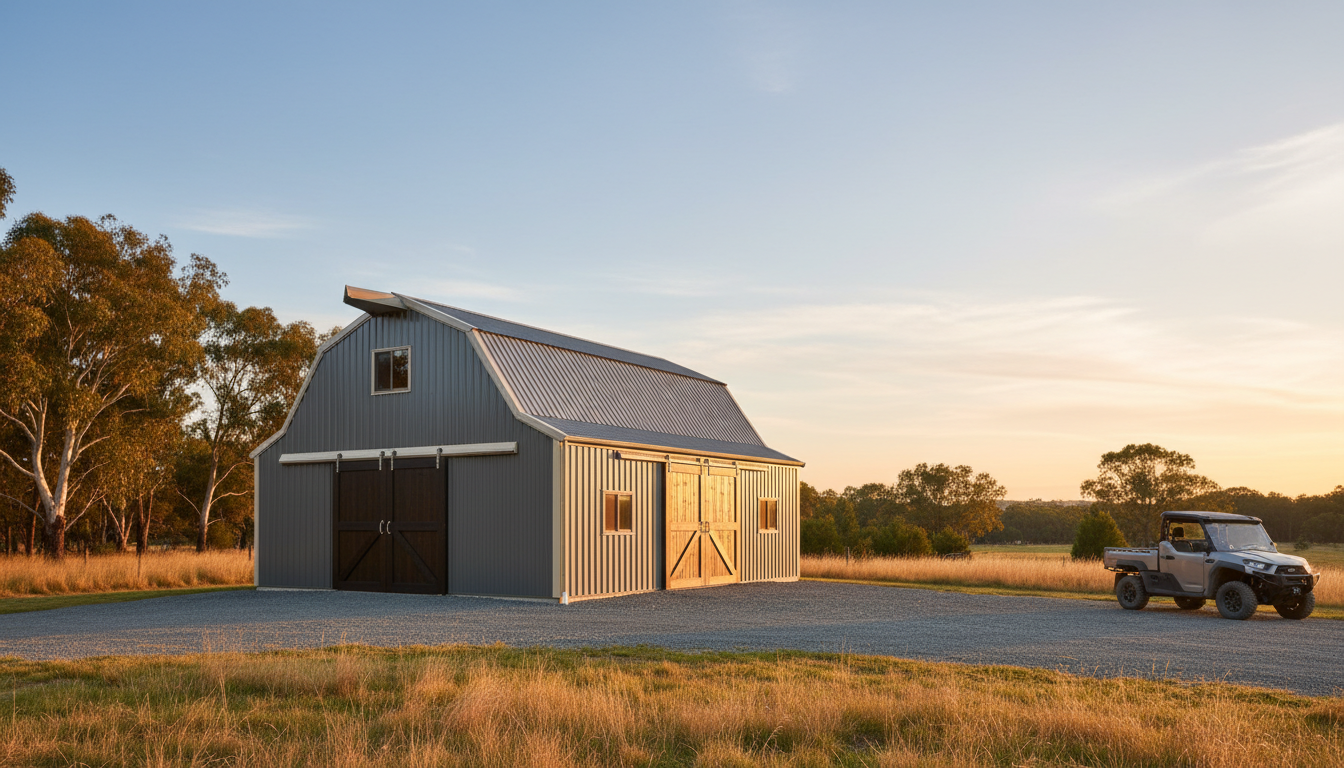
Quaker Barn Sheds draw from pragmatic agricultural buildings used historically by Quaker communities in North America and Britain. The aesthetic prioritises symmetry, simplicity and proportional balance: a rectangular footprint, a steep gabled roof, and evenly spaced windows. In contemporary Australian practice this vocabulary is preserved but adapted with modern materials and engineering for local climates and regulatory requirements.
Key Design Characteristics: Roof Pitch, Symmetry, and Window Styles
Signature design cues include a steep roof pitch (commonly 30°–45°), symmetrical façades with a centered ridge, and vertically proportioned windows often with divided panes. The roof pitch increases internal volume, improves rain shedding and enables loft or mezzanine spaces. Windows are selected not only for aesthetics but for ventilation, daylighting and egress — common options include double-hung, casement and fixed divided-pane windows.
Typical Dimensions & Roof Pitch Guidance
Below are worked examples to help you brief a designer:
- Example 1 — Small hobby shed (6 × 9 m): Roof pitch 35°; overall ridge height ≈ 4.2 m; internal clear height at eaves ≈ 2.4 m; usable loft area under the roof at 1.5 m headroom ≈ 3.2 m × 6 m. Suited for a workshop or vehicle storage.
- Example 2 — Medium shed with mezzanine (9 × 12 m): Roof pitch 40°; overall ridge height ≈ 6.0 m; ground-floor clear height 3.0 m; mezzanine usable area up to 30–35% of footprint depending on stair placement and structural member depth. Ideal for mixed workshop/residential utility or loft storage.
These examples are typical starting points; final dimensions must reflect local council height limits and engineered structural member sizes.
Window Configurations, Ventilation and Thermal Comfort Strategies
Window choice impacts ventilation, daylighting and egress:
- Double-hung: Good for controlled ventilation and traditional proportions; easy to fit in divided-pane aesthetic.
- Casement: Excellent for catching breezes and maximising airflow; useful where cross-ventilation is the priority.
- Fixed divided-pane: Best for daylight without ventilation (clerestory use), preserves historical look.
Key thermal comfort strategies that integrate with Quaker symmetry include clerestory windows for top-level daylight and stack ventilation, ridge vents combined with eave intake vents, deep eaves or external shading for west-facing glazing, and reflective roof finishes. These reduce reliance on mechanical cooling and support NCC 2025 energy-efficiency objectives.
Structural Options: Timber, Engineered Timber & Steel
Contemporary Quaker Barn Sheds usually use one of three structural approaches: traditional sawn timber framing with engineered connections, engineered timber (glulam or LVL) for longer spans and cleaner lines, or light-gauge steel framing for higher wind zones and durability. Each option affects internal layouts, connection details and overall cost. Timber gives warmth and easier on-site modification; steel gives slimmer members and higher durability under coastal exposure.
Design Checklist: Briefing Your Designer
- Primary use: workshop, storage, habitable, or mixed-use (affects NCC clauses and insulation).
- Preferred footprint and mezzanine requirements (list desired floor area and loft use).
- Target roof pitch and maximum ridge/eave heights (confirm local height limits).
- Preferred cladding (Colorbond or hardwood) and colour palette.
- Ventilation strategy: cross-ventilation, ridge vents, clerestory windows.
- Required wind rating or cyclone rating (if coastal/Qld) for insurance & compliance.
- Access needs: vehicle doors, sliding barn doors, personnel doors, and services.
When you’re ready to see plan examples or compliant layouts, review our modern resources such as modern barn house plans and compliance in Australia for further inspiration and compliance pointers.
Council Approval and Regulatory Frameworks for Quaker Barn Sheds in Australia
Overview of the National Construction Code (NCC) 2025
The NCC 2025 sets performance requirements for health, safety, amenity and sustainability. Relevant areas for Quaker Barn Sheds include structural adequacy (wind and gravity loads), energy efficiency (NCC Section J), fire safety where buildings are habitable or near property boundaries, and access. For NCC guidance and handbooks, consult the Australian Building Codes Board: abcb.gov.au.
Professional disclaimer: This guide is general information only — consult your local council and a certified structural engineer for site-specific compliance.
Approval Pathways: DA vs CDC and What Determines the Route
There are two common approval routes:
- Complying Development Certificate (CDC): Used where the proposal meets pre-defined development standards in state policy and local codes; typically faster (3–8 weeks) if criteria are met and documentation is complete.
- Development Application (DA): Required for non‑complying elements, larger or discretionary proposals, or where council-required consultation is necessary; timelines vary (6–12+ weeks) and may include public notification.
Whether you use a CDC or DA depends on local planning controls and the shed’s size, height, and proximity to site constraints such as heritage overlays or tree protection zones.
Authoritative Local Resources
- Australian Building Codes Board (NCC) — https://www.abcb.gov.au/ (NCC guidance and updates).
- NSW Planning Portal — https://www.planningportal.nsw.gov.au/ (Sydney area DA/CDC guidance and lodgement).
- Planning Victoria — https://www.planning.vic.gov.au/ (Melbourne and Victorian planning tools).
- Brisbane City Council — https://www.brisbane.qld.gov.au/ (Brisbane building and development pages).
Three Local Case Studies: Sydney, Melbourne, Brisbane
Sydney — 6 × 9 m Workshop (Inner Western Sydney)
Project snapshot: small 6 × 9 m Quaker Barn Shed on a suburban lot in Inner Western Sydney. Roof pitch 35°, Colorbond cladding in Monument colour, ridge height 4.4 m to suit local height limits; internal use: hobby workshop.
Approval path and documents: Lodged as a CDC after a pre-lodgement meeting. Submitted documents included: site plan with contours, engineered footing and frame drawings, architectural elevations, BASIX not required (non-habitable), tree-impact report (negligible), and structural engineer certificate referencing NCC 2025 wind loading. Timeline: pre-lodgement meeting week 0, lodgement week 1, CDC issued week 4 — total 4 weeks.
Council queries & resolution: Council requested reduced eave projection to meet setback interpretation and confirmation of stormwater runoff management. Resolved by submitting revised plan with concealed gutter detail and engineer calculations for stormwater retention on site. Key takeaways: early engagement and complete engineered documentation reduced the review time.
Melbourne — 9 × 12 m Mezzanine Workshop (Outer Northern Suburb)
Project snapshot: medium 9 × 12 m Quaker Barn Shed with 30% mezzanine for storage and office space. Roof pitch 40°, hardwood feature cladding selected for street presentation, overall ridge height 6.0 m. Located in an area requiring stormwater detention and neighbourhood amenity assessment.
Approval path and documents: Lodged as a DA due to variation in eave height and visible hardwood cladding within a neighbourhood character overlay. Documents included: site analysis, shadow diagrams, stormwater/drainage design, engineered structural drawings (AS/NZS 1170.2 wind load calculations cited), an acoustic report (due to potential workshop noise), and heritage overlay check (no heritage impact). Timeline: lodgement week 0, public notification period 4 weeks, council requests week 7, amended plans lodged week 9, approval granted week 12 — total 12 weeks.
Council queries & resolution: Council was concerned about visible timber maintenance and potential neighbour amenity. Resolved by committing to specified hardwood finish and maintenance schedule, and installing a stormwater detention tank to resolve runoff concerns.
Brisbane — Coastal Property 9 × 12 m (Near-Cyclone Prone Area)
Project snapshot: coastal 9 × 12 m Quaker Barn Shed designed for elevated wind actions. Roof pitch 38°, Colorbond with heavy-duty fixings, elevated slab on piers to manage storm surge risk, overall ridge 5.6 m. Use: combined storage and machinery shed.
Approval path and documents: CDC pathway used where possible, but structural design required detailed cyclone-rated connections. Documents lodged: site plan with flood overlay assessment, geotechnical report (pile design), full structural engineering with AS/NZS 1170.2 referenced (specific wind region mapping), and certified drawings. Timeline: pre-lodgement week 0, lodgement week 1, structural review and council conditional CDC issued week 6 — total 6 weeks.
Council queries & resolution: Council required confirmation of tie‑down capacities and corrosion-resistant fixings for coastal exposure. Resolved by specifying stainless or hot-dipped galvanized fixings and increasing anchor embedment; insurance acceptance required the higher wind rating and was satisfied after resubmission.
Common Documentation Checklist
- Site plan (to scale) with property boundaries, setbacks and stormwater flow.
- Floor plans and elevations with heights and materials noted.
- Engineered structural drawings and wind loading calculations (AS/NZS 1170.2 referenced).
- Soil/geotechnical report for foundations (if required).
- Stormwater/drainage design or drainage management statement.
- Heritage or environmental studies if in overlays or flood zones.
- Evidence of builder insurance and contractor certifications (if requested).
Early pre-lodgement meetings with council planners and engaging a certified structural engineer greatly reduce the risk of extended reviews and additional costs.
Material Selection for Quaker Barn Sheds in the Australian Market
Popular Cladding Materials: Colorbond Steel and Australian Hardwood Timber
Colorbond steel (BlueScope) and Australian hardwood are the two most common exterior materials for Quaker Barn Sheds. Colorbond offers a broad colour palette, strong corrosion protection systems and long service life — see BlueScope Colorbond technical data for product specifics: bluescope.com. Hardwood provides a bespoke, warm aesthetic, and when responsibly sourced and treated offers long-term performance.
| Material | Features | Advantages | Indicative Cost (AUD/m²) |
|---|---|---|---|
| Colorbond Steel | Pre-painted steel, corrosion protection systems | Durable, low maintenance, termite-proof, fast supply | $45–$65 |
| Australian Hardwood Timber | Solid hardwood boards, treated for weather resistance | Aesthetic warmth, renewable if certified, easy on-site modification | $50–$80 |
Standards and Supplier References
For Colorbond technical and warranty details consult BlueScope: BlueScope Colorbond technical data. For sustainably sourced timber guidance refer to Responsible Wood and the Forest Stewardship Council: fsc.org and responsiblewood.org.au. These references help confirm certification, durability expectations and environmental credentials.
Insulation, R-values and Energy Efficiency
Insulation selection depends on climate band and NCC Section J targets. Indicative recommendations:
- Cool temperate zones (Melbourne, Tasmania): roof R-values R4.0–R6.0 (or equivalent), wall R2.5–R4.0.
- Temperate zones (Sydney): roof R3.0–R5.0, wall R2.0–R3.5.
- Hot/humid and tropical zones (Northern QLD): focus on reflective foil and ventilation to reduce heat gain; roof R2.0–R3.5 as indicative.
Refer to NCC guidance for exact prescribed R-values; use insulation materials like reflective foil laminates, polyester batts, or natural wool depending on performance and VOC preferences.
Maintenance Cycles & Expected Lifespan by Climate
| Material | Climate | Maintenance Cycle | Indicative Lifespan |
|---|---|---|---|
| Colorbond Steel | Coastal | Inspect annually; wash salt deposits every 6–12 months | 30+ years (with correct maintenance) |
| Colorbond Steel | Inland | Inspect every 2 years; touch-up finishes as required | 30+ years |
| Australian Hardwood | High UV/Coastal | Seal or stain every 12 months; check fastenings annually | 20–30 years (depending on species & maintenance) |
Source: SmallTrades market survey — Apr 2025 (see Sources & methodology).
Supply Chain & Lead Times (2025)
Typical lead times in 2025:
- Colorbond panels and standard steel framing: 2–4 weeks from order (stock dependent).
- Specialty or heritage-matched hardwoods: 6–12 weeks depending on milling and certification.
- Engineered timber elements (glulam/LVL): 4–8 weeks (fabrication dependent).
Recommendation: confirm availability with suppliers at tender stage and allow contingency for long-lead specialty items.
If you want a detailed comparison between timber and steel options, see our guide on timber barn kits versus Colorbond steel sheds in Australia. To help decide between Colorbond and alternative metals, view our notes on Colorbond vs Zincalume cladding options.
Comprehensive Pricing Breakdown for Quaker Barn Sheds in 2025
Prices below are indicative 2025 averages. Always obtain site-specific quotes and add local permit fees and engineering costs where required. Prices accurate as of Apr 2025 — source lines follow each table.
Representative Cost Scenarios — 6 × 9 m Shed (Indicative 2025 pricing)
| Item | Low Spec | Mid Spec | High Spec |
|---|---|---|---|
| Foundation (gravel pad / slab edge) | $4,000 | $7,000 | $12,000 |
| Frame (timber / engineered) | $6,500 | $9,500 | $14,000 |
| Cladding & Roof (Colorbond / hardwood) | $4,500 | $6,000 | $9,000 |
| Insulation & internal lining | $1,200 | $2,200 | $3,200 |
| Windows & doors | $1,200 | $2,500 | $4,500 |
| Electrical & minor services | $1,500 | $3,000 | $6,000 |
| Permits & engineering | $1,000 | $2,200 | $4,000 |
| Labour & installation | $6,000 | $10,000 | $18,000 |
| Contingency (10%) | $2,990 | $4,940 | $7,670 |
| Total (indicative) | $28,890 | $47,340 | $78,370 |
Source: SmallTrades market survey Apr 2025 / local contractor quotes. Permit fee example: typical NSW local council permit approx. $1,200 (varies).
Representative Cost Scenarios — 9 × 12 m Shed (Indicative 2025 pricing)
| Item | Low Spec | Mid Spec | High Spec |
|---|---|---|---|
| Foundation (slab / piers) | $12,000 | $18,000 | $30,000 |
| Frame (timber / steel) | $11,000 | $18,000 | $30,000 |
| Cladding & Roof | $9,000 | $14,000 | $22,000 |
| Insulation & internal lining | $2,800 | $4,800 | $8,000 |
| Windows & doors | $3,500 | $6,000 | $10,000 |
| Electrical, plumbing & services | $5,000 | $9,000 | $18,000 |
| Permits & engineering | $2,500 | $4,500 | $8,000 |
| Labour & installation | $20,000 | $34,000 | $60,000 |
| Contingency (10%) | $6,680 | $10,430 | $18,800 |
| Total (indicative) | $72,480 | $119,730 | $204,800 |
Source: SmallTrades market survey Apr 2025 / HIA labour rate indications 2025. Note: commercial-grade electrics, mezzanine finishes and climate-specific engineering will push totals higher.
How to Use These Scenarios
Choose a scenario as a budgeting baseline. Factor in site-specific costs (access, rock excavation, geotechnical issues), council contributions and potential connection fees for services. Always include a 10% contingency for unforeseen items.
To compare broader project types, see our barndominium guidance at barndominium homes Australia guide.
Installation Process and Practical Considerations for Quaker Barn Sheds
Pre-Construction Steps and Site Preparation
Initial tasks and estimated durations:
- Pre-lodgement & design finalisation: 1–3 weeks (depends on consultant availability).
- Site clearing and set-out: 2–5 days (depends on trees and site access).
- Soil testing/geotechnical report (if required): 1–2 weeks to commission and receive results.
Construction Sequence with Typical Durations
- Foundations: excavation and formwork 2–5 days; pour and curing for slab 7–14 days depending on mix and weather; piers typically 3–7 days (including pile work).
- Frame assembly: 3–10 days depending on size and crew (timber vs steel framing speed differs).
- Roof & cladding: 2–7 days for sheeting and flashings; longer if heavy duty fixings or insulation retrofits are required.
- Services & internal finishes: 1–3 weeks for electrics, plumbing and internal linings depending on scope.
- Final inspections & commissioning: 1–2 days for council/engineer sign-offs.
Typical overall construction time for a small shed: 3–6 weeks; medium shed with mezzanine and services: 6–12 weeks (includes inspections and finishing).
Permit Checkpoints & Who Performs Them
- Pre-construction engineer sign-off (structural engineer) — before framing.
- Pegs and set-out verification — certified surveyor or builder provides evidence.
- Pre-slab or pier inspection — council or private certifier as applicable.
- Frame inspection (where required) — certifier or council officer.
- Final occupation or compliance inspection — council/private certifier issues final certificate.
DIY vs Contractor — Decision Table & Skills Checklist
| Task | DIY Acceptable | Engage Licensed Professional |
|---|---|---|
| Site clearing & basic landscaping | Yes (with care) | No |
| Footings and concrete slab | Not recommended | Structural engineer & licensed concreter |
| Framing (timber simple frames) | Experienced DIY with engineer input for small sheds | Complex frames, engineered connections, steel framing |
| Electrical & plumbing | No | Licensed electrician/plumber |
Engage licensed trades for electrical, plumbing and for geometric tolerances in structural connections, particularly where the wind rating or local codes require certified installation.
Installer QC Checklist (practical tips)
- Check fastener spacing and type match engineer specs for wind rating (AS/NZS 1170.2 referenced where performance required).
- Verify flashing continuity at roof-walls and openings; no exposed fixings in horizontal laps prone to water ingress.
- Validate cladding laps and kickers follow manufacturer’s installation guides (Colorbond datasheets).
- Confirm continuous eave and ridge ventilation where specified; check insulation installation for uninterrupted batts and foil laps.
- Document all inspections and sign-offs on-site to streamline final certification.
For mezzanine specifics and structural considerations, review our additional resource on barn sheds with mezzanine floors.
Post-Installation: Handover & Compliance
During handover obtain as-built drawings, engineer sign-off, warranty documentation and maintenance schedule. These documents are essential for insurance and future resale value.
Sustainability and Weather Resilience in Quaker Barn Sheds
Standards and Wind Loading Guidance
Design wind actions must reference AS/NZS 1170.2 (Wind Actions). This standard, together with regional wind maps and local site classifications, determines cladding fixings, anchor sizing and member capacity. Designers should specify wind classification (N1–N6) for the site and show compliance in structural calculations. For example, many coastal Queensland locations require a higher design action (N3–N6) to meet cyclone requirements.
Selecting Wind Ratings and Construction Responses
Action steps for wind resilience:
- Identify regional wind classification early (consult AS/NZS 1170.2 regional maps via structural consultant).
- Specify cladding fixings, increased screw density and corrosion-resistant fasteners in coastal zones.
- Use deeper footing embedment or pile foundations where uplift is significant; include tie-down straps detailed by an engineer.
Energy Efficiency Best Practice & NCC Section J
To meet NCC 2025 energy objectives, consider reflective roof finishes (high solar reflectance), adequate roof/wall insulation tuned to the climate band and minimising thermal bridging at connections. Indicative R-targets were provided earlier — final compliance must follow NCC Section J calculations in the documented statement of energy performance.
Five-Point Maintenance Schedule for Longevity & Insurance
- Annual external inspection: check paint, seals, flashings and fasteners; wash off coastal salt deposits.
- Every 3–5 years: re-seal timber cladding or touch-up Colorbond scratches to prevent corrosion.
- Every 5 years: check and service rainwater goods and downpipes; clear gutters and check outlets.
- After major storms: inspect for uplift, loose fixings and water ingress; record and repair promptly for insurance claims.
- Maintain documentation of all maintenance and repairs for warranty and insurer requirements.
Insurance considerations: many insurers require elevated wind rating compliance and documented maintenance to cover coastal or cyclone-prone properties — verify policy terms before construction.
Conclusion & Next Steps
Quaker Barn Sheds combine classic aesthetics with practical function and are fully compatible with modern Australian regulatory and climatic demands when designed and built correctly. Next steps: finalise your brief using the design checklist, confirm material and lead times with suppliers, and arrange a pre-lodgement meeting with your local council. Download the DA checklist and council submission template to streamline lodgement.
Download: Quaker Barn Sheds Australia 2025 — council checklist and DA template.
Professional disclaimer: This guide provides general information only. Always consult your local council and a certified structural engineer or building surveyor for site-specific compliance and construction approvals. If you need professional assistance, contact our team for a referral to a certified engineer.
Sources & methodology
- SmallTrades market survey and contractor quote aggregation — April 2025.
- BlueScope Colorbond technical and warranty information — bluescope.com (accessed Apr 2025).
- HIA labour rate indicators — 2025 survey.
- AS/NZS 1170.2 (Wind Actions) and NCC (ABCB) guidance — abcb.gov.au (referenced for standards).
- FSC and Responsible Wood certification guidance — fsc.org and responsiblewood.org.au (accessed Apr 2025).
Frequently Asked Questions
What are the key design features that define Quaker Barn Sheds in Australia?
Quaker Barn Sheds feature a steep gabled roof (commonly 30°–45°), a symmetrical façade, evenly spaced divided‑pane windows and a rectangular plan. Design focuses on natural ventilation, usable loft/mezzanine space and simple proportions, blending heritage aesthetics with modern materials and engineered structural connections.
How long does the council approval process take for a Quaker Barn Shed?
Complying Development Certificates (CDC) commonly take 3–8 weeks when documentation is complete; Development Applications (DA) typically take 6–12 weeks or longer depending on public notification and council queries. Early pre‑lodgement meetings and certified engineer submissions can reduce timeline risks.
Which materials are best suited for building Quaker Barn Sheds in coastal climates?
Colorbond pre-painted steel is widely preferred for coastal exposure due to corrosion-resisting coatings, quick availability and low maintenance. When timber is used, specify durable hardwoods with appropriate treatments and corrosion‑resistant fixings and commit to a stricter maintenance schedule to manage salt and humidity.
Can I customize my Quaker Barn Shed design without violating local regulations?
Yes—customisation is common, but it must meet NCC and local planning controls. Variations that affect height, setbacks or environmental overlays may require a DA. Engage council early and use certified engineers to certify structural elements to improve approval likelihood.
What is the typical cost breakdown for constructing a Quaker Barn Shed in 2025?
Typical cost items include foundations, frame, cladding/roofing, insulation, windows/doors, services, permits/engineering, labour and contingency. For a 6×9 m shed expect total ranges from ≈$29k (low) to ≈$78k (high); a 9×12 m shed typically ranges ≈$72k to $205k depending on spec. (Indicative Apr 2025).
What are the main challenges during the installation of Quaker Barn Sheds?
Common challenges include site access and uneven ground, supply lead‑times for specialty materials, meeting wind‑rating foundations and anchor requirements, and coordinating council inspections. Early ordering, thorough site investigation and certified drawings mitigate most of these issues.
How do local climate conditions influence insulation and ventilation choices?
Cool climates demand higher R‑value insulation and thermal breaks; hot/humid climates require reflective roofing, natural ventilation strategies (ridge and eave vents) and moisture‑resistant materials. Insulation selection must balance NCC energy targets, occupant comfort and condensation control per local conditions.
Are there financing options or grants available for building sustainable Quaker Barn Sheds in Australia?
Financing options include personal loans, construction loans and some green home improvement loans or rebates for energy-efficient upgrades. Occasional local government grants or rebates may apply for sustainable measures; check state and council programs and consult lenders for current offers.