

Upgrade your property with an industrial building–grade steel shed that’s engineered for Australian conditions. From a custom-built double garage in Perth to cyclone-rated sheds in QLD and rural machinery storage in NSW, this guide explains design choices, wind compliance, Colorbond vs Zincalume, council approvals, and cost drivers—so you buy once and buy right.
What Are the Best Shed Materials for Perth’s Climate?
Perth’s hot summers and coastal air demand materials that handle heat and corrosion. Most premium domestic sheds use BlueScope steel in Colorbond or Zincalume finishes. For backyards west of the escarpment or within coastal influence, material choice matters as much as design.
Colorbond vs Zincalume — Which Is Better for WA Conditions?
| Criteria | Colorbond | Zincalume |
|---|---|---|
| Coating and finish | Painted topcoat over AZ base; multiple layers for UV and chalking resistance | AZ metallic coating only; no colour topcoat |
| Coastal corrosion resistance | Excellent with correct grade and setbacks; good for coastal Perth with maintenance | Very good, but may show patina; watch for salt spray zones |
| Heat reflectivity | High in lighter solar-reflective colours (Thermatech) | High reflectance in bare metal; can glare |
| Colour range | Extensive Colorbond palette matched to gutters/flashings | Limited (metallic finish) |
| Warranty | Typically up to 20–25 years on roofing/walling when compliant | Comparable substrate warranties; check product/zone specifics |
| Cost | Higher upfront | Lower upfront |
| Best use | Premium residential sheds, custom Colorbond garages Perth | Rural sheds NSW interiors, budget DIY shed kits |
How Industrial Building Design Principles Improve Your Backyard Shed
Borrowing from commercial sheds, residential industrial building designs use engineered portal frames, C/Z purlins, certified hold-downs, and slabs detailed to AS 2870. The result: a quieter, stiffer shed that stands up to storms and long service life.
- Frames: Cold-formed galvanised C/Z sections to AS/NZS 4600; hot-rolled members to AS 4100 for large spans or mezzanines.
- Wind actions: Designed to AS/NZS 1170.2 for Region A–D and terrain categories. Doors and connections are critical.
- Cladding: Colorbond or Zincalume to AS 1397 with correct thickness (e.g., 0.42/0.48 BMT).
- Fasteners and flashings: Cyclone washers and screw patterns verified for edge zones (Zone 5) in high winds.
- Thermal/condensation: Insulation blankets (R1.3–R2.5), vapour barriers, and anticon to reduce heat and drips per NCC 2022.
Added 2024 WA wind-rating compliance notes: Perth metro is generally Region A (N2–N3), but sites exposed to coastal winds or escarpments may need higher categories. Pilbara and parts of the Gascoyne fall into Region D; specify cyclonic kits and door systems certified for internal/external pressure combinations.
Which Shed Type Suits Your Property?
For compact hobby spaces and backyard benches, see our work shed guide for Australian homes.
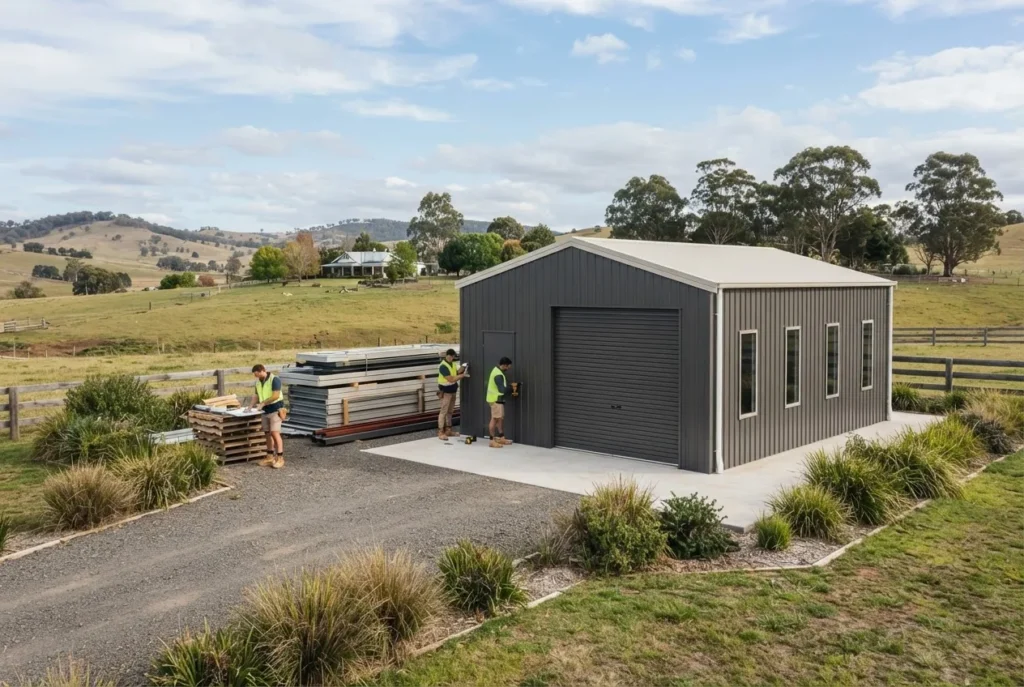
Custom-built double garage in Perth
Popular sizes: 6×6 m to 7×9 m with 2.4–3.0 m eave height. Pair Colorbond walls/roof with insulated roof blanket for summer comfort. Add a PA door, cyclone-rated roller doors if near the coast, and vermin flashing.
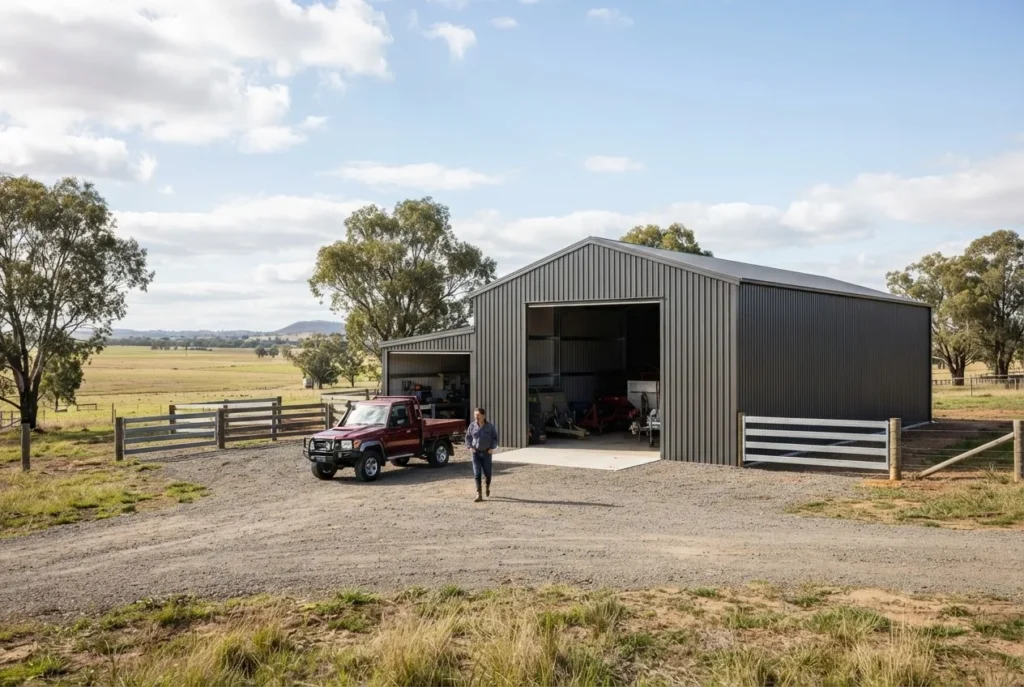
Rural sheds NSW for farm machinery storage
Open-bay hay/machinery sheds (e.g., 12×24 m with 4.5–5.0 m eaves) using hot-dipped columns, Z purlins, and long-bay portals reduce posts in working areas. Consider Zincalume roof for glare reduction inside and Colorbond walls for looks.
Custom carports Melbourne
Double or triple-bay carports engineered to snow/wind for Victoria’s regions, with gable or skillion roof, powder-coated posts, and integrated gutters. Ideal as affordable carports for Australian homes.
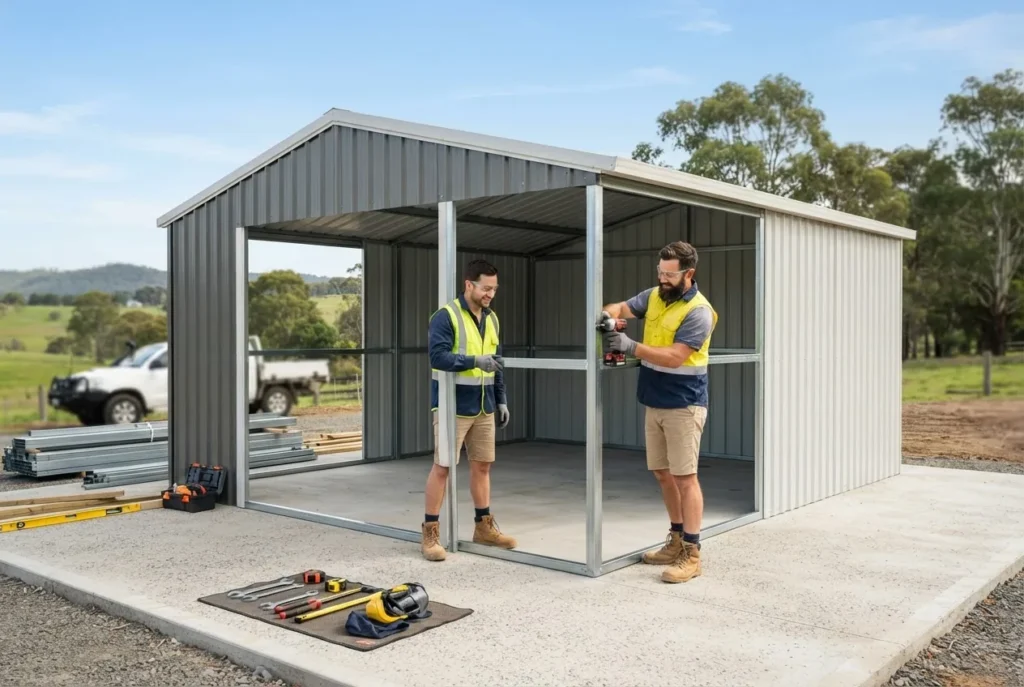
DIY shed kits vs custom-built
| Factor | DIY Shed Kits | Custom-Built (Supply & Install) |
|---|---|---|
| Cost | Lowest upfront | Higher upfront; turnkey |
| Lead time | Fast dispatch | Design, engineering and scheduling add time |
| Approvals | You manage council | Builder manages approvals and certification |
| Complexity | Best for simple single-bay sheds | Best for large garages, mezzanines, custom loads |
| Performance | To spec when built per plans | Optimised to site wind, terrain, exposure |
Roof Styles and Drainage for Australian Weather
| Roof type | Pros | Cons | Best for |
|---|---|---|---|
| Gable | Great drainage, classic look, good headroom | More ridge/flashing interfaces | Garages and workshops |
| Skillion (single pitch) | Modern, simple gutters, solar-friendly pitch | Lower high-side eave if height-limited | Carports Melbourne, tight setbacks |
| Flat (low pitch) | Cost-effective, low profile | Needs careful drainage sizing to AS/NZS 3500 | Small DIY shed kits |
Council Approvals and Compliance Across Australia
How to Get Council Approval for Your Custom Shed in WA
- Confirm zoning and setbacks on your site plan (R-Codes and local scheme).
- Obtain certified engineering for your wind region and terrain to AS/NZS 1170.2.
- Prepare drawings: floor plan, elevations, slab details (AS 2870), stormwater.
- Lodge a BA2/BA3 (certified) or BA1 (uncertified) with your council, plus energy/condensation notes if required by NCC 2022.
- On completion, book inspections and secure Form BA7 (notice of completion).
Ask for council-approved sheds WA packages that include engineering, site plans, and certification to save time.
Cyclone Regions in QLD and WA
- QLD (Region C): Coastal north and parts of central QLD need cyclone-rated sheds QLD with C1–C4 engineering, wind-rated roller doors, and enhanced hold-downs.
- WA (Region D): Pilbara and parts of Gascoyne require D-rated design; check door span limits and pressure combinations.
BAL, Coastal, and Corrosion Notes
- Bushfire (AS 3959): BAL-12.5 to BAL-40 can trigger ember seals, mesh to vents, and glazed opening protection.
- Coastal: Use marine-grade fasteners, sealed cut edges, and rinse schedules within the surf zone.
- Condensation (NCC 2022): Provide vapour-permeable sarking and ventilation in cooler climates.
Planning a commercial‑scale build? Use our warehouse building in Australia guide for specifications and approval checklists.
Real Build Examples (Australia-Wide)
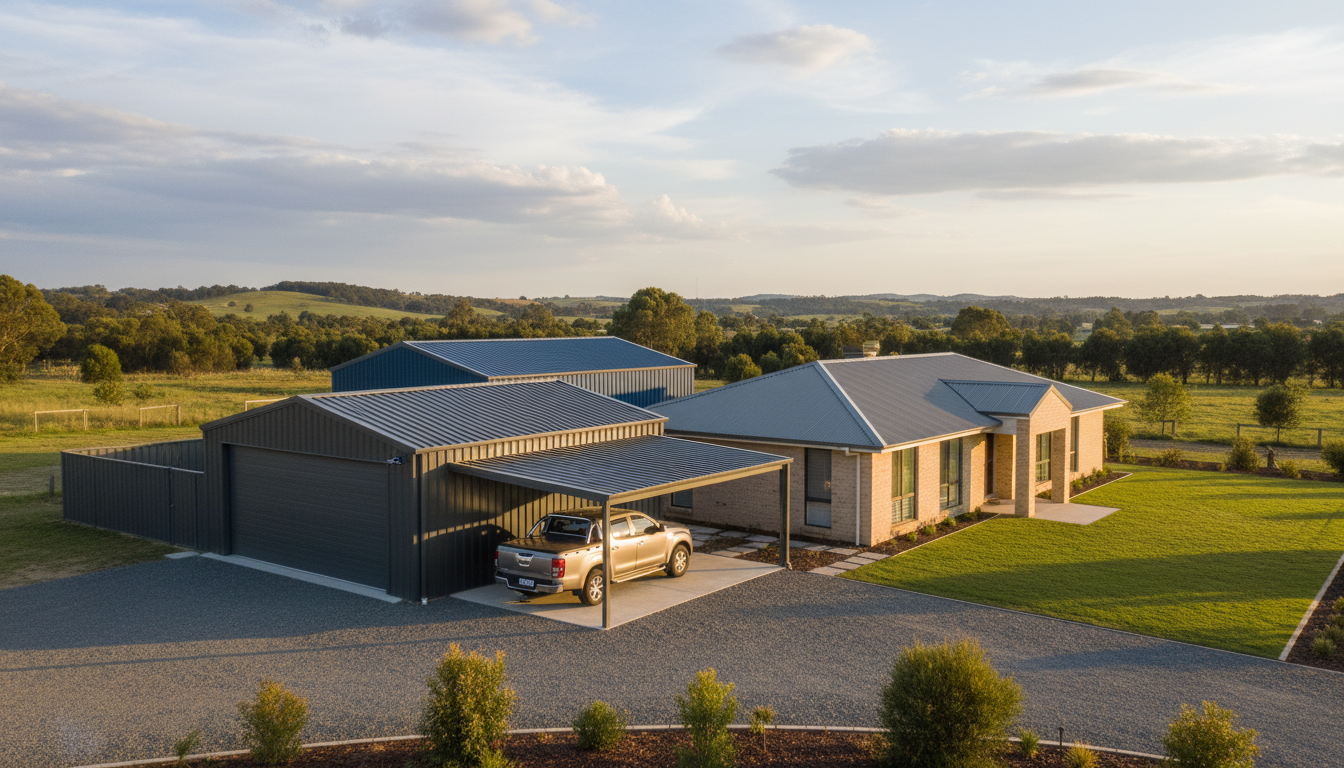
Perth: Custom Colorbond Double Garage
7×9 m, 3.0 m eaves, Colorbond Monument walls/roof, roof blanket R1.3, 2× 2.7 m wind-rated roller doors, slab to AS 2870, internal workshop bay. Result: a quieter, cooler garage suitable for summer heat—an example of custom Colorbond garages Perth.
Central QLD: Cyclone-Rated Farm Shed
12×18 m, 5.0 m eaves, Region C, open-front 3-bay with hot-dipped posts, C-sections, and C2 door system on enclosed bay for safe plant storage.
Rural NSW: Hobby Workshop
6×9 m gable, Zincalume roof and Colorbond walls, translucent skylight sheets, vermin seals, mezzanine platform. Designed for rural sheds NSW with cool nights and summer heat swings.
Cost Guide 2025: What Influences Price?
Prices vary by size, height, wind rating, and fit-out. Smaller DIY kits can be a few thousand dollars; large custom garages and rural sheds can run into the tens of thousands. Key drivers:
- Wind region (N2 vs C/D cyclonic hardware and door systems)
- Steel thickness (0.42 vs 0.48 BMT cladding), frame weight, bay spacing
- Doors (roller vs sectional), windows, insulation, skylights
- Concrete slab thickness and soil reactivity (AS 2870)
- Site access, earthworks, and stormwater requirements
5-Step Buying Guide for Custom Sheds in Australia
- Define use-case: farm machinery storage, workshop sheds, boat/caravan, or affordable carports for Australian homes.
- Confirm site parameters: setbacks, easements, overheads, and wind region.
- Choose materials: Colorbond for premium looks or Zincalume for value; consider insulation.
- Select builder: ask for AS/NZS engineering, council-approved sheds WA experience if relevant, and BlueScope-backed warranties.
- Lock in inclusions: gutters/downpipes, vermin flashing, roller door wind ratings, skylights, power and drainage.
FAQs for Australian Homeowners
Do I always need council approval?
Many councils require approval for sheds over a small area or height, or near boundaries. In WA and QLD, most garages and carports need building permits; planning may be exempt if compliant with setbacks. Check your local rules before ordering.
Which wind rating do I need?
Most suburban sites are N2–N3 (Region A). Coastal/exposed or cyclonic zones use C1–C4 (QLD) or D (Pilbara WA). Your engineer will set design actions to AS/NZS 1170.2 based on region, terrain, shielding, and topography.
What slab thickness should I allow?
Common residential slabs are 100–125 mm with thickened edges and mesh, but engineering to AS 2870 and soil tests govern the final design.
How long does delivery take in 2025?
Standard kits can dispatch in weeks; custom builds take longer for design, approvals, and scheduling. Lead times fluctuate with steel supply and local demand.
Colorbond vs Zincalume—what should I choose?
Colorbond for premium looks and colour stability; Zincalume for value and high reflectivity. In coastal or cyclonic areas, pay attention to product grade, fixings, and maintenance regimes.
Related Solutions and Coverage
We supply and install: steel sheds Perth, custom carports Melbourne, rural sheds NSW, wind-rated sheds for cyclonic areas, farm sheds WA, workshop sheds Adelaide, American barns, horse stables, mezzanine floors, DIY shed kits, council-approved sheds WA, cyclone-rated sheds QLD, and custom Colorbond garages Perth. We also advise on Colorbond vs Zincalume comparison and energy-smart designs for Australian homes.
Queensland readers can check Sheds Ipswich for local pricing, materials and private‑certifier pathways.
References and Standards
- Australian Steel Institute — design guidance and steel performance: industry resources
- Housing Industry Association — outdoor structures insights and compliance: HIA
- Master Builders Australia — building codes and regulatory updates: Master Builders
- Bureau of Meteorology — wind region maps and climate data: BOM
- Energy.gov.au — insulation and energy efficiency guidance: Energy efficiency
- Standards references: NCC 2022 (BCA), AS/NZS 1170.2 (wind actions), AS 4100 (steel structures), AS/NZS 4600 (cold-formed steel), AS 2870 (slabs/footings), AS 3959 (BAL).
Why Choose an Industrial Building–Grade Shed?
- Engineered longevity: compliant frames, fixings, and cladding for Australian weather
- Better doors and connections: a common failure point addressed by certified hardware
- Future-proofing: loads for storage racks, solar PV, or a small mezzanine
- Resale appeal: Colorbond finishes, clean installation, and documented approvals