

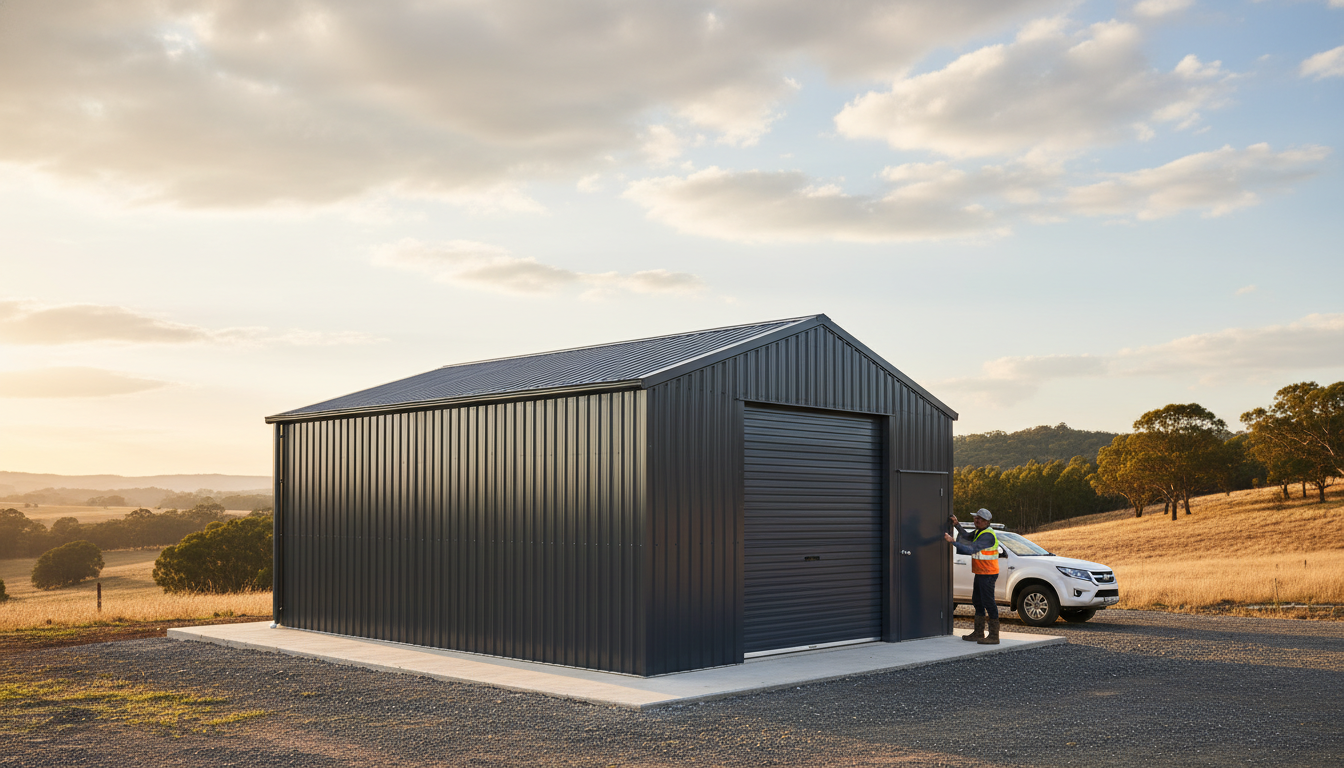

If you’re comparing a 6×4 shed for storage, a compact workshop, or a small farm implement bay, this expert guide gives you clear, Australian-specific answers on materials, wind ratings, council approvals, and costs—so you can choose a shed that lasts in local conditions.
Is a 6×4 shed 6 metres by 4 metres or 6 feet by 4 feet?
In Australia, most shed builders describe a 6×4 shed as a 6 metre x 4 metre footprint (approx. 24 m²). Some big-box retailers use feet for small garden sheds (6 ft x 4 ft ≈ 1.8 m x 1.2 m). When you ask for a 6×4 garden shed, confirm units:
- 6 m x 4 m shed: suits a compact workshop, ride-on mower storage, or narrow carport-style cover.
- 6 ft x 4 ft shed: suits garden tools and a push mower only.
For a 6 m x 4 m slab, many installers specify 100 mm thick, SL72 mesh, MPA25 concrete with edge thickenings to suit the engineer’s detail and soil class (AS 2870). Allow perimeter clearance for gutters and drainage.
What are the best shed materials for Perth’s climate?
Perth’s heat, UV, and coastal air demand proven cladding and fasteners. Two dominant choices are pre-painted Colorbond steel and bare-metal Zincalume steel by BlueScope. Both perform, but they’re different.
| Factor | Colorbond steel | Zincalume steel |
|---|---|---|
| Coating system | Painted topcoat over alloy-coated substrate; high UV resistance | Aluminium-zinc alloy coating (no paint); bright metallic finish |
| Heat reflectivity | Lighter colours reflect heat; Thermatech technology in many colours | Reflective when new; can dull over time |
| Coastal resistance | Strong performance inland and many coastal areas; check distance-to-coast in warranty | Good base corrosion resistance; requires more frequent washing near marine |
| Aesthetics | Modern Colorbond palette (e.g., Monument, Surfmist) | Industrial look; paint later if desired |
| Typical use | Premium residential and architectural sheds | Rural and budget-friendly sheds |
| Lifecycle/maintenance | Low maintenance; easy to match gutters/flashings | Low maintenance; washdowns vital in coastal zones |
Fasteners matter as much as sheeting. Use compliant cyclonic or non-cyclonic screws with appropriate Class 4 coatings or stainless near marine zones. Flashings, scribed valleys, and correctly sealed penetrations reduce corrosion risk over time.
How much does a 6×4 shed cost in Australia (2025)?
Prices vary by wind rating, doors, height, and finish. As a planning guide for a 6 m x 4 m Colorbond steel shed:
- DIY shed kits (non-cyclonic, single door, basic windows): roughly $5,500–$9,500 supplied.
- Custom-built, council-approved sheds (engineered, 2.4–3.0 m wall height, roller door, PA door, windows): roughly $11,000–$22,000 installed, plus slab ($2,200–$4,800 typical).
- Cyclone-rated sheds QLD/WA North (Region C/D, C2–C3): allow +20–40% for heavier frames, extra hold-downs, and engineering.
Costs reflect recent material trends noted in 2025 Australian Steel Market Outlook and the 2025 HIA Outdoor Structures & Home Improvement Report. Lead times in 2025 are generally 3–8 weeks for kits and 6–12 weeks for turnkey, pending council and engineering.
What wind rating does my 6×4 shed need?
Wind design for sheds is governed by AS/NZS 1170.2 (Wind actions) and the NCC 2022. Your site’s wind region (A, B, C, D), terrain, shielding, and topography determine design pressures and hold-downs.
- Most metro areas (e.g., Perth, Melbourne, Sydney, Adelaide) are Region A (non-cyclonic). Many house lots are built to N2/N3 equivalent conditions.
- Northern QLD (e.g., Cairns, Townsville) and WA’s northwest (e.g., Karratha, Port Hedland) are cyclonic Regions C/D and require cyclone-rated sheds (C2–C3 systems with specific connections and cladding fixings).
- Hills, escarpments, and coastal exposures increase design pressures; your engineer will specify edge zone fixings, strap bracing, and concrete hold-downs.
Added 2024 WA wind-rating compliance notes
Perth typically falls in Region A, but site specifics still apply. For council-approved sheds WA wide, you’ll need certified drawings and a wind classification noted on the plans (e.g., Region A, Terrain Cat 2, Shielding S2). Coastal shires may require extra corrosion protection and set-backs.
How to get council approval for your custom shed in WA
- Check local planning rules: site coverage, boundary setbacks, and height limits (many 6×4 garden sheds are exempt if under thresholds, but always verify).
- Obtain certified engineering: framing, connections, slab/footings to AS/NZS 4600 (cold-formed steel), AS 4100 (where relevant), AS 2870 (slabs), AS/NZS 1170.2 (wind).
- Prepare documents: site plan, elevations, specifications, bushfire BAL note (if applicable), stormwater disposal.
- Submit building permit: your builder or a private certifier can lodge; timeframes are often 10–25 business days.
- Final inspection and sign-off: ensure compliance with energy/condensation management where required (flashings, vapour barriers, ventilation).
What roof profile suits a 6×4 shed?
- Gable roof: Classic look, good drainage, easy to add whirlybirds or ridge vents. Efficient for 6 m spans with purlins.
- Skillion (mono-pitch): Modern, great for solar, simpler guttering. Watch maximum sheet length and windward uplift.
- Flat roof: Cheapest upfront; best for carport conversions. Ensure adequate fall and oversized box gutters to AS 3500.
Wall height: 2.4 m is common; 2.7–3.0 m gives headroom for roller doors and racking. Door options include 2.4 m roller door on the 4 m elevation, plus a PA door with threshold flashing.
Use-cases: How Australians use a 6×4 shed
- Backyard workshop for DIY shed kits and tools.
- Ride-on mower and ATV storage for small acreage and rural sheds NSW.
- Compact craft studio with insulation and windows.
- Covered parking where a small, affordable carport for Australian homes won’t fit—consider a 6 m x 4 m enclosed bay instead.
- Pool plant and garden equipment in coastal WA using Colorbond steel.
If you’re primarily after shade, compare 6×4 sheds with custom carports Melbourne or a simple skillion carport kit; both can be engineered to suit local wind ratings.
DIY shed kit vs custom-built installation
Both routes can be “right” depending on budget, time, and council rules.
- DIY kit pros: cheapest, quick to order, flexible build schedule. Cons: slab coordination, square/plumb accuracy, warranty dependence on correct install.
- Custom-built pros: council-approved sheds WA and nationwide, single point of accountability, faster inspections, better fit-out (insulation, power). Cons: higher upfront cost, lead time.
Case studies: Real Australian 6×4 builds
Perth backyard, Region A: 6 m x 4 m gable, 2.7 m wall height, Colorbond Monument walls/roof, single 2400 mm roller door on 4 m frontage, PA door, two louvre windows. Slab 100 mm with SL72, M12 chemical anchors per engineer. Cost: approx. $16,800 turnkey plus slab. Outcome: cool in summer with roof insulation and two whirlybirds.
Cairns suburban, Region C (cyclone-rated sheds QLD): 6 m x 4 m skillion, C2 design, extra hold-downs, cyclonic batten screws, closer purlin spacing. Door upgraded to windlock roller door. Cost uplift vs non-cyclonic: ~30%. Result: passed final inspection and performed well through wet-season storms.
5-Step Buying Guide for Custom Sheds in Australia
- Set use and size: Confirm 6 m x 4 m footprint, door clearances, and internal height for racking.
- Choose cladding: Colorbond vs Zincalume based on coast proximity, aesthetics, and budget.
- Confirm wind rating: Get your site’s wind region and terrain; insist on engineer-certified drawings.
- Plan compliance: Check setbacks, BAL, stormwater, and electrical. Aim for council approval before ordering.
- Lock in builder or DIY: Compare kit inclusions, fixings class, gutters, flashings, and warranty terms.
Frequently asked questions
Do I need a concrete slab for a 6×4 shed?
Not always, but a reinforced slab improves durability, anchorage, and weatherproofing. Some rural sites use piers and a suspended floor; follow the engineer’s design for wind tie-downs.
What about condensation and insulation?
Use roof sarking or anti-condensation blanket, ventilate the ridge, and add wall wrap behind sheeting. For comfort, add bulk insulation or insulated roof panels.
Can I collect rainwater from the shed?
Yes. Fit gutters and a downpipe to a small tank. Size gutters to AS 3500 flow rates. Secure tanks with proper bases and overflows away from footings.
Is Colorbond worth the upgrade?
For most metro and coastal homes, yes—better UV durability, colour choice, and street appeal. Zincalume is fine for budget rural installs or internal frames.
What about bushfire areas?
In BAL zones, choose non-combustible cladding, ember-proof vents, and toughened glazing per AS 3959. Position away from heavy vegetation and store fuels safely.
Can I turn a 6×4 shed into a mini-garage?
Yes. Many clients specify a custom-built double garage in Perth for two vehicles, but a 6×4 can be an enclosed single-bay for bikes, trailers, or a compact car with tight clearances. Ensure door width and turning radius suit your site.
Keyword clusters and use-cases covered
This guide addresses: 6×4 shed, 6×4 garden shed, 6 m x 4 m shed, steel sheds Perth, custom Colorbond garages Perth, rural sheds NSW, shed kits Adelaide, custom carports Melbourne, affordable carports for Australian homes, Colorbond vs Zincalume comparison, wind-rated sheds for cyclonic areas, cyclone-rated sheds QLD, council-approved sheds WA, farm machinery storage, DIY shed kits, gable roof shed, skillion roof shed, patio covers Sydney, garage builder Brisbane, coastal sheds WA, insulated sheds Australia.
Standards, climate, and resources
- Bureau of Meteorology wind/cyclone context: Bureau of Meteorology
- Australian Steel Institute guidance on steel selection: Australian Steel Institute
- HIA market insights for outdoor structures: Housing Industry Association
- Master Builders Australia for building regulations updates: Master Builders Australia
- CSIRO bushfire and materials research: CSIRO
- Energy.gov.au for insulation and energy tips: Energy.gov.au
Design and install to relevant standards: NCC 2022, AS/NZS 1170.2 (Wind actions), AS/NZS 4600 (Cold-formed steel), AS 4100 (Steel structures), AS 2870 (Residential slabs and footings), AS 1562.1 (Sheet roof and wall cladding), AS/NZS 3500 (Plumbing and drainage), and AS 3959 (Construction in bushfire-prone areas).
Flat-out ready to build?
Whether you need a simple 6×4 garden shed or a 6m x 4m engineered Colorbond unit, insist on certified drawings, the right wind rating, and corrosion protection suited to your postcode. That’s how you get a shed that still looks new in 10 years—Perth heat, Melbourne rain, or QLD cyclones.