

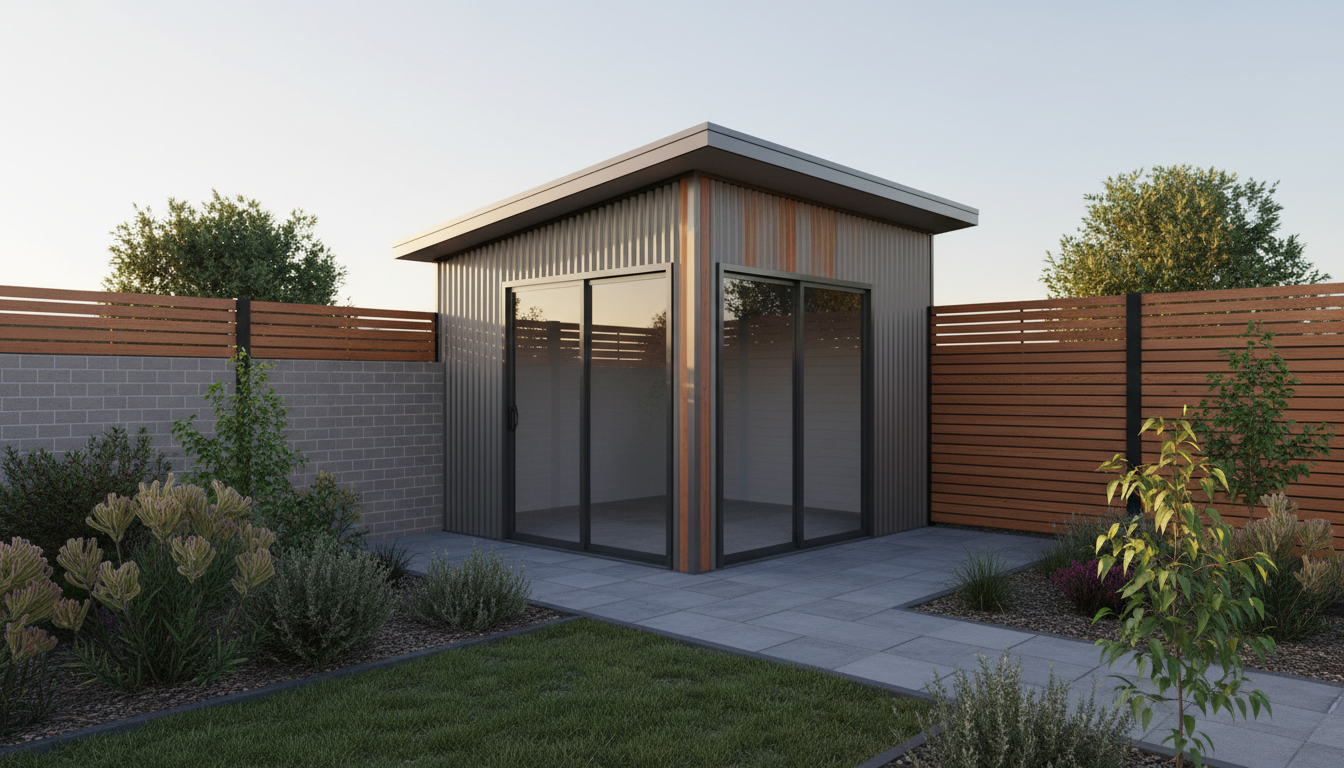

Smart Corner Garden Sheds for Australian Homes: Design, Compliance and Buying Guide
Short on space but big on storage? A corner garden shed neatly tucks into your boundary lines, maximising usable yard area without crowding your alfresco. Below, you’ll find everything a time‑strapped homeowner, renovator or investor needs: materials that survive Perth summers, wind ratings for cyclonic zones, council pathways, and cost drivers—plus how L-shaped garden sheds compare when you need more linear wall space.
Why Choose a Corner Garden Shed in Australia?
- Unlocks “dead” yard corners without blocking pathways or patio doors.
- Ideal for small lots and strata where setbacks and site coverage matter.
- Flexible internal layout for tools, bikes, pressure washers, and garden gear.
- Pairs neatly with skillion roof or compact gable roof shed designs for drainage and headroom.
- Available as DIY shed kits or fully installed, engineered solutions.
For larger footprints or odd blocks, many buyers step up to L-shaped garden sheds to wrap around existing structures or create discreet zones for lawn equipment and potting benches.
What Are the Best Shed Materials for Perth’s Climate?
Perth’s high UV, hot summers and sea-breeze salt exposure mean your corner shed needs quality cladding and fasteners. The two most common Australian options are Colorbond and Zincalume—both compliant steels under AS 1397.
Colorbond vs Zincalume — Which Is Better for WA Conditions?
| Feature | Colorbond (incl. Ultra/Matte) | Zincalume (AZ150) |
|---|---|---|
| Coating | Painted, baked-on finish over zinc/aluminium/magnesium-coated steel | Zinc/aluminium coating (no paint finish) |
| Coastal resistance | Excellent; choose Colorbond Ultra near marine environments | Good, but less resistant to coastal salt spray than Ultra |
| Colour range | Wide Colorbond palette to match roof/fascia | Metallic silver-grey only |
| Heat/UV performance | High UV stability; lighter colours reflect more heat | Reflective when new; can dull over time |
| Cost | Higher upfront; premium finish | More affordable |
| Best for | Urban/suburban WA, coastal, premium look, matching house | Budget builds inland; rural utility sheds |
Technical tip: Specify marine-grade screws and hot‑dip galvanised base rails for coastal Category C3–C4 areas (per ISO 9223 guidance). In high heat zones, add anti‑condensation fleece or insulated roof panels to reduce heat gain and dripping.
Corner vs L-Shaped Garden Sheds: Which Layout Works Best?
- Corner garden shed: Triangular or 90°-angled front with dual doors. Suits tight courtyards and townhouses.
- L-shaped garden shed: Two wings forming an “L” around a boundary or water tank—great for longer benches, bikes, or a mower bay.
For sloping blocks, a skillion roof that falls to the rear boundary is a simple, cost-effective solution. Where headroom matters, a compact gable roof shed can improve storage volume without overshooting height limits.
Will Your Shed Meet Australian Standards and Wind Ratings?
Your corner shed is a NCC Class 10a building. Ask for site-specific engineering that references AS/NZS 1170.2 (Wind Actions), AS/NZS 4600 (Cold-formed steel), and anchorage details for your soil class and slab design.
- Wind Regions: A & B (non-cyclonic), C & D (cyclonic). Coastal QLD and northern WA fall into C/D. Many metro areas are A/B.
- Bushfire: In BAL-rated zones (AS 3959), specify non-combustible cladding, ember-proof vents, and sealed eaves.
- Snow/Alpine: TAS/high country may need AS/NZS 1170.3 snow load checks.
Added 2024 WA wind-rating compliance notes: For Perth and regional WA, ensure shed documentation states Terrain Category, shielding, importance level, and hold‑down capacity of anchors. Upgrades often include heavier RHS columns, thicker C‑section purlins and additional bracing for open-front or corner-door layouts.
How to Get Council Approval for Your Custom Shed in WA
- Confirm planning rules: setbacks, height, site coverage, heritage/estate covenants.
- Prepare drawings: site plan, elevations, drainage, door locations.
- Obtain engineering: wind region, footing/slab design, tie-down schedule.
- Lodge building application: certified or uncertified route (speak to your council).
- Book inspections if required; keep compliance certificates on file.
WA buyers often ask for council-approved sheds WA packages—design, engineering and paperwork bundled to streamline approvals.
Cyclone-Rated Sheds for QLD and Northern WA
In Regions C & D, choose cyclone-rated sheds QLD spec with:
- Increased hold‑down to slab or piers, with engineered tie-down bolts.
- Thicker frames, closer purlin spacing, and reinforced door frames.
- Wind-rated roller doors with locking bars and wind locks.
Ask your supplier for a wind-rated shed for cyclonic areas certificate to lodge with council.
Design Options That Add Value
- Cladding: Colorbond (Ultra near coast) or Zincalume for budget builds.
- Roof: Skillion or gable; add sarking, anti-condensation fleece, or insulated panels.
- Doors: Power-coated hinged doors, wind-rated roller doors, sliding doors for tight spaces.
- Security: Reinforced jambs, deadbolts, internal bracing, motion lights.
- Water management: Gutters, downpipes to tank/soakwell; leaf guards for eucalypt areas.
- Seals: Vermin flashing, draught seals, sill angles to keep out dust and pests.
- Finish: Matching custom Colorbond garages Perth or carport colours for a cohesive facade.
DIY Shed Kits vs Custom-Built Installation
| Option | Pros | Cons | Best For |
|---|---|---|---|
| DIY shed kits | Lower cost; weekend build; flexible timing | Requires tools, slab prep, careful compliance; time on site | Handy owners, simple non-cyclonic installs |
| Custom-built | Turnkey; council support; faster; pro finish | Higher upfront cost | Busy homeowners, cyclonic or complex sites |
Space Planning for Tight Blocks
- Doors: Position toward the open side yard; avoid clashing with fence gates.
- Height: Keep within permitted height near boundaries; choose a low-fall skillion if needed.
- Slab: A 100 mm concrete slab with thickened edge beams is common; include fall to drain.
- Interior: Use wall battens, pegboards, and high shelving to preserve floor space.
Build Examples
- Perth (Region A/B): 2.0 m x 2.0 m corner shed, Colorbond Surfmist, skillion roof to boundary, vermin seal, anti-condensation fleece. Matches steel sheds Perth palette.
- Brisbane (Region C fringe): 2.4 m x 2.4 m corner shed, wind-rated doors, extra hold-downs, insulated roof panels for summer comfort.
- Regional NSW: 3.0 m x 1.5 m L-shaped garden shed for mower/bins; Zincalume walls with Colorbond flashing; part of a larger rural sheds NSW upgrade.
Costs in 2025: What Drives the Price?
Pricing varies by size, steel grade, wind rating, and install complexity. According to industry commentary in the 2025 Australian Steel Market Outlook and HIA home improvement reports, steel supply is stable but specification (wind, corrosion, insulation) still drives final cost.
- Materials: Colorbond Ultra and insulated panels cost more than standard cladding.
- Engineering: Cyclonic upgrades, BAL requirements, snow loads add steel and labour.
- Site: Access, excavation, slab thickness, and stormwater connections.
- Labour: Regional vs metro rates; installer lead times.
5-Step Buying Guide for Custom Sheds in Australia
- Scope: Measure your corner; map door swings; shortlist corner shed or L-shaped garden shed layouts.
- Spec: Choose Colorbond/Zincalume, roof type, insulation, security, vermin seals.
- Compliance: Confirm wind region, BAL, setbacks; request site-specific engineering.
- Quotes: Compare DIY shed kits vs turnkey install; check inclusions (slab, gutters, permits).
- Approval & Build: Lodge council; pour slab; install; book any final inspections.
Frequently Asked Questions
Do I need council approval for a corner garden shed?
Often yes. Most councils allow exempt development up to certain size/height and setbacks, but corner sheds near boundaries usually need a formal application. A “council-approved sheds WA” package saves time.
What wind rating should I ask for?
Non-cyclonic areas use Region A/B ratings; cyclonic areas need Region C/D. Ask for calculations referencing AS/NZS 1170.2 and a tie-down schedule. This is essential for wind-rated sheds for cyclonic areas.
Is Colorbond worth it over Zincalume?
For coastal or high-UV areas and when matching your home, Colorbond (or Colorbond Ultra) is a smart upgrade. If budget is tight and inland, Zincalume is acceptable.
Can I match my garage or carport?
Yes—most suppliers match profiles and colours across custom Colorbond garages Perth, custom carports Melbourne, and affordable carports for Australian homes so you get a unified street appeal.
What frame type should I choose?
A fully galvanised steel frame with C-section purlins and RHS columns is common. Ask for hot-dip galvanised base plates and high-tensile fixings to extend lifespan.
Any bushfire considerations?
In BAL zones, choose non-combustible materials, ember seals and mesh to AS 3959. Painted Colorbond and metal doors are typical choices for BAL-rated sheds.
Keyword Clusters and Use-Cases
- Residential: corner garden shed, L-shaped garden sheds, DIY shed kits
- Garages/Carports: custom-built double garage in Perth, custom Colorbond garages Perth, custom carports Melbourne
- Rural/Commercial: rural sheds NSW, farm machinery storage
- Technical: Colorbond vs Zincalume comparison, wind-rated sheds for cyclonic areas, cyclone-rated sheds QLD
Compliance and Industry Resources
- Bureau of Meteorology – wind region maps and cyclone outlooks: BOM
- Housing Industry Association – permits and building trends: HIA
- Australian Steel Institute – corrosion and steel design notes: ASI
- CSIRO – bushfire and building performance research: CSIRO
- Master Builders Australia – contractor selection guidance: MBA
- Energy.gov.au – cool roofs and energy tips for outbuildings: Energy.gov.au