

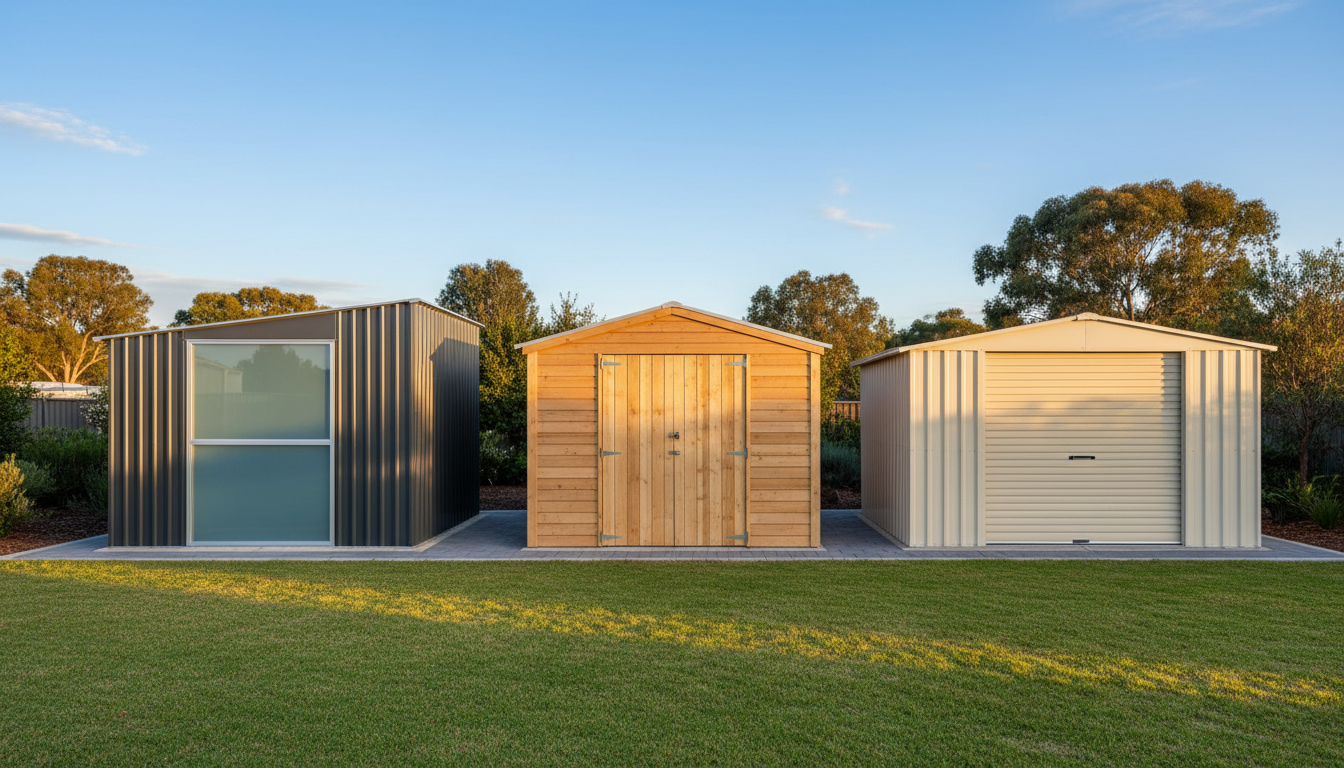

Expert guide to premium garden sheds and outdoor storage across Australia
Whether you want a small shed for tools, a timber look for the backyard, or a custom Colorbond steel shed with roller doors and power, this guide covers design, materials, wind ratings, council approvals and real budgets. Perfect for time‑strapped homeowners, renovators and investors.
What are the best shed materials for Perth’s climate?
Perth’s combination of intense UV, summer heat and coastal salt means material choice matters. For most garden shed storage applications, pre-painted BlueScope Colorbond steel performs best for appearance, longevity and low maintenance. Zincalume can be more cost-effective inland. Timber sheds suit specific aesthetics but need more upkeep.
Colorbond vs Zincalume — which is better for WA conditions?
| Factor | Colorbond | Zincalume |
|---|---|---|
| UV resistance (Perth) | Excellent; paint system resists chalking/fading | Good; reflective but not painted |
| Coastal corrosion (≤1 km from surf) | Better with correct grade; still maintain wash-down | Good inland; more care at exposed coasts |
| Colour options | Wide Colorbond palette | Metallic/silver only (unless painted after) |
| Typical warranty | Up to 20+ years (terms apply) | Up to 20+ years (terms apply) |
| Price | $$ (premium) | $ (more affordable) |
| Best for WA heat | Lighter Colorbond colours reduce heat gain | Reflective; can glare |
For steel sheds Perth projects, many owners also add sarking and roof insulation to tame summer heat and reduce condensation.
Which shed type fits your property?
Below are common shed configurations that align with Australian blocks and usage.
- Small shed / little garden shed / mini garden shed (e.g., 1.5 × 0.8 m to 2.3 × 1.5 m): cost-effective storage shed for tools, potting gear and bikes. Great where setbacks are tight. Look for a door garden shed with wide access.
- Backyard shed (3 × 2.25 m to 4.5 × 2.25 m): most popular garden storage sheds for sale; suits mowers, shelving and seasonal storage. Options include skillion or gable roof, single PA door or double doors.
- Big garden sheds / big storage sheds (6 × 3 m up to 9 × 4 m): room for workshops, packed shed fit-outs, or hobby space. Often engineered with cold-formed C/Z sections and portal frames for clear spans.
- Timber sheds / wooden garden shed / sheds for wood: warm aesthetic for heritage gardens. Choose treated, termite-resistant framing and exterior cladding with quality paint or stain. Expect higher maintenance than steel.
- Portable shed / storage sheds portable: relocatable options for renters and sites where a permanent slab isn’t wanted. Anchor safely per wind rating.
- Kit garden sheds / DIY shed kits / storage shed kits: flat-pack convenience with clear assembly guides. Ideal for competent DIYers; add a concrete slab or modular floor system.
- Custom Colorbond steel sheds: tailored height, span, roller doors and windows. Popular as custom Colorbond garages Perth or combined shed-and-carport designs, and as rural sheds NSW for farm machinery storage.
How much does a garden shed cost in Australia (2025)?
Indicative supply-and-install budgets from recent 2024–2025 quotes across major brands and builders. Your site, wind rating and fit-out will affect pricing.
- Small steel shed (1.5 × 0.8 m to 2.3 × 1.5 m DIY kit): $350–$650 supply; add $200–$500 for anchors/flooring.
- Mid-size backyard shed (3 × 2.25 m to 3 × 3 m): $900–$1,800 supply; $800–$2,400 installed with slab.
- Large garden shed (6 × 3 m): $2,500–$5,000 supply; $4,500–$9,500 installed with slab and power points.
- Custom Colorbond shed (e.g., 7 × 4 m with roller door, PA door, windows): $8,000–$18,000 turnkey.
- Double garage / large storage buildings (e.g., 6 × 6 m): $18,000–$40,000 depending on wind region, doors and lining.
- Concrete slab: commonly $120–$180/m² (100 mm, mesh, edge thickening as needed).
- Cyclone upgrades (tie-downs, purlin density, cladding gauges): typically +10–25% for Region C/D builds.
Source context: 2025 HIA Outdoor Structures and Home Improvement commentary, Australian Steel Institute manufacturer guidance, and 2024–2025 market rates. Always obtain site-specific quotes.
What wind rating and codes do you need?
Australia’s wind regions and terrain categories determine your shed’s design actions. For non-cyclonic areas (Regions A/B), many garden sheds are engineered to N2–N3. For cyclonic areas (Regions C/D), look for C2–C3 ratings and certified hold-down systems. This is vital for cyclone-rated sheds QLD (e.g., Townsville, Cairns) and the Top End.
Relevant standards and references:
- AS/NZS 1170.2 Wind actions and AS 4055 for housing-type structures
- AS/NZS 4600 Cold-formed steel structures; AS 4100 Steel structures
- AS 1397 steel substrate; AS/NZS 2728 for prepainted steel performance
Added 2024 WA wind-rating compliance notes: Many coastal WA sites require higher tie-down forces due to onshore winds and limited shielding. Ensure your engineering certificate lists your site’s Region (often A or B near Perth), terrain category, maximum ultimate wind speed, and connection schedules (anchors, cyclone rods, tek screw patterns).
How to get council approval for your custom shed in WA
For council-approved sheds WA, follow this process (similar principles apply in other states, but forms differ):
- Check local planning rules: setbacks, height, and site coverage (R-Codes and local scheme). Small sheds may be exempt, but boundary walls and flood or BAL overlays can trigger approvals.
- Prepare documents: site plan, elevations, slab detail, drainage plan to soakwells or stormwater, engineering certification showing wind rating.
- Lodge Building Permit: BA1 (certified) or BA2 (uncertified) under the Building Act 2011 and Building Regulations 2012.
- Organise inspections as required (footings/slab, final). Keep an as-built file for resale and insurance.
- Other states: use equivalent permits (e.g., Complying Development NSW, VBA processes in Victoria).
Garden shed foundations, drainage and anchoring
- Concrete slab-on-ground: Best long-term. Allows chemset anchors, vermin-proofing, and flat storage. Consider a 100 mm slab with SL72 mesh and thickened edges for larger spans.
- Pavers or compacted base: Budget-friendly for small sheds; use perimeter anchors and anti-sink edging. Expect more maintenance.
- Timber floor kits: Use H3/H4 treated pine or steel bearers; include termite barriers in termite-prone zones.
- Anchoring: Engineer-specified expansion or chemical anchors, cyclone ties, and correct tek screw spacing to purlins/girts.
- Drainage: Fit gutters, downpipes and direct to legal point of discharge or soakwells (common in WA). Keep cladding 75–100 mm above finished ground to reduce corrosion.
- BAL and bushfire: In BAL-rated areas, use non-combustible cladding, ember-proof vents and metal mesh to AS 3959 where required.
Plan your fit‑out: doors, ventilation, power and security
- Doors: PA door (the classic “shed with door”), double doors for mower access, or roller doors for big openings. Add thresholds and door seals.
- Ventilation: Ridge vents, whirlybirds, and louvre windows reduce heat and fumes. Cross-vent where possible.
- Thermal control: Foil sarking, roof blanket and wall batts (if lined). Light Colorbond colours reflect heat.
- Electrical: Sub-circuit from the main switchboard by a licensed electrician; LED battens, GPOs, exterior sensor light.
- Security: Lockable handles, concealed fasteners, anchor bikes and gear to floor plates. Consider cameras if the shed faces the street.
- Storage: Racking, workbench, pegboard. Aim for vertical storage to keep floors clear in a mini storage shed.
Real projects across Australia
- Perth (steel sheds Perth): 4.5 × 2.25 m Colorbond skillion on a 100 mm slab, N3 design, gutter to twin soakwells. Painted to match fence. Outcome: cooler interior with sarking; zero water ingress in winter storms.
- Townsville (cyclone-rated sheds QLD): 6 × 3 m gable, Region C2 engineering, upgraded hold-down bolts and purlin density, roller door + PA door. Outcome: certified compliance; insurer accepted documents without queries.
- Melbourne (custom carports Melbourne): Integrated carport-and-shed skillion, 7 × 3.5 m, Colorbond windsor grey. Outcome: sheltered parking plus garden shed storage; planning-compliant setback solution for a narrow block.
5-step buying guide for custom sheds in Australia
- Define use: garden shed storage only, hobby/workshop, or vehicle housing. Note door sizes and clearances.
- Check site: setbacks, easements, slope, drainage and wind region (BOM map). Photograph access for delivery.
- Choose materials: Colorbond vs Zincalume comparison, timber if aesthetic matters. Confirm warranty and coating grade.
- Engineer and approve: Select wind rating (N2/N3/C2), get engineering certificate, lodge approvals.
- Build and fit-out: Slab first, then shed. Add ventilation, insulation, power, and security before moving gear in.
FAQs
Do I need council approval for a garden shed?
Often yes for larger footprints or height. Small sheds may be exempt depending on council, but boundary setbacks, flood overlays and BAL can trigger approval. Always confirm with your local council or a private building surveyor.
What base is best: slab, pavers, or timber?
A concrete slab is the most durable and secure. Pavers suit a small, cheap garden sheds setup if well compacted. Timber floors work when slabs aren’t possible; ensure termite protection.
Colorbond vs Zincalume — which should I pick?
For coastal and hot climates, Colorbond is a strong choice for appearance and UV resistance. Inland and budget-focused projects may pick Zincalume. See comparison above.
Are DIY shed kits suitable for beginners?
Most kit garden sheds are designed for DIY with two people and basic tools. Larger spans, cyclonic ratings, or complex fit-outs are best left to licensed installers.
How long does installation take?
- Small shed: 2–4 hours DIY once the base is ready
- Medium shed: half to full day
- Large/custom sheds: 1–3 days plus slab cure time
What wind rating do I need?
It depends on your site’s wind region and exposure. Many suburban sites are N2–N3. Cyclonic zones in QLD/WA/NT require C2 or higher. Your supplier should provide site-specific engineering.
What about carports and garages?
Many suppliers offer affordable carports for Australian homes and custom garages. Ask for engineered, council-approved sheds WA and custom Colorbond garages Perth if you need combined storage and parking.
What maintenance is required?
Annual wash-down, clear gutters, check sealants, and tighten fixings. Inspect anchors after major storms, especially in wind-rated sheds for cyclonic areas.
Keyword clusters to help you find the right product
- Sheds for sale near me, garden storage sheds for sale, storage shed for backyard
- Big storage sheds, large storage buildings, exterior shed solutions
- Portable shed, storage sheds portable, mini garden shed, little garden shed
- Timber sheds, wooden garden shed, sheds for wood, shed wood shed
- DIY shed kits, kit garden sheds, storage shed kits
- Custom steel sheds, rural sheds NSW, steel sheds Perth
Resources and standards (Australia)
- Bureau of Meteorology wind regions map
- Housing Industry Association (HIA) — outdoor structures guidance
- Australian Steel Institute — design and durability
- CSIRO — building science and bushfire resources
- Energy.gov.au — cooling and insulation tips
Before you buy: final checklist
- Confirm wind rating and engineering cert (N2/N3/C2) for your address.
- Pick materials: Colorbond or Zincalume; confirm warranty and corrosion category.
- Decide base: slab, pavers, or timber floor kit; plan drainage to soakwells/stormwater.
- Set door/ventilation layout; add insulation and power if needed.
- Lodge approvals and book delivery/installation when the slab has cured.