

Practical guide to combining a shed with a pergola in Australia
A shed with pergola combines secure storage or a workshop with a shaded outdoor area for entertaining, boat/caravan cover, or a breezy workspace. This guide covers Colorbond steel options, wind ratings, council approvals, regional climate factors, and pricing—so you can design a council-ready, long‑lasting build the first time.
Added 2024 WA wind-rating compliance notes
What is a “shed with pergola” and why choose one?
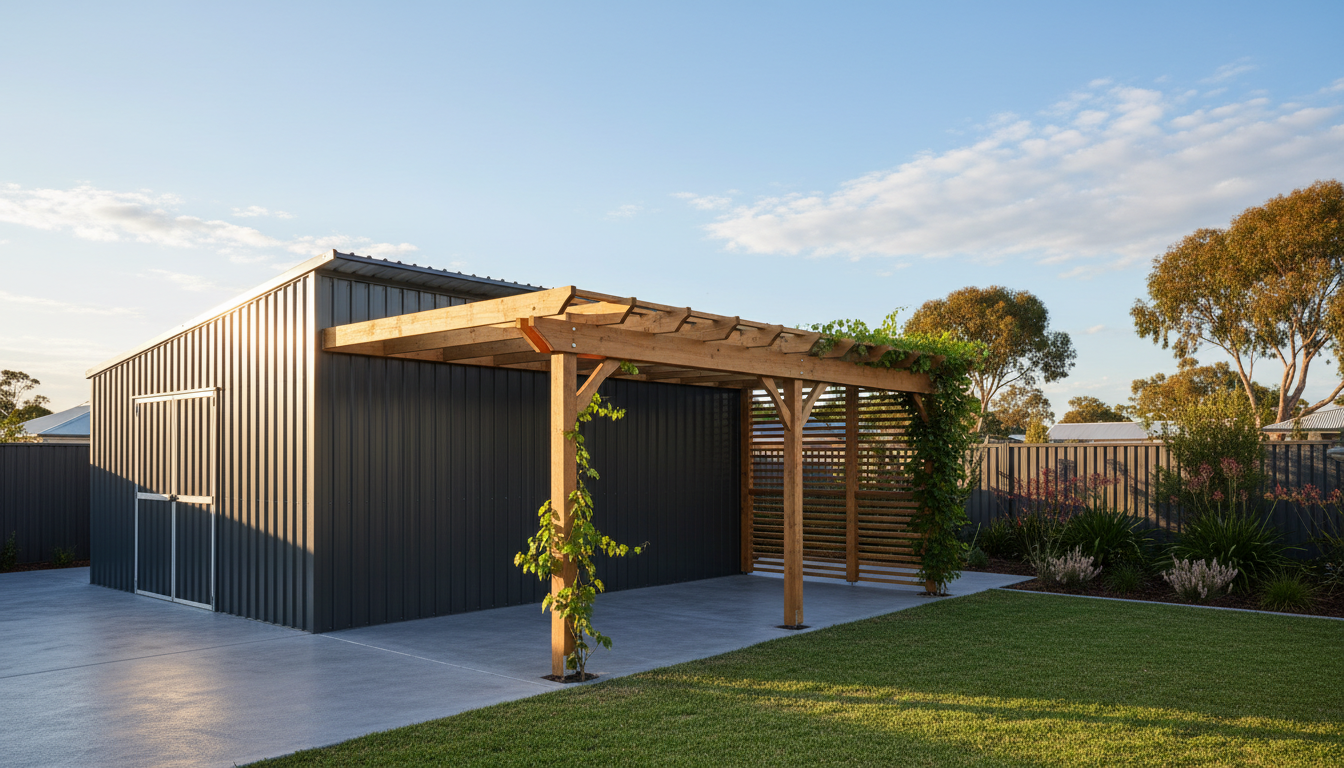
A shed with pergola integrates an enclosed Colorbond steel shed with an attached pergola, skillion or gable awning. It’s popular for garden sheds with pergolas, custom-built double garages in Perth with an alfresco, and rural sheds in NSW that add shaded bays for machinery. Typical uses:
- Workshop plus alfresco BBQ area or outdoor kitchen
- Boat and caravan cover beside a lock-up bay
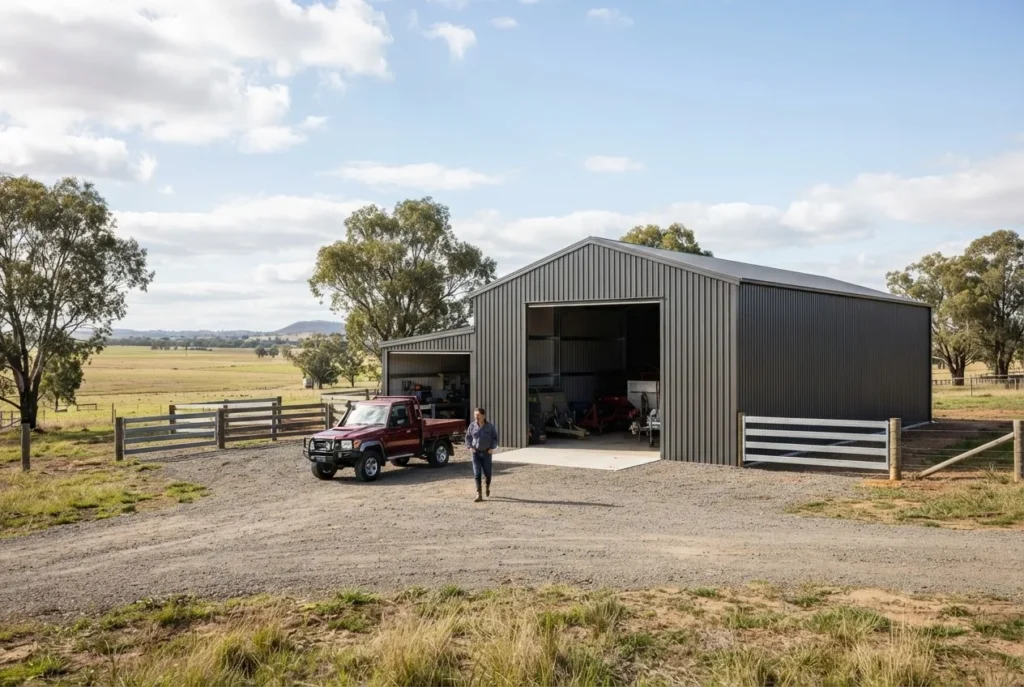
- Farm machinery storage with open skillion bay
- Pool equipment shed with pergola for seating
- Home gym or hobby room with breezeway pergola
What are the best shed materials for Perth’s climate?
For WA sun, sea breeze, and coastal corrosion, most premium suppliers recommend Colorbond steel cladding and rainwater goods, with Zincalume options for internal framing and budget builds. Here’s a quick Colorbond vs Zincalume comparison for Western Australia:
| Feature | Colorbond Steel | Zincalume Steel |
|---|---|---|
| Coating | Painted top coat over alloy substrate | Aluminium-zinc alloy (no colour) |
| Corrosion resistance (coastal) | High; Colorbond Ultra for severe marine | Good inland; can dull quicker near coast |
| Heat/UV performance | High; light colours reflect heat well | Good; reflective when new |
| Aesthetics | Wide Colorbond colour range | Metallic silver-grey only |
| Price | $$–$$$ (premium finish) | $–$$ (budget friendly) |
| Best use | Perth metro, coastal, premium homes | Rural interiors, internal framing |
- Colorbond steel — pre-painted, baked finish steel cladding suited to Australian conditions.
- Zincalume — aluminium/zinc alloy-coated steel known for durable base corrosion resistance.
Technical picks for durability in WA:
- Cladding: Colorbond or Colorbond Ultra near severe marine
- Frame: High-tensile 450MPa cold-formed C/Z sections to AS/NZS 4600
- Fasteners: Class 4 self-drilling screws; compatible with cladding coating
- Posts: Hot-dip galvanised RHS/SHS in splash zones
- Gutters/downpipes: Colorbond with leaf guard; 100 mm minimum downpipes for heavy rain events
For Tasmanian and Victorian coastal locations, consider additional coatings, vermin seals, and cavity closures to limit salt spray ingress. For Darwin and far‑north QLD, prioritise cyclone-rated connections and fixings.
Which roof style suits a shed with pergola?
- Skillion (mono-pitch) — simple, modern look; ideal for attached pergolas; easy water fall to one side.
- Gable — classic form; good head height for carports; suits rural sheds NSW with large spans.
- Flat pergola with insulated panels — clean lines; excellent heat reduction for Perth and Adelaide summers.
Drainage tip: Align pergola fall and box gutters to avoid backflow; integrate overflow measures to NCC 2022. In high-intensity rainfall zones (e.g., Sydney storms), oversized gutters and multiple downpipes are worth it.
How do wind ratings and codes affect your design?
Wind loads determine member sizing, bracing, connections, and footing design. In Australia, the key references are AS/NZS 1170.2 (Wind actions), the National Construction Code (NCC 2022), AS/NZS 4600 (cold-formed steel), and AS 4100 (steel structures). Cyclonic regions (QLD and NT coast) require upgraded frames and fixings.
- Wind Regions: A, B (non-cyclonic), C, D (cyclonic)
- Terrain Category and shielding affect local pressures
- Importance Level: sheds typically IL1–IL2; garages with habitable attachments may increase scrutiny
How to get council approval for your custom shed in WA
- Confirm wind region (A or B for most Perth; higher along exposed coasts). Obtain site wind classification from an engineer.
- Check local planning rules (heights, setbacks, streetscape). Lodge a Development Approval if required.
- Prepare certified engineering to AS/NZS 1170.2 and AS/NZS 4600. Include slab/footing details, bracing, and connection schedules.
- Submit Building Permit application with drawings, site plan, energy provisions (where applicable), and stormwater plan.
- Organise inspections (footings/slab and final). Keep delivery dockets and compliance certificates.
Gap solved: Council-approved sheds WA workflow now includes 2024–2025 wind-region clarifications and terrain category notes.
How to build cyclone-rated sheds in QLD
- Specify cyclone-rated sheds QLD for Regions C/D with certified tie-down details.
- Use increased connection density, heavier purlins/girts, and additional portal frame bracing.
- Limit large door openings on windward walls or use wind-rated roller doors.
- Seek RPEQ-certified drawings and lodge with council/private certifier.
What about bushfire (BAL) areas?
In NSW/VIC bushfire-prone land, comply with AS 3959. A metal-clad shed is advantageous; detail ember-proofing at eaves, vents, and doors. For BAL-40/Flame Zone, expect tighter construction specs and limited polycarbonate use.
- Cyclone rating — design to Regions C/D per AS/NZS 1170.2; higher pressures and stricter tie-down.
- BAL — Bushfire Attack Level; measures ember/heat risk and drives material/venting choices.
What size and layout works best for a garden shed with pergola?
- Compact urban: 3.0 x 3.0 m shed + 3.0 x 3.0 m pergola for tools and a small seating area.
- Family home: 6.0 x 6.0 m custom Colorbond garage + 6.0 x 3.0 m skillion awning.
- Rural: 9.0 x 6.0 m workshop + 9.0 x 3.6 m open bay for farm machinery storage.
Clearances: aim for 2.4–3.0 m eave height under the pergola for comfortable use and caravan/boat cover. For vehicles, allow 2.7 m clearance minimum and 3.0 m preferred.
How much does a shed with pergola cost in Australia (2025)?
Pricing varies by wind region, roof style, cladding, and engineering. As a ballpark:
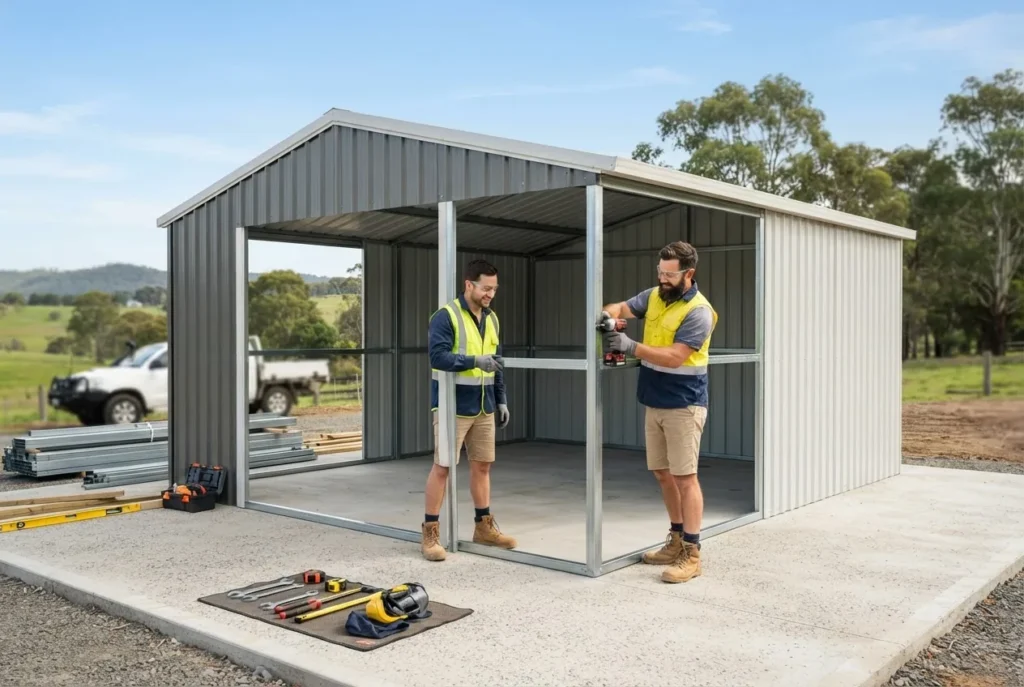
- DIY shed kits with attached pergola (non-cyclonic): from $6,500–$12,000 for small builds
- Custom steel sheds Perth with pergola (installed): typically $18,000–$45,000 for mid-size projects
- Cyclone-rated sheds QLD with large awning: $35,000–$80,000+ depending on spans and doors
Allow for slab/footings, electrical, drainage, council fees, and potential crane/erection costs. Get an itemised quote covering engineering, sheeting specs, fastener class, and site allowances.
DIY shed kits vs custom-built — which one fits your project?
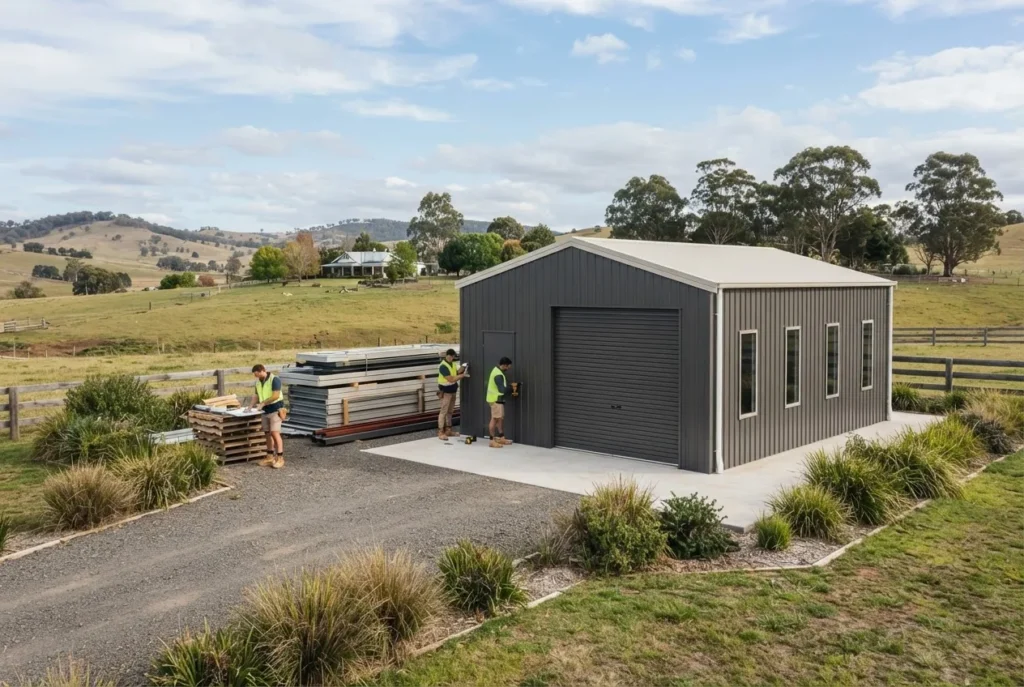
- DIY shed kits: fastest lead times, affordable carports for Australian homes when paired with an awning; best if you’re handy and site is simple.
- Custom-built: tailored to slopes, difficult access, or high wind/BAL; better aesthetics and integration with existing homes and patios.
| Factor | DIY Shed Kits | Custom-Built |
|---|---|---|
| Cost | Lower upfront | Higher but tailored |
| Engineering | Standard wind ratings | Site-specific (wind, BAL, soil) |
| Approvals | You handle | Builder can manage |
| Timeline | Faster to source | Longer lead/design |
| Aesthetics | Limited options | Match home, custom pergola |
Real Australian build examples
Perth, WA — custom Colorbond garage with pergola
6.0 x 6.0 m custom Colorbond garage in Perth with a 6.0 x 3.0 m insulated flat pergola. Colorbond Surfmist cladding, Class 4 fasteners, and hot-dip galvanised posts in splash zones. Approved under wind Region B with terrain category 2.5. Outcome: cool alfresco and tidy storage.
Townsville, QLD — cyclone-rated shed with awning
9.0 x 7.0 m workshop plus 9.0 x 3.6 m awning. Region C engineering, extra portal bracing, wind-locked roller doors, and increased hold-down bolts to edge beams. Result: compliant, insurable structure with usable shaded space year‑round.
Rural NSW — machinery bay and pergola
12.0 x 6.0 m rural shed NSW with a 12.0 x 4.0 m open pergola bay for tractor and tools. Gable roof, Zincalume interior framing with Colorbond exterior. Integrated water tanks capture pergola runoff.
What accessories make the biggest difference?
- Insulated roof panels over the pergola to cut heat and noise
- Vermin seals and cavity closures for dust and ember protection
- Skylights (polycarbonate or insulated translucent panels) in non-BAL zones
- Ceiling fans, LED strips, and external GPOs under the pergola
- High-cycle, wind-rated roller doors in coastal/cyclonic areas
- Gutter guards and leaf diverters tied into rainwater tanks
Pro tip: Using insulated roof panels on a pergola can reduce internal shed temperatures by up to 10°C in summer when paired with light Colorbond colours and adequate ventilation.
How to choose the right supplier (Australia-wide)
Look for a steel shed specialist with demonstrated engineering to AS/NZS standards, local wind-region knowledge, and clean documentation. If you’re comparing steel sheds Perth, custom carports Melbourne, and cyclone-ready sheds in QLD, ask each vendor for:
- Site-specific engineering certificates and drawings
- Material schedules (cladding grade, fastener class, frame size)
- Wind region, terrain category, and importance level assumptions
- Council permit assistance and as-constructed manuals
- Warranty terms for Colorbond, Zincalume, and workmanship
5-step buying guide for custom sheds in Australia
- Scope your use-case: workshop, garden shed with pergola, boat/caravan cover, or outdoor kitchen.
- Confirm site constraints: wind region, BAL, slopes, easements, and services.
- Select materials: Colorbond vs Zincalume comparison, insulated pergola panels, fastener class.
- Lock design: roof style, spans, door openings, drainage, and electrical layout.
- Approval and build: council-approved sheds WA/NSW/QLD, book slab, then erection by licensed installers.
Keyword clusters to help you plan
- Urban: steel sheds Perth, custom Colorbond garages Perth, garden shed with pergola
- Coastal: cyclone-rated sheds QLD, Darwin cyclonic sheds, Tasmanian coastal sheds
- Rural: rural sheds NSW, farm machinery storage, open bay skillion
- Residential upgrades: custom carports Melbourne, affordable carports for Australian homes, workshop with pergola
- Technical: wind-rated sheds for cyclonic areas, Colorbond vs Zincalume comparison, insulated roof panels
Frequently asked questions
Do I always need council approval?
Most sheds with pergolas require a building permit, and many need planning approval (setbacks, site coverage). Always check with your local council or a private certifier early.
What slab or footings do I need?
Commonly a 100 mm N25 slab on ground with thickenings under portals, or isolated pier footings for open pergola posts. Your engineer will size these to soil and wind loads.
Can I attach the pergola later?
Yes—if the original design allows for future connections. Ask for pre-planned connection plates, gutter allowances, and load paths to avoid re-engineering.
How long will a Colorbond shed last?
With correct detailing and maintenance (washdowns in coastal zones, clear gutters), Colorbond cladding provides decades of service. Specify Colorbond Ultra in severe marine environments.
Will a pergola make my shed hotter?
A shade-first pergola generally lowers heat gain. For best results, use light Colorbond colours, add roof insulation or insulated panels, and include ventilation.
Local standards, climate and references
- Standards and codes: AS/NZS 1170.2 (Wind actions), AS/NZS 4600 (Cold-formed steel), AS 4100 (Steel structures), AS 3959 (BAL), NCC 2022
- Climate design: refer to storm intensity and wind region mapping via the Bureau of Meteorology and local government portals
- Market trends: Australian steel demand and shed project growth remain steady through 2024–2025 per industry outlooks and HIA reporting
Helpful resources:
Ready to design your shed with pergola?
Whether you’re comparing steel sheds Perth suppliers, custom carports Melbourne, or cyclone upgrades in QLD, start with a site-specific, wind-rated design in Colorbond, plan drainage and insulation early, and insist on stamped engineering. You’ll end up with a cooler pergola, a tougher shed, and a smoother council approval.