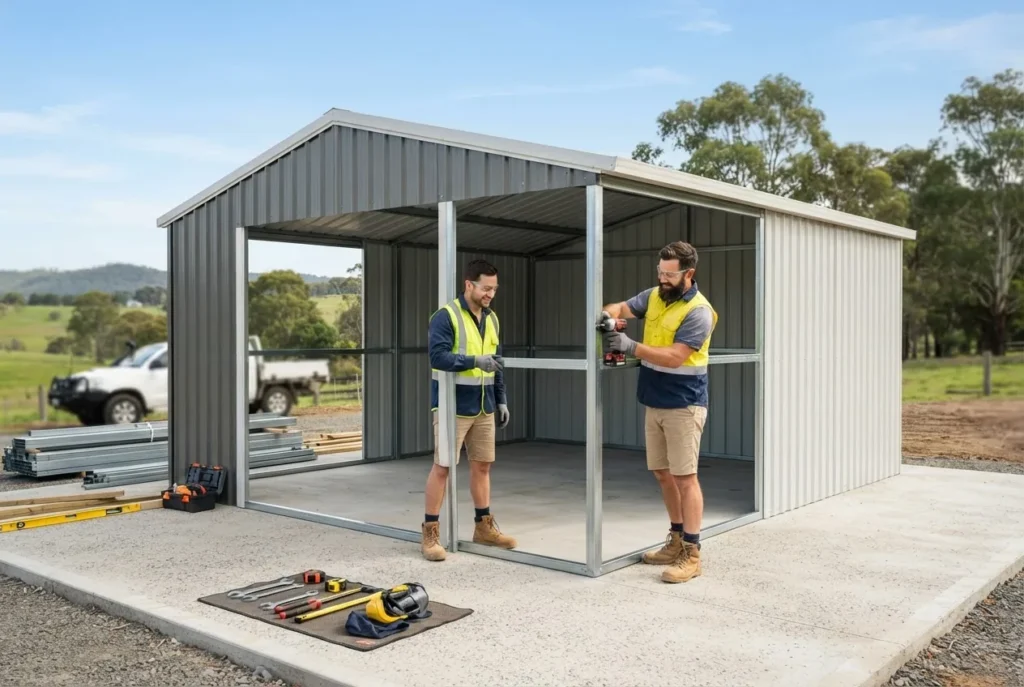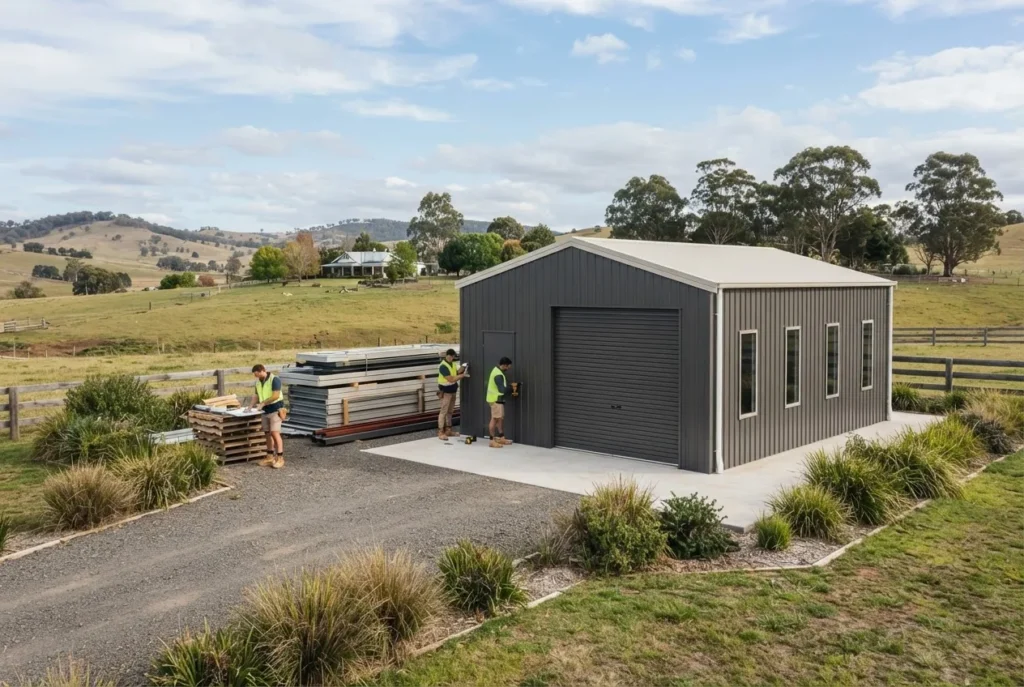

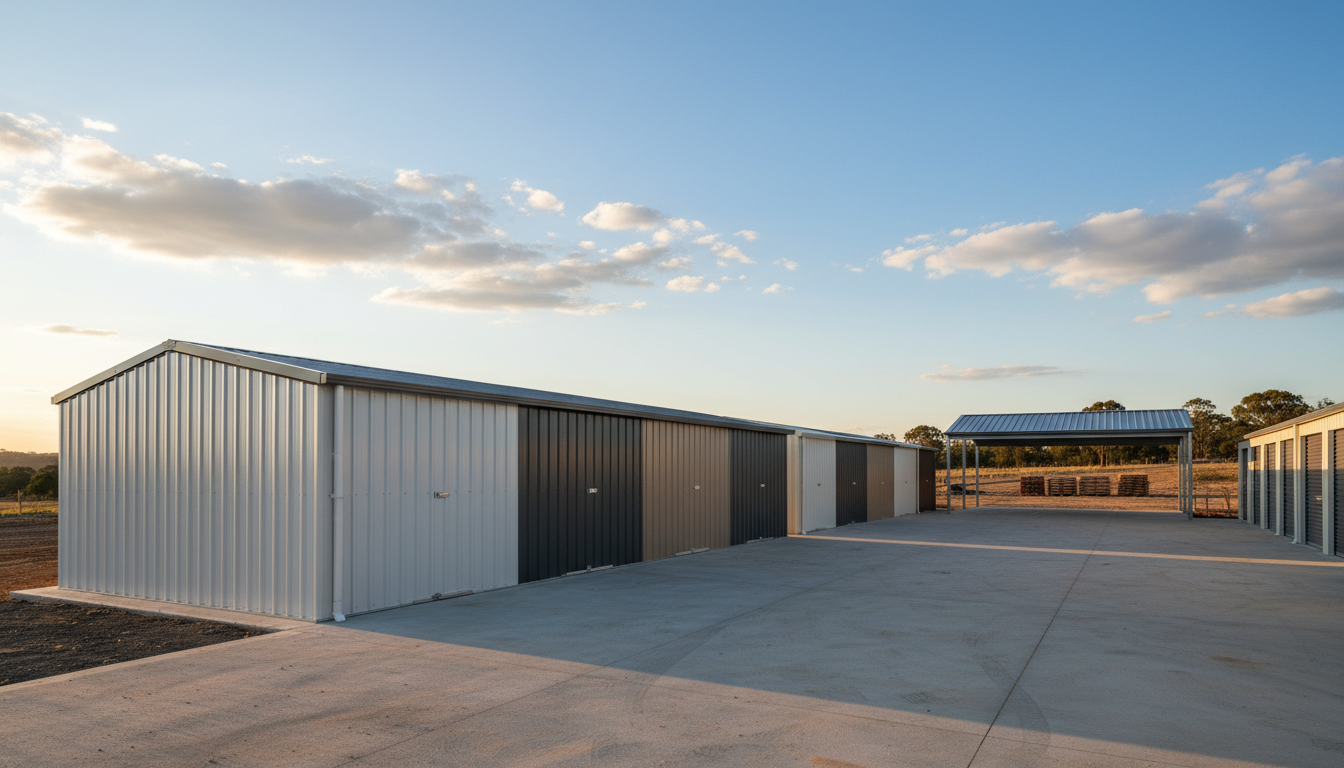

When you buy wholesale storage sheds direct, you want more than a bargain. You want engineered steel, compliant wind ratings, fast approvals, and a shed that survives harsh Australian weather. This guide shows you how to compare wholesale sheds, avoid common pitfalls, and get council-approved faster.
What Are the Best Shed Materials for Perth’s Climate?
In WA’s hot, high-UV environment, a Colorbond steel shed with Thermatech solar reflectance and quality anti-corrosion coatings is the proven performer. Pair it with insulation blanket and ventilators to keep temps down during Fremantle Doctor afternoons and 40°C days.
Colorbond vs Zincalume — Which Is Better for WA Conditions?
| Feature | Colorbond | Zincalume |
|---|---|---|
| Heat resistance (Perth summers) | High with lighter colours (e.g., Surfmist) | Good; reflective but can glare |
| Corrosion near coast | Excellent with correct grade and maintenance | Excellent base; may need paint system for aesthetics |
| Aesthetics | Wide colour range; matches modern homes | Industrial silver; paint later if needed |
| Cost | Higher upfront | Lower upfront |
| Typical use | Residential garages, custom Colorbond garages Perth | Farm machinery storage, rural sheds NSW |
Tip for WA: Specify BlueScope warranty-backed material and request the base metal thickness (BMT) in writing—e.g., 0.42 BMT for roofing, 0.35 or 0.42 BMT for walling as engineered.
Where Can You Buy Wholesale Storage Sheds in Australia (and What Should You Avoid)?
Wholesale sheds are available factory-direct from Australian rollformers and kit manufacturers. You’ll see options for garden sheds direct, garage kits, rural barns, and custom carports. Prioritise:
– Australian engineering to AS/NZS 1170.2 (wind) and AS/NZS 4600 (cold-formed steel)
– Site-specific wind classification (N2–N6 or C1–C4)
– Hot-dip galvanised or pre-gal fasteners and brackets
– Genuine BlueScope Colorbond/Zincalume
– Fully-documented plans for council
Avoid: “One-size-fits-all” kits with generic drawings, light-gauge frames without bracing details, and imports lacking RPEQ/RPEng certification for cyclonic regions.
How Much Do Wholesale Sheds Cost in 2025?
Pricing moves with steel indices (see the 2025 Australian Steel Market Outlook) and logistics. As a guide:
– Small Colorbond garden shed (2.3 x 2.3 m): from $600–$1,200 (kit)
– Single garage (3 x 6 m) with roller door: from $5,500–$9,500 (kit)
– Custom-built double garage in Perth (6 x 6 m): from $12,000–$22,000 installed, depending on slab, wind rating, doors, insulation
– Rural machinery shed (12 x 24 x 4.2 m): from $45,000–$85,000 (supply only), wind rating and bay spacing dependent
Note: Freight to regional WA, NT, and far-north QLD increases landed costs. Request an itemised quote including engineering, fasteners, gutters/downpipes, vermin flashing, and delivery.
Should You Buy a DIY Shed Kit or Go Custom-Built?
| Option | Pros | Cons | Best For |
|---|---|---|---|
| DIY shed kits | Lowest cost; fast lead times; garden sheds direct to site | Self-manage slab, approvals, erection; limited customisation | Small sheds, affordable carports for Australian homes |
| Custom-built | Tailored size/doors; council-approved; turnkey | Higher cost; 6–12 week lead times | Garages, workshops, boat and caravan storage |
What Wind Rating Do You Need for Your Shed?
Australia uses Wind Regions A–D and terrain categories per AS/NZS 1170.2. Most metro areas are N2–N3; coastal/high-risk or cyclonic areas are C1–C4. QLD north and WA north frequently require cyclonic design. Added 2024 WA wind-rating compliance notes
Ask for a site-specific engineering certificate. For cyclone-rated sheds QLD or council-approved sheds WA, insist on tiedown schedules, purlin/girt spacing, and door wind-locks suitable for your rating.
Do You Need Council Approval for a Shed in Australia?
Most sheds over small exempt sizes require approvals. Documentation varies by state:
– WA: Building Permit (BA2) with certified engineering; check coastal corrosion zones and setbacks.
– NSW: DA or CDC depending on size/height under SEPP; BAL may apply in bushfire-prone land.
– QLD: Building approval via private certifier; cyclonic detailing mandatory in Regions C/D.
– VIC: Building Permit; siting per local planning; stormwater connection required.
– SA, TAS, ACT, NT: Local rules; verify site coverage, easements, driveway crossovers.
How to Get Council Approval for Your Custom Shed in WA
- Request a site wind report and soil classification (AS 2870) for slab/pier design.
- Obtain certified engineering (RPEng) with member sizes and connection details.
- Prepare a site plan: boundaries, setbacks, stormwater, existing structures.
- Lodge BA2 with drawings, specs, energy notes if habitable uses are planned.
- Schedule inspections for slab (if required) and final occupancy documentation.
What Are the Best Shed Roof Styles for Your Use?
| Roof Type | Pros | Considerations |
|---|---|---|
| Gable | Classic look; strong in wind; easy water runoff | Higher ridge height affects planning limits |
| Skillion (mono-pitch) | Modern; easy solar panel orientation | Check eave height at high side near boundary |
| Flat | Low visual bulk; economical | Must meet minimum falls; careful drainage design |
What Are the Most Popular Wholesale Shed Configurations in 2025?
- Steel sheds Perth: 6 x 6 m double garage with 2x roller doors and PA door
- Custom carports Melbourne: 6 x 5 m double skillion carport with 100×100 SHS posts
- Rural sheds NSW: 12 x 12 m 3-bay machinery shed, open front, 4.5 m eave
- Workshop sheds Brisbane: 7 x 9 m with mezzanine storage and insulation blanket
- Garden sheds direct: 3 x 3 m kits, timber floor kits optional for sloping blocks
Case Studies: Built for Real Australian Conditions
Perth (N3) — Custom Colorbond Garage: 6 x 7 m, gable roof, Colorbond Monument walls/roof, insulation R1.3 blanket, vermin flashing. Slab 100 mm with SL72 mesh and thickenings at door openings. Council approved in 14 days.
Tropical QLD (C2) — Cyclone-Rated Farm Shed: 12 x 18 x 4.5 m, open-front, C2 engineering, heavier purlins, cyclone washers, wind-locked roller doors to enclosed bay. Galvanised frame, Zincalume roof for cost efficiency.
Coastal NSW (N3, marine): 6 x 9 m boat and caravan storage with marine-grade fasteners, extra wash-down tap and sacrificial anodes on trailer bay; gutter guard for leaf load.
How Do You Keep a Shed Cool, Dry, and Quiet?
- Insulation: Use roof blanket or insulated roof panels; add wall batts in stud-framed linings.
- Ventilation: Ridge vents, whirlybirds, and screened louvres reduce heat and condensation.
- Moisture: Install sarking, damp-proof course under frames, and adequate drainage falls.
- Noise: Acoustic batts and rubber door seals for workshop comfort in suburban areas.
5-Step Buying Guide for Custom Sheds in Australia
- Define use-case: farm machinery storage, workshop, or affordable carports for Australian homes.
- Confirm site constraints: wind rating, BAL, setbacks, easements, driveway access for trucks.
- Choose material/finish: Colorbond vs Zincalume, insulation, doors, windows, skylights.
- Get apples-to-apples quotes: BMT, frames, bracing, fixings, delivery, engineering, slab.
- Plan approvals and build: council application, slab pour, erection schedule, final sign-off.
Technical Specs That Separate Trade-Grade Wholesale Sheds
- Engineering to AS/NZS 1170.2, AS/NZS 4600; NCC 2022/2025 compliance notes included.
- Door systems: wind-locked roller doors (e.g., B&D) sized to rating, PA doors with threshold plates.
- Fixings: Class 4 corrosion-rated screws in coastal zones; cyclone washers where required.
- Framing: Heavier purlins/girts and knee/haunch brackets in cyclonic designs.
- Foundations: Slab or piers engineered to AS 2870 with tiedown rods/chemsets per schedule.
- Accessories: Mezzanine storage, skylight polycarbonate sheeting, gutter overflow provisions.
FAQ: Wholesale Storage Sheds in Australia
Are wholesale sheds lower quality?
No—quality depends on engineering, steel grade, and fixings. Choose genuine BlueScope coil and Australian certification.
Can I get garden sheds direct with fast delivery?
Yes. Many suppliers dispatch standard sizes in 3–7 business days to metro depots; remote deliveries may add a week.
What about energy and sustainability?
Colorbond’s reflectance can cut heat loads; add solar PV on a skillion roof. Steel is recyclable and supported by local supply chains.
Do I need a slab?
Small kits can use rebated pavers or timber floors; garages and larger sheds typically require a 100–120 mm reinforced slab with thickenings and tiedowns.
Latest Australian Insights
The 2025 HIA Outdoor Structures and Home Improvement Report highlights ongoing demand for carports, garages, and rural sheds, with homeowners prioritising outdoor storage and workshop space. The 2025 Australian Steel Market Outlook notes stable domestic supply and a focus on higher-spec coatings for coastal regions.
For climate design, consult Bureau of Meteorology cyclone mapping and local wind regions before ordering engineering.
Trusted Resources (Australia)
– Bureau of Meteorology cyclone and wind region info: BOM
– Australian Steel Institute guidance: ASI
– Housing Industry Association approvals advice: HIA
– CSIRO building science on condensation: CSIRO
– Master Builders Australia: MBA
– Energy.gov.au on cool roofs and insulation: Energy.gov.au
Get a Trade-Grade Quote
Whether you need a custom Colorbond garage in Perth, a cyclone-rated shed in QLD, or rural sheds in NSW, specify your wind region, dimensions, and door layout. Ask for engineering, BMT, and delivery in one fixed-price quote—and compare line by line.