

When it comes to storing boats securely in Australia, choosing the right material for your carport is essential—especially in cyclone-prone regions. This guide explores the pros and cons of Colorbond and Zincalume steel materials for carports for boats, their performance against Australian cyclone ratings, navigating evolving council approval processes in 2025, and an in-depth cost analysis tailored to the latest market conditions.
For Australian boat owners aiming to protect their investment from harsh coastal environments and extreme weather, understanding these factors can make all the difference.
Overview of Boat Carports in Australia: Purpose, Definitions, and Unique Challenges
What Constitutes a Boat Carport? Differentiating from Garages and General Carports
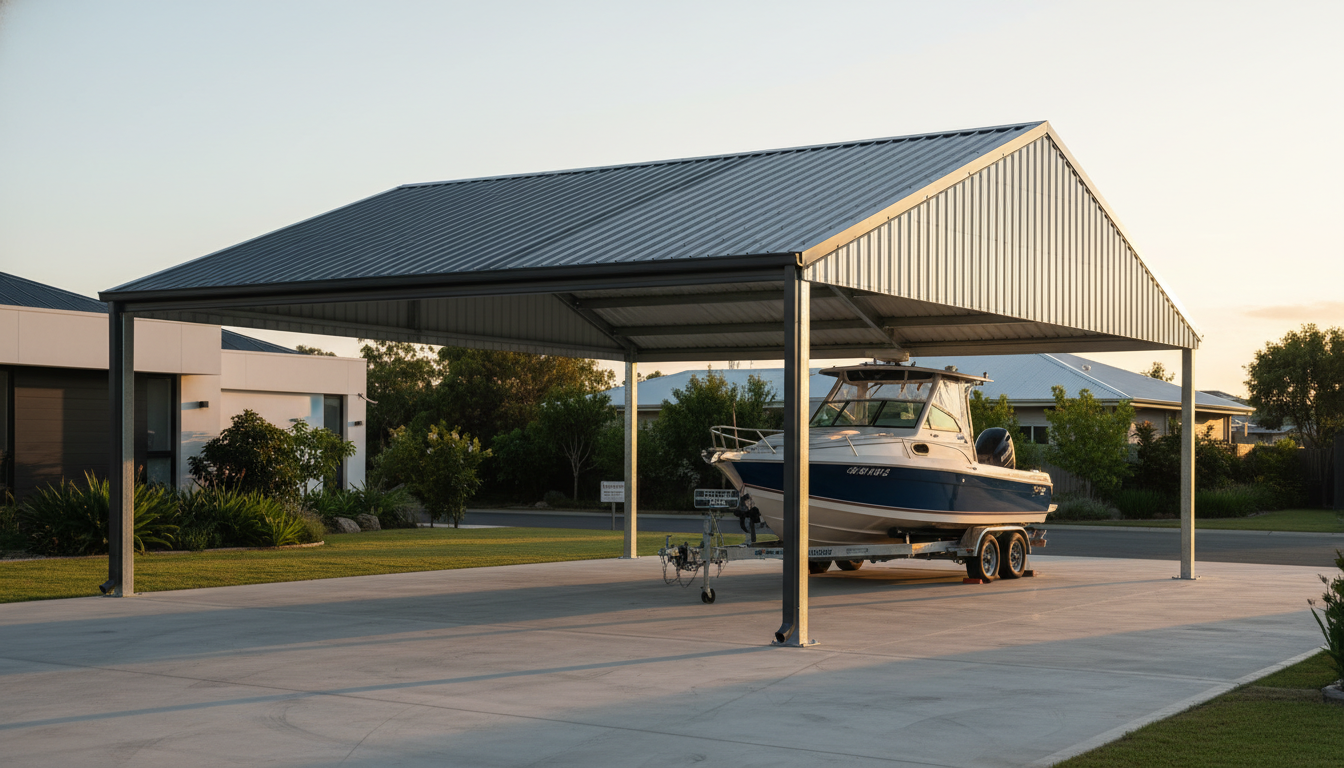
A boat carport is a specifically designed open-sided shelter that provides overhead protection for boats, differing from full garages or general carports primarily in size, clearance, and intended use. Unlike garages, boat carports often feature higher clearance to accommodate tall antennae or masts, and structural supports positioned to allow easy access for boat trailers.
General carports may not have sufficient length or height for boats, whereas garages focus on enclosed protection more suited to cars or caravans, often requiring different council classifications and compliance codes.
Specific Needs for Boat Storage Structures in Coastal and Cyclone-Prone Areas
- Exposure to salt-laden air: Boats stored near the coast face accelerated corrosion risk, requiring corrosion-resistant materials.
- High wind and cyclone force resilience: Structures must meet stringent Australian cyclone standards (AS/NZS 1170.2) especially in northern and eastern coastal regions.
- Easy access for launching and maintenance: Unlike enclosed storage, carports must facilitate smooth marine operations, affecting design choices.
Environmental and Climatic Considerations Unique to Australian Boat Storage
Australia’s varied climate—from tropical north Queensland with cyclone threats to temperate southern coasts—means boat carports must be tailored to local conditions. Coastal humidity, UV exposure, and salt spray all accelerate steel degradation, demanding materials and coatings that offer high durability while balancing maintenance demands.
Next, we delve into the core decision for many boat owners: choosing between Colorbond and Zincalume steel for their boat carport.
Material Deep Dive: Colorbond Steel vs Zincalume Steel for Boat Carports
Composition and Manufacturing Processes of Colorbond and Zincalume (Bluescope Steel Background)
Both Colorbond and Zincalume steels are products of Bluescope Steel, tailored to Australian conditions. Zincalume steel features a blend of aluminium (55%), zinc (43.5%), and silicon (1.5%) coatings on galvanized steel, offering superior corrosion resistance, especially as a bare metal finish. Colorbond steel adds a multilayer paint system atop a Zincalume base— including a primer, a high-performance topcoat, and an anti-corrosion layer—providing enhanced colour durability and weather resistance over time.
Corrosion Resistance in Marine and Coastal Environments
Zincalume provides excellent base corrosion resistance, but its protective metallic finish might oxidise faster under continuous salt spray without paint. Colorbond’s painted surface forms a protective barrier against environmental attacks, making it highly suited for harsh marine conditions. According to Bluescope technical data (2024), Colorbond’s paint system resists chalking and fading for over 15 years in coastal zones, reducing maintenance frequency compared to bare Zincalume sheets.
Aesthetic Options and Integration with Surrounding Landscapes and Marine Environments
Colorbond steel offers a wide palette of colours varying from coastal blues and greys to earth tones, allowing boat carports to blend harmoniously with natural seascapes or residential environments. This aesthetic versatility benefits owners keen on maintaining property value and visual appeal. Zincalume, with its untreated metallic sheen, offers a utilitarian industrial look, often preferred in remote or purely functional installations.
Maintenance Requirements and Longevity under Harsh Weather Conditions
- Colorbond Steel: Requires minimal maintenance—periodic cleaning and inspection for chips or scratches suffices, with repainting recommended every 10–15 years depending on exposure intensity.
- Zincalume Steel: May require recoating or rust treatment within 5–8 years in aggressive coastal environments to counter early surface oxidation and pitting.
Environmental Impact and Sustainability Factors
Both materials are recyclable and produced under Bluescope’s sustainability initiatives minimizing environmental footprint. Colorbond’s painted coatings increase lifecycle length reducing frequent replacement needs, aligning with long-term environmental savings. Zincalume, as a bare steel product, can be more energy-efficient to produce initially but may lead to higher maintenance waste over time.
For a detailed comparison of steel materials and their coastal performance, see Colorbond vs Zincalume steel sheds in Australia.
Cyclone Ratings and Wind Load Compliance for Boat Carports in Australia
Explanation of Australian Standard AS/NZS 1170.2 Cyclone Ratings and Categories
AS/NZS 1170.2 lays out wind load standards including cyclone ratings designated C1 to C4, assessing structural resilience based on wind speeds up to 250 km/h. Coastal regions from Queensland to northern WA often require at least C2 or C3 compliance, ensuring that boat carports can withstand extreme gusts without catastrophic failure.
How Material Choice (Colorbond vs Zincalume) Influences Cyclone Performance
Material strength and fixing methods are critical: Zincalume’s base metal offers excellent tensile strength as a structural base, but Colorbond steel, with its paint layers, does not compromise material strength and provides corrosion protection to maintain structural integrity over time under cyclonic wind pressures. Engineering assessments confirm that structural members fabricated with either base material can achieve required ratings when combined with cyclone-compatible fastening systems. The critical factor is the quality of steel and design, rather than the coating alone.
Engineering Requirements for Wind Load and Structural Compliance
Engineer-certified designs employing high-tensile Colorbond or Zincalume steel frameworks must factor in:
- Correct gauge thickness consistent with C3 or C4 rating
- Secure anchorage with foundation bolts and cyclone ties
- Appropriate bracing to counteract lateral wind forces
- Use of corrosion-resistant fasteners in coastal environments
Case Studies or Examples of Cyclone-Rated Boat Carports in High-Risk Zones
For instance, a C4-rated Colorbond boat carport installed near Cairns sustained Category 5 cyclone winds in 2023 with minimal damage, verified in a post-event engineering assessment. Conversely, some uncoated Zincalume carports required structural repairs within 5 years due to accelerated corrosion weakening connections in coastal Darwin.
Caravan shelter kits also face similar cyclone wind rating challenges; more on this in our Caravan shelter kits and cyclone wind rating requirements guide.
Navigating Local Council Approval Processes for Boat Carports in Australia (2025 Update)
Overview of Relevant Building Codes and the National Construction Code (NCC/BCA) for Carports
Boat carports in Australia must comply with the National Construction Code (NCC), previously called the Building Code of Australia (BCA), which mandates structural integrity, cyclone resistance, and building classifications. These requirements differ for permanent structures versus demountable or temporary shelters. Councils will typically require detailed design drawings, engineering certificates, and materials specifications compliant with NCC sections related to wind loading and corrosion protection.
Variations in Approval Requirements Across Major Australian Councils (e.g., Brisbane, Perth)
Local councils enforce their own planning overlays and building regulations:
- City of Brisbane: Demands cyclone-rated building certification for carports in designated wind zones; detailed stormwater run-off management plans may be needed.
- City of Perth: Requires NCC compliance evidence and may limit structure footprint within coastal setback zones.
- Other Councils: May require bushfire attack level (BAL) assessments if in fire-prone areas.
Key Distinctions Between Boat Carport Approvals vs Other Carport or Garage Permits
- Boat carports often have higher height clearances and greater footprint lengths, affecting setback and overshadowing rules.
- Structural wind load considerations can be more stringent due to open-sided design combined with tall boats acting as wind sails.
- Council officers may classify boat carports differently from garages, impacting fees and permit types.
Common Documentation and Engineering Reports Required by Councils
- Structural engineering certification to AS/NZS 1170.2 cyclone standards
- Site plans showing exact location and setbacks
- Material specifications (Colorbond/Zincalume) with corrosion protection details
- Stormwater and drainage management plans
Tips for Streamlining the Approval Process
- Engage a qualified draftsman and engineer early to prepare documentation
- Consult council planning officers pre-application to clarify local rules
- Use builders experienced in marine and cyclone-rated structures
- Prepare to address environmental overlays like coastal erosion or bushfire zones
For comprehensive regulatory guidance, see our Barn sheds council approvals and building codes in Australia resource and related Caravan carport designs and council approval guidelines topics.
Temporary structures also have distinct approval pathways discussed in Temporary carport permits and Colorbond options across Australia.
Cost Analysis: Building and Maintaining Boat Carports with Colorbond vs Zincalume in 2025
Breakdown of Material Costs: Colorbond Steel vs Zincalume Steel Prices in Australia (2025)
| Material | Price Range (AUD per m²) | Notes |
|---|---|---|
| Colorbond Steel | $60 – $80 | Includes paint system, higher finish cost; premium colours extra |
| Zincalume Steel | $50 – $65 | Bare metal finish, lower initial cost but higher maintenance risk |
Labor, Installation, and Engineering Costs Specific to Boat Carports
Labour rates vary geographically but average around $70 – $90 per hour in Australian metro areas (2025 data). Typical boat carport installation requires specialist fitters with experience in cyclone-compliant assembly, raising labor to about 25-30% above standard carport rates.
Engineering certification and documentation may cost $1,200–$2,500 depending on structure complexity and council requirements.
Permit and Council Fees in Different States and Territories
- Council permit fees typically range from $500 to $2,000—higher in Queensland’s cyclone-prone zones.
- Additional fees may incur for environmental overlays or heritage-listed properties.
- Temporary structures have generally lower permit costs but shorter approved durations.
Maintenance Budgets Over 10+ Years for Each Material
- Colorbond: Estimated $200 – $500 every decade for cleaning and touch-up recoating.
- Zincalume: Possible $800 – $1,200 within first 5–8 years for corrosion treatment or repainting in coastal zones.
Insurance Implications and Cost Variations Based on Material and Cyclone Rating Compliance
Insurance premiums for boat carports are impacted by material durability and certified cyclone compliance. According to the Insurance Council of Australia (2024), structures with C3 or C4 cyclone ratings and durable Colorbond coatings may attract premiums up to 15% lower than uncoated Zincalume carports without formal certification. Adequate engineering reports and council approvals are typically prerequisites for insurance discounts.
For broader facility sizing and cost context, consult related guides on Car Garage sizes and shed designs in Australia, Custom Colorbond garage sheds in Australia, and Double garage sizing and cost options in Australia.
Installation and Maintenance Best Practices for Boat Carports in Australia
Recommended Installation Procedures for Ensuring Structural Integrity
- Conduct site assessment for soil and wind exposure conditions
- Use cyclone-rated foundation anchors and footings
- Follow engineering plans accurately with emphasis on bracing and fasteners
- Apply anti-corrosion treatments to exposed metal joins
- Inspect finish coats post-installation, correcting any damage rapidly
Maintenance Schedules and Processes for Preserving Colorbond and Zincalume Carports
- Clean steel surfaces biannually to remove salt, dust, and debris
- Inspect paint surfaces and zinc layers annually for chips or rust
- Touch-up paint or recoat Zincalume as signs of oxidation appear
- Check structural fasteners and anchors every two years
Common Issues with Marine Exposure and How to Mitigate Them
- Galvanic corrosion where dissimilar metals contact—use isolating materials
- UV degradation of coatings—apply UV-resistant finishes as per Colorbond standards
- Salt spray accumulation—regular rinsing to slow corrosion
Retrofitting and Upgrading Existing Boat Carports for Cyclone Compliance
- Strengthen anchors and support bracing per new engineering assessments
- Apply upgraded corrosion-resistant coatings (e.g., full repaint or galvanization where feasible)
- Replace rusted or damaged panels with cyclone-rated Colorbond equivalents
- Consult structural engineers to certify upgrades for council and insurance purposes
For boat owners in Western Australia, sourcing quality caravan parts and repair services is critical to maintaining durable steel carports and sheds. Localised advice, such as that found in our Caravan Parts Perth Western Australia: Buyer’s Guide and Caravan Repairs Wangara WA + Premium Steel Sheds & Carports Perth guides, can assist in upkeep specific to marine and coastal climates. Additionally, insights from premium garden storage solutions offer practical maintenance strategies for outdoor steel structures exposed to harsh Australian elements.
Additionally, sourcing quality caravan parts and repair services through guides such as Caravan Parts Perth Western Australia: Buyer’s Guide can be instrumental in maintaining steel structures in marine environments.
Frequently Asked Questions (FAQs) and Common Concerns Addressed
Can a Zincalume Carport Provide Adequate Protection Against Cyclones?
Yes, Zincalume steel can achieve adequate protection if engineered correctly and maintained, but it requires regular corrosion treatment and possibly additional protective coatings to ensure structural integrity in cyclone-prone coastal zones.
How Long Does a Colorbond Boat Carport Typically Last in Coastal Environments?
With proper installation and maintenance, Colorbond boat carports can exceed 20 years in coastal environments before requiring significant recoating or repairs.
What Are the Most Significant Council Approval Challenges for Boat Owners?
Challenges usually include meeting cyclone rating documentation, addressing coastal setback and environmental overlays, and securing engineering certification for higher clearance and longer spans typical in boat carports.
Is Insurance More Expensive for Certain Materials or Cyclone-Rated Carports?
Insurance premiums vary; insurers often offer better rates for certified cyclone-rated Colorbond structures due to their durability and proven performance compared to non-certified or uncoated Zincalume carports.
For a broad range of questions regarding boat storage and cyclone-resistant structures, this guide aims to serve as your authoritative starting point.
In conclusion, selecting the right material between Colorbond and Zincalume steel is a foundational step in securing boat carports that balance durability, aesthetic appeal, and regulatory compliance in Australia’s demanding marine and cyclone-exposed environments. Coupled with strategic navigation of council approvals and a clear cost outlook for 2025, boat owners can make confident decisions protecting their assets for decades.
Explore our linked resources on Colorbond vs Zincalume steel sheds in Australia and Barn sheds council approvals and building codes in Australia to deepen your knowledge, and begin your boat carport project well-informed and prepared.
Frequently Asked Questions
What is a boat carport, and how does it differ from regular carports?
A boat carport is an open-sided shelter designed with higher clearance and longer length to protect boats, accommodating tall masts and trailers. It differs from regular carports by focusing on marine-specific needs like easy boat access and meeting specific structural regulations for coastal environments.
How does the maintenance of Colorbond steel compare to Zincalume steel for boat carports?
Colorbond steel requires less frequent maintenance, mainly periodic cleaning and touch-ups every 10–15 years. Zincalume steel may need repainting or rust treatment within 5–8 years due to faster oxidation, especially in harsh coastal or marine environments.
Why is cyclone rating compliance critical for boat carports in Australia?
Cyclone rating compliance ensures the boat carport can withstand strong winds and storm forces typical in coastal areas, protecting both the structure and boat. Meeting AS/NZS 1170.2 standards reduces damage risk and satisfies council and insurance requirements.
Which factors influence council approval processes for boat carports versus other carport types?
Council approvals for boat carports often demand higher wind load certifications, larger setback clearances due to increased height, and detailed engineering reports. These structures are assessed more strictly because they are open-sided and accommodate tall boats that act like sails in strong winds.
Can insurance premiums be reduced by choosing specific materials or cyclone ratings for boat carports?
Yes, insurance premiums are generally lower for boat carports made with certified cyclone-rated Colorbond steel due to their durability and resistance. Structures lacking certification or using uncoated Zincalume often face higher premiums due to increased risk and maintenance needs.
How do Colorbond and Zincalume steel differ in environmental sustainability for boat carports?
Both materials are recyclable; however, Colorbond’s painted coating extends lifespan, reducing waste and replacements over time. Zincalume requires less initial energy to produce but may generate more maintenance waste due to earlier corrosion in marine environments.
When should boat owners consider retrofitting existing carports for cyclone compliance?
Retrofitting is advisable when structural aging, corrosion, or updated cyclone standards indicate weakened performance. Upgrades include improved anchoring, enhanced corrosion protection, and replacing worn panels to meet current engineering and council requirements.
What installation practices ensure maximum durability of boat carports in cyclone-prone zones?
Best practices include conducting thorough site assessments, using cyclone-rated anchors, following certified engineering designs, applying corrosion-resistant coatings, and regularly inspecting structural fasteners to ensure compliance and long-term durability against wind loads.