

The Australian buyer’s guide to weatherboard-look garden sheds and garages
After a premium backyard shed with classic weatherboard charm and modern steel performance? Here’s how Australian homeowners and investors can spec a weatherboard garden shed—or a weatherboard garage—that looks at home beside a Federation or coastal cottage, yet meets AS/NZS engineering, wind ratings and council rules.
What are the best shed materials for Perth’s climate?
Perth summers are long, hot and windy. Your shed cladding choice must handle heat, UV and sea breeze corrosion. For a weatherboard look, most buyers choose one of two routes:
- Steel frame with Colorbond or Zincalume cladding plus timber-look accents (easiest maintenance, highest durability).
- Steel frame with fibre-cement or engineered composite “weatherboard” cladding (authentic profile, paintable).
Colorbond vs Zincalume — which is better near the coast?
Both are Australian-made coated steel per AS 1397. For Perth’s coastal suburbs, Colorbond (especially Ultra) typically wins on corrosion resistance and colour stability.
| Feature | Colorbond steel | Zincalume steel (AZ150) |
|---|---|---|
| Coating system | Painted, oven-baked over alloy coating | Aluminium-zinc alloy (no top paint) |
| Best use | Coastal/urban, visible façades, colour matching | Inland/rural interiors, budget-friendly |
| Corrosion near salt | Choose Colorbond Ultra or Matt near surf | Can stain earlier in marine zones |
| Heat and UV | High UV resistance; cool colours reduce heat gain | Reflective but can weather to patina |
| Cost | $$ (premium) | $ (economy) |
Can you build a weatherboard garden shed that meets Australian Standards?
Yes—provided it’s engineer-certified and detailed to AS/NZS standards. A compliant weatherboard-look shed or weatherboard garage generally uses a galvanised, cold-formed steel frame with engineered connections, proper tie-down, and compliant footings.
- Structural design: AS/NZS 4600 (cold-formed steel) and AS/NZS 1170.2 (wind actions)
- Cladding and roofing: AS 1562.1 and AS 1397; fasteners to AS 3566 Class 4 in marine zones
- Footings and slabs: NCC 2022 and AS 3600 (concrete); site classification and soil reactivity per AS 2870
Added 2024 WA wind-rating compliance notes: Many Perth metro sites are Region A (non-cyclonic), Terrain Category 2–3. Exposed hills or coastal fronts may increase design pressures—ask for site-specific AS/NZS 1170.2 calculations and hold‑down detailing.
How to get council approval for your custom shed in WA
Most weatherboard sheds over small exempt sizes need a Building Permit under the WA Building Act 2011.
- Choose certified or uncertified path
- BA1 (Certified): Engage a structural engineer for a Certificate of Design Compliance, then submit BA1 to your local council.
- BA2 (Uncertified): Submit to council; they arrange certification. BA1 is faster for custom builds.
- Provide site plan, elevations, engineering, energy/condensation notes, and anchorage details.
- Check setbacks, maximum height, stormwater plan, and any heritage/streetscape controls.
- For bushfire-prone land, confirm BAL rating and specify compliant materials (e.g., metal mesh vents).
Tip: Ask your supplier for council-approved sheds WA packages that include drawings, engineering, and a slab layout to save weeks.
Do you need cyclone rating in QLD or Northern WA?
Yes—in Region C/D you’ll need cyclone-rated sheds QLD or cyclone-rated specs in WA’s Pilbara/Kimberley. Look for:
- Engineer-certified C2/C3 design pressures
- Enhanced hold‑down (screw piles/embedded posts/upsized footings)
- Increased fastener density, high-capacity brackets and door wind-locks
Design options: from weatherboard garden shed to timber-look garage
Blend character with performance. Popular configurations include: Planning a larger garage to match your façade? Start with our home garage & steel shed guide.
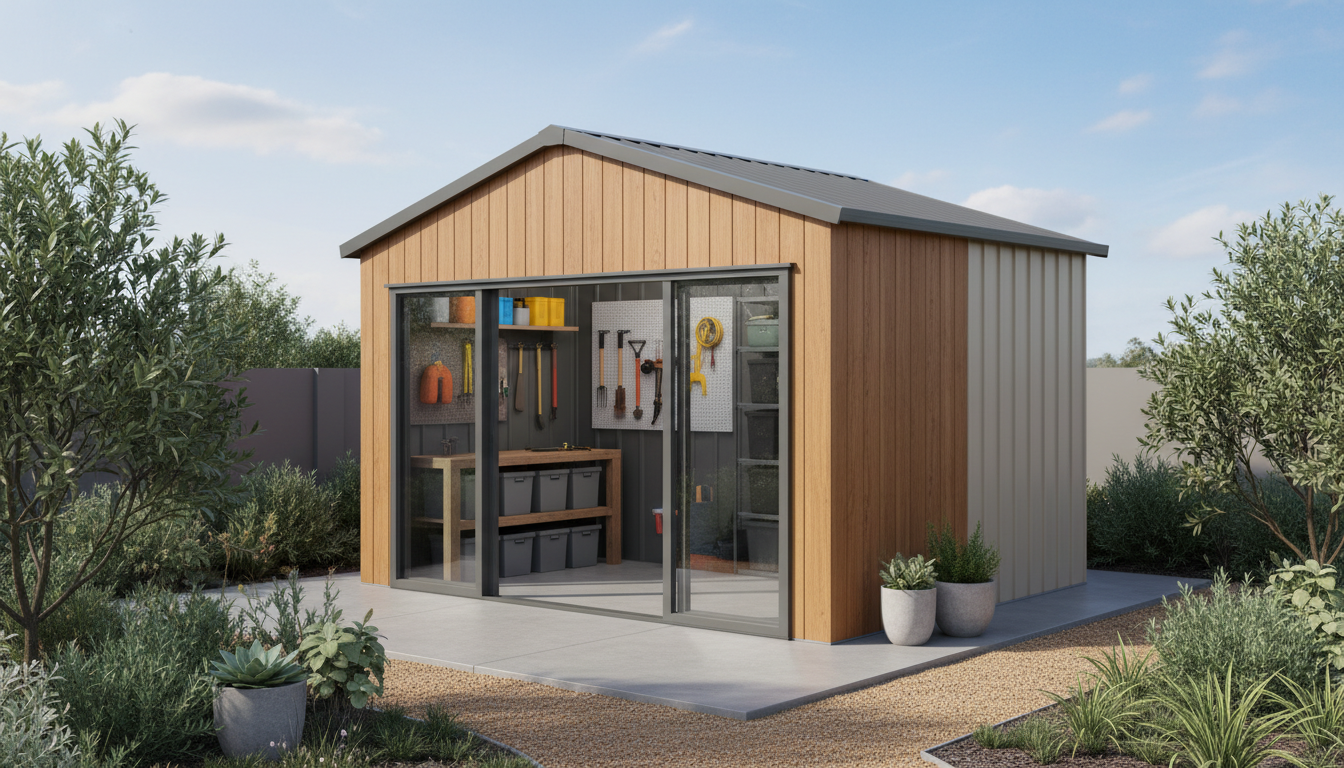
- 3.0 × 3.6 m weatherboard garden shed with skillion roof for compact backyards
- 6.0 × 6.0 m custom Colorbond garages Perth with a weatherboard façade to match the home
- Studio/workshop combos using composite weatherboard walls and Colorbond roof
Roof profiles: gable vs skillion vs flat
| Profile | Strengths | Considerations | Best for |
|---|---|---|---|
| Gable roof | Classic look, strong in wind, good heat venting | Taller ridge may trigger extra planning checks | Weatherboard garage beside heritage/federation homes |
| Skillion roof | Modern lines, easy solar panel fit, fast to build | Check drainage; specify larger gutters/downpipes | Compact garden sheds and studios |
| Flat roof | Low profile, budget-friendly | Lower pitch needs careful waterproofing and overflow provisions | Under-eave or boundary-adjacent installs |
Doors, windows, ventilation and insulation
- Doors: Colorbond roller doors (wind-locked where required), glazed PA doors for natural light. For sizing, wind ratings and automation options, see our roller door garden shed buyer’s guide.
- Ventilation: Ridge vents, screened louvres, or whirlybirds to manage condensation
- Insulation: Anticon blanket under roof sheets; add wall batts for habitable garden rooms
- Weatherboards: Pre-finished composites for low maintenance, or fibre‑cement for paintable custom colours
- Flashings: Vermin-proofing at base; marine-grade sealants near the coast
DIY shed kits vs fully installed — what suits your site?
| Option | Pros | Cons | Who it suits |
|---|---|---|---|
| DIY shed kits | Lowest cost; fast delivery; weekend project; common sizes in stock | Site set-out, slab and compliance are on you; limited customisation | Confident DIYers; inland sites with simple access |
| Custom-built and installed | Bespoke sizing; engineered for wind/corrosion; one point of accountability; faster approvals | Higher upfront cost; lead time for engineering | Coastal, cyclonic or tight urban sites; premium finishes |
For heavy‑use spaces or trade setups, compare specs in our Colorbond work shed guide.
Prefer a car shelter first? Ask about affordable carports for Australian homes and custom carports Melbourne to complement your shed or garage design.
How much does a weatherboard garden shed cost in Australia?
Indicative, GST‑inclusive ranges for 2025 based on typical metro installs (site-dependent):
- 3 × 3 m weatherboard-look garden shed (steel frame, skillion roof): $3,500–$7,500 supplied; $6,500–$11,000 installed
- 3 × 4.5 m garden studio with insulation and glazing: $9,000–$18,000 supplied; $15,000–$28,000 installed
- 6 × 6 m double weatherboard garage with Colorbond roof: $16,000–$28,000 supplied; $28,000–$45,000 installed
Prices vary with wind region, slab/footings, access, finishes and coastal upgrades (e.g., Colorbond Ultra, stainless fixings). Recent industry updates (HIA Home Improvements and Australian Steel market outlooks for 2025) note stabilising steel lead times with localised cost pressure on labour.
Real build examples (Australia)
Case study 1 — Perth, WA: timber-look shed that beats the heat
- Size: 3.2 × 4.0 m, skillion roof, Region A (non-cyclonic)
- Spec: Colorbond roof/walls (Shale Grey), composite weatherboard front, R2.5 roof Anticon, vermin flashings
- Outcome: Internal temps dropped ~8°C vs uninsulated; BA1 certified; installed in 2 days after slab cure
Case study 2 — Townsville, QLD: cyclone-ready workshop
- Size: 4.5 × 6.0 m, gable roof, Region C
- Spec: C2 design, wind-locked roller door, extra hold‑down, Class 4 fasteners
- Outcome: Passed private certification; insured as a cyclone-rated shed; zero damage after wet-season gusts
Case study 3 — Hunter Valley, NSW: rural shed with weatherboard façade
- Size: 9 × 6 m bay with attached 3 × 3 m weatherboard garden shed
- Use: Farm machinery storage plus garden tools; Zincalume interior, Colorbond façade to match homestead
What are the site and climate factors I must check?
- Wind: Region and terrain category; hilltop/topographic effects
- Corrosion: Distance to breaking surf; specify Colorbond Ultra within aggressive marine zones
- BAL: Ember screening, metal vents, non-combustible cladding as needed
- Snow: Alpine NSW/VIC requires snow load checks per AS/NZS 1170.3
- Slab: Typical 100 mm 25 MPa with SL72 mesh and thickened edges for posts—confirm engineering
- Drainage: Gutters, overflow provisions, and legal stormwater discharge
- Termites: Termite barrier at slab penetrations in susceptible areas
5-step buying guide for custom sheds in Australia
- Define use and size: garden tools, hobby space, or weatherboard garage for two cars?
- Pick materials: run a Colorbond vs Zincalume comparison and decide on composite or fibre‑cement weatherboards.
- Get engineering: request AS/NZS 1170.2 site-specific calcs, slab design and fastener schedule.
- Sort approvals: choose BA1/BA2 (WA) or a private certifier (QLD); check setbacks and heights.
- Build smart: plan access, power, lighting, ventilation and future storage (shelves, mezzanine).
Frequently asked questions
Will a weatherboard-look shed last as long as a steel shed?
Yes—if the frame is galvanised steel, claddings are rated for the environment, and fasteners are Class 4 near the coast. Composite or fibre‑cement weatherboards outperform softwood in durability and maintenance.
Can I match the shed to my home’s Colorbond roof and gutters?
Absolutely. Popular pairings include Shale Grey, Surfmist and Monument. Ask for matching roller doors and flashings for a cohesive façade.
What about bushfire-prone sites?
Use non-combustible cladding (steel or fibre-cement), ember‑proof vents and metal gutter guards. Your designer should verify the BAL level and specify compliant details.
How long do approvals take?
WA BA1 certified applications commonly turn around in 10–25 business days depending on council workload. Other states vary; private certification can be faster for standard sheds.
What foundation do I need?
Most sheds sit on a reinforced concrete slab. Some cyclonic or sloping sites use embedded posts or screw piles with a suspended floor—your engineer will specify the best option.
Keyword clusters to help your planning
- Location: steel sheds Perth, rural sheds NSW, custom carports Melbourne
- Technical: Colorbond vs Zincalume comparison, wind-rated sheds for cyclonic areas, BAL ratings
- Usage: farm machinery storage, DIY shed kits, affordable carports for Australian homes
Standards, climate and industry resources
- Master Builders (WA) guidance on permits
- Housing Industry Association — renovations and approvals
- Bureau of Meteorology — cyclone and wind information
- Australian Steel Institute — steel design and compliance
- CSIRO — building science and condensation
- Energy.gov.au — home energy and insulation basics
Quick spec checklist (copy/paste)
- Frame: Galvanised cold-formed steel, engineer-certified
- Cladding: Colorbond (Ultra for marine) or fibre‑cement weatherboards
- Roof: Gable or skillion with Anticon; overflow provisions to AS 3500
- Fasteners: AS 3566 Class 4 near coast; stainless in splash zones
- Wind: Region, terrain and topography per AS/NZS 1170.2
- Footings: Slab or posts per engineering; termite barrier as required
- Openings: Wind-locked roller door where applicable; PA door with weather seals
- Ventilation: Ridge/louvre vents; condensation control strategy
Ready to turn your concept into a certified plan? Whether you’re after a compact weatherboard garden shed, a double weatherboard garage, or a larger rural workshop, get a site-specific, engineer‑backed design. It’s the fastest path to approvals and a shed that stands up to Australian conditions.