

If you’re planning a shed custom build in Australia—whether a custom-built double garage in Perth, a rural machinery shed in NSW, or a cyclone-rated boat shed in QLD—this guide covers design, engineering, council approvals, and costs. It’s written for time‑poor homeowners and investors who want a premium, compliant result without surprises.
If you’re still exploring concepts for smaller projects, browse our yard shed ideas Australia guide for layouts, materials and council tips.
What Are the Best Shed Materials for Perth’s Climate?
In WA’s hot, dry summers and salty coastal air, material choice matters. Most custom sheds in Australia use high-tensile, cold‑formed steel frames and either Colorbond or Zincalume cladding. For “steel sheds Perth” conditions, coastal corrosion resistance and heat performance are key.
Colorbond vs Zincalume — Which Is Better for WA Conditions?
| Criteria | Colorbond | Zincalume |
|---|---|---|
| Coastal resistance (≤500 m from surf) | Better in Colorbond Ultra grades; choose marine-grade fasteners | Good, but visible tea-staining risk near coasts |
| Heat reflectivity | High with lighter colours; reduces heat gain in Perth summers | High natural reflectivity; can create glare |
| Colour stability and style | Large Colorbond palette + Matt range; suits premium builds | Limited (silvery metallic only) |
| Upfront cost | Higher | Lower |
| Warranty (typical) | Up to 25 years (conditions apply) | Up to 25 years (conditions apply) |
| Best fit for WA | Urban/coastal, premium custom sheds, custom Colorbond garages Perth | Rural/industrial where budget is critical |
For coastal or exposed sites, ask your shed builder for marine-grade fasteners and flashing details, plus added paint system warranties. A quick Colorbond vs Zincalume comparison during design will set you up for fewer maintenance headaches.
How Do Custom Shed Designs Differ Across Australia?
Local wind, fire and corrosion zones dictate the engineering. That’s why “shed designs Australia” vary a lot by postcode. A custom shed design for Melbourne’s suburbs is different to cyclone-rated sheds in North QLD or coastal WA boat storage.
- Perth & WA coast: High UV, salt; consider Colorbond Ultra, hot‑dip galvanised brackets, enclosed eaves, and stormwater to soakwells.
- Queensland cyclonic regions: Region C/D wind categories require heavier frames, extra hold-downs, wind-locked roller doors, and tighter sheet fixing patterns.
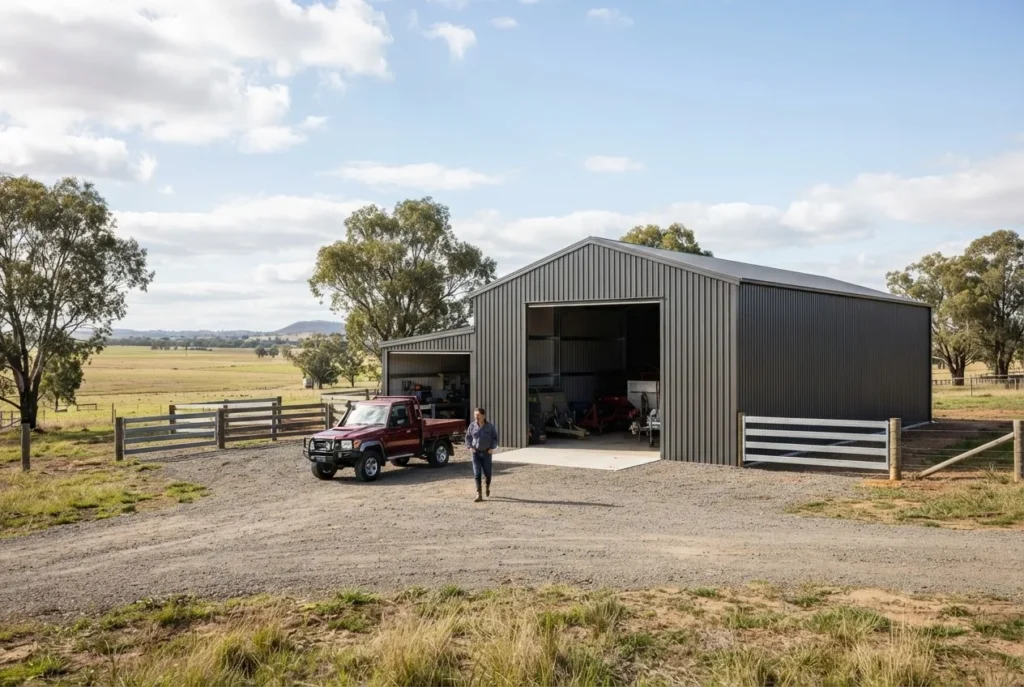
- NSW rural areas: Large clear-span rural sheds NSW for farm machinery storage often specify wider bays, higher eaves, and flexible door mixes.
- Victoria metro: Custom carports Melbourne must integrate with existing façade, boundary setbacks, and often include architectural features and powder-coated flashings.
Roof style and structure: flat, gable or skillion?
Gable roofs suit garages and workshops, shedding water evenly. Skillion (monoslope) roofs are modern, ideal for solar. Flat roofs are sleek on custom carports but need careful drainage. Choose roof pitch to balance clearance, aesthetics and rain intensity (BOM rainfall data).
Doors and access
- Roller doors with wind-lock clips for cyclonic or high-wind sites
- Glass sliding or sectional doors for showrooms
- PA doors (3‑point locking), security mesh, and accessibility thresholds
- High-clearance openings for caravans and farm machinery storage
Slab and footings
Design slabs to AS 2870. On reactive clay, thicken edges and consider piers. For salt-prone areas, use appropriate concrete cover and class exposure. Anchor bolts and hold‑downs must match the engineering schedule for your wind region and terrain category.
How to Get Council Approval for Your Custom Shed in WA
WA requires planning approval (where applicable) and a Building Permit under the Building Act 2011. For council-approved sheds WA, here’s the path:
- Site check: Setbacks, easements, services, BAL rating, and stormwater discharge.
- Engineering and drawings: Certified to NCC 2022 and relevant AS/NZS standards (e.g., AS/NZS 1170.2 wind actions; AS/NZS 4600 cold‑formed steel).
- Certificate of Design Compliance (CDC): Issued by a registered building surveyor (Form BA3).
- Building Permit application (BA2): Submit to your local council with CDC, titles and site plan.
- Inspections: Slab, framing, final (as required by council).
Added 2024 WA wind-rating compliance notes Ensure engineering references updated AS/NZS 1170.2:2021 wind region maps and local topography multipliers. This affects portal frame sizes, purlin spacing and fixings.
What about QLD and NSW?
- QLD: Many coastal and northern sites are Region C/D; cyclone-rated sheds QLD require wind-region specific doors, sheeting and hold‑downs. Check if your project is assessable or accepted development.
- NSW: Many sheds qualify as Complying Development via the State Environmental Planning Policy, if they meet setbacks, height and site coverage rules.
What Wind Rating Does Your Shed Need?
Wind design follows AS/NZS 1170.2. Your shed’s rating depends on:
- Wind Region: A (most of southern Australia), B (intermediate), C/D (cyclonic)
- Terrain Category: Open terrain vs suburban
- Topography: Ridges and escarpments increase wind speed
- Importance Level (IL): Most sheds are IL2; larger public-use structures may change category
Ask your shed builder for the site-specific wind speed (Vdes, Vu), pressure diagrams, and tie‑down schedule so the slab, anchors, and frame match real conditions.
How to Choose Between a DIY Kit and a Custom-Built Shed
Both options work. It depends on your skills, time and compliance confidence.
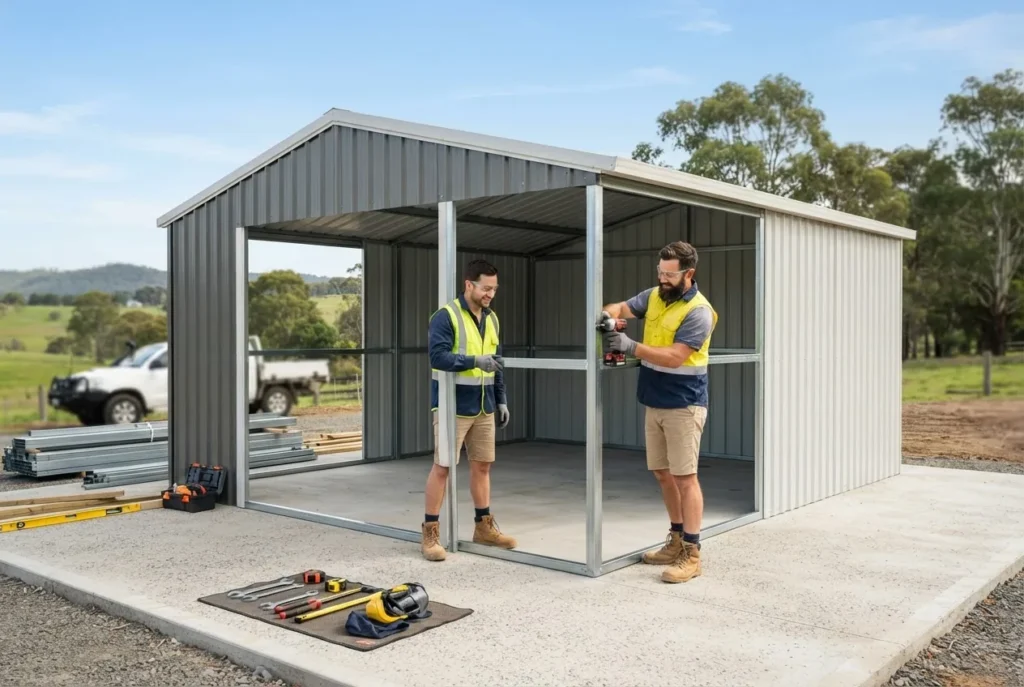
- DIY shed kits: Lower cost, fast delivery. You handle slab, erection and inspections. Great for small garden storage or simple workshops.
- Custom-built sheds: Design freedom, engineered for your site, turnkey council approvals and warranties. Best for high-value assets and tricky sites.
Planning a simple garden storage space? Compare garden shed layout ideas, floor plans and approvals in our dedicated guide.
Hybrid is common: a custom shed design with your choice of install (owner-builder or licensed installer). For affordable carports for Australian homes, a kit with a local installer offers value and speed.
Real-World Projects and Costs (2024–2025)
Costs vary by size, wind region, access and finish level. Recent industry data and the 2025 HIA Outdoor Structures and Home Improvement Report indicate steady demand and modest steel price stability, as echoed in the 2025 Australian Steel Market Outlook.
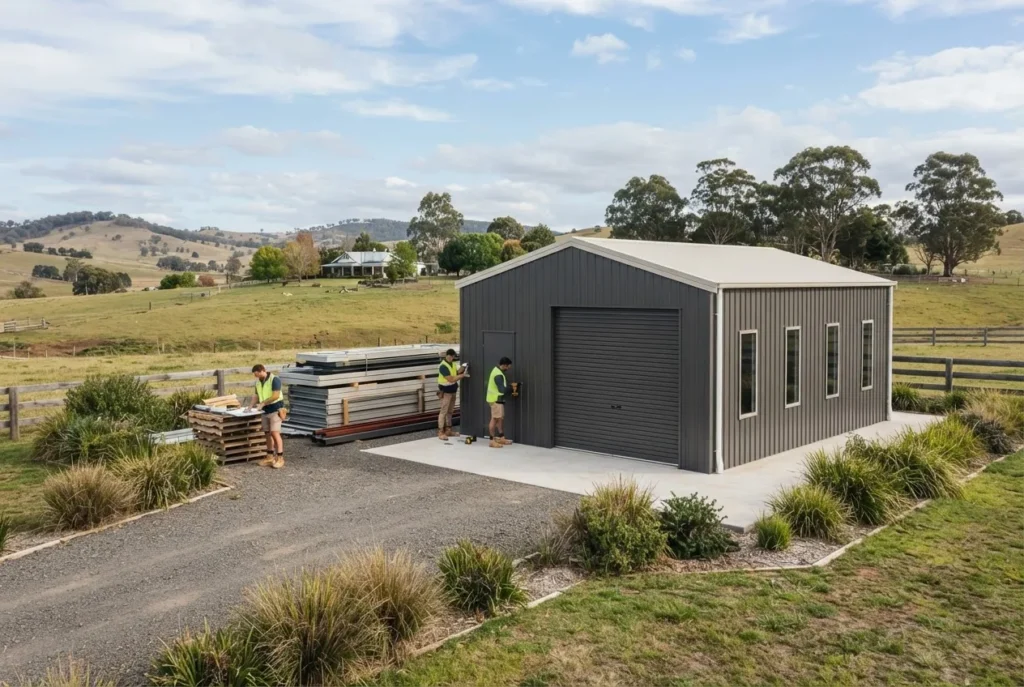
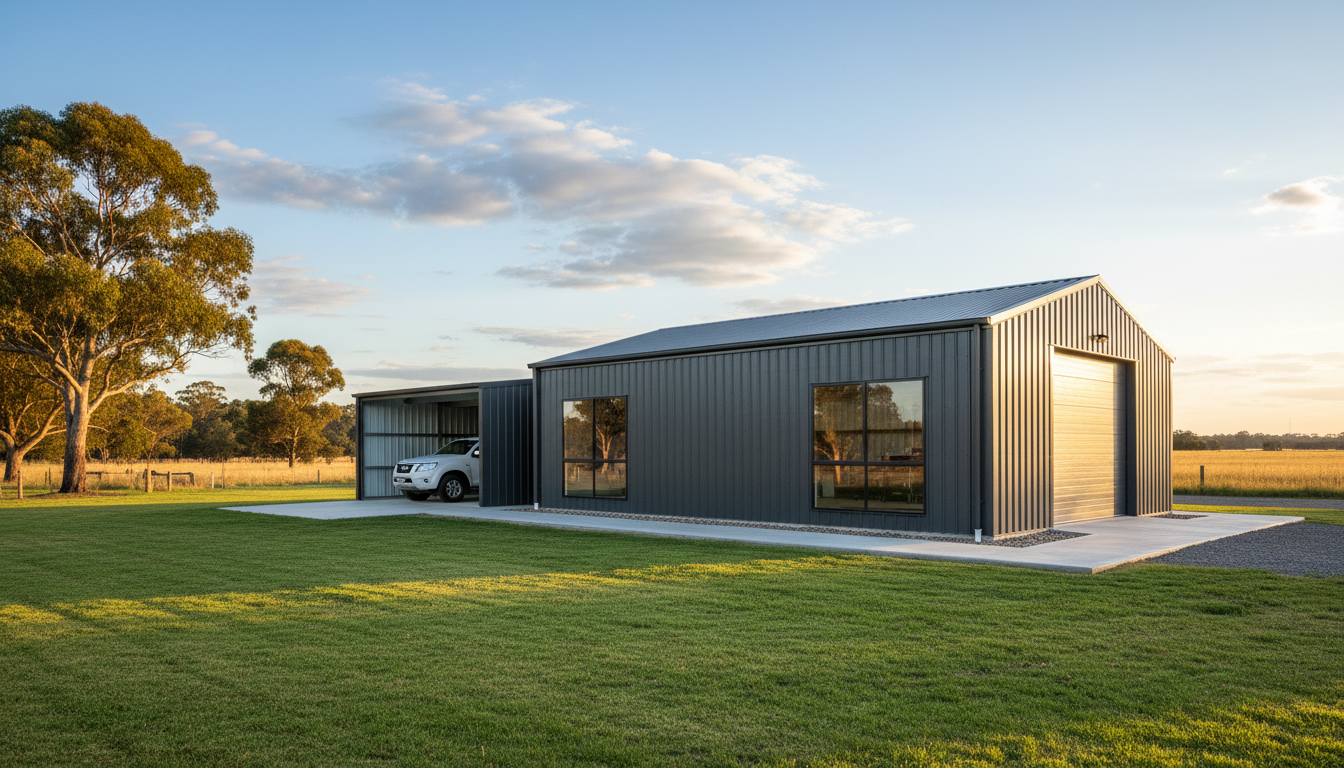
- Custom-built double garage in Perth: 6 x 7 m, gable, Colorbond Matt, 2x wind-locked rollers, PA door, insulation to roof. Council-approved sheds WA process included. Indicative turnkey: $18k–$28k.
- Rural machinery storage shed (NSW): 12 x 24 m, 5 m eave, four bays, open front, Zincalume. Kit: $38k–$55k; erected with slab and drainage: $70k–$110k (terrain/topography dependent).
- Cyclone-rated boat shed (North QLD, Region C): 8 x 12 m, skillion 5°, Colorbond Ultra, wind-locked roller with upgraded tracks, hold‑downs to engineer’s C‑region spec. Supply and install: $42k–$65k.
What Features Improve Durability and Comfort?
- Insulation and anti‑condensation: Foil blanket or insulated roof panels reduce heat and condensation drip.
- Ventilation: Ridge vents and whirlybirds purge hot air; add louvres for crossflow.
- Drainage: Box gutters sized to local rainfall; direct to soakwells or legal point of discharge.
- Vermin and dust proofing: Foam infills, vermin flashing, sealed thresholds.
- Corrosion control: Hot‑dip galvanised fixings (AS/NZS 4680), marine-grade screws near coasts.
- Bushfire detailing: BAL-compliant ember guards, steel mesh, sarking where required.
How to Get a Fast Shed Quote Online
If you’re chasing a shed quote online, have this ready:
- Dimensions (width x length x eave height), roof style and pitch
- Site address for wind region, BAL and terrain checks
- Preferred cladding (Colorbond vs Zincalume), colours and door openings
- Slab or footings preference, and any photos of the site
- Services and constraints: easements, sewer lines, power, driveway width
- Use case: workshop, custom made storage sheds, carports, or farm machinery storage
FAQs about Custom Shed Builds in Australia
Do I need council approval? Most custom built sheds need a Building Permit; planning permits vary by council and zone. In NSW, many are Complying Development; in WA, follow BA2/BA3 process; in QLD, check local planning scheme.
How long does it take? Design/engineering 1–3 weeks, approvals 2–6 weeks, slab 1 week, erection 1–3 weeks for typical custom sheds. Regional or cyclonic projects may take longer.
What slab thickness should I use? Commonly 100–120 mm with thickenings; engineer must size based on load (e.g., hoists), soil class and wind actions.
Can I add solar or a mezzanine? Yes—design roof pitch and purlin spacing for PV loads; mezzanines need dedicated engineering and bracing.
What warranties apply? Frame and cladding typically up to 20–25 years (conditions apply). Keep gutters clear and rinse coastal sheds to maintain coverage.
What about DIY shed kits vs installed? DIY suits competent owner‑builders. For cyclonic or complex builds, use licensed installers for compliance and warranty protection.
5-Step Buying Guide for Custom Sheds in Australia
- Define the brief: Size, use, access, future growth. Gather “shed plans Australia” examples for your builder.
- Check the site: Wind/BAL, drainage, power lines, neighbours. Use BOM climate data for rain and heat expectations.
- Select the system: Colorbond vs Zincalume, roof form, doors, insulation, security, and finishes.
- Engineer and approve: AS/NZS-compliant drawings, CDC, permits. For cyclone-rated sheds QLD, specify wind-locked doors and fasteners up front.
- Build and verify: Slab to spec, frame plumb, fixings per schedule, flashings sealed. Keep documentation for warranty and resale.
Standards, Climate and Industry Resources
- Bureau of Meteorology climate data for rainfall intensity and wind roses
- Housing Industry Association (HIA) guidance on approvals and contracts
- Master Builders Australia for licensing and best practice
- Australian Steel Institute for local steel and corrosion insights
- CSIRO research on building performance and bushfire guidance
Keyword Clusters Covered
Shed custom build, shed builder, custom sheds, design storage shed, shed design, shed build, shed designs Australia, custom built storage sheds, custom built sheds, custom made sheds, custom made storage sheds, shed plans Australia, shed quote online, custom shed design, steel sheds Perth, custom carports Melbourne, rural sheds NSW, Colorbond vs Zincalume comparison, wind-rated sheds for cyclonic areas, affordable carports for Australian homes, council-approved sheds WA, cyclone-rated sheds QLD, custom Colorbond garages Perth.