
![Off the Wall Garden Shed: Wall-Mounted and Lean-To Sheds in Australia [2025 Guide]](https://smalltrades.com.au/wp-content/uploads/2026/01/off-the-wall-garden-shed-wall-mounted-and-lean-to-sheds-in-australia-2025-guide.png)

The Off the Wall Garden Shed: Wall-Mounted and Lean-To Sheds in Australia [2025 Guide] unlocks a new paradigm in backyard storage and workspace design. Combining smart space-saving garden storage solutions with sleek aesthetics, these innovative sheds offer unique benefits tailored for Australian climates and urban lifestyles.
This comprehensive guide covers everything you need to know—from design principles and material choices to council approvals, installation best practices, and future-proofing your investment with the latest trends in flat pack sheds Australia.
Understanding Off the Wall Garden Sheds: Concepts and Benefits
Defining Off the Wall Garden Sheds and Their Unique Characteristics
Off the wall garden sheds refer to storage or utility units that are fixed directly onto existing vertical structures such as house walls, fences, or retaining walls. Unlike traditional standalone garden sheds, these sheds leverage the supporting wall to reduce footprint and foundation requirements.
Within this niche, two primary design types emerge: wall-mounted sheds, securely attached and elevated from ground level, and lean-to sheds, which lean against a wall with a sloped roof design. Both types maximize usable garden space, valuable in Australia’s increasingly compact urban backyards.
These sheds are ingeniously tailored to fit snugly against existing walls, making them ideal for storing garden tools, potting equipment, or small workshop areas without sacrificing precious lawn or patio space.
Differences Between Wall-Mounted and Lean-To Shed Designs
Wall-mounted sheds are typically framed and anchored directly onto an existing wall, often elevated above the ground to create a floating storage solution. This approach minimizes contact with soil, enhancing weather resistance and pest control.
Lean-to sheds rest on the ground but have their back walls formed by or against an existing vertical surface. Characterised by a single-pitch sloped roof, they provide effective rainwater runoff and natural integration with the home’s exterior.
While wall-mounted sheds offer superior spatial efficiency by freeing ground area, lean-to designs are often more straightforward to construct and can accommodate larger storage volumes in certain settings.
Advantages of Off the Wall Designs for Australian Backyards
- Spatial efficiency: Off the wall sheds reclaim precious garden space, perfect for small or narrow plots common in Australian cities.
- Better integration: They blend with existing structures for a cohesive backyard appearance instead of a standalone block.
- Reduced footing costs: Minimising or eliminating the need for concrete slabs or foundations cuts installation costs.
- Improved weather protection: Elevation and wall backing shield sheds from ground moisture, harsh sun, and wind.
- Customisable designs: Modular builds and flat pack sheds Australia options allow bespoke sizing and layout adjustments.
Common Materials Used: Focus on Colorbond Steel and Other Options
Colorbond steel dominates as the cladding material for off the wall and lean-to sheds in Australia due to its exceptional durability, UV resistance, and corrosion protection aligned with local climate challenges. Manufactured with a baked-on paint finish, Colorbond resists fading and offers an array of colour options to complement home exteriors.
While off the wall sheds often utilise Colorbond steel for durability, understanding the differences between Colorbond vs Zincalume sheds is critical for selecting the right cladding for your project. For a comprehensive comparison, see our Barn Sheds Australia: Prices, Council Approvals, Colorbond vs Zincalume, and Design Options guide.
Other materials include treated timber for framing and cladding in rustic designs, aluminum for lightweight modular units, and select composite panels for enhanced insulation or fire resistance in bushfire-prone zones. However, Colorbond remains the most commonly recommended material for its balance of strength, weight, and aesthetic appeal.
Transitioning into design specifics, understanding how material choices impact outdoor performance and compliance is critical for a successful off the wall shed.
Design Considerations for Wall-Mounted and Lean-To Sheds in Australia
Space-Saving and Aesthetic Integration with Existing Structures
Off the wall garden sheds excel in utilising the vertical plane without encroaching on outdoor living or garden space. Design approaches emphasise slim profiles and seamless connections with walls or fences. This requires careful examination of the shed integration with house, including wall condition, available height, and load-bearing capacity.
For standard garden shed dimensions, you can compare wall-mounted options with traditional 3×3 meter Colorbond garden sheds to gauge space requirements and design integration.
Comparing off the wall designs to popular sizes like 10×6 Colorbond garden sheds helps assess what suits your space best when planning your backyard storage.
Larger storage needs may be better served by standalone sheds such as the 10 x 20 Colorbond steel sheds, which offer extensive space but require more footprint.
Weather Resistance and Wind Ratings Specific to Australian Climates
Australia’s varied weather zones—ranging from tropical humidity and coastal storms to arid interiors—demand shed structures that endure extreme conditions. Off the wall designs must meet specific weather ratings Australian sheds, particularly concerning wind loads and water ingress prevention.
Materials like Colorbond steel are rated to withstand strong UV exposure and corrosive salt air near coastlines. Installation hardware, such as galvanised steel brackets and marine-grade anchors, ensures robustness against high winds, especially in cyclonic or bushfire-prone areas.
The Australian Bureau of Meteorology provides climatic zone data crucial to specifying the correct roof pitches, flashing, and sealants adaptable to the locality’s prevailing weather.
Customization Options: Size, Style, and Material Choices
Customization potential is a hallmark advantage of off the wall sheds. Flat pack sheds Australia manufacturers offer modular panels enabling bespoke configurations for:
- Dimensions tailored to fence lengths and wall heights.
- Roof styles: traditional lean-to single pitch, or flat roof alternatives.
- Insulation and ventilation options for workshop functionality.
- Colour selections matching or contrasting home exteriors.
This flexibility allows homeowners to optimise both function and visual appeal.
Awning sheds, often with lean-to designs, offer weather protection and aesthetic appeal similar to off the wall sheds, as detailed in our awning sheds with Colorbond cladding guide.
Larger off the wall units can be compared with popular 5×5 Colorbond garden sheds for space and durability insights to inform your decision.
Off the wall sheds can be contrasted with more common standalone 3×3 garden shed designs and pricing in terms of cost and functionality within tighter spaces.
Custom-sized sheds, such as the 6m x 3m Colorbond models, offer options for tailored storage beyond typical off the wall designs.
Comparison of Off the Wall vs. Traditional Standalone Sheds
| Aspect | Off the Wall Sheds | Traditional Standalone Sheds |
|---|---|---|
| Space Efficiency | High – uses vertical walls, frees ground | Lower – requires full ground footprint |
| Installation Complexity | Moderate to high – mounting hardware and wall compatibility critical | Varies – foundation required, but standardized |
| Weather Protection | Better ground moisture resistance, but dependent on wall integrity | Typically isolated, needs solid foundations |
| Customization | High – modular panels, sizes adaptable | High – variety of standalone kits |
| Cost | Often cheaper footing costs, but hardware and wall prep add cost | Potentially higher foundation cost, simpler hardware |
While off the wall sheds maximise small space use, they require precise design and quality materials to ensure durability and compliance. For deeper insights on cladding options, exploring the Colorbond vs Zincalume sheds discussion can help select the best materials for your environment.
Regulations, Council Approvals, and Australian Building Codes
Overview of Relevant Australian Building Codes for Wall-Mounted and Lean-To Sheds
Off the wall sheds must comply with the Australian shed building codes under the National Construction Code (NCC) and relevant Australian Standards. Key considerations include structural safety, fire resistance, and wind load requirements.
For wall-mounted installations, compliance with AS 1684 (timber framing), AS 1397 (steel sheet standards), and AS 3959 (construction in bushfire-prone areas) is essential. These standards verify that mounting methods, material use, and clearance from property boundaries meet rigourous safety rules.
Navigating Council Approval Processes in Different Australian States
- Determine if your proposed shed meets local council size and height exemptions.
- Submit architectural plans highlighting wall attachment method and material specs.
- Include engineering certifications for structural integrity if required.
- Await approval or requested modifications.
Each Australian state and territory has specific local government regulations, with coastal areas, heritage zones, and bushfire risk regions often imposing stricter conditions.
Permit Exemptions and Conditions for Off the Wall Sheds
- Sheds under certain size thresholds (often under 10m²) and height limits may qualify for permit exemptions.
- Setback rules from boundaries and easements are critical; wall-mounted sheds must typically maintain minimum separations.
- Non-permanent fixtures or easy removal designs can relax approval requirements.
Despite these rules, off the wall sheds often require detailed compliance documentation due to their attached nature.
Compliance Tips to Avoid Legal and Safety Issues
- Consult council early to confirm specific requirements for wall-mounted or lean-to sheds.
- Engage a structural engineer for complex installations, particularly in high wind zones.
- Ensure all materials meet Australian Standards and are certified for your climate zone.
- Retain permits and installation documentation for resale or insurance purposes.
Navigating council approvals can be complex, especially for novel designs like wall-mounted sheds. For detailed guidance on approvals, pricing, and compliance, refer to our Council approvals for sheds pillar page.
Understanding council approvals for various shed sizes, including 12×8 garden shed council approvals, is vital when considering off the wall designs to ensure compliance.
Installation and Construction Best Practices for Off the Wall Garden Sheds
Essential Mounting Hardware and Tools: Brackets, Anchors, and Fasteners
Choosing the correct hardware is paramount for a safe, lasting wall-mounted shed. Recommended components include:
- Heavy-duty steel mounting brackets with corrosion-resistant coatings suitable for outdoor exposure.
- Anchor bolts rated for structural loads per NCC requirements.
- Stainless steel or galvanized fasteners to prevent rust and maintain structural integrity.
- Shims and waterproof sealing tapes to ensure level installation and prevent water ingress behind walls.
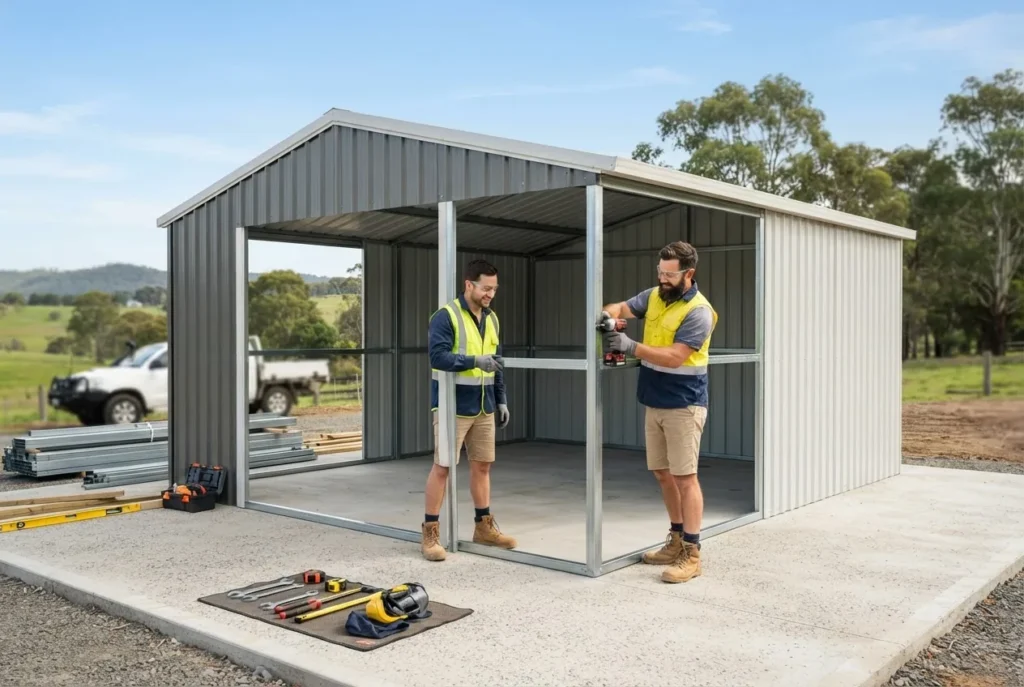
Step-by-Step DIY Assembly Process for Wall-Mounted and Lean-To Sheds
- Preparation: Inspect wall for structural soundness, moisture presence, and ensure level surface.
- Marking and drilling: Measure and mark fixing points aligned with mounting brackets; drill pilot holes carefully to avoid wall damage.
- Bracket installation: Secure brackets with appropriate anchors; test load capacity before proceeding.
- Frame assembly: Construct shed frame per manufacturer instructions ensuring structural rigidity and squareness.
- Fix frame to brackets: Attach the frame to brackets with supplied bolts and washers; use shims to maintain level.
- Cladding and roofing: Install walls and roof panels (typically Colorbond steel), sealing all joints against weather.
- Finishing touches: Apply weatherproof coatings on timber elements, fit doors, vents, and any accessories.
Professional Installation vs DIY: When to Call in Experts
While DIY installation is achievable for skilled homeowners, professional installers offer expertise with:
- Ensuring compliance with building codes and structural safety.
- Handling specialised mounting in confined or uneven sites.
- Managing complex permits and certification processes.
Engaging professionals is particularly advisable in high wind or bushfire risk zones.
Ensuring Structural Integrity and Longevity
Key factors include correctly anchoring to stable walls, using weatherproof sealants, and performing routine maintenance. Periodic inspections for corrosion or loosening fasteners enhance life expectancy.
Transitioning towards modern convenience, flat pack solutions streamline many installation steps.
Flat Pack Off the Wall Garden Sheds in Australia: Trends and Leading Suppliers
Overview of Flat Pack Shed Options Specific to Off the Wall Models
Flat pack sheds Australia companies now offer modular off the wall and lean-to options that ship pre-cut to specifications, simplifying transport and assembly. These kits incorporate pre-finished Colorbond panels, engineered brackets, and fasteners optimised for wall mounting.
Leading Australian Manufacturers Specializing in Wall-Mounted/LT Sheds
| Supplier | Speciality | Model Range | Notable Features |
|---|---|---|---|
| ShedMaster | Custom Colorbond wall-mounted kits | Lean-to and floating wall sheds | High wind rating hardware, quick assembly |
| FlatPack Sheds Australia | Modular off the wall units | Adjustable sizes, flat roof options | Lightweight frames, corrosion resistant |
| Aussie Shed Solutions | Hybrid DIY and professional install | Wall-mounted & lean-to ranges | Custom colours, integrated shelving |
When choosing flat pack off the wall garden sheds, consulting reviews of the best garden sheds in Australia ensures informed decisions and reliable quality.
Advantages of Modular Flat Pack Solutions in 2025
- Reduced on-site labour and tools needed.
- Pre-engineered components guarantee compliance and strength.
- Shipping efficiency lowers delivery costs.
- Expandable or adjustable modules available to suit evolving needs.
Cost Ranges and Value Considerations for Flat Pack Off the Wall Sheds
Pricing varies by size and customization but typically ranges from AUD 2,000 for small lean-to kits up to AUD 7,000+ for larger modular wall-mounted designs. Cost benefits arise from lower foundation requirements and streamlined installation, but high-quality mounting hardware and compliance certifications add to upfront expense.
Practical Use Cases and Space-Saving Storage Solutions
Use Cases: Garden Tool Storage, Workshop, Potting Area, and More
Off the wall sheds offer versatile applications including:
- Secure garden tool storage—protected and easily accessible without cluttering ground space.
- Compact workshop spaces with benches and power outlets enabled by stable wall support.
- Potting stations integrated with water and lighting for avid gardeners.
- Outdoor bar or hobby sheds where elevated design adds visual interest.
For extremely compact storage, 2×2 Colorbond garden sheds for small spaces offer inspiration for maximizing small footprint solutions for minimal areas.
If you need extra storage beyond wall-mounted sheds, 4×3 storage sheds for backyard organisation provide practical alternatives for backyard organisation with more ground space.
Some off the wall sheds can be adapted for specialized uses such as bar storage sheds and outdoor sheds for outdoor entertaining spaces.
While off the wall sheds provide efficient backyard storage, some Australians repurpose or upgrade sheds for alternative uses. For example, transforming garden sheds into ‘man caves’ or small home office studios is becoming increasingly popular. For detailed inspiration on such conversions and local options, see guides like Man Cave Shed: The Ultimate Australian Guide and Living in a Shed in Australia: Legal, Safe and Smart Options. Additionally, exploring Shed House Designs Australia (2025) helps understand larger scale shed conversions and compliance.
Maximizing Small Backyard Spaces with Wall-Mounted and Lean-To Designs
Installing an off the wall shed frees yard area for play, entertaining, or gardening. Their slim footprint and vertical storage options enhance utility without overwhelming limited floorspace. This is ideal in dense suburbs and strata properties where outdoor area comes at a premium.
Integration with Outdoor Living Spaces and Landscaping
Sheds can double as architectural features when paired with deck extensions, pergolas, or planter boxes. Selecting matching Colorbond colours harmonizes the shed with existing garden structures.
Maintenance Tips for Longer Shed Life and Performance
- Regularly clean gutters and roof fascia to prevent water damage.
- Inspect and tighten mounting brackets biannually.
- Touch up Colorbond paint chips to avoid corrosion.
- Check seals and ventilation to prevent moisture build-up inside the shed.
While off the wall sheds are versatile, understanding common pitfalls enhances satisfaction.
Challenges and Drawbacks of Off the Wall Garden Sheds: What to Watch For
Structural Limitations Compared to Standalone Sheds
Load-bearing capacity hinges on the existing wall strength—older or damaged walls may not support heavy sheds. Additionally, expansion or relocation options are limited without complete detachment.
Potential Weather-Related Risks and Mitigation Strategies
Exposed mounting brackets may corrode faster and require premium materials. Wind uplift forces can stress fixings; hence, appropriate wind-rated hardware is essential. Flashing and waterproof membranes prevent leaks where shed meets wall.
Common Installation Issues and How to Avoid Them
- Improper leveling causes doors and panels to misalign.
- Insufficient waterproofing leads to wall dampness or mould.
- Using incompatible fixings weakens attachment; always follow manufacturer guidance.
- Lack of permits can result in costly removal or fines.
Longevity and Repair Considerations
Periodic maintenance and inspections extend lifespan. Repairing damage on mounted sheds can be more complex than standalone units, especially if full wall access is impeded by landscaping or structures.
Consider these challenges carefully during planning to ensure a smooth project.
Future Trends in Off the Wall Garden Shed Design and Technology (2025 and Beyond)
Innovations in Materials and Weatherproofing for Australian Conditions
Emerging developments include nano-coated Colorbond panels for superior scratch resistance and hydrophobic coatings that repel water and dirt. Thermal insulation layers integrated within wall panels improve usability in extreme climates.
Smart Storage and Automation Features for Garden Sheds
- Integrated solar-powered LED lighting systems.
- Remote-controlled ventilation and humidity sensors.
- Smart lock systems compatible with home automation.
Sustainable and Eco-Friendly Design Trends
Australian manufacturers increasingly source recycled steel and promote modular designs for reduced waste. Incorporation of rainwater harvesting from lean-to shed roofs is gaining traction for eco-conscious gardeners.
Emerging Building Techniques and Modular Expansion Options
Hybrid designs with tool-less assembly and snap-lock panels allow sheds to evolve as storage needs change. Prefabricated wall systems with thermal and acoustic insulation are entering the market, improving comfort for workshop uses.
These trends promise to elevate wall-mounted sheds from purely functional units to versatile lifestyle assets.
FAQ: Frequently Asked Questions About Off the Wall Garden Sheds in Australia
Can I Install a Wall-Mounted Shed Without Council Approval?
Permit requirements vary by state and council. Small sheds under specific size and height limits may be exempt. However, attachment to external walls often necessitates formal approval to ensure structural and fire safety compliance. Always consult your local council first.
How Do Lean-To Sheds Compare in Cost to Fully Detached Sheds?
Lean-to sheds typically cost less than standalone sheds due to shared wall usage and reduced foundation needs. However, installation complexity and mounting hardware for secure attachment can add to expenses. Overall, lean-to designs offer a cost-efficient space-saving alternative.
What Maintenance Does a Colorbond Wall-Mounted Shed Require?
Colorbond steel requires minimal maintenance: periodic cleaning, checking for paint chips, and ensuring drainage systems remain clear. For wall-mounted sheds, also inspect brackets and fixings for corrosion or loosening every 6-12 months.
Are Flat Pack Off the Wall Sheds Durable Enough for Harsh Weather?
Quality flat pack sheds assembled with certified materials and hardware meet or exceed Australian weather protection standards, including cyclone zones when properly installed. Verify product ratings and supplier warranties before purchase.
Leading Australian manufacturers such as ShedMaster, FlatPack Sheds Australia, and Aussie Shed Solutions provide extensive customizable off the wall and lean-to shed ranges with modular flexibility and expert support.
Frequently Asked Questions
What is an off the wall garden shed?
An off the wall garden shed is a storage unit fixed directly onto an existing vertical structure like a house wall or fence, maximizing garden space by eliminating the need for separate footing and reducing ground footprint.
How does a wall-mounted shed differ from a lean-to shed?
Wall-mounted sheds are elevated and anchored directly to a wall, minimizing ground contact, while lean-to sheds rest on the ground with a sloped roof leaning against a wall, offering simpler construction and sometimes greater storage capacity.
Which is more cost-effective: an off the wall shed or a traditional standalone shed?
Off the wall sheds often reduce foundation costs due to wall support but may increase expenses from specialized mounting hardware. Standalone sheds require full foundations but use simpler installation. Overall cost-effectiveness depends on site conditions and design complexity.
Can off the wall garden sheds be customized in size and style?
Yes, many Australian flat pack shed suppliers offer modular off the wall sheds with adjustable dimensions, roof styles, materials, and colours, allowing tailored designs to fit specific backyard spaces and aesthetic preferences.
What maintenance is needed to ensure longevity of off the wall sheds?
Routine maintenance includes cleaning gutters, inspecting and tightening mounting brackets, touching up paint chips on Colorbond cladding, and checking seals to prevent moisture accumulation and corrosion for long-lasting durability.
How do installation challenges of off the wall sheds compare to standalone sheds?
Off the wall sheds require precise wall assessments, mounting hardware, and waterproofing to ensure integrity, often making installations more complex than standalone sheds, which generally need only a prepared foundation and simpler assembly.
What weatherproofing features are essential for off the wall sheds in Australia?
Essential weatherproofing includes corrosion-resistant brackets, waterproof seals between the shed and wall, UV-resistant Colorbond steel cladding, and appropriate roof pitches to manage rainwater and wind loads prevalent in Australia.
Why are flat pack sheds popular for off the wall garden setups?
Flat pack sheds are popular due to pre-cut materials, simplified assembly, reduced transport costs, compliance-guaranteed components, and modular designs that can be customized and expanded as storage needs evolve.