
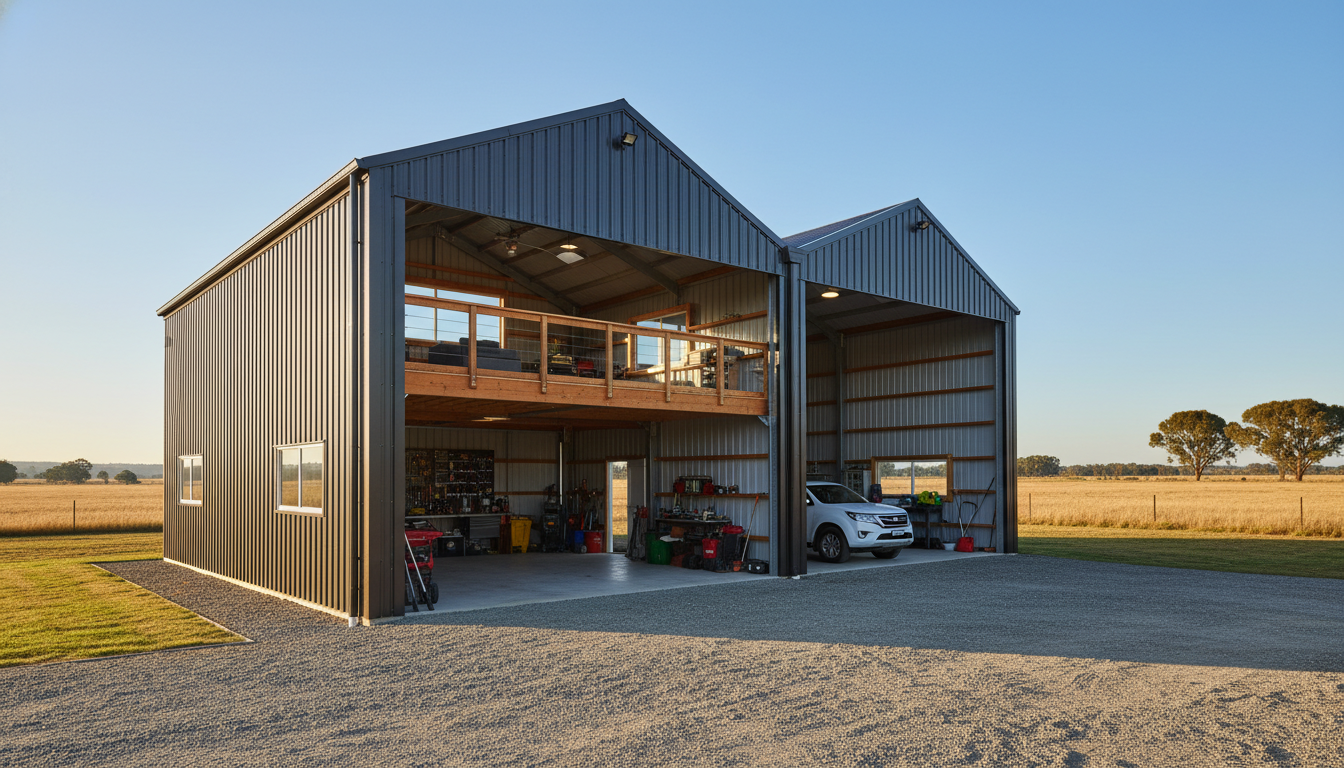
Barn sheds with mezzanine floors: the complete Australian guide (2025)
Why choose a barn shed with a mezzanine in Australia?
A mezzanine floor doubles your usable space without expanding the footprint. In a Colorbond steel barn, it becomes the perfect platform for farm machinery spares, a workshop loft, a home brewery, or even a studio (subject to classification rules). For large rural blocks, coastal properties, and acreage estates, barn sheds with mezzanine floors deliver high-volume storage, clear central spans for vehicles, and flexible headroom for car hoists or caravans. Curious about curved roof options? Learn about Quaker barn sheds.
- Popular uses: farm machinery storage, boat and caravan storage, hobby studios, e-commerce stock, tradie equipment rooms
- Common sizes: 9×9 m to 12×18 m; clear internal heights 3.0–5.0 m; mezzanine spans 3–6 m between supports
- Materials: BlueScope Colorbond steel cladding over galvanised steel portal frames, engineered per Australian Standards
What are the best shed materials for Perth’s climate?
Perth homeowners face high UV, summer heat, and coastal air. Most premium barn sheds use BlueScope steel with either Colorbond or Zincalume finishes, fixed to hot-dipped galvanised frames. Insulated roof panels and effective ventilation are essential for workshop comfort in WA summers.
Colorbond vs Zincalume — which is better for WA conditions?
| Feature | Colorbond | Zincalume |
|---|---|---|
| Coating | Painted steel (multiple layers) over metallic coating | Aluminium-zinc alloy coating |
| Corrosion resistance | Excellent in urban/regional; good in coastal if set back and maintained | Excellent inland; can dull near coast without maintenance |
| Coastal suitability | Preferable within 1 km–5 km of surf (with maintenance) | Better 5+ km from breaking surf |
| Heat reflectivity | High with light colours (e.g., Surfmist) | High initial; surface heats up once weathered |
| Colours | Full Colorbond palette | Silver-grey only |
| Typical cost | $$ (higher) | $ (lower) |
| Warranty | BlueScope backed when installed to spec | BlueScope backed when installed to spec |
| Best for | Premium barns, custom Colorbond garages Perth | Regional farm sheds, budget barn kits inland |
How a mezzanine floor is engineered in a barn shed
- Structure: Bolted steel portal frames with secondary members (purlins, girts) support mezzanine bearers and joists
- Live loads: 2.5 kPa typical for storage; 3.0 kPa for office; higher for heavy-duty storage (AS/NZS 1170)
- Joists: C-purlins or RHS at 450–600 mm centres with steel chequer plate or structural flooring panels
- Access & safety: Stairways, handrails and balustrades to AS 1657; edge protection to mezzanine per NCC
- Fire & use: If used for habitable purposes, the building may move from Class 10a to Class 1/5 triggering stricter NCC provisions—always check with your certifier
- Slab & footings: Thickened slab beams or piers under mezzanine posts; anchor bolts (e.g., M16–M20) per engineer detail
Wind ratings, cyclones, and Australian Standards you must meet
All quality barn sheds in Australia should be engineered to: AS/NZS 1170 (actions), AS/NZS 4600 (cold-formed steel), AS 4100 (steel structures), AS 1397 (coated steel), and NCC 2022 (with NCC 2025 changes pending). Wind ratings depend on location (Regions A, B, C, D) and site exposure.
- Perth metro: Typically Region A, N2–N3, Terrain Category 2–3
- WA north coast and Exmouth: Region D (severe cyclonic) — requires cyclone detailing
- QLD coastal: Region C for many areas; ensure cyclone-rated sheds in QLD
- Snow loads: Alpine NSW/VIC require snow design (AS/NZS 1170.3)
- BAL ratings: Bushfire construction per AS 3959 if applicable
Added 2024 WA wind-rating compliance notes: Some councils now request site-specific wind reports. Ask for a shed engineered for your exact wind region and terrain, not a generic “one-size” kit.
Added cyclone detailing for QLD Regions C/D: Look for extra hold-downs, denser screw patterns, and upgraded roller doors tested for cyclonic pressures.
How to get council approval for your custom shed in WA
Step-by-step approvals
- Planning check: Confirm zoning and setbacks with your local WA council
- Engineering: Obtain certified drawings, wind classification, slab detail, and connection schedule
- Building permit: Lodge BA2/BA3 with site plan, elevations, engineering, and owner-builder details (if applicable)
- Services and easements: Mark septic, leach drains, power runs; get dial-before-you-dig
- Final inspection: Provide as-built photos, slab certificate, and engineer’s compliance
Tip: Many suppliers offer council-approved sheds WA as a service. It’s worth it if you’re time-poor.
DIY barn kits vs custom-built sheds
Both can deliver a robust, long-life barn. Your choice depends on time, budget, and site complexity.
Curated barn shed kits in Australia can help streamline your build.
DIY shed kits vs custom-built — quick comparison
| Criteria | DIY Barn Kits | Custom-Built by Licensed Installer |
|---|---|---|
| Upfront cost | Lower | Higher |
| Speed | Depends on your availability | Faster, managed schedule |
| Design flexibility | Fixed options | Full custom (bays, doors, mezzanine loads) |
| Engineering | Standard; may need site-specific upgrades | Tailored to site wind, terrain, soil |
| Quality control | DIY dependent | Professional crews and QA |
| Best for | Simple sites, budget-focused | Premium, complex, sloping or coastal sites |
Roof styles: flat vs gable for barn sheds with mezzanines
| Feature | Gable (Classic Barn) | Skillion/Flat-Look |
|---|---|---|
| Headroom for mezzanine | Excellent in centre bay; allows loft feel | Good; uniform ceiling line |
| Rainfall handling | Great with ridge and eaves | Requires careful gutter design and fall |
| Wind performance | Predictable with correct detailing | Similar when engineered; edge lift detail is critical |
| Aesthetics | Traditional American barn profile | Modern, minimal lines |
| Solar panels | Easy on north roof plane | Easy if oriented for optimal tilt |
Real-world builds: Australian case studies
Swan Valley, WA — 12×15 m Colorbond barn with 50 m² mezzanine
- Use: Wine storage and workshop
- Spec: Colorbond Monument walls, Surfmist roof; N3 wind rating; 2.7 m clearance under mezzanine
- Add-ons: Insulated roof panels, whirlybirds, fire-rated access door (BAL-19 site)
- Outcome: 35% lower summer temps than previous zincalume shed; council approved in 21 days
Bundaberg, QLD — 9×12 m cyclone-rated barn with mezzanine
- Use: Boat storage and parts loft
- Spec: Region C, cyclonic roller doors, upgraded hold-downs; hot-dip galvanised frame
- Outcome: Passed post-storm inspection with no damage; insurance accepted engineered certs
Costs in 2025: what to budget for a barn shed with a mezzanine
Indicative supply-and-install ranges using BlueScope steel (regional variations apply):
- 9×9 m barn with partial mezzanine (20–30 m²): $28k–$42k
- 12×12 m with 40–60 m² mezzanine: $45k–$68k
- 12×18 m with 80–100 m² mezzanine: $65k–$95k
- Upgrades: Insulation, windows, stairs to AS 1657, cyclone kits, and epoxy floor coatings add to price
When budgeting your barn shed, you might want to compare with Barndominium Australia prices for different construction methods.
According to the 2025 Australian Steel Market Outlook and the 2025 HIA Outdoor Structures and Home Improvement Report, steel input prices stabilised in late 2024 but remain above pre-2020 levels, and homeowners continue to invest in high-utility outdoor buildings. HIA reports and Australian Steel Institute insights support planning a 10–15% contingency for custom features.
5-step buying guide for custom sheds in Australia
- Define use and loads: Storage vs office, mezzanine live load (2.5–5 kPa), door clearances for your vehicles
- Site and compliance: Wind region, BAL rating, setbacks, stormwater plan, soil test if required
- Choose materials: Colorbond vs Zincalume, galvanised frame, insulation, door wind ratings — and plan openings with our guide to sliding barn doors for barns
- Select delivery model: DIY shed kit vs custom install; confirm lead times and warranties
- Paperwork and finance: Council approvals, NCC/AS certs, insurance, and staged payments
Keyword clusters and common configurations
By location
- Steel sheds Perth, custom Colorbond garages Perth, council-approved sheds WA
- Rural sheds NSW, barn kits Newcastle and Hunter Valley
- Custom carports Melbourne, heritage-look barns in regional VIC
- Cyclone-rated sheds QLD, farm sheds Townsville and Cairns
By use-case
- Farm machinery storage and implement sheds
- DIY shed kits for acreage homes
- Affordable carports for Australian homes alongside barns
- Workshop lofts, hobby studios, and small business storage
Technical themes
- Colorbond vs Zincalume comparison for coastal areas
- Wind-rated sheds for cyclonic areas (Regions C/D)
- Insulation R-values, vapour barriers, condensation control
- Door wind locks, panel lift vs roller door selection
Frequently asked questions
Do I always need council approval for a barn shed?
Most Australian councils require approval for Class 10a buildings over small exempt sizes. Height, footprint, and setbacks trigger permits. Check your local planning scheme or use a supplier who manages approvals.
Can I add a mezzanine later?
Yes, if the original shed was engineered to take mezzanine loads. Otherwise you’ll need revised engineering and possibly slab upgrades and new hold-downs.
What wind rating should I ask for?
Site-specific. In WA metro, many sites are N2–N3. In North QLD or WA northwest, you may need Region C/D cyclone design. Always insist on engineering to AS/NZS 1170.2 for your exact site.
Will a mezzanine make the shed hotter?
Not if designed well. Choose light Colorbond roofs, add roof/wall insulation, ventilate, and consider ceiling fans under the mezzanine.
What foundations are typical?
A reinforced slab with thickened beams and post footings per the engineer’s drawings. Chemical or mechanical anchors sized to wind uplift.
Can I finance a barn shed?
Yes. Many suppliers provide staged payments; some offer finance via partners. Confirm that progress claims align with delivery milestones.
Safety, energy, and durability tips
- Ventilation: Ridge vents, whirlybirds, or powered roof fans reduce heat and condensation
- Condensation control: Use anti-condenser blanket and vapour barrier under the roof sheeting
- Corrosion zones: In coastal C3–C4 areas, upgrade fasteners and schedule washdowns for sea spray
- Energy: Insulate roof and walls; consider solar PV on north-facing slopes. See Energy.gov.au
- Maintenance: Annual check of fixings, door tracks, gutters, and repainting cut edges as needed
Color selection and style
Popular Colorbond colours for barns include Monument, Basalt, Woodland Grey, and Surfmist for roofs in hot climates. For rural NSW and VIC, classic two-tone American barn styling with heritage trims remains in demand.
Local codes, data sources, and standards
- Standards: AS/NZS 1170 (parts 0–2), AS/NZS 4600, AS 4100, AS 1397, AS 3959 (bushfire), AS 1657 (stairs/handrails)
- Climate data: Bureau of Meteorology climate data for wind and rainfall planning
- Industry guidance: HIA, Master Builders Australia, Australian Steel Institute
- Market: 2025 Australian Steel Market Outlook; 2025 HIA Outdoor Structures and Home Improvement Report
Ready to design your barn shed with mezzanine?
Whether you want a premium Colorbond steel shed for regional WA, cyclone-rated sheds in QLD, or rural sheds in NSW, choose a partner who provides site-specific engineering, council paperwork, and quality installation. Ask for references and recent jobs nearby.