
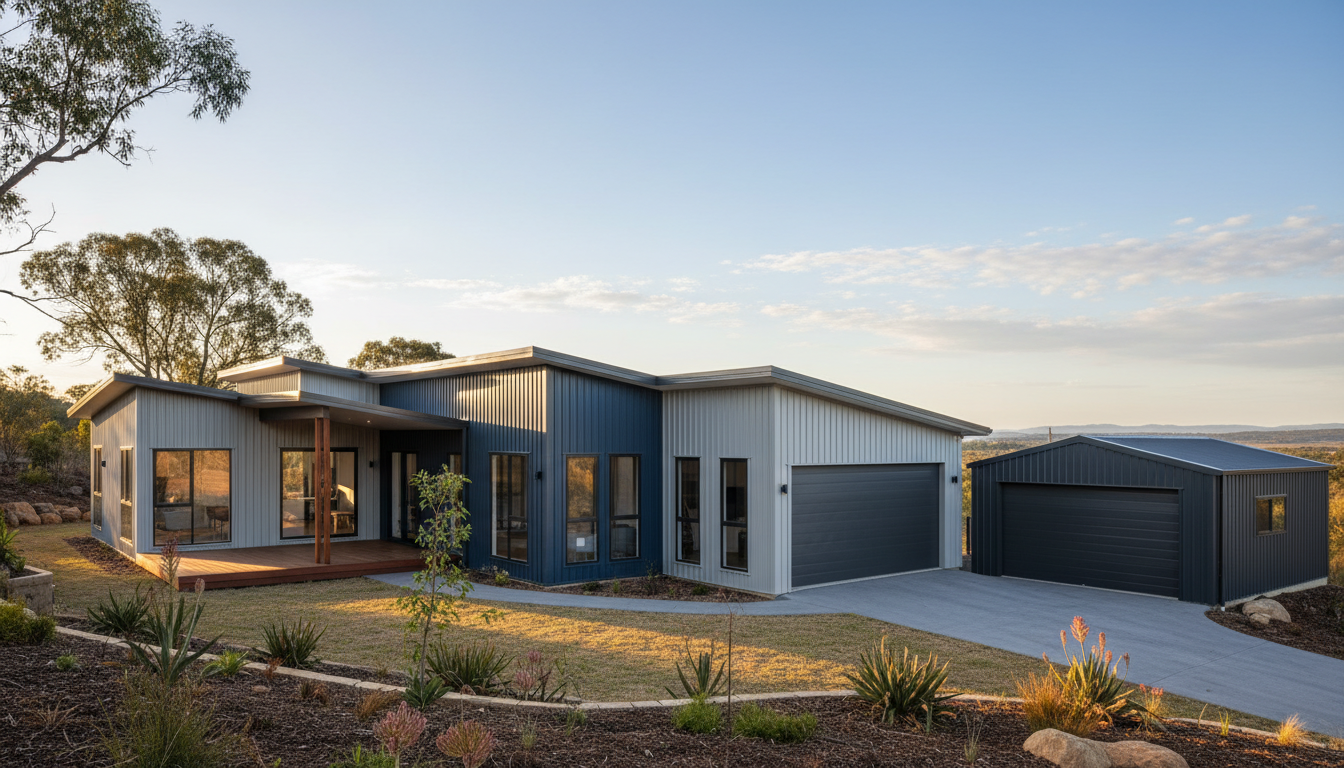
What does “bond kit homes” mean in Australia?
Most Aussies typing “bond kit homes” are after Colorbond steel kit homes or steel building kits. That includes:
-
– Kit home shells (steel frame + Colorbond cladding) ready for fit-out
– Premium Colorbond steel sheds and custom-built double garages
– Rural sheds NSW and farm machinery storage buildings
– Custom carports Melbourne, council-approved sheds WA, and cyclone-rated sheds QLD
Looking beyond shells and sheds? See our steel house kits Australia guide for NCC, energy and wind‑rating requirements on dwellings.
What are the best shed materials for Perth’s climate?
Perth’s intense UV, summer heat and coastal influences make roof and wall choice critical. For a custom Colorbond garage in Perth or a large workshop in Rockingham, go for:
-
– Roofing and cladding: Colorbond (including Ultra or Matt near coast) for UV stability and colour choice
– Framing: Galvanised cold-formed C-sections and RHS columns to AS/NZS 4600 and AS 4100
– Fasteners: Cyclone-rated screws with neoprene seals; stainless in marine zones
– Insulation: Anticon blanket or insulated roof panels for thermal performance and condensation control
Pro Tip: Using insulated roof panels can reduce internal shed temperatures by up to 10°C in summer, while also cutting condensation. Check Energy.gov.au guidance and local energy-smart details for your climate zone.
How much do Colorbond kit homes and steel sheds cost in 2025?
Indicative, ballpark figures only. Final pricing depends on wind region, terrain, engineering, design, site access, slab, and finish level.
Colorbond kit homes prices (shell kits)
-
– Small 1–2 bed shell (excl. fit-out): roughly $70,000–$140,000+
– Family-size shell: roughly $140,000–$300,000+
– Barndominium/shouse shells (shed-home hybrids): highly variable; budget for engineered shell plus internal build
Premium steel sheds and garages
-
– Single garage or small workshop (approx. 6×3 to 6×6): roughly $6,500–$18,000+ (kit); installed will be higher
– Custom-built double garage in Perth (6×6 to 7×7, with motorised roller doors, insulation): roughly $15,000–$35,000+ installed
– Rural sheds (9×12 farm machinery storage, high bay): roughly $25,000–$90,000+ depending on spans, doors, and wind rating
– Cyclone-rated sheds QLD (Region C/D): allow extra 10–30% for engineering, connections, and fasteners
DIY kit vs custom-built
-
– DIY shed kits: Cheapest path, suited to experienced owner-builders, still requires permits and engineering
– Custom-built turnkey: Faster, council-ready, better finish, one point of contact, higher upfront cost
If you only need storage or a small workshop, a DIY garden shed kit can be a faster, cheaper win before tackling a kit‑home build.
How do wind ratings and the Building Code affect your shed or kit home?
Every compliant steel shed or kit home must be engineered to AS/NZS 1170.2 wind actions and the NCC (BCA). Your site’s wind region (A, B, C, D), terrain category, shielding, and topography are used to assign a wind classification (e.g., N2, N3, C2). This drives frame size, connection details, and hold-down design.
Added 2024 WA wind-rating compliance notes For coastal WA and exposed ridge sites, expect higher pressures and extra bracing. Ask for a site-specific RPEQ/structural engineer certificate, footing design, and slab detail consistent with AS 3600 (concrete) and AS 2870 (residential slabs) where applicable.
How to get council approval for your custom shed in WA
- Planning check: Confirm setbacks and heights under your local planning scheme or R-Codes.
- Engineering: Obtain certified structural drawings to AS/NZS standards.
- Application: Submit BA2 (or relevant) with site plan, elevations, engineer’s certificate, and energy/ BAL if required.
- Slab and drainage: Provide stormwater plan, gutters/downpipes sizing, and soakwell details.
- Inspection: Book footing/slab and final inspections per Building Act 2011 (WA) processes.
Tip: Many suppliers offer council-approved sheds WA-wide and can lodge documentation on your behalf.
Colorbond vs Zincalume — which is better for WA conditions?
| Feature | Colorbond | Zincalume |
|---|---|---|
| Finish | Pre-painted, colourfast; wide palette incl. Matt | Unpainted metallic finish, modern/industrial look |
| Coastal suitability | Use Ultra near harsh marine; excellent with maintenance | Strong base corrosion resistance; consider paint/coating near surf |
| Heat & UV | High UV resistance; light colours reflect heat | Reflective when new; can dull over time |
| Cost | Typically higher than Zincalume | Generally more affordable |
| Best for | Premium street appeal, custom Colorbond garages Perth, homes | Rural sheds NSW, internal linings, budget-friendly roofs/walls |
Both perform well when detailed correctly. For coastal Perth or Geraldton, consider Colorbond Ultra roofing and stainless fasteners. Always match materials to your wind region and corrosion zone.
Which shed design options add the most value?
-
– Roof profiles: Gable for classic looks; skillion (monoslope) for modern lines and easy PV mounting
– Openings: Extra eave height for 4WDs/boats; wind-rated roller doors with auto openers
– Thermal upgrades: Anticon blanket, insulated roof panels, sarking, whirlybirds or powered ventilation
– Durability: Vermin seals, heavy-duty gutters, larger downpipes, cyclonic flashings in Region C/D
– Finishes: Colorbond Matt/Ultra, mixed cladding (e.g., horizontal corrugate + feature panels)
– Usability: Mezzanine floor, internal liner purlins, power and lighting rough-in, security doors
For studios or guest spaces, a flat pack cabin offers steel framing, Colorbond cladding and clear approval pathways—see our cabin guide.
What’s the right shed for your state?
WA
Steel sheds Perth need heat and coastal resilience. Opt for light Colorbond colours, vented ridges, and UV-stable sealants. Council-approved sheds WA are streamlined with a full engineer’s pack.
QLD
Choose cyclone-rated sheds QLD (C1–C4) with enhanced hold-downs, door wind-locks, and tighter fastener spacing. Consider louvres and high-level vents for tropical humidity.
NSW
Rural sheds NSW: prioritise clear spans for headers and harvesters, plus wider awnings for weather loading. Check BAL ratings in bushfire-prone zones.
VIC
Custom carports Melbourne: check heritage overlays, snow loads for alpine areas, and boundary setbacks. Add insulation to reduce condensation in cool winters.
SA, TAS, NT
Match wind region and terrain. TAS: allow for snow and condensation management. NT Top End: design for cyclonic winds and aggressive corrosion categories.
Case studies: real-world Aussie builds
Perth double garage upgrade
6×6 custom-built double garage in Perth, Colorbond Surfmist Matt, 2× wind-rated roller doors, 2.7 m eave height, Anticon roof blanket, vermin seals. Engineered to N3 with site-specific footing detail. Result: cooler, quieter workspace with street appeal.
Townsville cyclone-ready workshop
9×7 skillion workshop, Region C, C2 classification. Upgraded door wind-locks, additional hold-down bolts, cyclonic flashings. Zincalume roof, Colorbond walls. Passed final inspection post-install with zero remedials.
Dubbo farm machinery storage
12×18 rural shed NSW with 6 m bays, sliding doors for tractor headers, roof vents, mezzanine for parts storage. Zincalume roof and gutters; Colorbond Wallaby walls for visibility and branding.
5-Step Buying Guide for Custom Sheds in Australia
- Confirm your use-case: car storage, workshop, farm machinery storage, or DIY shed kits for weekend projects.
- Get the wind classification: ask for a site-specific AS/NZS 1170.2 assessment.
- Choose materials: Colorbond vs Zincalume, insulation type, fastener grade, and gutter/downpipe sizing.
- Engineer first, then price: request certified drawings and a detailed inclusions list before you compare quotes.
- Plan approvals and slab: line up council paperwork, drainage, and a level, compacted pad to avoid rework.
FAQs about bond kit homes and Colorbond sheds
Are kit homes the same as sheds?
No. Kit homes include habitable-compliant components and additional code requirements. Sheds are Class 10a non-habitable. Barndominium/shouse projects combine shed framing with a habitable fit-out and must meet NCC housing provisions.
Can I live in a shed?
Only if it’s approved and constructed as a habitable building to the NCC. A standard shed kit is not a dwelling without additional approvals, insulation, fire, energy, and health/safety compliance.
What slab thickness do I need?
Engineer-designed. Many garages use 100–120 mm slabs with thickened edges, but your design depends on loads, soil classification and wind rating. Follow the certified drawings.
Do I need insulation?
Highly recommended for comfort and condensation management. Options: Anticon blanket, sarking, insulated roof panels, wall batts with internal lining.
How long does delivery take in 2025?
Lead times fluctuate with steel supply and demand. Allow several weeks for engineering and council, plus manufacturing and transport. Confirm timelines in your contract.
Keyword clusters we cover
-
– steel sheds Perth
– custom Colorbond garages Perth
– custom carports Melbourne
– rural sheds NSW
– farm machinery storage
– DIY shed kits
– affordable carports for Australian homes
– wind-rated sheds for cyclonic areas
– Colorbond vs Zincalume comparison
– council-approved sheds WA
– cyclone-rated sheds QLD
– gable roof vs skillion roof sheds
– portal frame sheds
– insulated roof panels for sheds
– garage door wind locks
– shed vermin seals
– galvanised RHS columns
– site-specific engineering AS/NZS 1170.2
– BAL bushfire shed design
– shed drainage and stormwater design
Excerpt: Thinking about “bond kit homes”? Here’s the Australian guide to Colorbond kit homes prices, premium sheds, garages and carports—covering wind ratings, council approvals, Colorbond vs Zincalume, regional climate tips, and a 5-step buying checklist, plus real case studies from WA, QLD and NSW.