
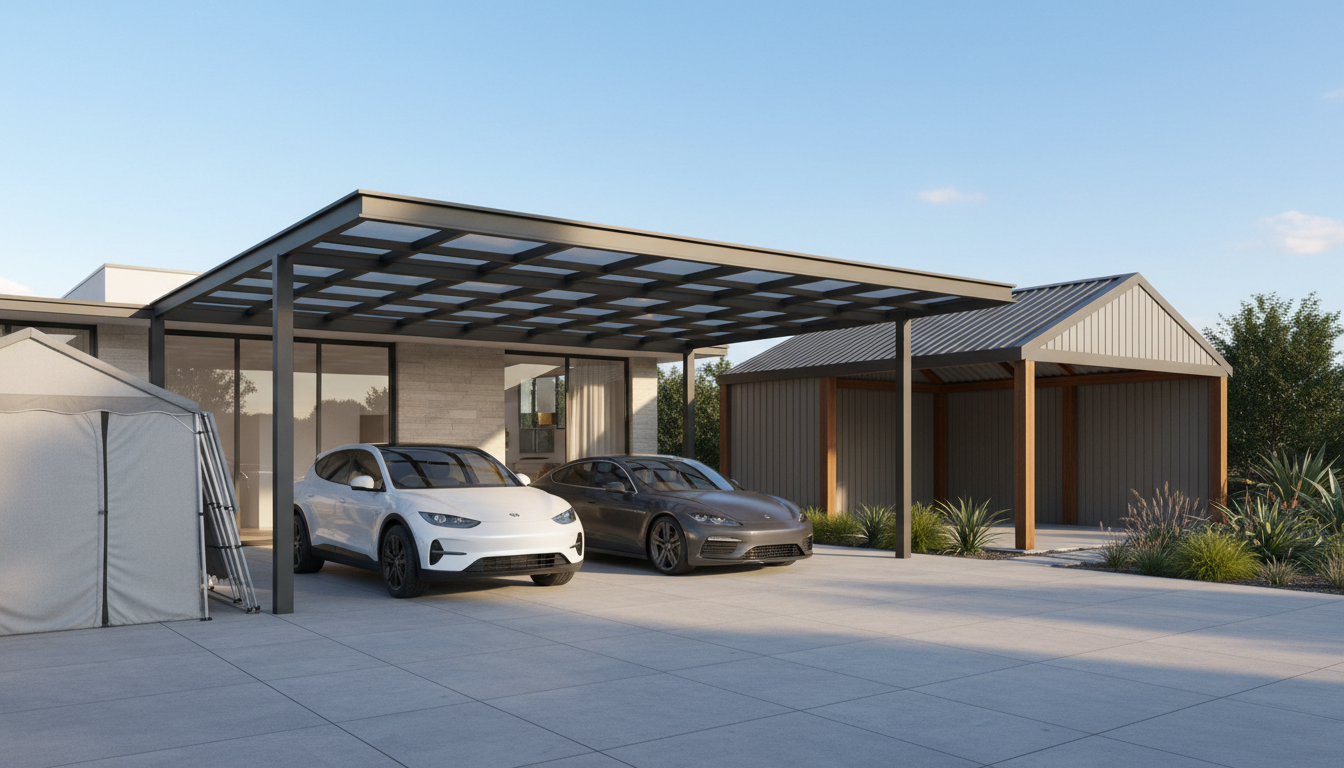
What is a canopy carport and is it right for Australian conditions?
A canopy carport is a roofed structure—often freestanding—that shields vehicles from sun, rain, hail and debris. Unlike a garage, it usually has open sides for airflow. In Australia, the premium choice is a Colorbond steel carport engineered to AS/NZS standards, but there are also temporary pop up carport options and fabric carport covers.
This guide is written for Australian sites—from steel sheds Perth in hot, coastal conditions to cyclone-rated sheds QLD—to help you select the right frame, sheeting, and engineering.
What are the best carport materials for Australia?
For long service life, look for:
- Hot-dip galvanised SHS/RHS portal frames or UB columns for higher spans and coastal sites.
- Colorbond steel roof sheeting in high solar reflectance colours for heat reduction (e.g., Surfmist).
- Zincalume for budget-friendly performance in non-coastal zones.
- Marine-grade fasteners and isolation washers in C4–C5 zones to prevent bimetallic corrosion.
- Insulated roof panels (EPS/PIR) in hot regions to reduce heat and dampen rain noise.
Where budgets are tight or for temporary shade, heavy-duty carport covers or a pop up carport can be a stopgap—but they will not meet structural wind loads for permanent use.
How to choose the right size: is a 6×3 carport enough?
A 6×3 carport (6.0 m x 3.0 m) suits most small-to-medium passenger vehicles. Consider:
- Single: 6.0 x 3.0 m clear, 2.4–2.7 m eave height for SUVs/utes with racks.
- Double: 6.0 x 6.0 m (minimum) or 6.0 x 6.5 m for easier doorswing.
- Boat/van: 7.5–9.0 m length and 3.0–3.6 m clearance.
- Farm machinery storage: 8–12 m clear spans using heavier portal frames.
Allow extra overhang for rainfall control and cyclone tie-down detailing in Regions C–D.
Which roof style suits your site and climate?
- Flat/skillion: Clean look, cost-effective, easier to attach to eaves. Ensure minimum fall per manufacturer (often 2–3°).
- Gable: Better airflow, sheds water faster in heavy rain zones (QLD/NSW North Coast); classic streetscape in custom carports Melbourne.
- Dutch gable/hip: Premium aesthetics for street-facing additions in heritage areas (check overlays).
How much does a canopy carport cost in 2025?
Indicative supply-and-install ranges (engineering to AS/NZS, regional allowances may apply):
- Single 6×3 Colorbond carport: $4,800–$8,500
- Double 6×6 Colorbond carport: $8,900–$15,500
- Insulated panel roof upgrade: +$1,800–$4,500
- Coastal (C4–C5) corrosion package: +$1,200–$3,000
- Temporary pop up carport (heavy-duty fabric): $350–$1,200
Costs vary with wind region, footing depth (AS 2870 site class), access, and finish level. According to industry commentary and the Australian Steel Institute’s market outlook, steel prices stabilised through late 2024–2025, but freight and labour remain key cost drivers.
Do you need council approval for a carport?
Most Australian councils treat carports as Class 10a structures. You’ll generally need:
- Site plan and elevations
- Structural certification to AS/NZS 1170.2 (wind), AS 4100/4600 (steel), NCC 2022 compliance
- Setback compliance to planning scheme (front/side setbacks vary)
- BAL assessment if in bushfire-prone area
How to get council approval faster
- Confirm planning overlays (heritage, flood, bushfire).
- Obtain engineered drawings with wind region, terrain category and importance level.
- Provide neighbour consent if building near boundaries where required.
- Submit a RFI-ready pack: soil report (if requested), footing details, tie-down schedule.
- Use a local certifier/private building surveyor where permitted.
council-approved sheds WA often benefit from pre-checked engineering packages aligned to local wind speeds in Perth Metro and WA coastal towns.
What wind rating and footings do you need?
Design to AS/NZS 1170.2 with site-specific parameters:
- Wind Region A (most of inland), B (coastal/non-cyclonic), C (cyclonic), D (severe cyclonic)
- Terrain Category (e.g., TC2 suburban, TC3 open)
- Topography (hills, escarpments) and shielding
- Importance Level (usually IL1 for carports)
Footings follow AS 2870 with pier size and embedment matched to uplift. Expect deeper piers and heavier columns in Regions C–D with non-shrink grout and hold-down bolts.
Added 2024 WA wind-rating compliance notes: In coastal WA, check Region B to C transition lines and corrosion category C4–C5. Use galvanised or duplex coatings and sealed connections to handle salt spray.
cyclone-rated sheds QLD require specific tie-down schedules, cyclone washers, and purlin spacing per engineer’s certificate.
Colorbond vs Zincalume — which is better for WA conditions?
| Feature | Colorbond Steel | Zincalume Steel |
|---|---|---|
| Finish | Polymer paint with baked-on colour | Aluminium-Zinc alloy metallic coating |
| Heat performance | High-reflectance colours reduce heat gain | Reflective when new; warms as it weathers |
| Coastal resistance | Very good with correct grade and maintenance | Good inland; avoid surf-exposed zones |
| Aesthetics | Wide palette; matches house roof/gutters | Silver-grey; industrial look |
| Cost | $$ (premium) | $ (budget) |
| Best for WA | Perth coastal/suburban heat and sea breeze | Regional inland WA with low salinity |
DIY kit vs custom-built: which path is best?
DIY shed kits and carport kits
- Pros: Lower cost, quick delivery, weekend build with two people.
- Cons: Council paperwork is on you; foundation errors risk uplift failures.
Compare to our Carport Carport for more robust Colorbond options.
Custom-built carports
- Pros: Engineered for site wind, better finishes, integrated gutters/electrical, smoother approvals.
- Cons: Higher upfront cost, lead time for fabrication.
For premium streetscape upgrades—think custom Colorbond garages Perth paired with an attached carport—a custom, engineered build is the safe bet.
Pop-up carports and carport covers: pros and cons
Pop up carport units and fabric carport covers are ideal for renters or temporary protection during builds.
- Pros: Low cost, fast setup, portable.
- Cons: Not wind-rated to permanent standards; UV breakdown of fabrics; insurance may exclude storm damage.
Anchor temporary units with screw piles or ballast, and always pack down for severe weather alerts.
Real-world build examples
Perth coastal single carport (Cottesloe)
6×3 Colorbond skillion, galvanised SHS frame, C4 corrosion spec, insulated panels. Outcome: 8–10°C cooler under-roof, zero rust after 24 months with quarterly rinsing.
Brisbane double carport with gable
6×6 gable to match house roof, IL1, Region B, BAL-12.5 compliant. Integrated gutter to rainwater tank to meet local stormwater policy.
Townsville cyclone-ready carport
7×6 skillion, Region C design with cyclone washers, deeper 600–900 mm piers, purlin spacing per engineer. Passed post-storm inspection with no damage.
5-Step buying guide for custom sheds and carports in Australia
- Define use-case: single 6×3 carport, double, boat, or farm machinery storage.
- Select materials: Colorbond vs Zincalume, insulated panels, corrosion package for coastal zones.
- Engineer for site: wind region, terrain, BAL, soil class; request a stamped certificate.
- Plan approvals: setbacks, overlays, stormwater; submit a complete pack to avoid RFIs.
- Choose delivery path: DIY shed kits for simple installs or turnkey custom carports for premium outcomes.
Maintenance and lifespan tips
- Rinse roof and frames quarterly in coastal areas; clear gutters and downpipes.
- Touch up chips with compatible paint; avoid dissimilar metals in contact.
- Re-check anchor bolts after major wind events.
- Consider a shade screen on western sides to reduce radiant heat on vehicles.
FAQs
Do I need building approval for a front setback carport?
Often yes—front setbacks are sensitive. Many councils allow reduced setbacks if the design is open-sided and matches dwelling materials. Engage a planner or surveyor early.
What height should I choose?
2.4 m clear for most sedans/SUVs; 2.7–3.0 m if you have a lift kit, roof racks or camper. Check local height limits adjacent to boundaries.
Flat roof vs gable—what’s better for heavy rain?
Gable sheds water faster. If using a flat/skillion roof, meet minimum falls and oversize gutters/downpipes in high rainfall zones.
Is Colorbond worth the premium?
For heat, durability, and looks—yes, especially in Perth and coastal suburbs. Zincalume can be great inland or for budget projects.
Can I attach a carport to my existing fascia?
Yes, with a certified fascia bracket system and engineer approval. Many upgrades also use a freestanding front beam with concealed posts for clean aesthetics.
Related projects and keyword clusters we cover
steel sheds Perth, custom carports Melbourne, rural sheds NSW, affordable carports for Australian homes, DIY shed kits, wind-rated sheds for cyclonic areas, council-approved sheds WA, cyclone-rated sheds QLD, custom Colorbond garages Perth, double carport Brisbane, pergola vs carport, sail shade vs carport, Colorbond vs Zincalume comparison, farm machinery storage, insulated roof panels, portal frame carports, galvanised steel carports
Want a DIY alternative? Our Carport Kit Australia buyer’s guide walks you through pricing and wind standards.