
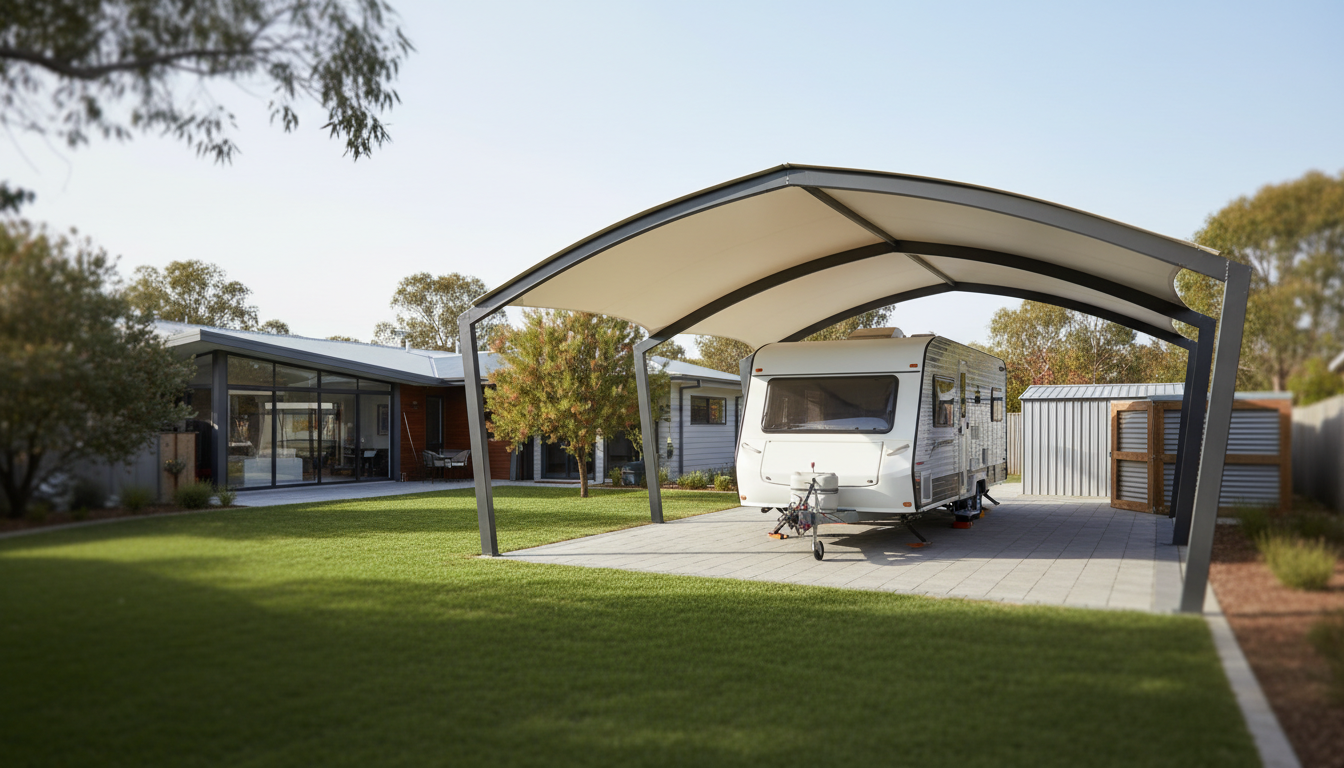
Looking for a caravan shelter that actually stands up to Australian weather? This expert guide compares caravan shelter kits, shade sheds (including portable shade sheds), and custom Colorbond steel options. We’ll cover prices, wind ratings, council approval, and which materials work best in Perth heat, QLD cyclones, and coastal sites.
• Shade shed / caravan shade shed: A steel-framed, roof-only shelter (often arched or gable) for caravans, boats, or machinery.
• DIY shed kit: Pre-engineered, flat-packed steel building kit for onsite assembly.
• Wind region (NCC/AS 1170.2): Australian wind categories (A–D) including cyclonic C–D for QLD/WA north.
• Colorbond: Pre-painted steel by BlueScope designed for Australian conditions.
• Zincalume: Aluminium-zinc coated steel with a metallic finish.
What is a caravan shelter kit and who is it for?
A caravan shelter kit is a pre-engineered steel structure delivered flat-packed for onsite assembly. Most “caravan shade sheds” are roof-only shelters with open sides, ideal for caravans, motorhomes, boats, and farm machinery storage. They’re popular with Australian homeowners and investors who want fast coverage, clean spans, and lower cost than fully enclosed garages.
- Great for: caravans, RVs, camper trailers, boats, tradie utes, and ride-on mowers
- Also suits: farm machinery storage on rural sheds NSW or regional VIC properties
- Options include: portable shade shelters, temporary caravan shelter solutions, and council-approved permanent builds
What Are the Best Shed Materials for Perth’s Climate?
Perth summers are hot and dry with high UV. Coastal suburbs cop salt spray; inland areas face thermal expansion. For “steel sheds Perth” and “custom Colorbond garages Perth,” consider the following:
Colorbond vs Zincalume — Which Is Better for WA Conditions?
| Feature | Colorbond | Zincalume |
|---|---|---|
| Finish | Pre-painted, colourfast, many profiles | Metallic finish, modern industrial look |
| Heat reflectivity | High with light colours (e.g., Surfmist) | Good, but gains heat visually faster in summer glare |
| Corrosion resistance | Excellent with correct grade near coast | Very good inland; check coastal exposure limits |
| Cost | Typically higher | Usually 5–12% lower |
| Warranty | Up to 20–25 years (conditions apply) | Up to 20–25 years (conditions apply) |
| Best for | Residential, coastal, premium looks | Inland, rural, budget-driven builds |
Always confirm exact grade, coating, and distance-to-coast requirements with your supplier in WA.
How much do caravan shade sheds cost in Australia (2025)?
Indicative supply-only price ranges for caravan shelter kits and shade sheds (varies by wind rating, size, coatings, footing type, and location):
- Entry open shade sheds (approx. 6 m L x 3 m W x 3 m H): $2,800–$5,500
- Mid-range gable roof kits (7.5–9 m L x 3–3.5 m W): $4,900–$8,900
- Large caravan shade sheds (9–12 m L x 3.5–4 m W): $7,500–$13,500
- Installation (crew + concrete piers/slab): add $2,500–$7,500+ depending on site/slab
- Shade sheds QLD prices (cyclone-rated): typically +15–35% for C1–C2 engineering, heavier footings, and thicker members
Portable shade sheds and temporary caravan shelter options often cost less upfront but may have shorter lifespans and limited wind ratings. If you’re comparing “caravan sheds prices,” factor in delivery, cranage, slab/footings, council fees, and regional surcharges (remote WA/QLD).
DIY kit vs custom-built vs portable shade sheds
- DIY shed kits: Lowest cost; ideal for experienced DIYers. Ensure engineering to AS/NZS 1170.2 and correct anchors/footings.
- Custom-built Colorbond steel shed: Tailored bay widths, eave height for taller vans, gutters, and water harvesting; faster install by pros.
- Portable shade shelters: Quick setup, good for renters or events; check tie-down systems and local temporary structure rules.
Wind ratings, engineering, and Australian Standards that matter
Any caravan shelter or shade shed should be engineered to Australian codes. Key references include:
- AS/NZS 1170.2 (Wind actions)
- AS/NZS 4600 (Cold-formed steel structures)
- NCC 2022/2025 (National Construction Code) and local council planning schemes
For cyclone-rated sheds QLD, specify Region C/D engineering (e.g., Townsville, Port Hedland). In alpine NSW/VIC, check snow actions (AS/NZS 1170.3). Coastal zones need the right steel grade, screws, and maintenance schedule.
Added 2024 WA wind-rating compliance notes: In WA, confirm your site’s wind region (most Perth metro is A, some coastal A+; northern WA includes Regions C–D). Terrain category, shielding, and topography can push design pressures up. Ask for site-specific certification and footing detail on the engineer’s drawings.
How to Get Council Approval for Your Custom Shed in WA
- Check planning: Some small, compliant shelters may be exempt from planning in certain LGAs. Confirm setbacks and height under R-Codes.
- Engineering: Obtain certified drawings to AS/NZS 1170.2 and AS/NZS 4600 for your exact site location and terrain.
- Building permit: Submit form, site plan, engineering, and specs. Private certifiers can speed things up in some areas.
- Footings/slab: Ensure the design matches the soil class and uplift loads, especially in coastal winds.
- Final inspection: Keep certificates and warranties for insurance and resale.
council-approved sheds WA are straightforward when the supplier provides pre-checked engineering and documentation.
Quick approval notes for other states
- QLD: Region B–D; many caravan shade sheds need building approval. Cyclone tie-downs and uplift verifications are crucial.
- NSW: Some rural sheds NSW may qualify as exempt development if they meet SEPP specs; otherwise go through your council/PC.
- VIC: Check local planning overlays (bushfire/heritage). Private building surveyors can approve most shed permits rapidly.
Design options and caravan shelter ideas that add value
- Roof styles: flat/skillion (low cost, modern), gable (better clearance, airflow), arched shade sheds (fast install)
- Eave height: 3.2–3.6 m typical for caravans; allow for A/C units and antennas
- Bay width: 3–4 m for single van; 6–7 m for dual-use or boat + car
- Cladding: leave sides open for ventilation or add partial infills/windbreaks
- Gutters/downpipes: harvest water to tanks; size to local rainfall intensity (BOM maps)
- Finish: Colorbond for homes, Zincalume for rural budget builds
- Solar-ready purlins: align for PV rail spacing; pre-wire conduits
- Coastal hardware: class 4 fasteners, sealed laps, site washdown plan
Portable and temporary caravan shelters: what to know
“Shade shelters portable” are quick to deploy and ideal for renters or seasonal cover. Check wind ratings, anchoring (screw piles, concrete ballast), and whether your LGA requires a temporary structure permit. For long-term coastal use, portable canvas covers typically degrade faster than steel.
Used shade sheds for sale: a smart inspection list
- Check steel thickness and surface corrosion, especially base plates and cut edges
- Look for brand stamps/labels and ask for original engineering certificate
- Confirm wind rating and whether it matches your site
- Inspect screw/bolt quality (upgrade to class 4 if coastal)
- Budget for new footings/anchors and transport
5-Step Buying Guide for Custom Sheds in Australia
- Measure the caravan: overall length with drawbar, height incl. A/C, door swing, turning space.
- Confirm site wind region and exposure: ask your supplier for AS/NZS 1170.2 site-specific engineering.
- Choose materials: Colorbond near coast; consider insulation/sarking for heat and condensation.
- Compare quotes apples-to-apples: steel grade, thickness, fasteners, footings, delivery, install, permits.
- Plan approvals early: engage a caravan storage shed builder who provides drawings and can liaise with council/certifiers.
Local case studies and build examples
Perth, WA — custom Colorbond gable caravan shelter
- Size: 9.0 m L x 3.5 m W x 3.3 m eave, gable roof, Surfmist Colorbond
- Wind: Region A, terrain T2; engineer-certified to AS/NZS 1170.2
- Features: gutters to 5,000 L tank, anti-condensation blanket
- Outcome: 2-day install on piers; indicative total $10–14k incl. install (site dependent)
Townsville, QLD — cyclone-rated shade shed for large van
- Size: 9.0 m x 3.0 m skillion, Zincalume roof, open sides
- Wind: Region C, C2 tie-down; heavy-duty anchors and bracing
- Outcome: Passed final inspection; indicative $11–16k incl. install and footing upgrades
Rural NSW — budget Zincalume caravan shade with end wall
- Size: 12.0 m x 4.0 m gable, partial end wall windbreak
- Wind: Region A; simple piers, farm track access
- Outcome: Supply-only ~$8–11k; owner installed with local concreter
How to choose the right supplier or installer
- Uses Australian steel (ask for BlueScope mill certs)
- Provides site-specific engineering and footing details
- Clear warranty terms for coastal and cyclonic areas
- Can manage permits and “council-approved sheds WA/QLD/NSW/VIC”
- Local references and after-sales support; check lead times and logistics
FAQs
Do I need a slab for a caravan shade shed?
No. Many are built on concrete piers or screw piles. A slab is great for cleanliness and drainage control but not mandatory unless specified by engineering.
Can I enclose the sides later?
Yes. Ask for frame spacing that allows future cladding and door openings. Check if enclosure changes approvals or wind loads.
What size should I pick?
Common footprints: 7.5–9 m long x 3–3.5 m wide. Allow clearance for awnings and drawbar. Eave heights of 3.2–3.6 m suit most caravans with roof units.
What about “custom carports Melbourne” vs shade sheds?
Carports can match roof pitches and gutters on the home; shade sheds focus on quick-span shelter. Both require compliant engineering for wind loads.
Lead times in 2025?
Allow 2–6 weeks for engineered kits, longer in remote areas or during peak periods. Cyclone-rated and custom colours may add time.
Related keyword clusters we cover
Caravan shelter kits, caravan shelter, caravan shade sheds, shade sheds, portable shade sheds, shade shelters portable, shelter sheds, temporary caravan shelter, used shade sheds for sale, shade sheds australia, shade shelters, shade shed prices, caravan sheds prices, shade sheds qld prices, steel sheds Perth, rural sheds NSW, custom carports Melbourne, wind-rated sheds for cyclonic areas, Colorbond vs Zincalume comparison, affordable carports for Australian homes, DIY shed kits, custom Colorbond garages Perth.
Citations and resources:
- Bureau of Meteorology climate and rainfall intensity maps
- Australian Standards (AS/NZS 1170.2, AS/NZS 4600) overview
- Housing Industry Association (HIA) — Outdoor structures guidance
- Master Builders Australia — building approvals and compliance
- Australian Steel Institute — steel design and durability
- energy.gov.au — roofs and insulation for heat control
- CSIRO — building science and corrosion research