
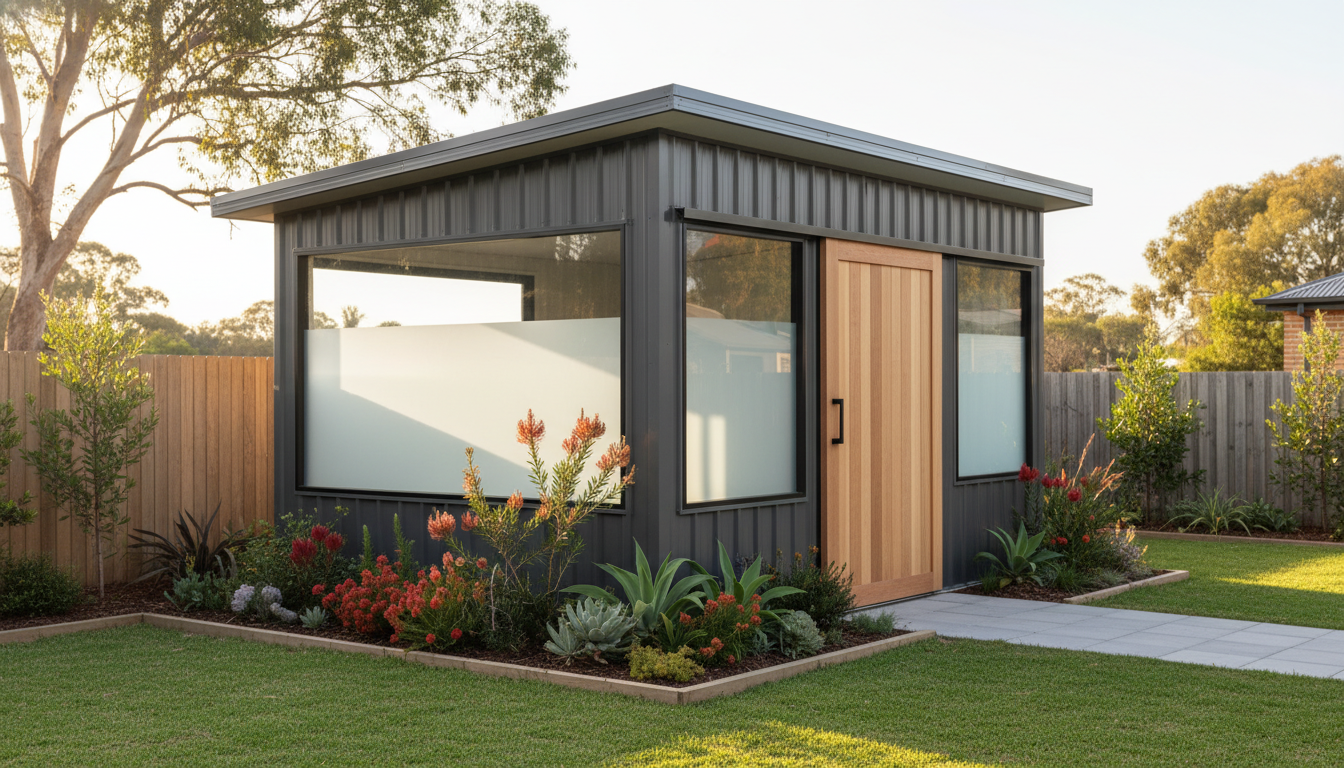
Pressed for space on a narrow block or courtyard? A corner garden shed makes dead corners work hard—stow mowers and bikes, create a compact workshop, or add secure garden storage without crowding your backyard. This guide brings together Australian standards, wind regions, Colorbond and Zincalume options, and council rules so you can spec a shed that’s compliant, durable, and great-looking.
What makes a corner garden shed ideal for Australian homes?
- Space efficiency on tight urban lots in Sydney, Melbourne, and Perth.
- Neat fit against fencing lines with compliant setbacks and heights.
- Shorter wall spans improve bracing efficiency in higher wind zones.
- Easy upgrade path: shelving, bike hooks, workbench, or garden tool racks.
Related solutions for site planning: steel sheds Perth, custom carports Melbourne, rural sheds NSW, and custom Colorbond garages Perth.
What are the best shed materials for Perth’s climate?
In WA’s hot, dry summers and coastal corrosion zones, cladding and fastener choice matter. Here’s a practical Colorbond vs Zincalume comparison for WA conditions.
Colorbond vs Zincalume — Which is better for WA conditions?
| Feature | Colorbond steel | Zincalume steel |
|---|---|---|
| Coating & standard | Painted alloy-coated steel (AS 1397, AS/NZS 2728) | Al-Zn alloy coating (AS 1397) |
| Heat performance | Cooler colours reflect solar heat; better for Perth heat | Reflective but can glare; heat build-up similar in dark tones |
| Coastal durability | Excellent with correct grade/maintenance; check distance-to-surf | Good, but generally needs more frequent washing near surf |
| Aesthetics | Matches house roof and fence colours; premium look | Industrial/silver look; paint if colour is desired |
| Cost | Typically higher upfront | More budget-friendly |
| Best fit | Residential yards, coastal WA, heritage or design-led sites | Value-focused projects away from harsh marine exposure |
What size corner shed should you choose?
Common footprints (measured along each fence line):
- 1.5 m × 1.5 m triangle — basic garden tools and a whipper snipper
- 2.25 m × 2.25 m — lawn mower, bikes, and shelving
- 3.0 m × 3.0 m — compact workshop with bench and power
Height: keep overall height under typical local limits (e.g., 2.4–2.7 m) to streamline approvals and neighbour relations.
Slab or no slab?
- Concrete slab (typ. 100 mm), designed to AS 2870, with mesh and edge thickenings — best for security, cyclone tie-downs, and moisture control.
- Pavers/crusher dust — fine for DIY shed kits, but add perimeter formwork, ground anchors, and a damp-proof membrane.
How do Australian wind ratings affect a corner shed?
Corner sheds must be engineered for your wind region per AS/NZS 1170.2 (Wind actions) and the NCC. Regions A/B (non-cyclonic) use N1–N6 ratings; Regions C/D (cyclonic) use C1–C4. Shorter corner walls often need fewer mullions but precise hold-down design is critical.
- Non-cyclonic examples: Adelaide, much of Victoria, inland NSW — N2–N3 common
- Cyclonic examples: coastal QLD, parts of WA’s Pilbara — C2–C3 common
Added 2024 WA wind-rating compliance notes: In WA, local governments often request site wind classification with the building application. Ask for engineering showing Region B or C, terrain category, shielding, and topographic multiplier.
How to get council approval for your custom shed in WA
- Check your LGA planning codes for outbuildings: area cap, max height, and setbacks to boundaries/fences.
- Choose a council-approved shed supplier offering signed engineering to AS/NZS 4600 (cold-formed steel) and AS 4100 as required.
- Prepare documents: site plan with distances to boundaries, elevations, slab detail to AS 2870, stormwater connection, colour schedule (Colorbond).
- Lodge a Building Permit (BA2 or BA1 in WA) with your certifier or LGA.
- Book final inspection for completion certification if required.
Tip: Ask for “council-approved sheds WA” packages that include engineering computations, slab spec, and tie-down schedule.
How to certify cyclone-rated corner sheds in QLD
- Confirm wind region (often C for coastal QLD) and terrain category.
- Specify “cyclone-rated sheds QLD” with C2/C3 engineering, cyclonic roof battens, and extra hold-downs.
- Use high-capacity anchor bolts and cyclonic roller doors tested to AS/NZS 4505.
- Submit Form 15 (Compliance Certificate for Building Design or Specification) as part of building approval.
Corner shed roof options: flat, skillion, or hip?
- Flat/skillion — simple, cost-effective; easy against a fence line; ensure 5–7° fall to gutter.
- Gable — extra headroom and better airflow; suits visible corners.
- Hip/pent — premium look for architect-designed landscapes.
Add guttering and downpipes to connect to stormwater or a small rainwater tank for garden use.
Custom options that add value
- Doors: single hinged, double doors, or cyclonic-rated roller doors
- Windows and louvres for crossflow ventilation
- Insulation: anti-condensation blanket or insulated panels
- Vermin-proofing and foam infills at roof/wall intersections
- Electrical rough-in: LED strip lights, GPOs, and outdoor-rated fans
- Security: keyed locks, reinforced jambs, motion lights, CCTV
- Match house colours: Colorbond roof, walls, and flashings
DIY shed kits vs custom-built installations
Decide based on time, tools, and wind region.
- DIY shed kits — great for shed kits Brisbane and regional VIC; follow the engineering and anchor schedule closely.
- Custom-built — recommended for C-wind regions, tight access, or premium finishes; engage licensed installers with ShedSafe-backed engineering.
Case studies: real Australian installs
Perth (Non-cyclonic, N3) — Colorbond steel shed for regional WA
A 2.25 m × 2.25 m corner shed in Colorbond Woodland Grey with skillion roof and anti-condensation blanket. Slab 100 mm to AS 2870, M12 expansion anchors, gutter to 500 L tank. Result: secure tool storage on a narrow block; approval via BA2 in 10 business days.
Cairns (Cyclonic, C2) — Small footprint, big resilience
A 2.4 m × 2.4 m corner shed with cyclonic bracing kit, high-capacity roof battens, and C2 door system. Stainless fixings within 1 km of coast, sealed flashings, and ventilation louvres to control condensation. Certified with Form 15 and Form 16 on completion.
How much does a corner garden shed cost in 2025?
- Entry-level Zincalume DIY kit (about 1.5 m × 1.5 m): $650–$1,100
- Mid-range Colorbond kit (2.25 m × 2.25 m): $1,200–$2,200
- Premium custom Colorbond with insulation and power (3.0 m × 3.0 m): $3,500–$7,500+
- Concrete slab and install: allow $900–$2,500+ depending on site access, thickness, and engineering
Note: Cyclonic upgrades, coastal-grade fasteners, and council fees add to the total. Ask for a fixed quote including engineering, delivery, and installation.
5-step buying guide for custom sheds in Australia
- Confirm wind region (N or C rating) and terrain category per AS/NZS 1170.2.
- Choose materials — Colorbond for premium residential and coastal zones; Zincalume for value inland.
- Lock in size and doors — measure both fence-line legs, check setbacks and easements.
- Pick roof and heat control — skillion vs gable; add anti-condensation blanket or insulated panels.
- Approval & install — request council packs, engineering, and ShedSafe-compliant documentation from your supplier.
Frequently asked questions
Do corner sheds need engineering?
Yes. Even small sheds should be designed to AS/NZS 1170.2 for wind loads. Look for ShedSafe-backed engineering and NCC compliance.
Can I put a corner shed on the boundary?
Often yes, but height, wall length, and eave overhangs are controlled. Check your LGA’s outbuilding policy for setbacks and maximum wall heights.
How do I control condensation?
Use an anti-condensation blanket or insulated roof panels, add crossflow ventilation, and manage landscaping irrigation away from the shed perimeter.
Are there coastal restrictions for warranties?
Most steel warranties require regular washing in marine zones and minimum distances from breaking surf. Confirm your chosen Colorbond grade and care requirements.
Should I run power to a small corner shed?
If you plan a workbench or charging tools, yes. Use a licensed electrician and weather-rated fittings.
What about termites?
Steel framing resists termites, but keep timber shelves off the slab, seal gaps, and avoid storing cellulose directly against walls.
Standards, codes, and industry guidance
- NCC (Building Code of Australia) — wind, structure, and performance requirements See NCC guidance
- AS/NZS 1170.2 — wind actions; AS 2870 — residential slabs; AS 1397 and AS/NZS 2728 — steel and paint coatings
- Australian Steel Institute and ShedSafe — best-practice shed engineering Australian Steel Institute
- Bureau of Meteorology — wind regions and cyclone information Bureau of Meteorology cyclone regions
- CSIRO — building science including condensation risk CSIRO condensation guidance
- HIA — outdoor structures trends and approvals HIA home improvement insights
- Energy.gov.au — guidance on cool roofs and energy-efficient add-ons Energy.gov.au
Industry outlook: The Australian Steel Institute’s 2025 market commentary and HIA’s 2025 Outdoor Structures and Home Improvement insights indicate steady demand for backyard upgrades, with homeowners prioritising compliant, low-maintenance Colorbond solutions that match the main dwelling.
Where does a corner shed fit among other steel structures?
Many homeowners stage projects: start with a corner shed, then add affordable carports for Australian homes, patios and carports Adelaide, or a custom-built double garage in Perth. A single supplier can streamline engineering and colour matching.
Keyword clusters to help you plan
- Local: steel sheds Perth, shed kits Brisbane, rural sheds NSW
- Technical: Colorbond vs Zincalume comparison, wind-rated sheds for cyclonic areas
- Usage: garden storage Sydney, farm machinery storage (larger rural projects)
- Gap terms: council-approved sheds WA, cyclone-rated sheds QLD, custom Colorbond garages Perth