
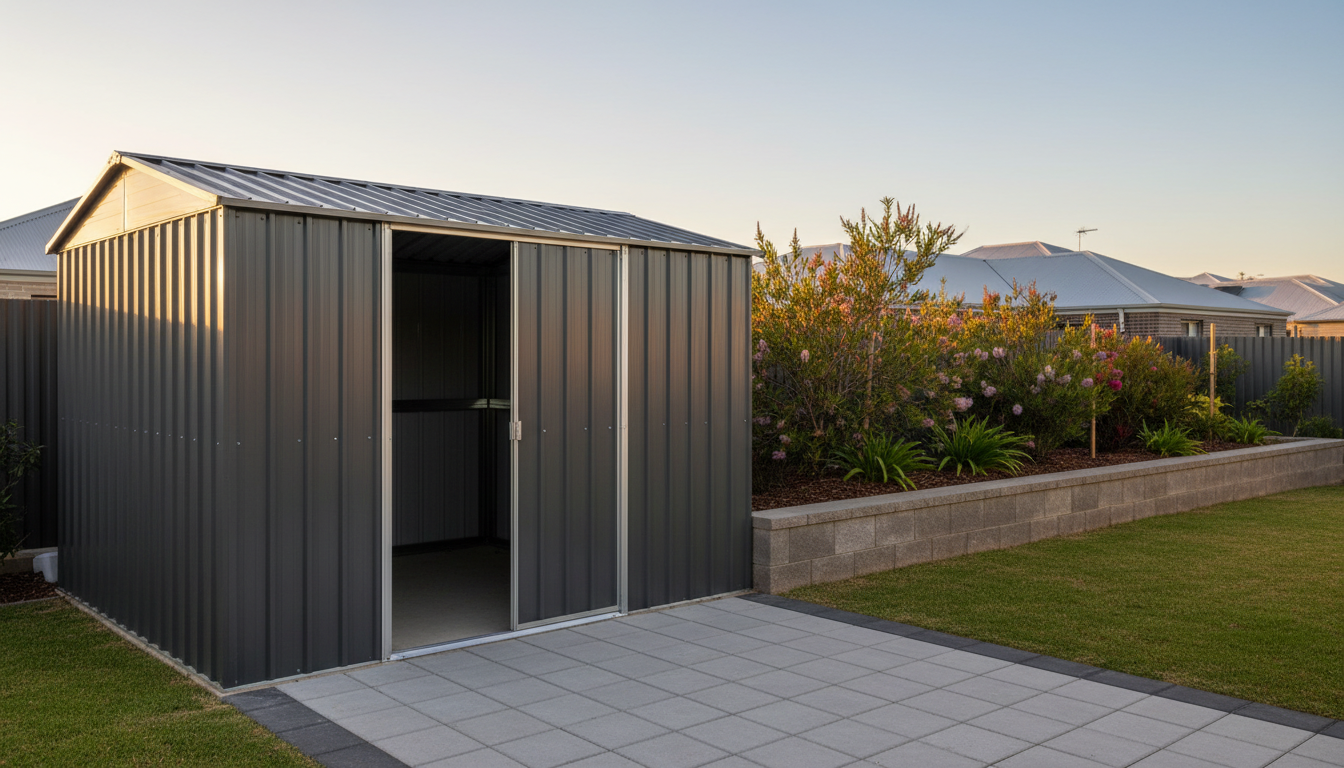
Your practical guide to corrugated garden sheds in Australia
A corrugated garden shed is the workhorse of the Aussie backyard—tough, low-maintenance, and built to handle sun, salt, wind, and the odd hailstorm. Below you’ll find a deep-dive on materials, wind ratings, council approvals, and smart upgrades so you can specify a shed that lasts.
Added 2024 WA wind-rating compliance notes
What is a corrugated garden shed made of, and why does it matter?
Most premium corrugated sheds use ribbed steel cladding on a galvanised frame with engineered brackets, cyclone ties (where required), and a fixed slab or pier system. For Australian conditions, the two headline cladding options are Colorbond steel and Zincalume.
A Metal Garden Storage Shed may also offer the durability you need.
What Are the Best Shed Materials for Perth’s Climate?
Perth’s hot summers, coastal exposure, and occasional storm fronts favour coated steels with high heat reflectance and strong corrosion resistance. Here’s a quick comparison focused on WA conditions.
Colorbond vs Zincalume — Which Is Better for WA Conditions?
| Feature | Colorbond (pre-painted) | Zincalume (metallic) |
|---|---|---|
| Corrosion resistance (coastal/suburban) | Excellent, with specific marine options near surf coasts | Very good; may require greater setback in harsh marine zones |
| Heat performance | Cooler roofs possible with light colours and Thermatech technology | Moderate; reflective but can run warmer than light Colorbond colours |
| Aesthetics | Wide colour range, matches modern homes and fencing | Industrial look; weathers to a matte patina |
| Maintenance | Low; periodic wash-down in coastal areas | Low; rinse to remove salt and dust |
| Cost | Typically higher | Usually more affordable |
| Best use in WA | Backyard sheds in Perth metro, custom Colorbond garages Perth, architectural builds | Rural sheds WA, farm machinery storage, workshops away from surf spray |
Pro Tip: Did you know using insulated roof panels can reduce internal shed temperatures by up to 10°C in summer? Pair with ridge vents or whirlybirds for best results.
Related LSI terms: corrugated metal shed, Colorbond storage shed, steel sheds Perth, rural sheds NSW, shed builder Brisbane, garden storage Adelaide, DIY shed kits, affordable carports for Australian homes.
How much does a corrugated metal shed cost in Australia?
Indicative ranges only—always obtain a site-specific quote with engineering and wind classification.
- 3×3 m Colorbond garden shed (kit): $1,800–$3,500
- 6×3 m workshop with slab and roller door: $6,500–$12,000
- Custom-built double garage (engineered): $14,000–$28,000+
- Cyclone upgrades (Region C/D): typically +15–30% for frames, fasteners, and hold-downs
For smaller lots, check out the Garden Shed 3m x 2m guide.
Costs vary with slab thickness, doors and windows, insulation, local wind region, and coastal corrosion category.
Which roof style suits your site and use?
| Roof style | Best for | Pros | Considerations |
|---|---|---|---|
| Gable | Most backyards | Classic look, good ventilation, sheds water well | Higher ridge may increase planning visibility |
| Skillion (mono) | Modern homes, tight setbacks | Simple structure, easy guttering to one side | Check prevailing wind direction and downpipe location |
| Flat (low pitch) | Under eaves and carports | Low profile, often faster approvals | Requires careful drainage and leaf guard in tree-heavy sites |
How do you select the right wind rating, slab, and anchors?
- Know your region: Non-cyclonic regions (N1–N3) include most of VIC, SA, TAS, inland NSW; higher wind or topographic areas may be N4–N6. Cyclonic regions (C1–C4) include coastal QLD north of Rockhampton and parts of WA’s north-west (Pilbara/Kimberley).
- Perth metro: Typically Region A (N2–N3) with local topography and shielding affecting final classification. council-approved sheds WA usually require engineering to AS/NZS 1170.2 and AS/NZS 4600.
- Anchors: Use cast-in bolts for new slabs, chemical anchors for existing concrete, or screw piers for reactive soils or sloping sites. Edge thickening and hold-down brackets add uplift resistance.
- Slab: 100 mm typical residential slab with SL72 mesh on compacted subgrade; consider thickenings under walls for heavier sheds. Refer to AS 2870 for slab-on-ground where relevant.
- Fixings: Cyclone-rated sheds QLD (cyclone-rated sheds QLD) require upgraded purlins, batten screws, straps, and door wind locks.
How to Get Council Approval for Your Custom Shed in WA
Step-by-step process
- Check exemptions: Many WA councils exempt small outbuildings under certain size/height, but rules vary. Always confirm local planning schemes.
- Gather documents: Site plan with setbacks, elevations, structural drawings, energy/insulation notes if applicable, and engineering certificate.
- Apply for Building Permit: BA1 (certified) or BA2 (uncertified). Certified can be faster if you have a private certifier.
- Neighbour consultation: Required if you’re close to boundaries, easements, or exceeding typical height limits.
- Inspection and compliance: Provide concrete pour photos (if requested), final engineering sign-off, and install as per manufacturer’s instructions.
Other states: NSW often needs a Complying Development Certificate for larger sheds; QLD uses private certifiers for building approval; VIC requires a building permit from a registered building surveyor. Always check local overlays (flood, BAL, heritage).
DIY shed kits vs custom-built — what’s best for you?
- DIY shed kits: Cheapest option, fast delivery, great for small garden storage or rural settings. Choose wind-rated kits for your region and confirm slab specs before ordering.
- Custom-built: Ideal for odd blocks, tight setbacks, and when you want matching cladding and colours. Suits custom Colorbond garages Perth (custom Colorbond garages Perth) and tandem carports adjoining a shed.
Use-cases and keyword clusters
- Backyard storage: Corrugated garden shed, Colorbond storage shed, garden storage Adelaide
- Vehicle cover: Custom carports Melbourne, affordable carports for Australian homes
- Rural and farm: Rural sheds NSW, farm machinery storage, shearing and feed sheds
- Work and trade: Industrial workshops Victoria, shed builder Brisbane, lock-up tool sheds
- Special conditions: Wind-rated sheds for cyclonic areas, Colorbond vs Zincalume comparison, council-approved sheds WA
Case studies: real builds in varied Australian conditions
Perth, WA — heat and coastal breeze
3.0×4.5 m Colorbond gable shed, N3 design, slab 100 mm with SL72. Light-colour roof to reduce heat, whirlybird, and 50 mm roof insulation. Outcome: Cooler summer temps and no salt staining after seasonal rinse-downs.
Cairns, QLD — cyclonic design
6×6 m workshop, Region C C2, upgraded hold-downs, cyclone-rated roller doors with wind locks, and additional roof bracing. Outcome: Passed private certification; insurer-approved for local wind category.
Central West, NSW — rural storage
9×6 m rural shed, Zincalume cladding, skillion roof for simple water collection to tanks, vermin flashing, and mesh screens. Outcome: Dust and pest control for feed storage; easy gutter maintenance.
Shed accessories that add value
- Roller doors and wind locks (cyclonic)
- Windows with flyscreens, security grills
- Insulation batts or insulated roof panels
- Vermin flashing and draught seals
- Gutters, leaf guards, first-flush diverters
- LED lighting, GPOs, and hard-wired smoke alarms (garages/workshops)
- Adjacent patio or custom carports Melbourne for covered access
Maintenance and lifespan
- Quarterly rinse in coastal zones; remove leaf litter from gutters and valleys
- Touch up scratches promptly; avoid dissimilar metal contact
- Check anchors, brackets, and door tension annually
- Expect 10–25+ years service life depending on location and maintenance; check cladding and perforation warranties
5-Step Buying Guide for Custom Sheds in Australia
- Define use and size: Tools only, or workshop and vehicle? Consider future needs like a boat bay or DIY shed kits add-ons.
- Pick materials: Choose Colorbond for colour and heat control, Zincalume for value and rural looks.
- Confirm wind rating: N or C category, terrain, shielding; request certified engineering.
- Plan approvals: Check planning and building permit pathways, setbacks, and easements.
- Lock in builder or kit: Compare quotes, lead times, and inclusions (slab, doors, insulation, vermin flashings).
FAQs
Do I need council approval for a corrugated garden shed?
Often yes, depending on size, height, and setback. Small sheds may be exempt. For WA, use BA1/BA2 building permit pathways; other states use similar permit/certifier systems.
What slab do I need?
A typical 100 mm reinforced slab on compacted base suits small to medium sheds. Larger workshops may need thickened edges or footings. Always follow engineering and local soil/site classification.
Is Colorbond worth the premium over Zincalume?
In coastal or high-visibility sites, yes—better colour stability, heat reflectance with light colours, and easier architectural matching. Zincalume is great value inland or on farms.
Can I add a carport to my shed later?
Yes. Many systems allow attached lean-to’s or custom carports. Plan connections, drainage, and approvals at the outset to avoid rework.
What about BAL (bushfire) sites?
Choose compliant ember-proof vents, metal screens, and appropriate door seals. Check the shed’s construction against your BAL rating and local rules.
Local standards, climate and industry references
- AS/NZS 1170.2 wind actions and AS/NZS 4600 cold-formed steel design
- NCC (BCA) compliance and state permit systems
- Bureau of Meteorology climate and wind region maps: BOM
- Housing Industry Association: HIA
- Australian Steel Institute: Australian Steel Institute
- CSIRO bushfire resources: CSIRO
- Energy-efficient roofs and insulation: Energy.gov.au