
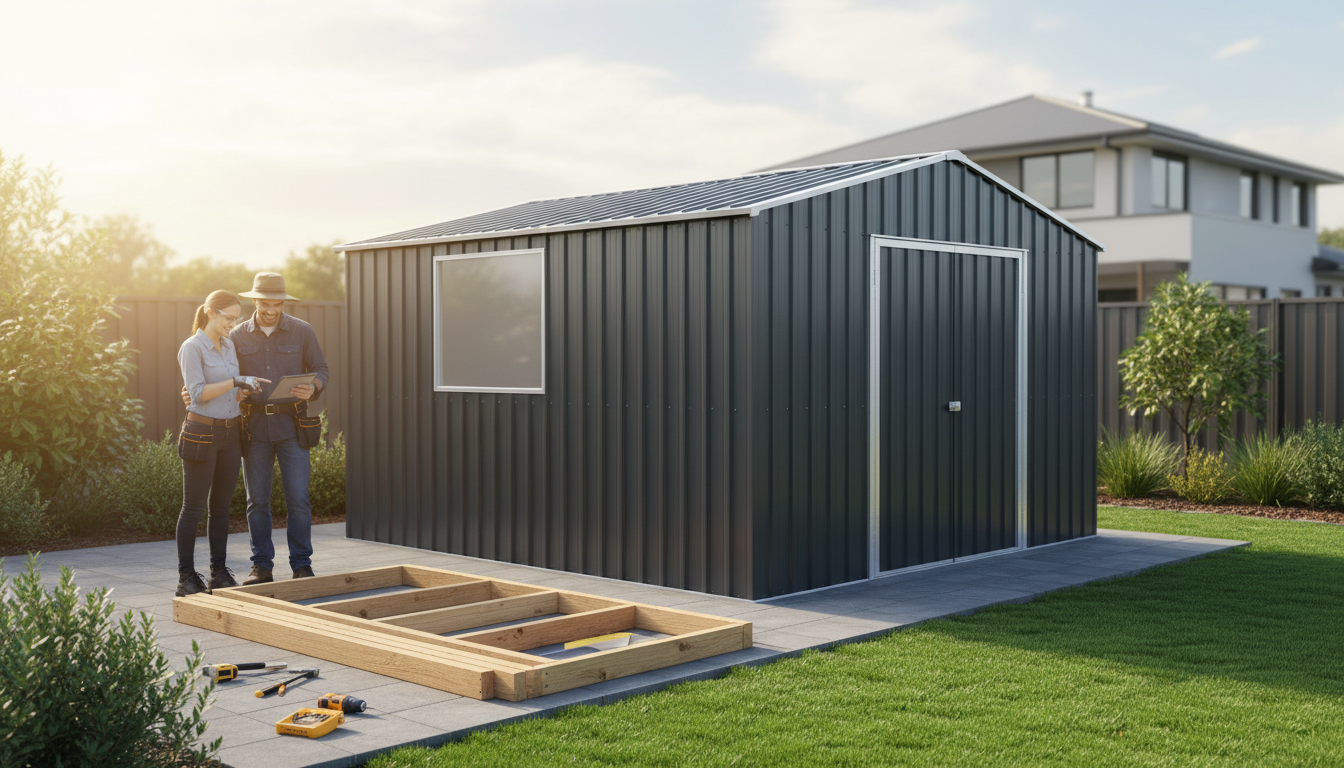
Whether you’re adding backyard storage in Perth, a workshop in Melbourne, or farm machinery storage on rural land in NSW, the right DIY garden shed kit saves money and delivers premium quality. This guide compares materials, wind ratings, council approvals, and kit options suited to Australian climates, from non-cyclonic regions to cyclone-rated sheds in QLD.
Why choose a DIY garden shed kit in Australia?
- Cost control: Inexpensive shed kits with engineered components keep labour costs down.
- Speed: Pre-punched, pre-cut frames reduce on-site time.
- Quality: Australian-made Colorbond steel panels and fully engineered framing to AS/NZS standards.
- Flexibility: Upgrade paths for insulation, vermin-proofing, skylights, and roller doors.
Popular options include compact DIY shed kits for small yards, larger workshop sheds with skillion roofs, and custom Colorbond garages in Perth for vehicles and tools.
What are the best shed materials for Perth’s climate?
Perth summers demand heat-resistant roofing and walling, while coastal suburbs need corrosion resistance. Here’s how Colorbond vs Zincalume stack up.
| Factor | Colorbond steel | Zincalume steel | Best for |
|---|---|---|---|
| Coating & durability | Painted, baked-on finish over AZ coating; excellent UV resistance. | Aluminium-zinc alloy (AZ) coating; strong corrosion performance. | Coastal suburbs choose Colorbond; inland can use either. |
| Heat performance | Light “Cool Roof” colours reflect heat; great for Perth summers. | Metallic finish; can run hotter unless insulated. | Hot regions (WA, SA, NT): Colorbond light colours. |
| Aesthetics | Wide Colorbond colour palette; matches fences and roofs. | Classic metallic look; limited colour choice. | Urban streetscapes, strata approvals: Colorbond. |
| Cost | Slightly higher upfront. | More budget-friendly. | Budget builds: Zincalume; premium look: Colorbond. |
| Warranty & compliance | Backed when installed to spec; ideal for custom carports and sheds. | Strong warranty in non-coastal zones. | All states, with correct siting and maintenance. |
Pre-painted steel by BlueScope designed for Australian conditions. Excellent UV resistance and colour retention, widely used for steel sheds Perth, fencing, and roofing.
Steel sheet coated with aluminium-zinc alloy for corrosion resistance. A cost-effective option in many inland sites.
Further reading: see guidance on cool roofs via Energy.gov.au
insulation and roofing advice, and coastal corrosion notes from the Australian Steel Institute
steel corrosion resources.
Compliance 101: Wind ratings, cyclonic design, and footing options
Australian sheds must be engineered for wind actions per AS/NZS 1170.2 and designed to AS/NZS 4600 (cold-formed steel). Regions differ:
- Regions A–B: Non-cyclonic (most of NSW, VIC, SA, southern WA).
- Regions C–D: Cyclonic (many coastal and northern QLD, parts of WA’s north).
Added 2024 WA wind-rating compliance notes: For Perth metro, most sites fall in non-cyclonic categories (N2–N3), but coastal exposure and terrain category can push requirements. Always confirm site wind class with engineering.
A site-based rating (e.g., N2, N3, C2) that sets tie-downs, frame spacing, cladding fixings, and door bracing requirements under AS/NZS 1170.2.
For wind-rated sheds for cyclonic areas, look for:
- Heavier gauge purlins/girts and closer spacings.
- Increased screw density with cyclone washers and edge distances.
- Upgraded door frames and wind-lock roller doors.
- Engineer-certified footings (slab thickening or deeper piers).
See Bureau of Meteorology wind region mapping
BoM resources. Your supplier should provide a site-specific engineering set for approvals.
The slab or pier system transferring loads to ground. Common choices: 100–120 mm slab with thickened edges, or isolated concrete piers with hold-down bolts. Soil reactivity (e.g., Class M) influences design.
Compare footing choices and anchoring options in our shed base kit overview to pick a base that suits your kit and wind class. (smalltrades.com.au)
How to get council approval for your custom shed in WA
If you’re pursuing council-approved sheds WA, the process typically involves:
- Check planning scheme: setbacks, height limits, site coverage.
- Order engineering: certification to AS/NZS 1170.2, AS/NZS 4600, and relevant NCC provisions.
- Prepare drawings: site plan, slab details, elevations, stormwater plan.
- Lodge Building Permit application with your local council (certified path recommended).
- Arrange final inspections as required.
For QLD, a building certifier can assess plans; cyclone regions C/D demand cyclone-rated sheds QLD engineering. NSW rural sites often need farm-use declarations and bushfire assessments (AS 3959) where applicable.
See general homeowner permit guidance via the Housing Industry Association
HIA resources.
DIY shed kits vs custom-built: which suits you?
DIY shed kits (inexpensive and fast)
- Pre-punched frames, cut-to-length Colorbond/Zincalume sheets.
- Clear manuals and labelled bags of hot-dip galvanised bolts.
- Best for standard sizes: e.g., 3×3 m garden sheds, 6×3 m workshops.
Custom-built sheds and garages (design freedom)
- Any size, bay spacing, door mix, mezzanines, and awnings.
- Ideal for boat and caravan cover, custom-built double garage in Perth, and commercial storage.
- Higher cost, but optimised layout and street appeal with Colorbond colours.
Comparing brands? Our EasyShed review covers materials, wind ratings and when to step up to custom steel builds. (smalltrades.com.au)
5-step buying guide for custom sheds in Australia
- Define use-case: garden storage, workshop, or farm machinery storage.
- Confirm site constraints: easements, setbacks, BAL rating, and wind class.
- Choose materials: Colorbond for heat/coastal zones; Zincalume for inland budgets.
- Pick roof profile and drainage: gable for airflow; skillion for boundary siting.
- Lock approvals and engineering early to avoid delays; then order your DIY storage shed kit.
Specifying your DIY garden shed kit: details that matter
- Frame system: high-tensile cold-formed steel, engineered to AS/NZS 4600.
- Cladding: Colorbond or Zincalume; consider anti-condensation blanket.
- Doors: wind-lock roller doors, personal access doors, and security hardware.
- Vermin-proofing: perimeter flashing to seal slab edges.
- Gutters/downpipes: adequate rainwater capacity; connect to soakwell or tank.
- Insulation: roof and wall batts or insulated panels for comfort and noise.
- Finish: choose Colorbond colours that match your home and fence.
Finish well with storage shed accessories—vents, insulation, security doors and racking—to turn a basic kit into a durable workspace. (smalltrades.com.au)
Bushfire Attack Level. In bushfire-prone areas, sheds may need ember protection, metal mesh, and non-combustible cladding. Common levels: BAL–12.5 to BAL–40 and BAL–FZ.
Case studies: what works where
Perth backyard (non-cyclonic N2/N3)
3×3 m Colorbond shed in Surfmist with a skillion roof against a boundary. Anti-condensation blanket, vermin flashing, and a PA door. Outcome: cool, tidy storage matching the home’s roof and fence.
North QLD coastal (cyclonic C2)
6×6 m workshop with gable roof, upgraded tie-downs, cyclone screws, and wind-lock roller doors. Certified footings and engineered bracing satisfied the certifier for a cyclone-rated shed QLD.
Rural sheds NSW
9×6 m machinery bay with Zincalume cladding for value, extra eave overhangs, and gutter guards. Designed for Region A wind with terrain category 2 exposure; future awning planned.
Installation snapshot: tools, slab, and timeframes
- Base: 100–120 mm concrete slab with thickened edges or certified piers. Ensure level and square before frame-up.
- Tools: impact driver, tek bits, riveter, tin snips, string line, laser level, and PPE.
- Assembly: two people can erect a 3×3 m DIY shed kit over a weekend; larger builds may take a few days.
- Weather: avoid cladding on high-wind days; follow safe work practices.
Keyword clusters and popular searches we cover
- Local: steel sheds Perth, custom carports Melbourne, rural sheds NSW.
- Technical: Colorbond vs Zincalume comparison, wind-rated sheds for cyclonic areas, BAL compliance, terrain category checks.
- Use-cases: DIY shed kits, DIY storage shed kit, affordable carports for Australian homes, farm machinery storage, backyard workshops.
- Gap terms: council-approved sheds WA, cyclone-rated sheds QLD, custom Colorbond garages Perth.
Recent industry updates (2024–2025), including the Australian Steel Institute’s market commentary and HIA’s Outdoor Structures insights, indicate steady demand for engineered steel sheds as households invest in outdoor improvements.
FAQs: DIY shed kits Australia
Do I need a concrete slab?
A slab delivers the best finish for storage and vermin control. On reactive soils or sloping sites, engineered piers with a formed slab or suspended floor may be specified.
What wind rating should I choose?
Your supplier will engineer to your site (e.g., N2, N3, C2). Provide address, terrain exposure, and topography. Never downgrade wind class to save cost.
Are kits pre-punched and easy to assemble?
Quality DIY shed kits arrive pre-punched with labelled components and manuals. A competent DIYer with a helper can assemble smaller models safely.
Can I match my house colours?
Yes. Colorbond colour ranges allow cohesive looks for sheds, fences, and custom carports.
What about bushfire and corrosion?
In BAL zones, follow AS 3959 details (metal mesh, ember seals). For coastal sites, select Colorbond and appropriate flashings; increase maintenance intervals.
Do you deliver Australia-wide?
Most suppliers ship to metro and regional areas. Remote deliveries may require forklift access or depot pickup—check lead times and offload requirements.
Putting it together: the smart path to your shed
Define your use-case, confirm wind and BAL requirements, then select a DIY garden shed kit in Colorbond or Zincalume with the right roof profile and accessories. If you need more flexibility, step up to fully engineered custom Colorbond garages Perth or a tailored workshop shed.
Standards referenced: AS/NZS 1170.2 (wind actions), AS/NZS 4600 (cold-formed steel), AS 3959 (bushfire), AS/NZS 1562.1 (metal roofing), and NCC compliance. See technical primers via CSIRO
building science.