
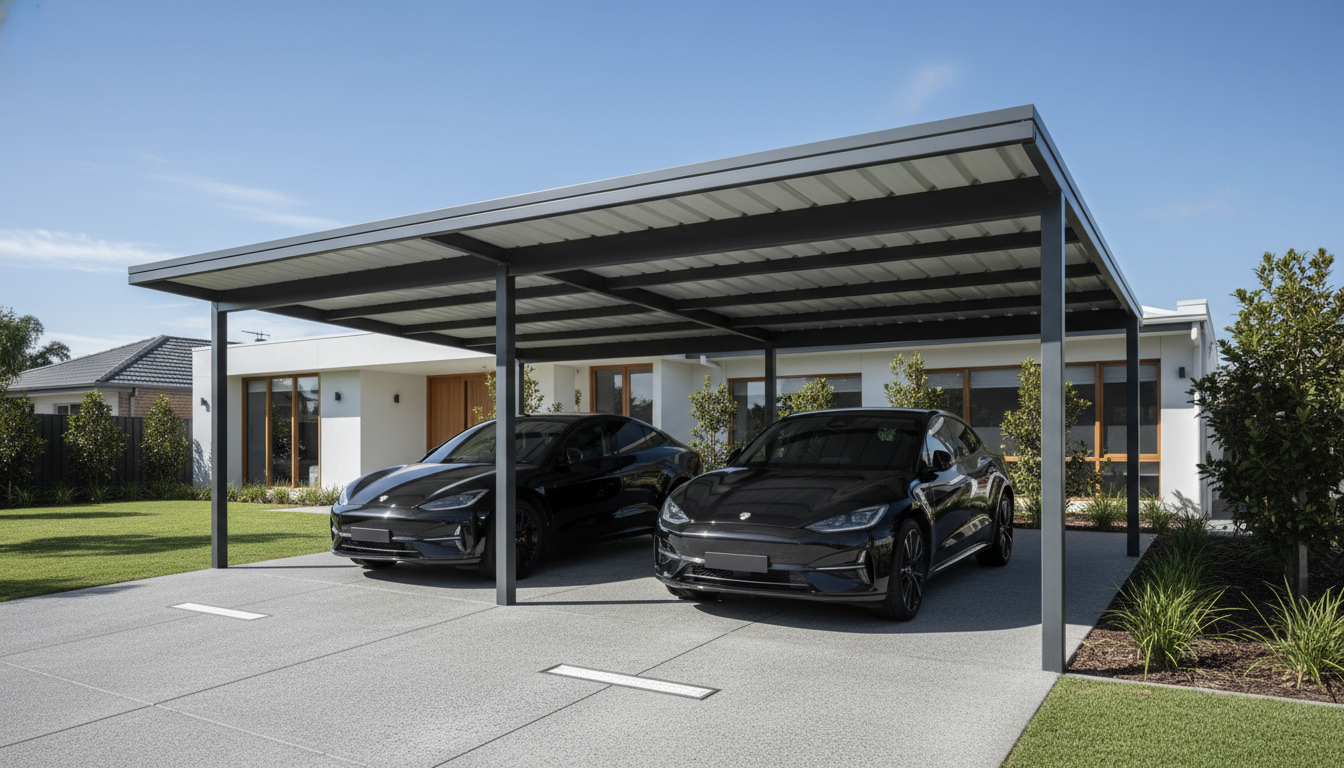
Planning a double car port isn’t just about parking space. It’s about engineering for local wind zones, choosing the right Colorbond finish for your climate, getting council-approved drawings, and ensuring a clean install that adds value. This expert guide covers double carport dimensions, engineering, material selection, approvals, and costs—tailored to Australian conditions from Perth heat to cyclone-rated sheds in QLD.
What size double car port do I need?
For most Australian vehicles (sedans, SUVs, dual-cab utes), the sweet spot is a carport 6×6 metres. That’s the most popular double carport footprint for comfortable door swing and easy reversing.
Typical double carport dimensions (clear span x depth x height)
- Everyday family cars: 5.8–6.0 m (span) x 5.5–6.0 m (depth) x 2.4–2.7 m (clear height)
- 4WDs with roof racks: 6.0–6.5 m x 6.0–7.0 m x 2.7–3.0 m
- Boat or caravan-friendly: 6.0–7.5 m x 7.0–9.0 m x 3.0–3.6 m
Pro tip: Allow at least 800–1,000 mm walkway clearance on sides where possible. If your block is tight, consider an attached carport to maximise space.
Popular sizes
- 6 x 6 m: The classic Australian double carport dimensions. Fits two cars comfortably.
- 6 x 7 m: Extra depth for bull bars/tow bars and storage at rear.
- 6.5 x 6.5 m: Extra elbow room for larger SUVs and prams.
What Are the Best Shed Materials for Perth’s Climate?
Perth’s hot summers and coastal air demand corrosion-resistant steel and sun-smart colours. Most premium double car ports in WA use BlueScope’s COLORBOND steel or ZINCALUME for roofing and flashings, with hot-dip galvanised or powder-coated RHS posts and beams.
Colorbond vs Zincalume — Which Is Better for WA Conditions?
| Feature | COLORBOND Steel | ZINCALUME Steel |
|---|---|---|
| Finish | Painted, durable colour layer (many designer colours) | Metallic zinc/aluminium coating (silvery look) |
| Heat performance | Thermatech colours can reduce heat gain; good for Perth | Reflective but can glare; heat similar in light environments |
| Coastal resistance | Excellent when installed to spec; choose correct warranty zone | Strong base corrosion resistance; appearance may dull over time |
| Aesthetics | Premium look; matches gutters/fascia | Industrial look; budget-friendly |
| Typical choice for Perth homes | Yes (Surfmist, Shale Grey, Monument popular) | Yes for budget/side yards, less for street-facing facades |
Design options that add value
- Roof styles: Flat roof carport for modern minimalism; gable roof carport for better runoff and headroom.
- Freestanding carport or attached carport to the dwelling fascia (subject to engineering).
- Posts and beams: Galvanised RHS posts, powder-coated beams to match your Colorbond roof.
- Drainage: Quad gutters, 90 mm downpipes to stormwater or soakwell (check local council rules).
- Lighting and power: LED battens, motion sensors; run conduits before slab/footings.
- Insulated roof panels: Reduce radiated heat and rain noise.
Pro Tip: Using insulated roof panels can reduce under-roof temperatures by up to 10°C in summer—especially useful for steel sheds in Perth or custom carports in Melbourne’s north-facing driveways.
Flat roof vs gable roof
| Aspect | Flat Roof | Gable Roof |
|---|---|---|
| Look | Contemporary, low profile | Traditional, adds street appeal |
| Headroom | Lower | Higher midway clearance |
| Drainage | Needs fall and larger gutters | Excellent runoff |
| Cost | Usually cheaper | Slightly higher |
| Wind performance | Great when engineered | Great when engineered |
Engineering, wind ratings, and compliance
Australian carports must comply with AS/NZS 1170.2 (Wind actions), AS/NZS 4600 for cold-formed steel, and relevant state building regulations. In cyclone-prone regions, use cyclone-rated sheds (QLD) detailing, including stronger hold-downs and purlin spacings.
Added 2024 WA wind-rating compliance notes: Many Perth suburbs are rated N2 or N3; coastal or escarpment sites can be higher. Your engineering must specify terrain category, importance level, and site wind speed. Ask for a ShedSafe accredited supplier and a signed engineer’s certificate.
How to Get Council Approval for Your Custom Shed in WA
- Check R-Codes and local planning: Setbacks, street-facing materials, and open space rules.
- Site plan and elevations: Include finished floor level, post locations, roof pitch, and heights.
- Engineering: WA-registered engineer certifies wind rating, footings, and connections.
- Lodge building permit: Include owner/installer details, specs, and stormwater solution.
- Inspections: Footings/structure as required by your council/private certifier.
Outside WA: VIC may allow exempt development under certain size/height limits; NSW has Complying Development pathways; QLD needs careful cyclonic detailing (cyclone-rated sheds QLD). Always check with your local authority.
DIY kit vs custom-built double car port
Both approaches can be fully engineered and council-approved. Your choice depends on time, tools, and site complexity.
| Aspect | DIY Shed Kits | Custom-Built (Supply & Install) |
|---|---|---|
| Cost | Lower upfront | Higher but turnkey |
| Lead time | Fast if in stock | Allow design + scheduling |
| Complex sites | Challenging | Handled by installer |
| Finish quality | Depends on DIY skill | Consistent, warranted |
| Cyclonic areas | Requires experience | Recommended |
Australian case studies
Case study 1: Custom Colorbond double carport in Perth (6 x 6 m)
- Use-case: Two SUVs, surfboards overhead
- Spec: Gable roof, COLORBOND Surfmist, 0.42 BMT; galvanised 100 x 100 RHS posts; N3 wind classification
- Footings: 450 mm dia x 900 mm deep concrete piers with M16 anchors
- Drainage: Quad gutter + 90 mm downpipes to soakwell
- Outcome: Planning cleared, building permit issued, 2-day install after footings cure; neat street appeal
Case study 2: Cyclone-rated double carport in North QLD (6 x 7 m)
- Use-case: Dual-cab ute + boat trailer
- Spec: Flat roof, 0.48 BMT sheeting, upgraded purlins, cyclone tie-downs and washers; C2 region
- Footings: Deeper piers and more hold-down bolts per AS/NZS 1170.2
- Outcome: Passed engineering and final inspection; excellent storm performance
Costs: how much does a double car port cost in 2025?
Indicative supply-and-install ranges (subject to site, wind rating, and finishes):
- Flat roof, 6 x 6 m: $6,500–$10,500+
- Gable roof, 6 x 6 m: $8,500–$13,500+
- Cyclone-rated upgrades (QLD/WA north): +$1,500–$4,000 depending on site classification and fixings
- Insulated roof panels: +$2,000–$4,000 (size-dependent)
Material prices track the steel market. The Australian Steel Institute and industry outlooks for 2024–2025 note continued demand for outdoor structures. Always request a written, itemised quote with engineering included.
Planning for your site and climate
- Perth and coastal WA: Choose corrosion-resistant finishes; sealed cuts; rinse roof near breaking surf. Consider council-approved sheds WA providers.
- QLD cyclonic zones: Specify wind-rated sheds for cyclonic areas with C1–C3 engineering and certified installers.
- NSW rural properties: For rural sheds NSW and farm machinery storage, increase spans and bay depths for utes and equipment.
- VIC alpine: Check snow and wind loads; upgrade purlin spacing and roof pitch as required.
- Coastal corrosion: Select suitable warranty zone; consider hot-dip galvanised posts and stainless fixings within the splash zone.
5-Step Buying Guide for Custom Sheds in Australia
- Define size and clearance: Start with a double carport dimensions brief (e.g., carport 6×6, 2.7 m height).
- Select materials: Colorbond vs Zincalume, insulated vs single-skin, galvanised vs powder-coated posts.
- Engineer for wind: Confirm N or C classification, terrain category, and tie-down design. Ask for ShedSafe credentials.
- Council pathway: Planning, building permits, siting (setbacks/easements), and stormwater.
- Install and handover: Footings inspection, structure install, gutters connected, compliance docs supplied.
Localised keyword clusters to help you plan
- WA: steel sheds Perth, custom Colorbond garages Perth, council-approved sheds WA
- VIC: custom carports Melbourne, driveway carport permits
- NSW: rural sheds NSW, farm machinery storage
- QLD: cyclone-rated sheds QLD, wind-rated sheds for cyclonic areas
- National: DIY shed kits, affordable carports for Australian homes
FAQs: double car port
Do I need council approval for a double carport?
Often yes. Many councils require a building permit and sometimes planning approval, especially if near boundaries or easements. Check your local rules before ordering.
What’s the ideal height?
2.4 m suits most cars. Choose 2.7–3.0 m for 4WDs with racks or for boat/caravan flexibility.
Slab or piers?
Carports commonly use concrete piers (footings). Add a slab later if you plan to convert to a garage.
Can I attach to my house?
Yes, if engineered. Fascia or wall connections must consider loads and waterproofing; approvals apply.
What colours are popular?
Surfmist, Shale Grey, Monument, Woodland Grey. Match gutters/fascia for a cohesive look.
Technical definitions at a glance
Where to learn more (useful Australian resources)
- Housing Industry Association (HIA) — building and permits guidance
- Master Builders Australia (WA) — local building advice
- Australian Steel Institute — ShedSafe accreditation
- Bureau of Meteorology — cyclone info and region maps
- CSIRO — materials and corrosion research
- Energy.gov.au — energy-efficient roofs and colours
Get a compliant, great-looking double carport
From Perth’s coastal suburbs to cyclonic North QLD, we design and install engineered, council-ready double car ports using premium Colorbond steel. Ask about insulated panels, matching gutters, and fast-track approvals.
- Engineered to AS/NZS standards for your wind region
- Custom colours, flat or gable roof, freestanding or attached
- Supply-only DIY shed kits or turnkey install
Need help sizing your double carport dimensions? Get a free plan and quote in 24–48 hours.