
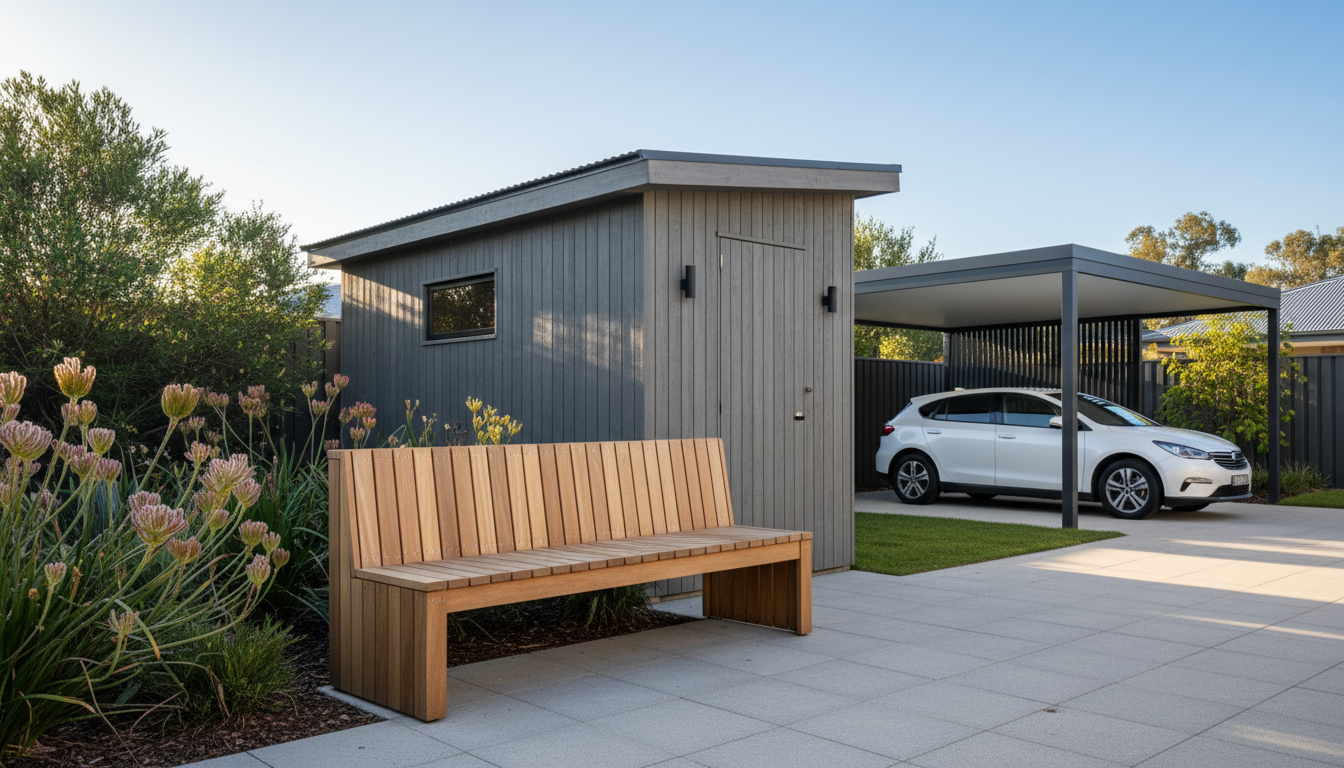
If you’re short on space or want a tidy, coastal-tough solution for cushions, toys, pool gear or garden tools, an exterior storage bench is a brilliant upgrade. This guide explains how to pick a durable outdoor storage bench for Australia’s climate—and how to plan it alongside a Colorbond steel shed, custom carport, or patio cover for a clean, council-compliant outdoor setup.
What is an exterior storage bench and who is it for?
- Perfect for balconies, courtyards, pool areas, patios and compact gardens.
- Popular finishes: timber-look, powder-coated steel, UV-stabilised resin, and white outdoor storage bench styles for Hamptons or coastal looks.
- Typical capacity: 80–600 L; common seat ratings: 150–300 kg.
Which exterior storage bench materials stand up to Australian conditions?
Powder-coated or Colorbond steel benches
- Best for coastal or high-UV areas when using marine-grade coatings and stainless fixings.
- Choose Colorbond Ultra near surf (within ~200 m) and consider hot-dip galvanised frames.
- Pros: high strength, fire-resistant, long life with minimal maintenance.
- Cons: can get hot in direct sun without shade; specify insulated or ventilated lids where possible.
UV-stabilised resin (polypropylene) box seats
- Lightweight, affordable, easy DIY assembly, good water resistance.
- Pros: won’t rust, many lockable options, hidden wheels/feet for drainage.
- Cons: cheaper resins can chalk or fade under harsh UV; look for UV8+ additives and known brands.
Hardwood/timber benches
- Pros: warm look, easy to refinish, suits heritage or Hamptons homes.
- Cons: needs oiling/sealing; avoid direct splash zones (salt/chlorine); specify silicone seals and drip edges for lids.
White outdoor storage bench: colour durability
- Pick UV-stable topcoats and moulded-in pigment resin to resist yellowing.
- For steel, choose a high-durability white in the Colorbond palette; wash salt monthly in coastal zones.
Zincalume: Aluminium-zinc alloy coated steel with excellent base corrosion resistance, typically used as a substrate or unpainted finish.
What are the best shed materials for Perth’s climate?
Perth’s hot summers and sea-breeze salts demand finishes that handle UV and corrosive mists. For the shed or patio near your bench, Perth homeowners often choose Colorbond steel cladding, Zincalume framing and galvanised hardware. Below is a quick buyer’s comparison.
Colorbond vs Zincalume — Which is better for WA conditions?
| Factor | Colorbond (painted) | Zincalume (unpainted) |
|---|---|---|
| UV resistance | Excellent; baked-on paint resists chalk/fade | Good; can reflect heat but may weather to dull grey |
| Coastal performance | Use Colorbond Ultra near surf | Good, but avoid severe marine splash zones |
| Aesthetics | Broad colour range to match home | Industrial look; limited style options |
| Maintenance | Low; periodic washing | Low; rinse salt in coastal areas |
| Cost | Generally higher initial cost | Usually lower material cost |
How to size and specify your outdoor seat and storage
Capacity and clearances
- Measure cushions and pool gear; allow 20–30 mm clearance on each side.
- Common sizes: 120–150 cm long x 45–60 cm deep x 45–55 cm high (300–550 L). Balconies often suit 80–120 cm lengths.
Waterproofing and drainage
- Look for overlapping lid lips, compression seals, and drainage channels.
- Feet or plinths should elevate the base ≥10 mm for runoff on tiled or paved areas.
Safety and security
- Specify gas struts or soft-close hinges to prevent lid slam.
- Choose lockable hasps and marine-grade stainless padlocks (316) in coastal regions.
Load and seating
- Seat ratings: many benches are rated to 150–300 kg. Check manufacturer load data.
BAL (bushfire) considerations
- In BAL-12.5 and above, choose non-combustible or low-combustible exteriors (e.g., steel), keep bench clear of leaf litter and timber screens.
Where should you place an outdoor box seat?
- Position under eaves or a patio for best UV protection; ensure lid opens fully without hitting balustrades or downpipes.
- On decks, use corrosion-resistant fixings and allow airflow beneath to deter mould.
- Pool zones: keep out of direct splash from chlorinated water; rinse hardware regularly.
- Coastal: specify Colorbond Ultra coatings and 316 stainless fasteners.
Do exterior storage benches need council approval?
Generally, no—freestanding benches are furniture, not a “structure”. If you bolt a bench to concrete or integrate it into a new deck or patio roof, local rules can apply. Always check local planning overlays (heritage, BAL, coastal). For sheds and carports, approvals are more involved—see below.
How to get council approval for your custom shed in WA
Added 2024 WA wind-rating compliance notes
- Confirm Wind Region (often A for Perth metro) and Terrain Category per AS/NZS 1170.2:2021.
- Most WA metro sites are N2–N3; regional and coastal exposures vary—engineer must verify.
- Provide site plan, slab/footing details (AS 2870), cladding specs (AS 1397/AS/NZS 2728), and tie-down schedule.
- Use ShedSafe-accredited designs or engineering computations signed by a WA-registered practitioner.
- For patios/carports attached to dwellings, check NCC 2022 adoption via your council’s building team.
Plan storage like a pro: bench + shed + carport
Smart layouts combine a weatherproof exterior storage bench near the patio for daily items, plus a Colorbond steel shed or custom carport for bulk gear, tools, and bikes. This approach keeps traffic flow clean and your outdoor room uncluttered.
- steel sheds Perth: match bench colours to your shed or patio fascia.
- custom carports Melbourne: integrate a slim bench along the side fence for EV cables and detailing kits.
- rural sheds NSW: add benches at entry doors for boots and animal feed tubs.
- custom Colorbond garages Perth: add lockable side storage and a waterproof outdoor box seat near the laundry door.
- cyclone-rated sheds QLD: use wind-rated sheds for cyclonic areas with reinforced frames and roller doors with wind-locks.
Case study: Coastal Perth courtyard
A Scarborough duplex used a 1500 mm white outdoor storage bench for cushions, paired with a 3.0 x 2.2 m Colorbond Ultra mini-shed in Surfmist. The bench sits under a skillion patio, and the shed uses hot-dip galvanised purlins and sealed slab edges for coastal splash protection.
Case study: North QLD pool home
In Townsville, the owners selected a resin bench with marine-grade hinges for pool toys and a 6 x 6 m cyclone-rated shed (C2) for mowers and kayaks. The shed has wind lock roller doors and additional hold-down bolts per AS/NZS 1170.2 terrain category assessment.
Roof choices for sheds and patios: which suits your site?
| Roof type | Pros | Considerations | Best for |
|---|---|---|---|
| Flat/skillion roof | Sleek, cost-effective, easy to slope for drainage | Lower headroom; ensure adequate fall and gutter sizing | Side setbacks, modern homes, narrow lots |
| Gable roof | Great ventilation, classic look, more internal height | Higher cost and ridge details; more wind loading in some sites | Workshops, double garages, barn-style sheds Victoria |
DIY bench and shed options: kits vs custom-built
| Option | What you get | Pros | Watch-outs | Best for |
|---|---|---|---|---|
| DIY bench or DIY shed kits | Pre-cut components, fixings, instructions | Lower cost, fast delivery | Check wind ratings; ensure slab/anchors suit site | Handy homeowners, renters (non-fixed benches) |
| Custom-built | Engineered to site, colour matched, council-approved sheds WA or your state | Optimised for wind/BAL, premium finishes, one-stop approvals | Higher upfront cost, longer lead times | Permanent upgrades, premium homes, complex blocks |
5-step buying guide for custom sheds in Australia
- Wind and site check: Determine N/C rating, Terrain Category, BAL and coastal exposure.
- Scope and layout: Size for current and future storage (mezzanine storage, workshop zones, farm machinery storage).
- Materials: Colorbond vs Zincalume comparison; specify Colorbond Ultra if coastal; galvanised steel purlins.
- Engineering and approvals: ShedSafe designs; council-approved sheds WA, cyclone-rated sheds QLD, rural sheds NSW requirements.
- Installation: Choose experienced crews; verify edge distances, anchor torque and flashing details. Add an exterior storage bench for everyday gear.
Care and maintenance
- Rinse benches monthly in coastal or pool zones (fresh water). Avoid harsh chlorinated splashes.
- For white outdoor storage benches, use pH-neutral cleaners; avoid abrasive pads.
- Lubricate hinges/struts annually; inspect seals and replace if cracked.
- For steel sheds and custom carports, wash cladding per manufacturer guidance; check door wind-locks and fixings before storm season.
Frequently asked questions
Are outdoor storage benches waterproof?
Quality benches are highly water resistant with lapped lids and seals. For 100% dry storage in heavy rain, place under a patio or eave and ensure base drainage.
How much weight can they hold?
Most are rated 150–300 kg as a seat. Always verify the manufacturer’s load rating and fix to a flat, stable surface.
Will a bench fade in the Aussie sun?
Choose UV-stabilised resin or Colorbond/powder-coat systems. Light colours stay cooler and show less fade.
What’s the delivery/assembly time?
Flat-pack benches assemble in 30–90 minutes. Custom Colorbond sheds typically install in 1–3 days after slab cure and approvals.
What about cyclones in QLD?
Benches are movable items; the key is secure placement before severe weather. For buildings, specify cyclone-rated sheds QLD (C1–C4) with engineered tie-downs and wind-rated roller doors.
Keyword clusters and use-cases we cover
- Residential: steel sheds Perth, custom Colorbond garages Perth, affordable carports for Australian homes, patio covers Sydney
- Rural/Ag: rural sheds NSW, farm machinery storage, barn-style sheds Victoria
- Commercial: industrial workshops Brisbane, mezzanine storage, wind-rated sheds for cyclonic areas
- DIY/Tech: DIY shed kits, Colorbond vs Zincalume comparison, insulated panel roofing, roller doors with wind locks
Why choose us for benches, sheds and carports?
- Australian engineering to AS/NZS 1170.2 wind actions, AS 1397, AS/NZS 4600, and NCC 2022.
- ShedSafe accreditation and end-to-end service: design, council approvals, slab, build.
- Local advice for Perth heat, QLD cyclones, NSW rural winds and coastal corrosion zones.
References and resources
- Housing Industry Association (HIA) – Outdoor structures market insights and homeowner advice.
- Master Builders Australia – Licensing and building guidance by state.
- Australian Steel Institute – 2025 Australian Steel Market Outlook and technical notes.
- Bureau of Meteorology – Climate data for wind, rainfall and heat planning.
- CSIRO – Materials, energy and bushfire research relevant to sheds and outdoor rooms.
- Energy.gov.au – Cooling, insulation and energy-smart roofing guidance.
- Standards Australia – AS/NZS references including 1170.2 wind, 4600 steel design.
- 2025 HIA Outdoor Structures and Home Improvement Report – homeowner spend and renovation trends.