
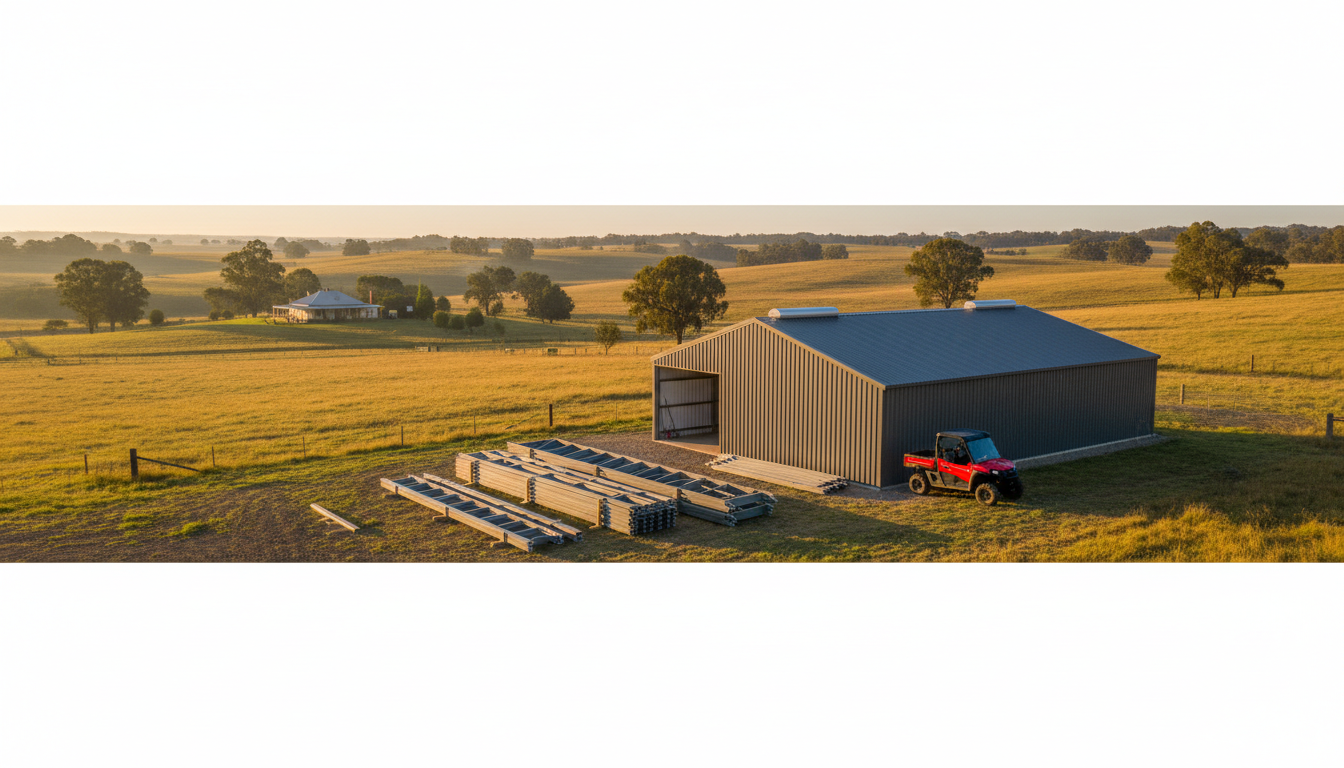
Comparing farm sheds, rural sheds and farm buildings across Australia? This expert guide explains farm shed kit prices, machine shed prices, council approvals, and the key choices like Colorbond vs Zincalume. It’s written for Australian homeowners, renovators and property investors who want premium quality, council-ready outcomes with no surprises.
What do farm shed kit prices cost in Australia in 2025?
Short answer: most farm shed kit prices start from around $6,500–$9,500 for smaller utility sheds and span well past $90,000 for large, high-clearance machinery sheds with heavy-duty wind ratings and wide bay spacing. Installed prices vary by region, site, slab and specification.
Typical 2025 price ranges (national)
Ranges below assume quality Australian steel, engineer-certified frames and cladding, and code-compliant design to the National Construction Code (NCC) and AS/NZS standards. Cyclone or alpine ratings, hot-dip galvanised frames, mezzanines, or custom features increase costs.
| Shed type / footprint (indicative) | Kit price range (AUD) | Typical installed (excl. slab) | Concrete slab ballpark | Notes |
|---|---|---|---|---|
| 6 × 4 m utility farm shed (skillion) | $6,500–$9,500 | $10,500–$15,000 | $130–$190/m² | DIY-friendly. Popular for pumps, tools, small farm storage. |
| 9 × 6 m workshop or feed store | $9,500–$15,000 | $15,000–$24,000 | $130–$190/m² | Ideal rural sheds NSW/VIC. Add roller door, PA door, skylights. |
| 12 × 6 m machinery shed (gable) | $14,000–$24,000 | $22,000–$36,000 | $130–$190/m² | Common bay spacing 4–6 m. Good for Utes, slashers. |
| 18 × 9 m open-front hay/machinery shed | $28,000–$48,000 | $42,000–$70,000 | $130–$190/m² | Higher wall height (4.5–5.5 m). Add end wall for weather. |
| 24 × 12 m large farm machinery shed | $55,000–$95,000 | $80,000–$140,000 | $130–$190/m² | Harvester/tractor clearance, wide bays, heavier wind loads. |
| American barn (9–12 m span, 3 bays) | $22,000–$45,000 | $35,000–$68,000 | $130–$190/m² | Great for stables, tack rooms; mezzanine option. |
Adjustments to expect:
- Wind-rated sheds for cyclonic areas (QLD Regions C/D): typically +15–35% on kit price; heavier frames, more hold-downs.
- Alpine snow loads (VIC high country, TAS): +10–25% for additional roof capacity.
- Coastal corrosion zones: upgrade to higher-spec coatings; consider Colorbond Ultra or marine-grade elements.
- Slab: allow $130–$190/m² in 2025 depending on region, excavation, thickening and mesh specification.
- Installation: $65–$110/m² is a common guide, but site access, height and cranes can shift this.
Cross‑check numbers with our alternate breakdown of farm shed kit prices (2025) by size and region.
These figures reflect current 2024–2025 steel and labour conditions noted by industry bodies such as the HIA and the Australian Steel Institute. Always compare like-for-like on wind region, terrain category, door schedule, guttering, and inclusions.
What Are the Best Shed Materials for Perth’s Climate?
In Perth and regional WA, heat, UV exposure and coastal air drive material choice. A Colorbond steel shed for regional WA is the go-to for durability, colour range and warranty support. Zincalume is cost-effective but may need more care near the coast.
Colorbond vs Zincalume — Which Is Better for WA Conditions?
| Criteria | Colorbond (painted, baked-on coating) | Zincalume (aluminium-zinc alloy coating) |
|---|---|---|
| Coastal resistance | Better aesthetic longevity; choose Ultra near marine environments | Good general corrosion resistance; consider setbacks from surf |
| Heat & UV | Excellent UV stability, cool colour options | Reflective finish initially; dulls over time |
| Cost | Higher upfront (premium finish) | Lower initial outlay |
| Warranty support | Strong network and documentation nationally | Strong, but check coastal/salt spray limitations |
| Appearance | Wide colour palette, matches custom Colorbond garages Perth | Metallic grey; industrial look |
Pro Tip: Did you know using insulated roof panels can reduce internal shed temperatures by up to 10°C in summer? This helps protect machinery and reduce heat stress for workers in WA’s hot months. For energy considerations, see Energy.gov.au.
How much do machine shed prices vary by state?
Wind region, terrain, and local approvals drive differences in farm shed prices between states. Below is a practical guide for rural farm sheds.
Western Australia (WA)
Added 2024 WA wind-rating compliance notes
- Regions A (most metro), B (inland), zones near Geraldton/Karratha/Carnarvon often require higher design speeds. Check AS/NZS 1170.2 wind region maps and terrain category.
- council-approved sheds WA: Typically a Building Permit (BA2). Structural certification to NCC and AS/NZS 4600 (cold-formed steel structures) required.
- Material choice: Colorbond with cyclonic detailing where required. Consider hot-dip galvanised columns for exposed coastal farms.
- Price effect: +10–30% for higher wind regions or coastal corrosion mitigation.
Queensland (QLD)
- Large parts of coastal QLD are Region C; some northern pockets Region D. You may need cyclone-rated sheds QLD with heavier rafters, purlin/girt spacing, and hold-downs.
- Expect +15–35% on kit pricing vs non-cyclonic areas.
- Stormwater, tie-down inspections, and slab design are more stringent.
New South Wales (NSW) — including farm sheds for sale Sydney
- Greater Sydney is usually non-cyclonic but check terrain shielding. Some farm sheds can go through Complying Development (CDC) with a private certifier; others need DA.
- Urban boundaries: setbacks, height limits, stormwater detention can add costs.
- Rural sheds NSW: commonly 12 × 6 m and 18 × 9 m; budget for better guttering and vermin-proofing to protect feed.
Victoria (VIC) — farm shed prices Victoria
- Moderate wind regions, but allow for alpine snow loads in the high country. Consider wider eaves for rain protection.
- Permits via a Registered Building Surveyor; soil class testing favoured for slab design.
- farm sheds Victoria: strong demand for workshops plus lean-tos; 9 × 6 m kits from ~$9.5k–$15k; larger 18 × 9 m kits ~$28k–$48k depending on spec.
Tasmania (TAS) — sheds Tasmania price list (what to expect)
- Exposure to wind and cool climate; snow loads in some areas. Allow for insulated roof/walls if using as a workshop.
- Typical “sheds Tasmania price list” patterns align with VIC but with higher transport to remote sites.
- Plan for condensation control (sarking, roof vents, insulation).
For regional wind and climate data, check the Bureau of Meteorology. For steel design standards and corrosion categories, see the CSIRO and the Master Builders Australia.
DIY Shed Kits vs Custom-Built — Which Is Cheaper?
DIY shed kits can save on labour if you’re handy, but complex builds (tall walls, crane lifts, cyclone detailing, or strict council conditions) often come out cheaper and safer with a licensed installer.
| Option | Pros | Cons | Best for |
|---|---|---|---|
| DIY shed kits | Lower upfront; flexible timing; learn-as-you-go | Time-consuming; risk of errors; lifting/height safety; weather delays | Smaller sheds, farm crew with tools, non-cyclonic sites |
| Custom-built (supply and erect) | Faster, safer; warranty on workmanship; council-ready documentation | Higher upfront labour cost | Large farm sheds, high wind/snow loads, strict council requirements |
Tip: Ask for an apples-to-apples quote including wind region, terrain category, door schedule, gutters/downpipes, flashings, insulation, vermin-proofing, and council-approved sheds WA documentation where applicable.
If you’re after a bargain, our Second Hand Sheds for Sale: 2025 Australian Buyer’s Guide is essential reading.
How to Get Council Approval for Your Custom Shed in WA
Step-by-step (works similarly across Australia)
- Site check: title, easements, setbacks, bushfire overlays, flood levels.
- Engineering: design to NCC (Class 10a), AS/NZS 1170 (actions), AS/NZS 4600 (cold-formed steel), AS 4100 (steel structures as applicable).
- Drawings & certification: portal frame details, footings, hold-down schedule, slab design.
- Permit: WA uses BA2 for uncertified application or BA1 certified; many clients use a certifier/engineer to expedite.
- Inspections: footings/slab, framing (if required), final sign-off.
How approvals differ by state
- NSW: Complying Development (CDC) vs DA; private certifier can speed up. Urban “farm sheds for sale Sydney” often need drainage and stormwater detail.
- VIC: Building Permit via RBS; soil testing recommended; consider planning overlays in regional councils.
- QLD: Private certifiers common; cyclone detailing in Regions C/D; QBCC requirements for larger projects.
- TAS: Council permit with wind/snow load verification; condensation management may be requested.
Real Australian Case Studies
Case Study 1: 18 × 9 m open-front machinery shed — VIC wheat/sheep
- Specs: 5 m eave height, 3 × 6 m bays, Colorbond walls/roof, open front, vermin-proofing.
- Pricing: kit ~$32k–$44k; install ~$14k–$22k; slab optional (often piers + compacted base).
- Outcome: Fits header front, tractor and boom spray; wind Region A, Terrain 2.
Case Study 2: 12 × 6 m enclosed workshop — farm sheds for sale Sydney peri-urban
- Specs: 3 m eave, roller door 3.0 × 3.0 m, PA door, insulation to roof, gutters connected to tank.
- Pricing: kit ~$14k–$20k; install ~$8k–$12k; slab ~$9k–$12k (site cut added ~$2k).
- Approvals: CDC with private certifier; stormwater plan included.
Case Study 3: 24 × 12 m multi-bay — cyclone-rated sheds QLD (Region C)
- Specs: 5.5 m eave, heavy hold-downs, wider purlin/girt spacing, doors on lee side.
- Pricing: kit ~$68k–$95k; install ~$28k–$42k; slab often thicker edge beams.
- Outcome: Compliant with AS/NZS 1170.2 wind actions; insurance accepted.
5-Step Buying Guide for Custom Sheds in Australia
- Define use and clearances: list machinery (height, width, turning circle), future growth, bay spacing.
- Confirm wind region/terrain and snow/bushfire overlays: ask for site-specific engineering to NCC and AS/NZS.
- Choose materials: Colorbond vs Zincalume, gutter size, insulation, bird/rodent protection, door types.
- Compare quotes apples-to-apples: inclusions, delivery, lead time, custom Colorbond garages Perth or matching structures if needed.
- Plan approvals and program: council/certifier, slab schedule, crane access, wet-weather contingency.
How to Choose a Supplier
Look for suppliers with certified engineering, clear inclusions, documented lead times, robust warranty terms and local installation experience that matches your wind and access conditions.
For Bathurst-based installations, try Garages Bathurst.
Looking at multi‑purpose spaces? Explore Sheds and Studios: Adelaide 2025 for fit‑out ideas.
To compare other rural building styles, browse Barn Sheds Australia.
FAQs: farm sheds, farm shed kit prices and approvals
What affects farm shed cost the most?
Wind region, height/clearance, bay spacing, door schedule, cladding (Colorbond vs Zincalume), slab thickness, and installation logistics.
Do I need a slab?
Not always. Many open machinery sheds use engineered piers and a compacted hardstand. Workshops benefit from a slab for stability and usability.
Are guttering and downpipes included?
Often included on enclosed sheds; open-front sheds may be optional. Confirm overflow provisions; councils increasingly require stormwater management.
What wind ratings are used?
Design to AS/NZS 1170.2. Non-cyclonic Regions A/B cover much of AU; cyclonic Regions C/D (QLD north/WA north) require cyclone detailing.
How long does delivery take?
Typically 3–8 weeks for standard kits; 8–14 weeks for custom/rural or peak periods. Check current lead times due to steel and transport conditions.
Do you handle council approvals?
Many suppliers offer permit packs and engineering. For rural sheds for sale in regulated zones, choose council-approved sheds WA/NSW/VIC options to streamline.
Colorbond or Zincalume for coastal farms?
Colorbond (or Colorbond Ultra) is preferred near coastlines for appearance and warranty scope; Zincalume is economical inland.
Quick definitions
Keyword clusters we’ve covered
- Primary: farm shed kit prices, farm shed prices, farm shed cost
- Rural: farm sheds, rural sheds, rural farm sheds, large farm sheds, machine shed prices
- Local: farm sheds for sale Sydney, farm sheds Victoria, farm sheds Australia, steel sheds Perth, custom Colorbond garages Perth, rural sheds NSW
- Technical: wind-rated sheds for cyclonic areas, Colorbond vs Zincalume comparison, council-approved sheds WA
- Lifestyle/usage: farm machinery storage, DIY shed kits, affordable carports for Australian homes